
Quantum Metaphysics: Entanglement, Consciousness, Universal Laws
Quantum metaphysics explores the profound philosophical implications arising from quantum mechanics, challenging our classical understanding of reality, consciousness, and the very fabric of the universe. This field delves into how phenomena like quantum entanglement, superposition, and the observer effect might hint at deeper, interconnected universal laws that transcend conventional physical explanations.
At its core, quantum metaphysics seeks to bridge the gap between scientific observation and ancient philosophical inquiries, proposing that the bizarre behaviors of subatomic particles could offer clues to the nature of consciousness, the existence of multiple realities, and the fundamental interconnectedness of all things. It invites us to reconsider our place in a universe that appears far more fluid and responsive than previously imagined.
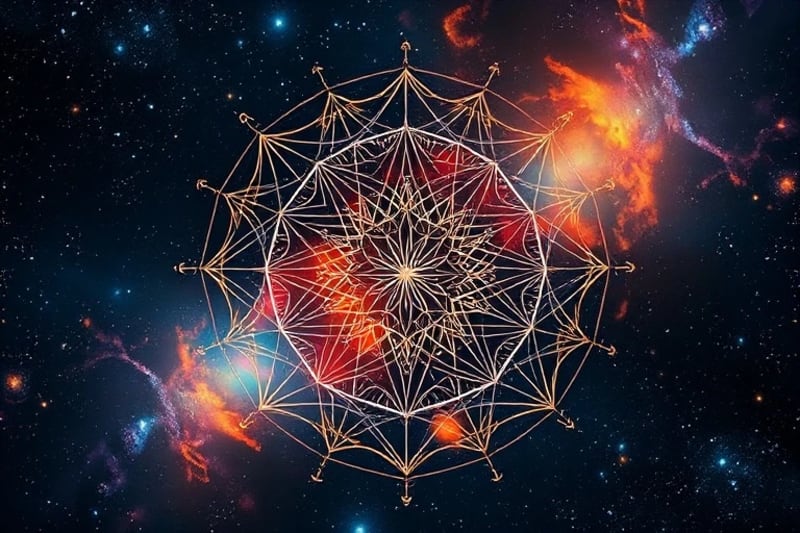
Conceptual depiction of quantum entanglement and the universal web of existence.
Visual source subject to ecosystem availability: Wikimedia Commons under license CC BY-SA 4.0 or conceptual AI rendering.
The journey into quantum metaphysics requires an open mind, as it often ventures into territories that blur the lines between physics, philosophy, and spirituality. By examining the implications of quantum phenomena, we can begin to construct a more holistic and integrated understanding of existence.
Table of Contents
Quantum Entanglement and Non-Locality
Quantum entanglement is one of the most perplexing and fascinating phenomena in quantum mechanics. It describes a situation where two or more particles become linked in such a way that they share the same quantum state, regardless of the distance separating them. Measuring the property of one entangled particle instantaneously influences the property of the other, even if they are light-years apart.
This "spooky action at a distance," as Albert Einstein famously called it, implies a profound non-locality in the universe. Information appears to be shared faster than the speed of light, challenging our classical notions of space and time. Metaphysically, entanglement suggests an intrinsic interconnectedness at the most fundamental level of reality, where individual entities are not truly separate but part of a larger, unified whole.
Some theorists propose that this non-local connection could be a mechanism for phenomena often dismissed as paranormal, such as telepathy or remote viewing. While these are speculative interpretations, the scientific reality of entanglement undeniably points to a universe where connections can exist without physical proximity, opening doors for new understandings of cosmic synchronicity and universal communication.
The Observer Effect and Consciousness
Another cornerstone of quantum metaphysics is the observer effect, which states that the act of observing a quantum system can influence its state. In the famous double-slit experiment, particles behave as waves when not observed, creating an interference pattern. However, when an observer attempts to measure which slit the particles pass through, they behave as discrete particles, and the interference pattern disappears.
This phenomenon raises critical questions about the role of consciousness in shaping reality. Does consciousness actively collapse the wave function, transitioning potential possibilities into concrete realities? Or is it merely the interaction of a measuring device that causes the change, with consciousness simply being the ultimate "measuring device"?

The conceptual role of consciousness in shaping quantum outcomes.
Many quantum physicists and philosophers, including figures like Eugene Wigner, have explored the idea that consciousness is not merely an emergent property of the brain but a fundamental aspect of the universe itself, perhaps even necessary for reality to manifest. This perspective suggests that our minds are not passive recipients of information but active participants in the creation of our experienced reality. This perspective has profound implications for understanding our own agency and the nature of existence, extending to how we interact with the digital age and the potential for consciousness shifts within a technologically advanced society.
Superposition and Multiple Realities
Superposition is another counter-intuitive quantum principle, stating that a quantum particle can exist in multiple states simultaneously until it is measured. For example, an electron can spin both up and down at the same time, or be in multiple locations at once. It is only upon observation that it "chooses" a single state.
Metaphysically, superposition has given rise to theories such as the Many-Worlds Interpretation (MWI), proposed by Hugh Everett III. MWI suggests that every time a quantum measurement is made, the universe splits into multiple parallel universes, each representing a different possible outcome. In this view, all potential realities exist, and our consciousness simply follows one path.
While highly speculative, MWI offers a way to resolve the paradox of the observer effect without invoking consciousness as a special collapsing agent. Instead, it posits an infinite branching of realities, where every quantum possibility is actualized in some universe. This concept profoundly alters our understanding of what constitutes "reality" and the potential for parallel existences, similar to how esoteric concepts explore astral travel in a metaverse of possibilities.
Universal Laws and Quantum Foundations
If quantum mechanics describes the fundamental nature of reality, then it must also underpin the universal laws that govern our cosmos. From the force of gravity to the laws of thermodynamics, these macroscopic principles must ultimately emerge from the quantum realm. Quantum metaphysics seeks to understand how these seemingly disparate levels of reality are connected.
Some theories propose that the universe operates on a holographic principle, where the information of the entire universe is encoded on its boundaries, much like a hologram. This idea, rooted in quantum gravity research, suggests that our three-dimensional reality might be a projection from a two-dimensional surface, implying a deeper, more abstract universal law at play.
Abstract representation of the underlying structure of universal laws.
The quest to unify quantum mechanics with general relativity, known as the theory of everything, is a central goal of modern physics. Success in this endeavor could reveal a single, elegant set of universal laws that govern all phenomena, from the smallest subatomic particles to the largest galaxies. Such a discovery would have profound metaphysical implications, potentially revealing the ultimate nature of existence and the source of cosmic omens and synchronicities.
Implications for Free Will and Destiny
The probabilistic nature of quantum mechanics also raises fascinating questions about free will versus determinism. In classical physics, the universe was often seen as a giant clockwork mechanism, where every event was predetermined by prior causes. Quantum mechanics, however, introduces inherent randomness at the fundamental level.
If quantum events are truly random, does this mean free will exists, or does it simply replace deterministic causality with pure chance? Some interpretations suggest that consciousness, through the observer effect, might play a role in selecting from these quantum probabilities, thereby exercising a form of free will. Others argue that even quantum randomness does not equate to conscious choice.
The debate continues, but quantum metaphysics provides a new lens through which to examine these age-old philosophical dilemmas. It challenges us to move beyond simplistic deterministic or purely random models, inviting a more nuanced understanding of how our choices might interact with the probabilistic tapestry of the quantum universe.
Quantum Metaphysics and Spiritual Perspectives
Beyond the scientific and philosophical debates, quantum metaphysics often intersects with spiritual and mystical traditions. The concepts of interconnectedness, non-locality, and the role of consciousness resonate deeply with ancient wisdom that speaks of a unified field of existence, where everything is part of a single cosmic consciousness or divine matrix.
Many spiritual teachings emphasize that separation is an illusion and that all beings are fundamentally connected. Quantum entanglement provides a scientific analogy for this idea, suggesting that at the deepest level, there is no true isolation. The observer effect, too, can be seen as a scientific parallel to the power of intention and belief, where our focus can influence our reality.
While it is crucial to distinguish between scientific findings and spiritual interpretations, quantum metaphysics offers a fertile ground for dialogue and exploration, allowing for a richer, more integrated understanding of ourselves and the universe we inhabit. It encourages a perspective where science and spirituality are not in opposition but rather complementary paths to profound truths.
Related Articles
- Cosmic Omens: Interpreting Synchronicities, Esoteric Symbols Horoscope
- Cosmic Sociology Digital Age AI Consciousness Shifts
- Archaeoastronomy: Decoding Ancient Sites Celestial Alignments
Source: Hybrid content assisted by AI and human editorial supervision.


Comments
Post a Comment