
Astro-Archeology: Unearthing Celestial Narratives
Astro-archeology stands as a captivating interdisciplinary field, bridging the meticulous study of ancient civilizations with the grand narratives of the cosmos. It delves into how our ancestors perceived, understood, and integrated celestial phenomena into their daily lives, spiritual practices, and monumental architecture. Far from a mere academic exercise, this discipline unveils the profound intellectual and cultural sophistication of societies long past, revealing their intricate relationship with the heavens.
This exploration takes us on a journey through time, examining how ancient peoples, from Neolithic farmers to advanced Mesoamerican empires, meticulously tracked the movements of the sun, moon, stars, and planets. Their observations were not simply for curiosity; they were fundamental to developing calendars, predicting seasons for agriculture, navigating vast distances, and shaping their cosmologies and religious beliefs. Astro-archeology seeks to unearth these celestial narratives, providing invaluable insights into the worldview, technological prowess, and societal organization of our ancient predecessors.
Table of Contents
- What is Astro-Archeology? Defining a Cosmic Discipline
- Historical Roots and Foundational Discoveries
- Methodologies and Interpretations: Reading the Celestial Blueprint
- The Cultural and Spiritual Significance of Ancient Astronomy
- Challenges, Debates, and the Future of Astro-Archeology
- Conclusion: Echoes of the Cosmos in Ancient Stones
What is Astro-Archeology? Defining a Cosmic Discipline
Astro-archeology, often used interchangeably with archaeoastronomy, is the study of how people in the past "read" the sky and how this understanding influenced their cultures. It is a multidisciplinary field that combines the techniques and theories of archaeology, astronomy, anthropology, and history to understand the astronomical practices and beliefs of ancient societies. This involves examining physical evidence, such as architectural alignments, rock art, artifacts, and written records, in conjunction with astronomical data.
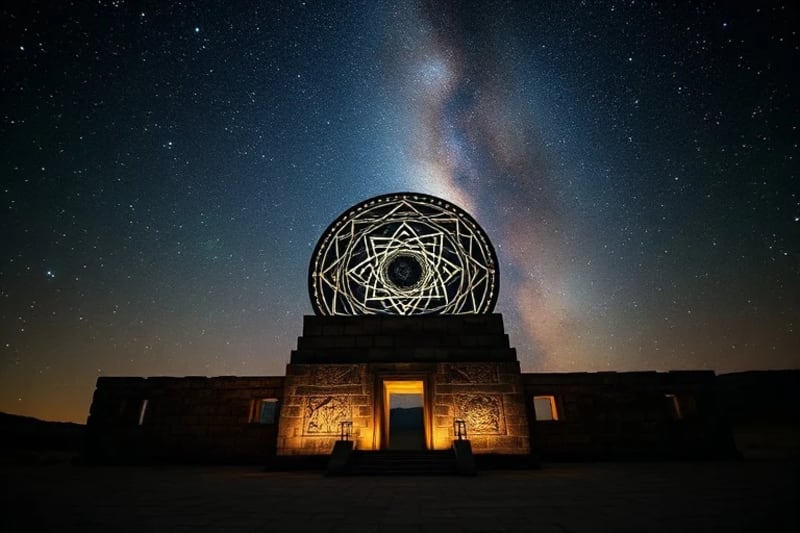
Exploring the profound connection between ancient monumental architecture and the celestial sphere, revealing sophisticated astronomical knowledge encoded in stone.
Conceptual rendering of an ancient observatory, blending historical architectural styles with cosmic elements, created through advanced AI synthesis.The core premise of astro-archeology is that ancient peoples were keen observers of the night sky, and these observations were far more significant than often acknowledged. They used the sky as a clock, a calendar, a compass, and a source of divine inspiration. The alignment of a temple to a solstice sunrise, the orientation of a burial mound to a specific star, or the depiction of constellations in ancient art all fall under the purview of astro-archeological investigation. It seeks to reconstruct the "skyscape" of ancient cultures and understand its role in their worldview.
The field is not without its challenges, primarily the difficulty in distinguishing deliberate astronomical alignments from coincidental ones. Rigorous statistical analysis, combined with a deep understanding of cultural context and astronomical principles, is crucial for valid interpretations. Astro-archeology thus requires a delicate balance between scientific precision and anthropological empathy, aiming to understand the universe through the eyes of those who lived millennia ago.
Historical Roots and Foundational Discoveries
The roots of astro-archeology can be traced back to early antiquarians who noted astronomical patterns in ancient structures, but it gained scientific rigor in the mid-20th century. Key sites around the world have provided compelling evidence of ancient celestial observations:
- Stonehenge, England: Perhaps the most famous example, Stonehenge is meticulously aligned with the solstices. The summer solstice sunrise aligns perfectly with the Heel Stone, and the winter solstice sunset aligns with the main axis of the monument. This suggests a sophisticated understanding of solar cycles by its Neolithic builders.
- Giza Pyramids, Egypt: The Great Pyramids at Giza are aligned with remarkable precision to the cardinal directions. Furthermore, theories suggest alignments with stars like Orion's Belt, reflecting the ancient Egyptians' deep cosmological beliefs about the afterlife and the journey of the pharaohs.
- Chichen Itza, Mexico: The El Castillo pyramid at Chichen Itza, built by the Maya, is a marvel of astro-architectural design. During the spring and autumn equinoxes, the sun creates a shadow of a serpent (Kukulkan) descending the pyramid's staircase, culminating in a stone serpent head at the base. This demonstrates advanced calendrical and astronomical knowledge.
- Nazca Lines, Peru: While often associated with geoglyphs of animals, some researchers propose that certain Nazca Lines may have functioned as astronomical observatories or markers, pointing to significant celestial events or the rising and setting points of specific stars.
- Newgrange, Ireland: This Neolithic passage tomb is famous for its alignment with the winter solstice sunrise. For a few minutes on the shortest day of the year, the rising sun illuminates the main chamber, a powerful symbolic event for its ancient creators.
These discoveries highlight that ancient societies across diverse cultures shared a common thread: a profound connection to the celestial realm. Their monumental constructions were not merely shelters or tombs but often served as grand observatories, sacred calendars, and physical manifestations of their cosmic understanding. This global phenomenon underscores the universal human desire to comprehend our place in the universe.
Methodologies and Interpretations: Reading the Celestial Blueprint
The methodology of astro-archeology is rigorous, combining field research with astronomical calculations. Researchers typically begin by identifying potential astronomical alignments in ancient structures or sites. This involves precise measurements of orientations and angles, which are then compared with the calculated positions of celestial bodies (sun, moon, stars) at the time the structure was built. This requires knowledge of archaeoastronomy software that can simulate ancient sky conditions.
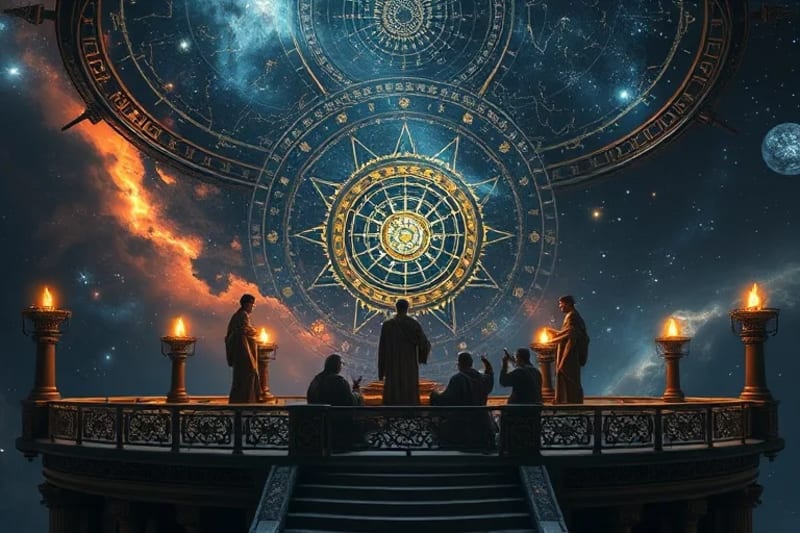
Depicting ancient scholars meticulously observing celestial movements, illustrating their dedication to understanding the universe.
Artistic interpretation of ancient astronomical practices, rendered through digital painting techniques, available under a free use license.Beyond physical alignments, astro-archeologists also analyze:
- Calendrical Systems: Many ancient cultures developed sophisticated calendars based on solar, lunar, or lunisolar cycles. The Maya, for instance, had several interlocking calendars (Tzolk'in, Haab', Long Count) that required precise astronomical observations.
- Symbolism and Iconography: Celestial bodies were often deified or imbued with symbolic meaning. Examining ancient art, pottery, and carvings for depictions of stars, constellations, or planetary gods provides crucial context for understanding their astronomical beliefs.
- Oral Traditions and Written Records: Where available, myths, legends, and historical texts can offer direct insights into how ancient peoples interpreted celestial events and their significance. For example, Egyptian texts describe the journey of the sun god Ra across the sky.
- Ethnoastronomy: Studying the astronomical knowledge and practices of contemporary indigenous cultures can provide analogies and insights into how ancient societies might have viewed the cosmos, though direct comparisons must be made with caution.
The interpretation phase is critical and often subject to debate. It requires not only astronomical accuracy but also a deep dive into the cultural context. What might appear as a simple alignment could have profound religious, social, or political implications for the people who created it. For instance, the esoteric symbolism of planetary transits was often interwoven with daily life and spiritual guidance.
The Cultural and Spiritual Significance of Ancient Astronomy
For ancient civilizations, the sky was not merely a backdrop; it was a dynamic, living entity that governed their existence. The movements of celestial bodies dictated the rhythms of life, from agricultural cycles to religious festivals. This deep connection permeated every aspect of their culture:
- Agriculture and Survival: Predicting the changing seasons through solar and stellar observations was vital for planting and harvesting. The heliacal rising of certain stars, like Sirius for the ancient Egyptians, signaled the flooding of the Nile, a life-sustaining event.
- Religion and Cosmology: The heavens were often seen as the abode of gods or the manifestation of divine will. Celestial phenomena like eclipses or comets were interpreted as omens or messages from the deities. Many creation myths are deeply intertwined with cosmic events. Understanding these past life connections to the cosmos reveals a holistic worldview.
- Social and Political Power: Knowledge of the heavens often conferred immense power upon priests, shamans, or rulers. Those who could predict celestial events were seen as having a direct line to the divine, reinforcing their authority and control over society.
- Navigation and Exploration: For seafaring cultures, celestial navigation was indispensable. The positions of stars and constellations guided ancient mariners across vast oceans, enabling trade, migration, and exploration.
- Timekeeping and Social Organization: The development of accurate calendars allowed for the organization of society, scheduling of rituals, and administration of resources. This sophisticated timekeeping was a direct result of meticulous astronomical observation.

A conceptual representation of the intricate interplay between ancient artifacts and the celestial mechanics that influenced their creation and meaning.
3D rendered conceptual artwork exploring the abstract connections between ancient human creations and cosmic phenomena, under a creative commons license.The study of these cultural dimensions helps us appreciate the holistic nature of ancient knowledge, where science, religion, and daily life were not separate but deeply integrated. The celestial sphere provided a universal framework for understanding existence, shaping everything from monumental architecture to the most intimate spiritual beliefs. This ancient wisdom often informs modern practices, such as urban geomancy, which seeks to align human dwellings with cosmic energies.
Challenges, Debates, and the Future of Astro-Archeology
Despite its fascinating insights, astro-archeology faces several inherent challenges and ongoing debates:
- Confirmation Bias: There is a risk of seeing patterns where none exist, or of over-interpreting alignments based on preconceived notions. Rigorous statistical methods are employed to mitigate this, ensuring that observed alignments are statistically significant and not merely coincidental.
- Lack of Direct Evidence: For many prehistoric sites, there are no written records to confirm astronomical intent. Interpretations must rely heavily on circumstantial evidence, comparative ethnography, and astronomical calculations, which can lead to differing conclusions among scholars.
- Preservation and Destruction: Many ancient sites are subject to erosion, vandalism, or modern development, which can obscure or destroy crucial evidence. Climate change also poses a significant threat to the preservation of these invaluable cultural heritage sites.
- Cultural Context: Reconstructing the precise cultural and spiritual meaning behind an alignment can be difficult without direct ethnographic data from the period. Modern interpretations may not fully capture the nuances of ancient worldviews.
The future of astro-archeology looks promising, with advancements in technology offering new avenues for research. Lidar scanning, drone photography, and advanced GIS (Geographic Information Systems) are enabling more precise mapping and analysis of ancient sites. Virtual reality and augmented reality tools can help reconstruct ancient skyscapes, allowing researchers and the public to experience celestial events as ancient peoples might have. Furthermore, interdisciplinary collaboration continues to strengthen, integrating insights from cognitive archaeology, anthropology, and even neuroscience to better understand the human perception of the cosmos.
Conclusion: Echoes of the Cosmos in Ancient Stones
Astro-archeology offers a profound window into the intellectual and spiritual lives of ancient civilizations. It reveals that our ancestors were not primitive observers but sophisticated astronomers who meticulously charted the heavens, integrating their cosmic understanding into the very fabric of their societies. From the megalithic circles of Europe to the intricate pyramids of Mesoamerica, the stones speak of a universal human quest to understand the cosmos and our place within it.
By continuing to unearth these celestial narratives, we gain not only a deeper appreciation for the ingenuity of past cultures but also a renewed sense of connection to the timeless human endeavor of looking up at the stars and seeking meaning. Astro-archeology reminds us that the sky has always been, and continues to be, a source of wonder, knowledge, and inspiration for humanity.
Explore More Celestial Insights
Advanced Astro-Genomics Epigenetic Karmic Blueprints DNA: Delve into the intricate connections between celestial influences and genetic predispositions.
Financial Markets Astrology: Predicting Economic Trends: Discover how celestial cycles have been historically linked to economic fluctuations.
Astro-Economy Predicting Financial Markets Planetary Cycles: A deeper dive into the methodologies of forecasting financial trends using planetary movements.
Planetary Dignities: Exaltation Detriment Natal Chart Impact: Understand the historical significance and impact of planetary positions in astrological charts.
Guías Espirituales: Conectar, Recibir Orientación, Seres de Luz: Explore ancient and modern ways of connecting with spiritual guidance, often linked to cosmic wisdom.
Source: Hybrid content assisted by AI and human editorial supervision.


Comments
Post a Comment