
Eco-Astrology Planetary Cycles Environmental Stewardship
Eco-Astrology: Planetary Cycles and Environmental Stewardship
Eco-astrology emerges as a fascinating and increasingly relevant field, bridging the ancient wisdom of celestial mechanics with contemporary environmental consciousness. It posits that the intricate dance of planets and stars profoundly influences Earth's ecosystems, climate patterns, and even human collective action towards environmental stewardship. This discipline encourages a deeper understanding of our planet's rhythms through an astrological lens, fostering a more harmonious relationship with nature.
Far from being a mere predictive tool, eco-astrology offers a framework for recognizing the interconnectedness of all life. It suggests that by observing planetary cycles, we can better anticipate environmental shifts, understand the underlying energetic currents driving ecological challenges, and align our efforts for conservation and sustainability with cosmic timing. This approach moves beyond anthropocentric views, placing humanity within a larger, interconnected web of cosmic and terrestrial influences.
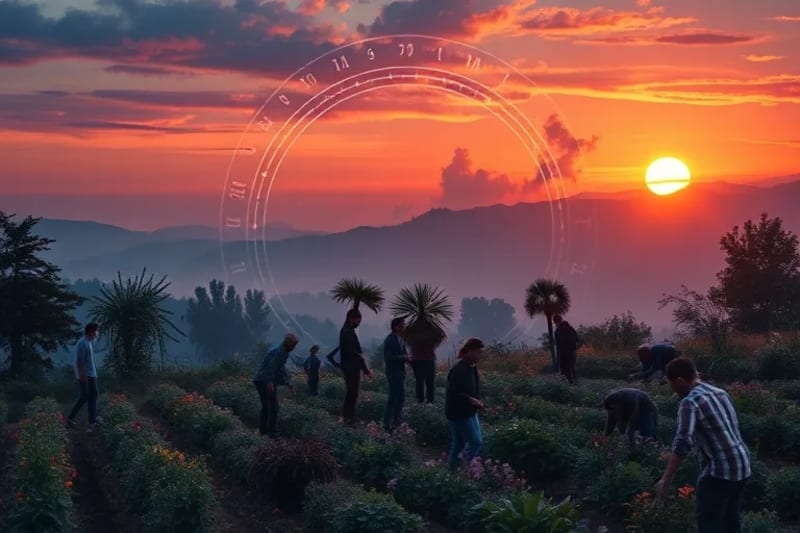
A community cultivating a garden, subtly illuminated by celestial patterns, embodying the principles of eco-astrology and environmental harmony.
Visual source subject to ecosystem availability: Wikimedia Commons under license CC BY-SA 4.0 or conceptual AI rendering.
The core premise of eco-astrology is that everything is interconnected. Just as the Moon governs the tides and influences biological rhythms, other planets exert subtle yet significant influences on Earth's climate, geology, and biodiversity. Understanding these celestial blueprints can empower individuals and communities to act as more effective stewards of the environment, integrating ancient wisdom with modern ecological science.
Table of Contents
- Historical Roots of Eco-Astrology
- Planetary Cycles and Earth's Rhythms
- Astrological Aspects and Environmental Events
- The Astrological Chart as an Ecological Blueprint
- Practical Applications of Eco-Astrology
- Ethical Considerations and Modern Perspectives
- Conclusion: Harmonizing with Cosmic Rhythms
Historical Roots of Eco-Astrology
The concept of celestial influence on terrestrial life is not new; it is deeply embedded in ancient cultures across the globe. Indigenous peoples, early agricultural societies, and classical civilizations all observed and revered the cycles of the Sun, Moon, and visible planets, recognizing their direct impact on planting, harvesting, weather, and the well-being of their communities. Their spiritual practices often intertwined astronomical observations with ecological understanding.
From the Mayan calendars tracking agricultural seasons to the Vedic traditions linking planetary deities with natural elements, humanity has long sought to understand and align with cosmic rhythms. Ancient Greek philosophers like Plato and Aristotle also explored the concept of a "macrocosm" (the universe) reflecting in the "microcosm" (Earth and humanity), a foundational idea for eco-astrology. This historical perspective highlights a time when the separation between humanity, nature, and the cosmos was far less pronounced than it is today.
These historical roots provide a rich tapestry upon which modern eco-astrology builds, re-establishing a connection that was largely lost during periods of scientific reductionism. By studying how Hellenistic Astrology bridged ancient wisdom with modern spirituality, we can appreciate the enduring human quest to find meaning and order in the celestial sphere and apply it to our earthly existence.
Planetary Cycles and Earth's Rhythms
Each celestial body, with its unique orbit and energetic signature, contributes to the complex symphony of Earth's rhythms. Understanding these individual influences is crucial for grasping the full scope of eco-astrology.
- Lunar Cycles: The Moon's approximately 29.5-day cycle is perhaps the most obvious celestial influence on Earth. It directly governs the tides, affecting ocean currents and coastal ecosystems. Beyond this, lunar phases are observed to impact plant growth (e.g., planting by the moon), animal breeding cycles, and even human emotional and biological rhythms. A New Moon often signifies new beginnings in nature, while a Full Moon can bring culmination and heightened activity.
- Solar Cycles: The Sun, our primary source of energy, dictates the seasons and weather patterns. Its 11-year solar flare cycle can influence Earth's magnetic field, potentially affecting global climate, communication systems, and even seismic activity. Eco-astrology views the Sun as the life-giver, and its cycles are fundamental to all biological processes on Earth.
- Inner Planets (Mercury, Venus, Mars): These planets have shorter, more immediate cycles that can influence localized environmental conditions and human interactions with nature. Mercury's retrogrades, for instance, might correlate with periods of communication breakdowns in environmental policy or challenges in ecological data interpretation. Venus, associated with harmony and growth, can highlight times favorable for beautification projects or fostering biodiversity. Mars, representing action and energy, might signify periods of intense environmental activism or, conversely, destructive natural events.
- Jupiter and Saturn: These social planets influence broader societal trends. Jupiter's 12-year cycle can mark periods of expansion or growth in environmental awareness and policy, while Saturn's 29.5-year cycle often brings structural changes, limitations, or the need for disciplined conservation efforts. Saturn's influence can highlight the consequences of unsustainable practices, demanding accountability and long-term planning for ecological balance.
- Outer Planets (Uranus, Neptune, Pluto): These generational planets operate on much longer cycles, signifying profound collective shifts and evolutionary changes.
- Uranus (84-year cycle): Associated with innovation, disruption, and awakening. Its transits often coincide with technological breakthroughs in sustainability, sudden environmental crises that demand radical solutions, or the emergence of new ecological paradigms and movements.
- Neptune (165-year cycle): Linked to spirituality, dissolution, and collective consciousness. Neptune's influence can manifest as increased awareness of oceanic pollution, the dissolution of old industrial practices, or a rising tide of collective empathy for the natural world. It can also point to periods of confusion or illusion regarding environmental issues.
- Pluto (248-year cycle): Represents transformation, death, and rebirth. Pluto's transits are often associated with profound ecological transformations, the uncovering of hidden environmental destruction, or the powerful regeneration of ecosystems after crisis. It signifies deep systemic changes in our relationship with the Earth, often through intense pressure or necessary destruction for renewal.
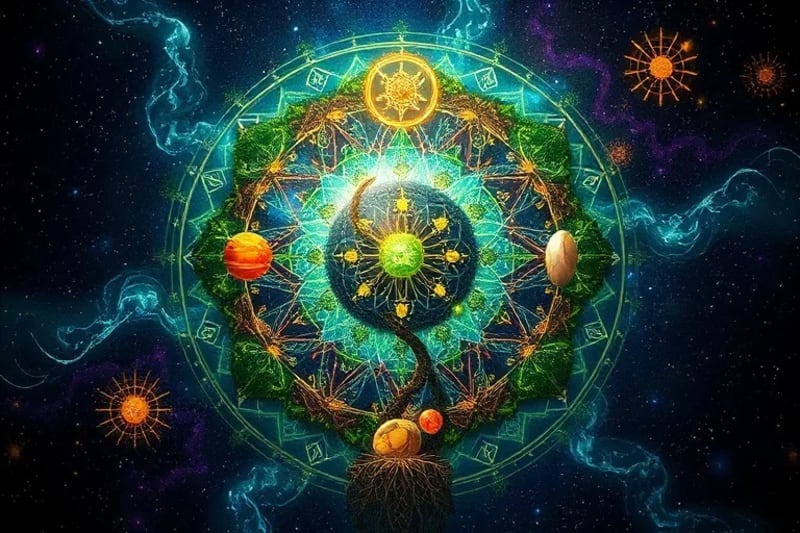
An artistic representation of Earth's intricate ecosystems, subtly influenced by the unseen forces of planetary cycles and astrological symbolism.
Astrological Aspects and Environmental Events
Beyond individual planetary influences, the geometric relationships, or "aspects," between planets play a critical role in eco-astrology. These aspects create energetic patterns that can correlate with significant environmental events or shifts in collective consciousness regarding the Earth.
- Conjunctions: When two planets align, their energies merge, often initiating new cycles or intensifying existing themes. A conjunction involving an outer planet and an inner planet might trigger a new environmental initiative or highlight a specific ecological concern with renewed urgency.
- Oppositions: These aspects can bring awareness to polarities and create tension, often requiring balance. An opposition involving environmental indicators could highlight conflicting interests between economic development and ecological preservation, demanding a resolution.
- Squares: Squares represent challenges and dynamic tension, often leading to necessary action or breakthroughs. A square involving planets related to resources and sustainability might indicate a crisis point that forces innovative solutions or significant policy changes.
- Trines and Sextiles: These harmonious aspects facilitate flow and opportunity. They can signify periods of ease for environmental collaboration, successful conservation efforts, or the natural unfolding of positive ecological regeneration.
For example, historical periods marked by significant environmental legislation or major ecological disasters can often be correlated with specific challenging aspects involving outer planets. These correlations suggest that celestial alignments may act as energetic triggers, amplifying underlying terrestrial conditions or collective human responses. The study of esoteric symbolism and digital consciousness can further enhance our understanding of these subtle yet powerful connections.
The Astrological Chart as an Ecological Blueprint
An individual's birth chart can be viewed as a unique ecological blueprint, revealing their inherent connection to nature, their environmental sensitivities, and their potential role in stewardship. Certain placements and aspects within the chart can indicate a strong affinity for the Earth, a calling towards environmental activism, or specific challenges in relating to the natural world.
- Earth Signs (Taurus, Virgo, Capricorn): Individuals with a strong emphasis on Earth signs often possess a practical, grounded connection to the physical world. They may be naturally inclined towards gardening, sustainable living, or working with natural resources.
- Water Houses (4th, 8th, 12th): These houses relate to roots, transformation, and hidden realms. The 4th house, representing home and foundations, can indicate one's relationship with their immediate environment and ancestral lands. The 8th house, linked to shared resources and regeneration, can highlight a person's approach to collective environmental responsibility. The 12th house, associated with the subconscious and universal interconnectedness, might reveal a deep, intuitive empathy for all living beings.
- Planets in the 6th House: The 6th house governs daily routines, health, and service. Planets here can indicate how one integrates sustainable practices into their daily life or their dedication to serving the Earth through practical work.
- Aspects to Ceres: Ceres, an asteroid goddess associated with agriculture, nurturing, and the Earth's bounty, can reveal one's relationship to food production, resource management, and ecological care. Strong aspects to Ceres often indicate a deep concern for the planet's well-being.
- Uranus, Neptune, Pluto placements: The houses and signs where these outer planets reside can indicate areas where an individual is called to bring about revolutionary environmental change (Uranus), foster collective ecological consciousness (Neptune), or engage in deep environmental healing and transformation (Pluto).
By understanding these astrological indicators, individuals can harness their innate strengths to become more effective environmental advocates and practitioners. It encourages a personalized approach to stewardship, recognizing that each person has a unique contribution to make based on their cosmic design.

A conceptual 3D rendering illustrating the intricate mechanical influence of planetary cycles on various terrestrial ecosystems.
Practical Applications of Eco-Astrology
Eco-astrology is not merely theoretical; it offers tangible ways to integrate celestial wisdom into practical environmental actions. Its applications range from personal lifestyle choices to broader community initiatives.
- Timing Environmental Actions: Just as farmers have traditionally planted by the moon, eco-astrologers can use planetary alignments to optimize timing for various environmental activities. This could include:
- Planting and Harvesting: Aligning with lunar and planetary positions for optimal growth and yield.
- Conservation Projects: Initiating clean-up drives, reforestation efforts, or policy advocacy during favorable planetary aspects that support growth, collaboration, or transformation.
- Energy Conservation: Understanding solar cycles to better manage renewable energy resources or anticipate periods of higher energy demand.
- Developing a Deeper Personal Connection: By observing how planetary energies manifest in local ecosystems, individuals can cultivate a more profound and intuitive bond with nature. This involves mindful observation of weather patterns, animal behavior, and plant growth in relation to celestial events.
- Understanding Collective Challenges: Eco-astrology can provide insights into the energetic undercurrents of global environmental issues. For instance, a challenging aspect involving Neptune and Saturn might indicate a period where collective illusions about climate change (Neptune) clash with the need for concrete, disciplined action (Saturn), leading to a critical turning point.
- Guiding Policy and Advocacy: While not a direct policy-making tool, eco-astrology can inform a holistic perspective for environmental leaders and activists. It can help identify optimal periods for launching campaigns, negotiating agreements, or raising public awareness, aligning human efforts with cosmic flow for greater effectiveness.
The integration of astrological insights into environmental planning can lead to more intuitive, effective, and sustainable practices, moving beyond purely rational approaches to embrace a more holistic understanding of Earth's dynamics.
Ethical Considerations and Modern Perspectives
As with any emerging field that bridges ancient wisdom with modern challenges, eco-astrology faces ethical considerations and requires a nuanced perspective. It is crucial to approach this discipline with an open mind, while also grounding its insights in scientific understanding and critical thinking.
- Addressing Skepticism: Eco-astrology, like traditional astrology, often encounters skepticism from conventional scientific communities. It is important to emphasize that eco-astrology is not a replacement for ecological science but rather a complementary framework that offers a different lens through which to understand environmental dynamics. It encourages pattern recognition and intuitive understanding alongside empirical data.
- Integrating Science and Spirituality: A balanced approach integrates scientific ecological data (e.g., climate models, biodiversity reports) with astrological insights. This means using astrology to identify potential energetic patterns or optimal timings, and then applying scientific methods to implement and evaluate environmental strategies.
- Avoiding Determinism: Eco-astrology should not be used to promote fatalism or to absolve human responsibility. While planetary cycles may indicate tendencies or energetic currents, human free will and collective action remain paramount in shaping environmental outcomes. The purpose is to empower, not to predict with absolute certainty.
- The Role of Technology: Modern technology, including artificial intelligence, can play a role in advancing eco-astrology. AI could potentially analyze vast datasets of environmental changes alongside astrological transits to identify correlations that are imperceptible to the human eye. This could lead to a new era of understanding, where AI Astrology explores ethical implications and future cosmic readings, offering innovative tools for environmental insights. Similarly, Techno-Shamanism could integrate digital tools with spiritual practices to foster a deeper connection to nature.
By embracing these considerations, eco-astrology can evolve into a robust and respected field, contributing meaningfully to the global conversation on environmental stewardship and sustainability.
Conclusion: Harmonizing with Cosmic Rhythms
Eco-astrology offers a compelling vision for a future where humanity lives in greater harmony with the Earth, guided by the wisdom of the cosmos. By understanding the profound influences of planetary cycles on our environment, we can move beyond reactive measures to proactive stewardship, aligning our efforts with the natural flow of universal energies.
This interdisciplinary approach encourages us to view ourselves not as separate from nature, but as integral parts of a vast, interconnected system. It calls for a re-enchantment with the natural world, fostering a sense of reverence and responsibility that is deeply rooted in both scientific understanding and spiritual insight. As we navigate the complex environmental challenges of our time, eco-astrology provides a unique lens through which to seek solutions, fostering a more sustainable and spiritually enriched relationship with our planetary home.
Explore More Cosmic Connections
- Intercepted Signs Compatibility: Overcoming Karmic Blocks
- Alchemy of Sleep: Dream Incubation for Insights
- Biomagnetic Therapy Starseed Lineage Cosmic Healing
- Aquarius Decans Deep Dive: Water Bearer Faces Explained
- North Node Retrograde: Unlocking Past Life Karma
- Venus Zodiac Signs: Decoding Love Language & Values
- Black Holes: Mysteries, Astrophysics and AI
- Kabbalah Astrology: Connecting the Divine Celestial
- Biblical Ecological Prophecies: Creation Stewardship End Times
Source: Hybrid content assisted by AI and human editorial supervision.


Comments
Post a Comment