
Fixed Stars Mundane Astrology: Global Event Prediction
In the vast tapestry of astrological study, while planetary movements often command primary attention, the enigmatic influence of fixed stars offers a profound, yet often overlooked, layer of cosmic insight. These distant suns, seemingly immutable against the backdrop of the zodiac, possess a distinct energetic signature that, when properly understood, can illuminate the deeper currents shaping global events, societal shifts, and collective human destiny. Unlike the wandering planets, which symbolize dynamic processes and psychological drives, fixed stars represent archetypal forces, karmic imprints, and powerful, often fated, energies that manifest on a grand scale.
Mundane astrology, the branch dedicated to world affairs, nations, and collective phenomena, finds in fixed stars a potent tool for discerning the underlying themes of an era. Their conjunctions with planets, angles of mundane charts, or significant celestial events can act as cosmic signposts, indicating periods of profound transformation, conflict, innovation, or collapse. This exploration delves into the mystery of fixed stars, their historical perception, their unique astrological mechanics, and their specific application in predicting and understanding global occurrences, offering a more nuanced perspective on the celestial influences that govern our world.
Table of Contents
- Historical Perspective on Fixed Stars
- Fixed Stars vs. Planets: A Fundamental Distinction
- Mechanics of Fixed Stars in Mundane Astrology
- Key Fixed Stars and Their Mundane Influence
- Interpreting Fixed Stars in Global Predictions
- Modern Perspectives and Cautions
Historical Perspective on Fixed Stars in Astrology
The study of fixed stars predates much of what we recognize as modern astrology. Ancient civilizations, from Mesopotamia to Egypt and Greece, meticulously charted the heavens, recognizing patterns and attributing divine significance to the constellations and their brightest stars. These early astronomers and astrologers viewed the fixed stars as the permanent backdrop against which the planets danced, providing a stable, foundational influence.
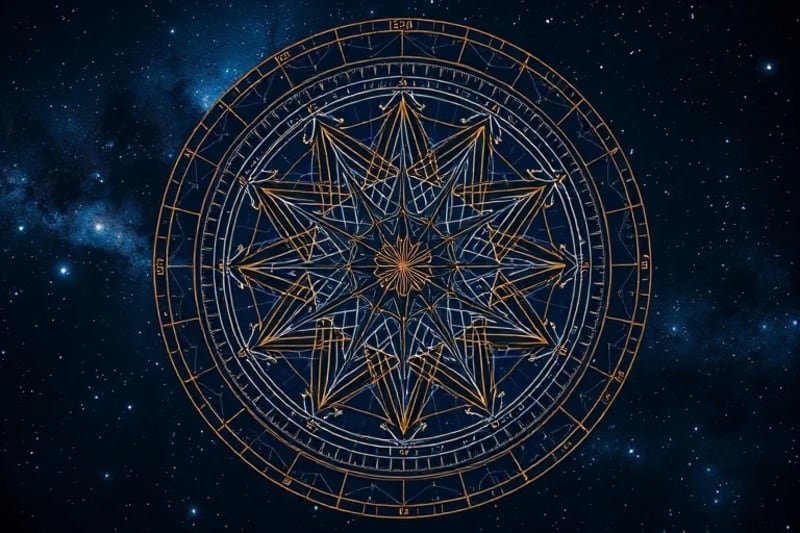 A conceptual visualization of the profound influence of distant suns and their intricate patterns, shaping the destinies of nations and the collective human experience across epochs.
Conceptual rendering generated by advanced AI, reflecting historical astronomical observations and their esoteric interpretations.
Ptolemy, in his seminal work the "Tetrabiblos," extensively detailed the natures of various fixed stars, often associating them with planetary temperaments (e.g., "of the nature of Mars and Jupiter"). This established a framework for interpreting their influence, which was largely adopted and expanded upon by medieval Islamic and European astrologers. Astrologers like Al-Biruni and Guido Bonatti further integrated fixed star interpretations into their predictive techniques, particularly for significant events like the rise and fall of empires, epidemics, and natural disasters.
During the Renaissance, figures like William Lilly continued to reference fixed stars, especially the more prominent ones, in their horary and mundane analyses. However, with the advent of the scientific revolution and a more mechanistic view of the cosmos, the intricate study of fixed stars gradually receded from mainstream astrological practice. It was not until the 20th century, with the work of astrologers like Vivian Robson, Bernadette Brady, and Diana Rosenberg, that a renewed interest emerged, leading to a more systematic and nuanced understanding of their complex energies.
Fixed Stars vs. Planets: A Fundamental Distinction
To grasp the unique role of fixed stars, it is crucial to differentiate their influence from that of the planets. Planets, by definition, are "wanderers," constantly shifting their positions through the zodiac. They represent dynamic forces, psychological functions, and active principles that evolve over time. Their transits, progressions, and aspects describe ongoing processes, personal development, and the ebb and flow of daily life and collective trends.
Fixed stars, on the other hand, maintain relatively constant positions within the celestial sphere. While they do precess slowly (approximately one degree every 72 years), their movement is imperceptible within a human lifespan or even across several generations. This immutability gives them a quality of permanence, representing archetypal energies that are deeply ingrained in the fabric of existence. Their influence is often described as more fated, profound, and less subject to individual will or transient circumstances.
 Ancient instruments used to chart the heavens, reflecting humanity's enduring quest to understand celestial mechanics and their impact on earthly realms.
In mundane astrology, planetary cycles might indicate economic booms or recessions, political elections, or social movements. Fixed stars, however, often point to the underlying archetypal themes that drive these events, the deeper karmic patterns at play, or the ultimate consequences that transcend immediate causes. They can signify periods of great glory or catastrophic downfall, profound spiritual awakenings, or widespread societal upheaval rooted in ancient patterns. Their energies are often more dramatic, impactful, and less negotiable than planetary influences.
Mechanics of Fixed Stars in Mundane Astrology
The application of fixed stars in mundane astrology requires precision and a clear understanding of their specific mechanics. Unlike planetary aspects, which involve angular relationships, fixed stars primarily exert their influence through conjunctions with sensitive points in a mundane chart. The orb of influence for fixed stars is generally much smaller than for planets, typically ranging from 0.5 to 1.5 degrees, though some astrologers may extend it slightly for very bright or significant stars.
Key points of conjunction in mundane charts include:
- Planets: When a planet conjuncts a fixed star, the star's energy is channeled through the planet's function. For instance, Mars conjunct Algol might indicate violent conflict or a decisive, perhaps brutal, action on a national or global scale.
- Angles (ASC, MC, DSC, IC): Conjunctions with the Ascendant (national identity, public image), Midheaven (government, leadership, national reputation), Descendant (foreign relations, open enemies), or Imum Coeli (foundations, homeland, collective unconscious) are particularly potent. A fixed star on the Midheaven of a nation's chart can describe its destiny or the nature of its leadership.
- Lunar Nodes: Conjunctions with the North or South Node can indicate karmic themes, collective destiny, or unresolved issues coming to the forefront for a nation or the world.
- Eclipses and Lunations: When a solar or lunar eclipse, or a significant New or Full Moon, occurs in conjunction with a fixed star, the star's influence is amplified and imprinted upon the event, often signaling major turning points.
- Ingresses: The ingress of the Sun or a major planet into a cardinal sign (Aries, Cancer, Libra, Capricorn) often marks the beginning of a new season or quarter of the year. If these ingresses occur in conjunction with a fixed star, the star's themes will permeate the subsequent period.
The nature of the fixed star itself is paramount. Each star carries a unique mythological narrative and an energetic quality often described in terms of planetary equivalencies (e.g., "like Jupiter and Mars"). Understanding these traditional significations is crucial for accurate interpretation. For a deeper dive into planetary influences and their broader implications, one might explore Astrological Cycles: Major Transits Global Events Impact.
Key Fixed Stars and Their Mundane Influence
While hundreds of fixed stars exist, a select few are particularly prominent in mundane astrology due to their brightness, historical significance, and potent symbolism. Here are some of the most impactful:
| Fixed Star | Zodiacal Position (Approx.) | Nature/Influence in Mundane Astrology |
|---|---|---|
| Aldebaran (Alpha Tauri) | 9° Gemini | One of the four Royal Stars. Associated with integrity, leadership, courage, and military command. Can bring great success but also danger from violence or accidents, especially if integrity is compromised. Mundanely, signifies powerful military actions, leadership challenges, and national defense. |
| Antares (Alpha Scorpii) | 9° Sagittarius | Another Royal Star. Associated with passion, obsession, destruction, and self-destruction. Can bring great power but also danger from fanaticism, war, and sudden downfall. Mundanely, relates to intense political struggles, revolutionary movements, and significant conflicts. |
| Regulus (Alpha Leonis) | 0° Virgo | The third Royal Star. Associated with royalty, nobility, success, ambition, and pride. Brings power and honor but warns against arrogance and revenge, which can lead to downfall. Mundanely, signifies the rise and fall of leaders, national prestige, and challenges to authority. |
| Fomalhaut (Alpha Piscis Austrini) | 4° Pisces | The fourth Royal Star. Associated with magic, idealism, spiritual vision, and sometimes scandal or deception. Can bring great artistic or spiritual success but also vulnerability to illusion. Mundanely, relates to collective dreams, spiritual movements, humanitarian crises, and sometimes widespread deception or disillusionment. |
| Algol (Beta Persei) | 26° Taurus | One of the most malefic stars, associated with decapitation, violence, extreme passion, and loss of control. Can signify extreme danger, brutality, and catastrophic events. Mundanely, often linked to major accidents, mass violence, political assassinations, and destructive natural phenomena. |
| Spica (Alpha Virginis) | 24° Libra | A highly benefic star, associated with success, brilliance, grace, and artistic talent. Brings good fortune, honor, and intellectual achievement. Mundanely, signifies periods of peace, prosperity, artistic flourishing, scientific breakthroughs, and diplomatic successes. |
| Sirius (Alpha Canis Majoris) | 14° Cancer | The brightest star in the night sky. Associated with fame, honor, wealth, ambition, and leadership. Can bring great success but also intense pressure and responsibility. Mundanely, relates to national pride, significant public figures, major cultural events, and periods of intense national focus. |
Interpreting Fixed Stars in Global Predictions
Interpreting fixed stars in mundane astrology requires a synthesis of traditional knowledge, contextual awareness, and intuitive insight. It's not a deterministic prediction but rather an understanding of the archetypal energies that are being activated. When a significant fixed star is activated, it often signifies a period where the collective unconscious is grappling with the themes represented by that star.
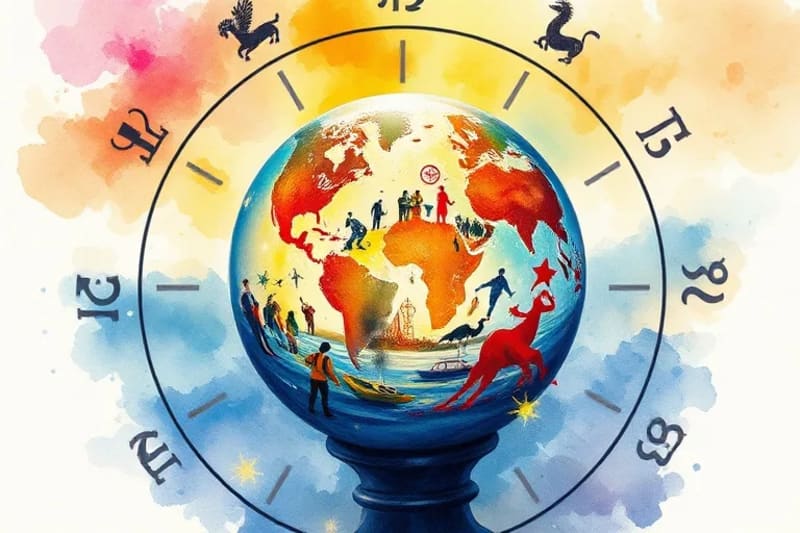 A symbolic representation of how celestial energies, particularly from fixed stars, subtly yet profoundly shape the unfolding narrative of global events.
Consider the following steps for interpretation:
- Identify the Activated Star: Pinpoint which fixed star is in close conjunction with a planet, angle, eclipse, or ingress point in the mundane chart under consideration.
- Understand the Star's Nature: Recall the traditional significations, mythological associations, and planetary equivalencies of that specific star. Is it benefic or malefic? What are its core themes (e.g., leadership, violence, inspiration, deception)?
- Analyze the Conjoining Point: What planet or angle is involved? The star's energy will be expressed through the function of that planet or the domain of that angle. For example, Algol conjunct Mercury might signify dangerous or deceptive communication, propaganda, or severe issues with transportation/information flow. Algol on the MC could indicate a period of extreme challenge or even downfall for a nation's leadership.
- Consider the Mundane Context: What is the current geopolitical, social, and economic climate? Fixed star influences don't occur in a vacuum; they interact with existing conditions.
- Look for Historical Parallels: Research past instances when that specific star was similarly activated. While history doesn't repeat exactly, patterns can emerge.
For instance, periods when Algol is strongly activated often correlate with times of intense social unrest, political extremism, or acts of terror. Conversely, strong activations of Spica might coincide with periods of significant artistic or scientific advancement, diplomatic breakthroughs, or economic stability. The Royal Stars often mark pivotal moments for national leaders or the very structure of governance. Understanding these deep cosmic influences can provide a unique lens through which to view global events, offering insights that go beyond conventional analysis. The intricate dance of celestial bodies, including fixed stars, plays a crucial role in shaping collective human experiences, much like the detailed analysis of Advanced Synastry: Composite Chart Aspects & Relationship Destiny reveals the dynamics of interpersonal connections.
Modern Perspectives and Cautions
In contemporary astrology, the study of fixed stars has evolved beyond simple benefic/malefic classifications. Modern astrologers emphasize understanding the archetypal energies and psychological implications of these stars, rather than viewing them as purely deterministic. The influence of a fixed star is often subtle but profound, acting as a background hum that shapes the quality of an era or event.
It is crucial to approach fixed star interpretations with caution and nuance:
- Not Deterministic: Fixed stars do not dictate events in a rigid, unavoidable manner. Instead, they represent powerful energetic currents that influence the collective consciousness, creating propensities and themes.
- Integration: Fixed star analysis should always be integrated with other astrological techniques, such as planetary transits, progressions, and solar returns. They add a layer of depth, rather than being the sole predictive factor.
- Orb of Influence: Strict adherence to small orbs is essential. A wide orb dilutes the influence and can lead to misinterpretations.
- Context is Key: The manifestation of a fixed star's energy is highly dependent on the specific planet or angle it conjuncts, the house it falls in (in a mundane chart), and the broader astrological and terrestrial context.
- Evolutionary Understanding: As humanity evolves, so too might our understanding and experience of these stellar energies. What was once interpreted as purely destructive might now be seen as a catalyst for profound transformation or necessary catharsis.
The mystery of fixed stars continues to unfold, offering astrologers a powerful lens through which to perceive the deeper, often fated, patterns that govern our world. By honoring their ancient wisdom while applying modern critical thought, we can gain invaluable insights into the grand cosmic drama in which all nations and individuals play a part.
Explore More Cosmic Insights
- Mediumship: Bridging Worlds, Exploring Connections
- Ancestral Veneration Natal Chart: Lineage Blessings Healing Karmic
- Numerology Manifestation Life Path: Aligning Desired Reality
- Progressed Chart Analysis: Inner Growth, Evolution
- Chrono-Astrology Ancestral Echoes Personal Time Cycles
- Pisces Zodiac Sign: Traits, Compatibility, Life Path
- Libra Zodiac Sign: Balance, Relationships, Justice
- Crystal Grids: Amplifying Intentions with Sacred Geometry and Gemstones
- Virgo Scorpio Synastry: Healing Karmic Wounds
- Astro-Botany: Celestial Influences Plant Growth
- Advanced Planetary Dignities Electional Astrology: Optimizing Timings
- Tarot Sacred Geometry: Unlocking Universal Truths Divination
- Daily Elemental Horoscope: Energy, Mood, Guide Explained
- Luna en Signos Zodiacales: Emociones, Comportamientos, Guía
- Ecliptismo Kármico: Viaje Transformador del Alma
- Astrología IA Algoritmos Predicciones Cósmicas Futuro
Source: Hybrid content assisted by AI and human editorial supervision.


Comments
Post a Comment