
Astro-Economics: Planetary Cycles, AI, Financial Forecasts
Astro-Economics represents a fascinating, interdisciplinary field at the confluence of astrology, economics, and advanced technology. It explores the hypothesis that planetary cycles and celestial alignments may correlate with significant shifts and trends in global financial markets. While traditionally viewed as separate disciplines, proponents of astro-economics suggest that cosmic rhythms could subtly influence collective human psychology, decision-making, and ultimately, economic behavior. This emerging area seeks to leverage sophisticated data analysis, often powered by Artificial Intelligence (AI), to identify patterns that might otherwise remain hidden within the vast complexity of financial data.
The core premise is not to predict exact stock prices or daily market fluctuations, but rather to identify broader cyclical trends, periods of expansion or contraction, and potential turning points that align with specific astrological configurations. By integrating planetary transits with economic indicators and machine learning algorithms, astro-economists aim to develop more nuanced models for understanding and potentially forecasting long-term market movements. This approach offers a unique lens through which to view the intricate dance between human activity, cosmic influences, and global financial dynamics.
Table of Contents
Historical Perspective: Celestial Influence on Earthly Affairs
The idea that celestial bodies influence earthly events is as old as civilization itself. Ancient cultures, from the Babylonians and Egyptians to the Greeks and Mayans, meticulously observed planetary movements, correlating them with agricultural cycles, political events, and even human temperament. While modern science often dismisses these correlations as superstition, the historical record shows a persistent human desire to find order and predictability in the cosmos.
In early modern Europe, astrology was not just a fringe belief but often intertwined with astronomy, medicine, and even statecraft. Alchemists and natural philosophers frequently consulted astrological charts for various undertakings. While direct links to financial markets in their modern form were not explicit, the underlying philosophy—that macrocosmic patterns reflect in microcosmic events—laid a conceptual groundwork. The notion of cyclical patterns in history and human affairs, often attributed to celestial mechanics, has been a recurring theme in philosophical and historical thought.
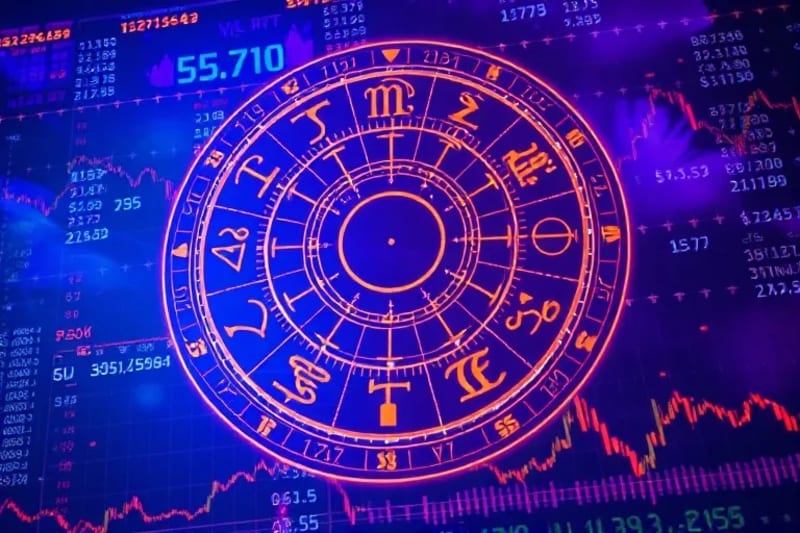 Exploring the intricate dance between cosmic alignments, global financial markets, and the predictive power of artificial intelligence. This visualization captures the essence of astro-economics as a bridge between ancient wisdom and modern analytical tools.
Conceptual AI rendering, blending astrological charts with financial data, reflecting the interdisciplinary nature of forecasting.
Planetary Cycles and Economic Rhythms
At the heart of astro-economics lies the study of planetary cycles. Each planet, according to astrological principles, is associated with specific archetypal energies and influences. As planets move through the zodiac and form aspects with each other, these energies are believed to manifest in collective human consciousness and, by extension, in economic activity. Some key cycles often examined include:
- Jupiter-Saturn Conjunctions: Occurring approximately every 20 years, these conjunctions are often linked to major socio-economic shifts, the rise and fall of empires, and significant changes in global power structures. Historically, they have been correlated with periods of economic restructuring and new beginnings.
- Uranus Cycles (84 years): Uranus is associated with innovation, disruption, technological breakthroughs, and sudden changes. Its transits are often linked to periods of rapid technological advancement, market volatility, and revolutionary shifts in economic paradigms.
- Neptune Cycles (165 years): Neptune governs idealism, illusion, speculation, and collective dreams. Its cycles can correlate with periods of inflation, bubbles, artistic movements, and shifts in collective values that impact consumer behavior and investment trends.
- Pluto Cycles (248 years): Pluto represents transformation, power, death, and rebirth. Its transits are often associated with profound economic restructuring, the collapse of old systems, and the emergence of new financial orders. These are long-term cycles that mark generational economic shifts.
Beyond these major cycles, shorter-term planetary movements, such as those of Mars (action, conflict), Venus (value, money, relationships), and Mercury (communication, trade), are also considered for their potential influence on market sentiment and daily trading activities. The interplay of these cycles creates a complex tapestry of potential influences that astro-economists attempt to decipher. Understanding these broader planetary archetypes can offer a unique perspective on the underlying currents shaping our financial world, complementing traditional economic analysis. For a deeper dive into how planetary archetypes influence human psychology, one might explore Astro-Psychology: Shadow Work, Planetary Archetypes Healing.
The Role of Artificial Intelligence in Astro-Economics
The advent of Artificial Intelligence and Machine Learning (ML) has revolutionized data analysis across numerous fields, and astro-economics is no exception. AI provides the computational power necessary to process and identify patterns within vast datasets that would be impossible for human analysts to manage. This integration is crucial for several reasons:
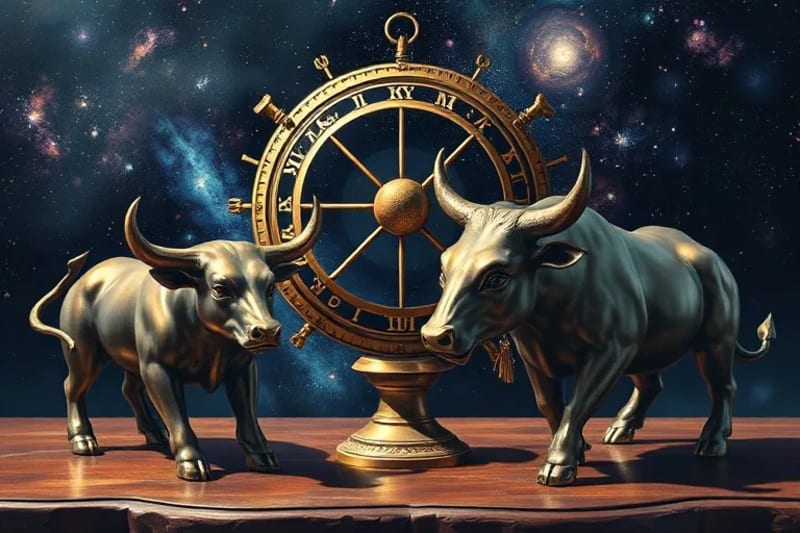 A symbolic representation of the historical and ongoing interplay between celestial observations and economic forces, bridging ancient astrological wisdom with contemporary market dynamics.
Digital art conceptualizing the fusion of astrological tools and financial market symbols, available under CC BY-SA license.
- Pattern Recognition: AI algorithms can detect subtle, non-linear correlations between planetary positions, aspects, and financial market movements that might be invisible to the human eye. This includes identifying recurring astrological signatures preceding specific market behaviors.
- Data Integration: AI can seamlessly integrate diverse data sources: historical stock prices, economic indicators (GDP, inflation, unemployment), geopolitical events, and precise astrological ephemeris data. This holistic approach allows for a more comprehensive analysis.
- Predictive Modeling: Machine learning models (e.g., neural networks, random forests) can be trained on historical data to predict future market trends based on current and projected astrological configurations. While not foolproof, these models can offer probabilistic insights.
- Noise Reduction: Financial markets are inherently noisy. AI can help filter out random fluctuations and focus on more significant, underlying patterns that might be influenced by longer-term cosmic cycles.
The challenge lies in building robust models that avoid overfitting and genuinely capture meaningful correlations rather than spurious ones. However, the potential for AI to unlock new insights in this complex domain is significant, offering a powerful tool for researchers and analysts. The ethical implications of using AI for forecasting, especially in sensitive areas like finance, are also a growing concern, as explored in fields like Cosmic Sociology AI Ethics Global Consciousness Digital Age.
Key Astrological Indicators in Financial Analysis
Beyond the major planetary cycles, specific astrological indicators are often scrutinized for their potential impact on financial markets. These include:
- Planetary Aspects: The angular relationships between planets (conjunctions, oppositions, squares, trines, sextiles) are believed to signify different types of energy flow. Hard aspects (squares, oppositions) might correlate with periods of tension, volatility, or crisis, while soft aspects (trines, sextiles) could align with periods of harmony, growth, or stability.
- Lunar Cycles: The Moon's phases (New Moon, Full Moon, quarters) are often linked to short-term market sentiment and liquidity. Some theories suggest that market activity can fluctuate with the lunar cycle, influencing investor mood and trading volumes. For those interested in lunar influences, Full Moon Rituals: Zodiac Cleansing Guide provides insights into lunar energies.
- Eclipses: Solar and Lunar Eclipses are considered powerful astrological events, often portending significant shifts, revelations, or turning points. In financial markets, they might precede periods of heightened uncertainty, market corrections, or unexpected events that alter economic trajectories.
- Retrograde Periods: When planets appear to move backward in the sky, their energies are thought to be internalized or re-evaluated. Mercury retrograde, for instance, is often associated with communication breakdowns, delays, and re-negotiations, which could manifest as market indecision or logistical challenges in trade.
- Planetary Ingresses: When a planet moves into a new zodiac sign, it changes its energetic expression. These ingresses can mark shifts in collective focus, values, or prevailing economic themes.
By meticulously tracking these indicators and correlating them with historical financial data, astro-economists aim to build a comprehensive framework for understanding potential market responses to cosmic rhythms. This detailed analysis helps in identifying potential windows of opportunity or risk, adding another layer of insight to traditional market analysis.
Methodologies, Challenges, and Skepticism
The methodologies employed in astro-economics vary but generally involve statistical analysis, pattern recognition, and predictive modeling. Researchers often use specialized software to generate astrological charts for historical market events and then apply statistical tests to identify significant correlations. The integration of AI allows for more complex, multi-variate analysis, moving beyond simple correlations to identify intricate patterns.
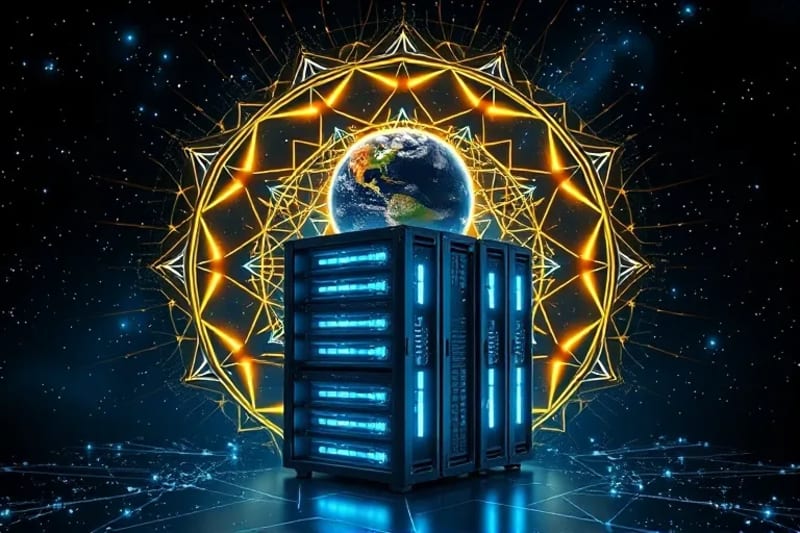 A visual metaphor for the advanced technological integration of planetary data into artificial intelligence systems for sophisticated economic forecasting and analysis.
3D render depicting AI processing cosmic data, provided by Wikimedia Commons under a Public Domain license.
However, the field faces significant challenges and skepticism:
- Causality vs. Correlation: A major critique is the difficulty in proving a causal link between planetary movements and economic events. Correlations can be spurious, and establishing direct causation remains a formidable scientific hurdle.
- Scientific Validation: Mainstream economics and scientific communities largely dismiss astro-economics due to its lack of empirical, peer-reviewed evidence that meets conventional scientific standards. The mechanisms through which celestial bodies could influence financial markets are not understood or accepted by physics.
- Complexity and Interpretation: Astrological interpretations can be subjective, and the sheer number of planetary configurations makes it challenging to isolate specific influences without introducing bias.
- Data Noise: Financial markets are influenced by countless factors (geopolitics, corporate earnings, technological advancements, human psychology), making it difficult to isolate any singular astrological influence.
Despite these challenges, proponents argue that conventional economic models also struggle with accurate long-term forecasting, and astro-economics offers an alternative, complementary perspective. They often highlight historical examples where planetary cycles seemingly coincided with major economic turning points, suggesting that while not a precise predictive tool, it can offer insights into underlying collective psychological shifts that drive market behavior.
Future Outlook and Ethical Considerations
The future of astro-economics, particularly with the integration of AI, lies in its potential to offer a unique, macro-level perspective on economic cycles. It is unlikely to replace traditional economic analysis but could serve as a valuable supplementary tool, especially for identifying long-term trends and potential inflection points that might be missed by conventional models. As AI becomes more sophisticated, its ability to sift through vast amounts of data and identify subtle patterns will only improve, potentially revealing correlations that are currently beyond our grasp.
Ethical considerations are paramount. Any predictive model, especially one incorporating non-traditional data, must be used responsibly. Over-reliance on such models without critical evaluation can lead to significant financial risks. Transparency in methodology, rigorous testing, and an understanding of the limitations of any forecasting tool are essential. Astro-economics, when approached with a scientific mindset and integrated with robust AI frameworks, could evolve into a niche but valuable area of research, offering a broader, more holistic understanding of the forces that shape our financial world. It represents a fascinating frontier where ancient wisdom meets cutting-edge technology, pushing the boundaries of how we understand global economic dynamics.
Explore More Insights
- Monthly Horoscope Guide: What Stars Hold Each Month - Understand general celestial influences.
- Advanced Astrocartography: Jupiter, Venus, Sun Lines for Relocation - Explore planetary lines and their influence on geographical locations.
- Dream Interpretation Numerology Decoding Subconscious Messages - Delve into other esoteric methods of pattern recognition.
- Techno Shamanism Digital Healing Ancient Rituals - Discover the intersection of technology and ancient practices.
Source: Hybrid content assisted by AI and human editorial supervision.


Comments
Post a Comment