
Celestial Mechanics Ancient Civilizations Lost Knowledge
Celestial Mechanics: Ancient Civilizations and Lost Knowledge
Celestial mechanics, the study of the motions of celestial bodies, has captivated humanity since the dawn of civilization. From the earliest stargazers to the most advanced astronomers, our ancestors sought to understand the intricate dance of the heavens. This quest was not merely academic; it was deeply intertwined with survival, spirituality, and the very fabric of their societies.
Ancient civilizations meticulously observed the sun, moon, stars, and planets, developing sophisticated systems to track their movements. These observations led to the creation of calendars, navigation techniques, and complex cosmological beliefs. More profoundly, they formed the bedrock for early astrological practices, where the positions of celestial bodies were believed to influence earthly events and human destiny.
This article delves into how various ancient cultures grappled with celestial mechanics, the knowledge they amassed, and how some of this wisdom was lost or transformed over millennia. We will explore the profound impact these early astronomical insights had on their worldviews and the enduring legacy they left for future generations.
Table of Contents
- Celestial Mechanics: Ancient Civilizations and Lost Knowledge
- The Dawn of Celestial Observation: Mesopotamia and Egypt
- Hellenistic Astronomy: Geocentric Models and Philosophical Insights
- Mesoamerican Calendars: Precision and Prophecy
- The Silk Road of Knowledge: Transmission and Preservation
- Celestial Mechanics and the Birth of Astrology
- Reclaiming the Past: Archaeoastronomy and Modern Interpretations
- Conclusion: The Enduring Cosmic Legacy
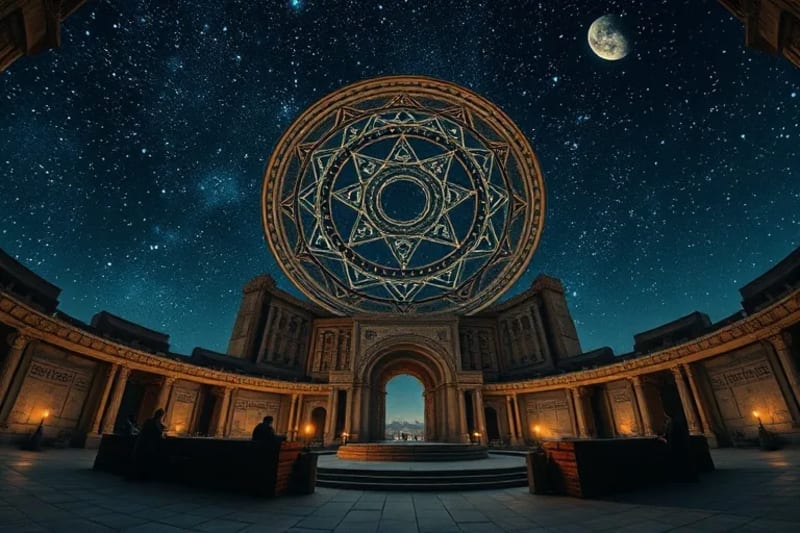 The grand scale of ancient observatories and the meticulous efforts of early astronomers to map the celestial sphere, bridging the gap between earthly existence and cosmic order.
Conceptual rendering of ancient astronomical practices, inspired by historical accounts and architectural designs, created with AI assistance.
The Dawn of Celestial Observation: Mesopotamia and Egypt
The earliest systematic observations of celestial mechanics can be traced back to the fertile crescent, particularly Mesopotamia. The Sumerians, Babylonians, and Assyrians, living in what is now modern-day Iraq, were pioneers in astronomy. They built ziggurats, massive stepped pyramids, which likely served as elevated platforms for observing the night sky. Their cuneiform tablets contain incredibly detailed records of planetary movements, eclipses, and star positions, some dating back thousands of years BCE.
Mesopotamian astronomers developed sophisticated mathematical methods to predict celestial phenomena. They identified the zodiacal constellations, dividing the ecliptic into twelve segments, a system that still influences modern astrology. Their primary motivation was often divinatory; celestial events were seen as omens from the gods, influencing the fate of kings and empires. This blend of precise observation and spiritual interpretation laid the groundwork for much of what we now understand as early astrology.
In ancient Egypt, celestial mechanics was equally vital, though perhaps with a different emphasis. The annual flooding of the Nile, crucial for agriculture, was directly linked to the heliacal rising of Sirius (Sopdet). This observation allowed them to create a remarkably accurate solar calendar of 365 days. Egyptian temples and pyramids were often aligned with astronomical precision, reflecting their deep understanding of cardinal directions and celestial cycles.
Astronomical ceilings in tombs and temples, such as those in Dendera, depict constellations, planets, and decans (36 groups of stars used for timekeeping). These celestial maps were not just decorative; they were integral to their religious beliefs about the afterlife and the cosmic order. The Egyptians' practical application of celestial mechanics for timekeeping and agriculture demonstrates a profound connection between the heavens and earthly existence.
Hellenistic Astronomy: Geocentric Models and Philosophical Insights
The ancient Greeks inherited much of their astronomical knowledge from the Babylonians and Egyptians, but they added a unique philosophical and mathematical rigor. Early Greek thinkers like Thales and Pythagoras began to conceptualize the cosmos in more abstract, geometric terms. Aristotle's geocentric model, which placed a spherical Earth at the center of a series of concentric celestial spheres, became the dominant cosmological view for over 1,500 years.
The Hellenistic period saw the zenith of Greek astronomical achievement. Hipparchus, in the 2nd century BCE, compiled the first comprehensive star catalog, discovered the precession of the equinoxes, and developed trigonometry for astronomical calculations. His work was foundational for later astronomers. However, it was Claudius Ptolemy, in the 2nd century CE, who synthesized centuries of Greek astronomical thought in his monumental work, the "Almagest."
 A collection of ancient tools and tablets, showcasing the ingenuity and precision of early astronomers from various cultures.
Digitally rendered collection of historical astronomical instruments, reflecting diverse ancient traditions, created through AI algorithms.
Ptolemy's Almagest presented a refined geocentric model incorporating epicycles and deferents to explain the retrograde motion of planets. This complex system, while incorrect in its fundamental premise, was remarkably accurate for predicting planetary positions and became the standard astronomical text for the next fourteen centuries. The Greeks also developed instruments like the armillary sphere and early astrolabes, which were crucial for observation and calculation.
The philosophical underpinnings of Greek astronomy deeply influenced their astrological views. The concept of planetary spheres and their associated qualities became central to Western astrology, linking celestial movements to human temperament and fate. This era solidified the intellectual framework that would govern both astronomy and astrology for centuries.
Mesoamerican Calendars: Precision and Prophecy
Across the Atlantic, Mesoamerican civilizations, particularly the Maya, developed an equally sophisticated, if independently conceived, understanding of celestial mechanics. Their astronomical prowess is most evident in their intricate calendrical systems, which were among the most accurate in the ancient world. The Maya utilized several interlocking calendars, including the 260-day Tzolkin (sacred calendar) and the 365-day Haab' (civil calendar), which combined to form a 52-year cycle.
Beyond these, the Maya also employed the Long Count calendar, capable of tracking vast spans of time, demonstrating a profound grasp of cyclical celestial patterns. Their observations of Venus were particularly precise; they tracked its synodic period with remarkable accuracy, integrating its cycles into their ritual life and architectural alignments. Structures like El Caracol at Chichen Itza served as sophisticated observatories, aligning with solstices, equinoxes, and the extreme positions of Venus.
For the Maya and other Mesoamerican cultures like the Aztecs and Olmecs, celestial mechanics was inseparable from prophecy, divination, and the maintenance of cosmic balance. The movements of celestial bodies dictated agricultural cycles, warfare, and the timing of religious ceremonies. Their cosmologies were deeply cyclical, reflecting the observed patterns in the heavens, where time was not linear but an endless repetition of creation and destruction. This unique perspective offers a fascinating parallel to other ancient traditions, highlighting the universal human drive to connect with the cosmos.
The Silk Road of Knowledge: Transmission and Preservation
The knowledge of celestial mechanics was not confined to isolated civilizations; it traveled across continents, often along trade routes like the Silk Road. Indian astronomers made significant contributions, developing sophisticated mathematical techniques, including the use of sine functions, and proposing heliocentric models centuries before Copernicus. Chinese astronomers meticulously recorded supernovae, comets, and solar eclipses, contributing a vast catalog of celestial events.
Perhaps the most crucial period for the preservation and advancement of ancient celestial mechanics was the Islamic Golden Age (8th to 14th centuries). Islamic scholars, driven by a thirst for knowledge and practical needs (like determining prayer times and the direction of Mecca), translated and critically studied Greek, Indian, and Persian astronomical texts. They built advanced observatories in cities like Baghdad, Maragheh, and Samarkand, developing new instruments and refining existing models.
 A surreal depiction of fragmented ancient texts and cosmic elements, symbolizing the enduring quest for understanding lost celestial wisdom.
Conceptual art representing the mysterious nature of ancient knowledge, rendered through advanced AI imaging techniques.
Scholars like Al-Battani, Al-Biruni, and Nasir al-Din al-Tusi made groundbreaking discoveries, correcting Ptolemy's models and laying the groundwork for the Copernican revolution. Much of the "lost knowledge" of antiquity was not truly lost but preserved, critiqued, and expanded upon by these scholars, eventually making its way back to Europe during the Renaissance. Without their efforts, much of the classical astronomical heritage might have vanished.
Celestial Mechanics and the Birth of Astrology
It is impossible to discuss ancient celestial mechanics without acknowledging its profound and inseparable link to astrology. For millennia, astronomy and astrology were two sides of the same coin: astronomy was the observation and calculation of celestial movements, while astrology was the interpretation of their perceived influence on earthly affairs. The precise tracking of planetary positions, lunar phases, and solar cycles was not just for calendars or navigation; it was primarily for understanding destiny and divine will.
The development of the birth chart, or natal chart, is a direct consequence of advancements in celestial mechanics. Once astronomers could accurately calculate the positions of the sun, moon, and planets at a specific moment in time (the moment of birth), astrologers could then interpret these configurations. Concepts like planetary aspects, which describe the angular relationships between celestial bodies, emerged from these precise calculations. These aspects, such as conjunctions, oppositions, and trines, were believed to signify different types of energies and influences.
Even more nuanced astrological concepts, such as minor astrological aspects or harmonic astrology, build upon the foundational understanding of celestial geometry. The division of the sky into houses, representing different areas of life, further refined the interpretative framework. Thus, the birth chart became a cosmic snapshot, a map of the heavens at a crucial moment, interpreted through the lens of accumulated celestial knowledge and symbolic associations. The belief that the macrocosm (the universe) reflects the microcosm (human life) was central to this ancient worldview, making celestial mechanics the ultimate tool for self-understanding and prognostication.
Reclaiming the Past: Archaeoastronomy and Modern Interpretations
In recent centuries, a new field of study, archaeoastronomy, has emerged to bridge the gap between archaeology and astronomy. Archaeoastronomy investigates how ancient cultures understood and used the sky by examining their archaeological remains. Sites like Stonehenge, Newgrange, and the Nazca Lines are prime examples where astronomical alignments reveal sophisticated celestial knowledge. These sites often mark solstices, equinoxes, or significant lunar positions, demonstrating a deep connection between architecture, landscape, and the cosmos.
This interdisciplinary approach helps us decode ancient sites' celestial alignments and appreciate the scientific rigor and spiritual depth of our ancestors. It reveals that many ancient constructions were not merely temples or tombs but also sophisticated astronomical observatories and calendrical devices. The study of archaeoastronomy continues to uncover "lost knowledge" by reinterpreting ancient structures and texts through a celestial lens.
Modern astrology, while distinct from scientific astronomy, continues to draw inspiration from these ancient roots. It seeks to understand the symbolic language of the cosmos, building upon millennia of observations and interpretations. The enduring human fascination with celestial mechanics, from ancient omens to modern astronomical research, underscores our fundamental connection to the universe. This journey from ancient observations to contemporary understanding highlights the continuous evolution of our cosmic worldview, influencing even our cosmic sociology and global consciousness.
Conclusion: The Enduring Cosmic Legacy
The study of celestial mechanics by ancient civilizations represents one of humanity's earliest and most profound intellectual endeavors. From the meticulous planetary records of Mesopotamia to the precise calendars of the Maya, and the philosophical models of the Greeks, our ancestors laid the foundational understanding of the cosmos. This knowledge was not abstract; it was deeply practical, influencing agriculture, navigation, timekeeping, and the very structure of their societies.
The inseparable link between astronomy and astrology in antiquity highlights a holistic worldview where the heavens and Earth were seen as interconnected. While some specific interpretations and models have been superseded by modern science, the spirit of inquiry, the meticulous observation, and the profound sense of wonder that drove these ancient astronomers continue to inspire us. The "lost knowledge" often refers to the specific contexts and detailed practices that have faded, but the core understanding of celestial cycles and their influence remains a powerful legacy.
Ultimately, the legacy of ancient celestial mechanics is a testament to the enduring human quest to understand our place in the vast universe. It reminds us that our fascination with the stars is as old as civilization itself, a timeless pursuit that continues to shape our perception of reality and our connection to the cosmic dance.
Explore More Cosmic Insights
- Rat Snake Synastry: Dynamics & Growth in Chinese Zodiac
- Deep Dive Harmonic Astrology: Unlocking Complex Aspect Patterns
- Feng Shui Chinese Zodiac Home Energy
- Electional Astrology Timing Life Events Success Guide
- Chinese Zodiac Career Paths Aligning Strengths Professions
- Tarot Sacred Geometry Divination Universal Truths
- Lilith Signs Houses: Wild Feminine & Primal Nature
- Bi-quintiles Tri-quintiles: Unlock Creative Potential
- Descendant Sign: Decoding Ideal Partnerships
- Daily Cosmic Rituals: Harmonizing Modern Spirituality
- Chiron Astrology: Healing Soul Wounds
- Profecías Marianas Desconocidas: Impacto y Aprobación
- Eclipses Astrológicos: Zonas de Transformación
Source: Hybrid content assisted by AI and human editorial supervision.


Comments
Post a Comment