
Esoteric Symbolism Modern Art Decoding Meanings
Esoteric Symbolism in Modern Art: Decoding Hidden Meanings in Visual Media
Modern art, often perceived as a departure from traditional forms and narratives, frequently harbors a rich tapestry of esoteric symbolism. Far from being merely abstract or decorative, many contemporary artworks draw upon ancient mystical traditions, alchemical principles, astrological archetypes, and spiritual philosophies to convey deeper, often concealed, meanings. Understanding these symbols unlocks a new dimension of appreciation for the artist's intent and the profound messages embedded within their creations.
This exploration delves into how artists, consciously or unconsciously, weave these hidden languages into their visual media, transforming canvases and sculptures into conduits for universal truths and personal spiritual journeys. From the early 20th-century avant-garde to contemporary digital installations, the presence of esoteric thought has consistently provided a fertile ground for artistic expression, challenging viewers to look beyond the surface.
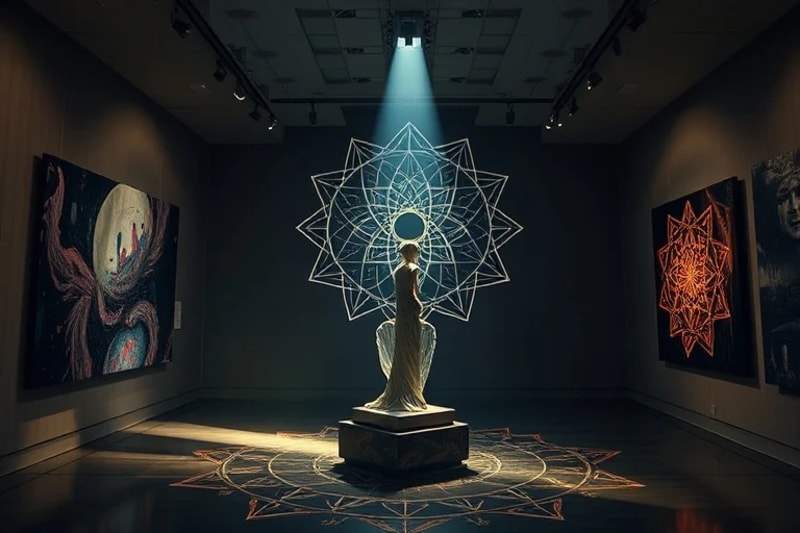
Exploring the interplay of hidden symbols and contemporary aesthetics in visual media.
Table of Contents
- Historical Roots: Esotericism and Art
- Key Esoteric Traditions Influencing Modern Art
- Decoding Common Esoteric Symbols
- Artists and Their Esoteric Inspirations
- The Viewer as Interpreter: Engaging with Esoteric Art
- Contemporary Expressions: New Frontiers in Esoteric Art
Historical Roots: Esotericism and Art
The connection between esoteric thought and artistic creation is not a modern phenomenon. Throughout history, artists have often served as conduits for spiritual and mystical ideas, embedding them into their works. From ancient Egyptian hieroglyphs to medieval alchemical manuscripts, symbols have been used to transmit knowledge that was often considered sacred or hidden from the uninitiated. The Renaissance, for instance, saw a resurgence of Neoplatonism and Hermeticism, influencing artists like Botticelli and Leonardo da Vinci, who incorporated complex allegories and symbolic geometries into their masterpieces.
The late 19th and early 20th centuries marked a pivotal period. As traditional religious frameworks began to wane in influence, many artists turned to alternative spiritualities, including Theosophy, Rosicrucianism, and various forms of occultism. These movements offered new ways of understanding the cosmos, human consciousness, and the nature of reality, providing a rich lexicon of symbols and concepts for artists seeking to express the ineffable. This shift laid the groundwork for the profound impact of esotericism on modern art movements.
Key Esoteric Traditions Influencing Modern Art
Several esoteric traditions have profoundly shaped modern art, offering artists a framework for exploring abstract concepts and spiritual dimensions. These traditions often share common themes such as transformation, cosmic order, and the hidden unity of all things.
- Theosophy: A spiritual movement founded by Helena Blavatsky, Theosophy emphasized universal brotherhood, the study of ancient religions and sciences, and the investigation of the hidden laws of nature. Its focus on spiritual evolution, cosmic planes, and the symbolic representation of divine principles deeply influenced early abstract artists like Wassily Kandinsky and Piet Mondrian, who sought to express spiritual realities beyond the visible world.
- Alchemy: More than just a proto-science, alchemy was a spiritual discipline aimed at transmuting base metals into gold, symbolizing the transformation of the self from a mundane state to an enlightened one. Its intricate symbolism of processes like dissolution, coagulation, and conjunction, along with its rich iconography of vessels, elements, and mythical creatures, has appeared in the works of Surrealists and contemporary artists exploring themes of psychological transformation and material change.
- Astrology: The study of celestial bodies and their influence on earthly events and human personality has provided a vast symbolic language. Planetary archetypes, zodiacal signs, and cosmic alignments offer artists a means to explore fate, destiny, character, and universal cycles. Understanding the planets in astrology can reveal layers of meaning in artworks that subtly reference these cosmic influences.
- Jungian Psychology: Carl Jung's theories of the collective unconscious, archetypes, and individuation resonate strongly with esoteric concepts. His work provided a psychological lens through which artists could explore universal symbols and myths, often leading to deeply personal yet universally resonant expressions. The concept of shadow work and planetary archetypes in astro-psychology offers a modern framework for understanding these deep psychological and symbolic connections.
- Kabbalah: A mystical tradition within Judaism, Kabbalah explores the nature of the divine and the universe through complex symbolic systems, particularly the Tree of Life. Its intricate diagrams and numerological associations have inspired artists seeking to represent cosmic structure, divine emanations, and the path to spiritual enlightenment.
A conceptual still-life illustrating the tools and texts of esoteric study.
Decoding Common Esoteric Symbols
Many symbols recur across different esoteric traditions and find their way into modern art. Recognizing these can significantly enhance the viewer's understanding.
- The Circle and Sphere: Representing wholeness, eternity, unity, and the cosmos. Often appears as a mandala or a cosmic egg.
- The Triangle: Symbolizes trinity (mind, body, spirit), manifestation, or the divine. Pointing upwards, it can signify aspiration or fire; downwards, water or introspection.
- The Square: Represents stability, the material world, earth, and foundation.
- The Spiral: Denotes evolution, growth, cosmic energy, and the journey inward or outward.
- The Serpent/Dragon: A complex symbol of transformation, rebirth, wisdom, healing, and primal energy.
- The Eye: Often depicted as the "All-Seeing Eye," symbolizing divine omniscience, spiritual awakening, or inner vision.
- Geometric Forms: Sacred geometry, such as the Flower of Life or Metatron's Cube, represents the underlying structure of the universe.
- Colors: Specific colors carry symbolic weight (e.g., gold for divinity, red for passion/transformation, blue for spirituality).
- Numbers: Numerology assigns specific meanings to numbers, which can be subtly embedded in compositions or titles.
Artists often combine these symbols in intricate ways, creating a visual language that communicates on multiple levels. The interpretation is rarely singular, allowing for a rich and personal engagement with the artwork.
Artists and Their Esoteric Inspirations
Many influential modern artists have openly acknowledged or subtly incorporated esoteric themes into their work. Hilma af Klint, a Swedish artist, created abstract paintings decades before Kandinsky, driven by her spiritualist beliefs and Theosophical studies. Her works were intended to represent spiritual concepts and cosmic laws, often featuring geometric forms and vibrant colors imbued with specific meanings.
The Surrealists, including Salvador Dalí and René Magritte, frequently delved into dreams, the subconscious, and alchemical imagery, reflecting Jungian archetypes and the mysteries of the human psyche. Their art aimed to unlock hidden realities and challenge conventional perceptions. Even artists like Jackson Pollock, through his spontaneous and energetic drip paintings, can be seen as channeling a form of primal, universal energy, echoing the concept of vibrational linguistics where intention and energy create form.
The Viewer as Interpreter: Engaging with Esoteric Art
Engaging with esoteric symbolism in modern art transforms the viewing experience from passive observation to active interpretation. It invites the viewer to become a participant in the decoding process, using intuition, knowledge of symbolic languages, and personal reflection. This active engagement can lead to profound insights, not just about the artwork, but about one's own inner world and connection to universal themes.
To fully appreciate such art, one might need to cultivate a certain openness to non-rational modes of understanding. This includes recognizing that symbols can have multiple layers of meaning and that their impact is often felt on an emotional and intuitive level, rather than purely intellectual. The journey of decoding esoteric art is akin to a meditative practice, where mindfulness and deeper meditation can enhance perception and understanding.
An abstract representation of interconnectedness through glowing lines and ancient symbols.
Contemporary Expressions: New Frontiers in Esoteric Art
In the 21st century, esoteric symbolism continues to evolve within modern art, adapting to new technologies and cultural contexts. Digital art, immersive installations, and performance art now offer novel platforms for exploring mystical themes. Artists use algorithms to generate sacred geometry, virtual reality to create otherworldly landscapes, and interactive elements to engage viewers in a direct, experiential encounter with symbolic narratives.
The renewed interest in spirituality, holistic well-being, and alternative philosophies ensures that esoteric symbolism will remain a vital and dynamic force in artistic expression. As society grapples with complex global challenges, artists continue to draw upon these ancient wisdom traditions to offer perspectives on interconnectedness, transformation, and the enduring search for meaning in a rapidly changing world.
Ultimately, esoteric symbolism in modern art serves as a bridge between the visible and the invisible, the material and the spiritual. It invites us to look deeper, to question, and to connect with the universal currents of human experience that transcend time and culture.
Explore More Esoteric Insights
Source: Hybrid content assisted by AI and human editorial supervision.


Comments
Post a Comment