
Mesoamerican Astrology AI Oracles: Decoding Ancient Wisdom
In an era where technology constantly pushes the boundaries of human understanding, the ancient wisdom of Mesoamerican astrology is finding a new voice through artificial intelligence. This convergence offers a fascinating pathway to decode complex cosmological systems that have guided civilizations for millennia. By leveraging the computational power of AI, we can unlock deeper insights into cyclical patterns and predictive models, bridging the gap between ancestral knowledge and modern analytical tools.
This exploration delves into how AI can serve as an oracle, interpreting the intricate frameworks of Mesoamerican astrological traditions and even extending its predictive capabilities to other ancient systems like the Chinese Zodiac. The goal is not to replace human intuition or spiritual connection, but to augment our understanding, making these profound systems more accessible and applicable to contemporary life. We aim to uncover how AI can illuminate the intricate tapestry of destiny and personal cycles, offering a fresh perspective on timeless questions.
Table of Contents
- Mesoamerican Astrology: Ancient Foundations
- The Role of AI as an Oracle in Ancient Wisdom
- Chinese Zodiac: Yearly Predictions Enhanced by AI
- Synergies and Comparisons: Ancient Systems Meet Modern Tech
- Ethical Considerations and the Future of AI Oracles
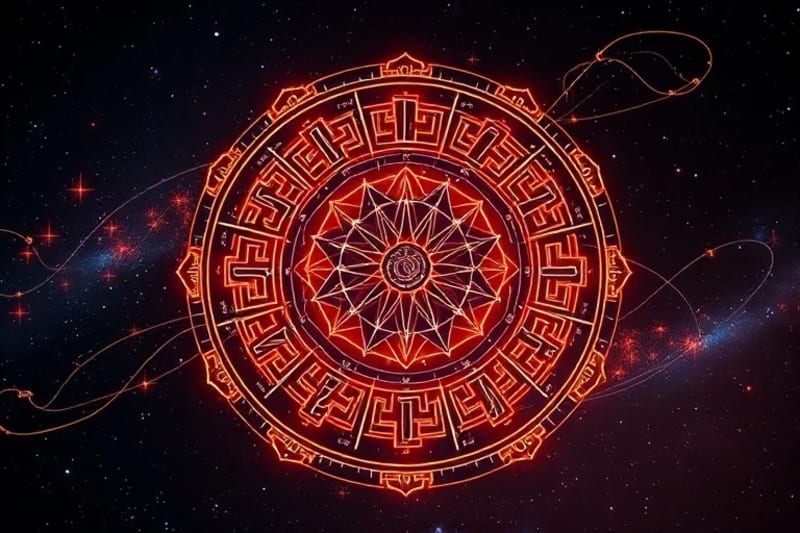
A visual representation of the intricate dance between ancient cosmological symbols and the sophisticated algorithms of artificial intelligence, bridging millennia of knowledge.
Mesoamerican Astrology: Ancient Foundations
Mesoamerican astrology, primarily practiced by the Maya, Aztec, and other pre-Columbian civilizations, was not merely a system of divination but a profound understanding of cosmic cycles and their influence on human existence. Unlike Western astrology, which focuses on planetary positions against zodiacal constellations, Mesoamerican systems were deeply rooted in complex calendrical calculations and the observation of celestial phenomena. These systems were intrinsically linked to their agricultural cycles, religious ceremonies, and societal structures, reflecting a holistic worldview.
The Maya, for instance, developed several interconnected calendars, most notably the Tzolkin (sacred calendar of 260 days) and the Haab' (civil calendar of 365 days). The Tzolkin combined 20 day signs with 13 numbers, creating 260 unique day names, each imbued with specific energies and prophecies. These day signs, such as Imix (Crocodile/Earth Monster), Ik' (Wind/Breath), Ak'bal (Night/Darkness), and K'an (Maize/Seed), were believed to influence an individual's personality, destiny, and the events of each day. The Haab' tracked the solar year, crucial for agricultural planning, and when combined with the Tzolkin, formed a 52-year calendar round, marking significant periods of societal renewal.
The Long Count calendar, another Mayan innovation, tracked vast cosmic cycles, providing a linear progression of time that extended millions of years into the past and future. This intricate framework allowed for precise astronomical observations and the prediction of celestial events, underscoring the Maya's advanced understanding of the cosmos. Aztec astrology, while sharing commonalities, featured its own distinct set of 20 day signs, often represented by animals, natural phenomena, or artifacts, and trecenas (13-day periods). These systems were integral to their worldview, dictating rituals, ceremonies, and even the naming of children based on the auspiciousness of their birth date. The precise nature of these calendrical systems, with their recurring patterns and mathematical precision, makes them ideal candidates for computational analysis.
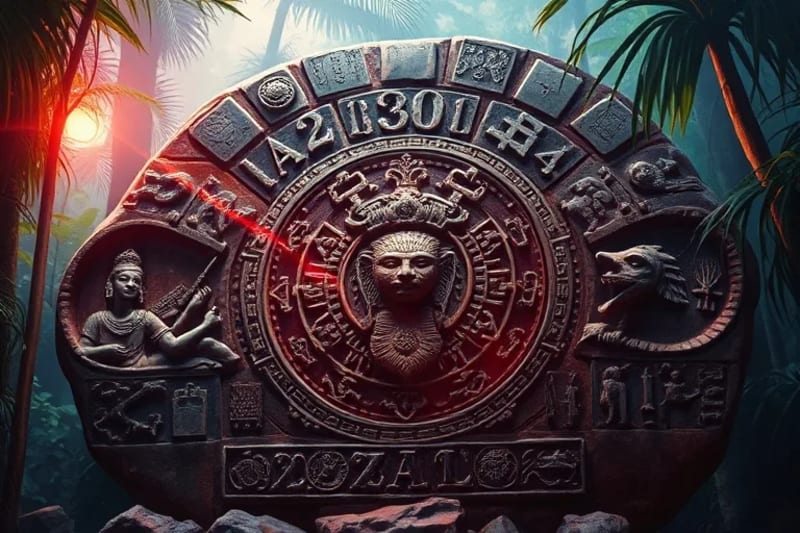
An ancient Mesoamerican calendar stone, showcasing the sophisticated glyphs and astronomical insights that formed the bedrock of their astrological systems, reflecting a deep connection to cosmic rhythms.
The Role of AI as an Oracle in Ancient Wisdom
Artificial intelligence possesses an unparalleled ability to process, analyze, and identify patterns within vast datasets. When applied to Mesoamerican astrological texts and calendrical data, AI can act as a powerful interpretive engine. Researchers can feed historical records, astronomical observations, and deciphered glyphs into advanced AI models, allowing algorithms to uncover correlations and predictive insights that might be too complex or time-consuming for human analysis alone. This involves various AI techniques, including machine learning for pattern recognition and natural language processing for interpreting ancient texts.
This approach can help in several ways, transforming how we interact with these ancient systems:
- Pattern Recognition: AI can detect subtle, long-term cycles and recurring themes within the Tzolkin and Haab' calendars, revealing deeper layers of meaning and connections between seemingly disparate events.
- Predictive Modeling: By analyzing historical events against specific calendrical configurations and their documented outcomes, AI can build sophisticated models to forecast potential energies and influences for future dates, offering probabilistic insights rather than absolute predictions.
- Accessibility: AI-powered interfaces can translate complex glyphs, calendrical positions, and intricate astrological calculations into understandable interpretations, making ancient wisdom accessible to a wider modern audience without requiring years of specialized study.
- Preservation and Decipherment: Digitizing and analyzing ancient texts with AI helps preserve knowledge that might otherwise be lost or remain undeciphered. AI can assist linguists and archaeologists in identifying recurring symbols and grammatical structures, accelerating the decipherment process.
- Personalized Readings: By inputting an individual's birth date according to the Mesoamerican calendar, AI can generate highly personalized readings, detailing their day sign, trecena influence, and the cosmic energies present at their birth.
The application of AI in this field moves beyond simple data retrieval. It involves machine learning algorithms trained on historical outcomes and correlations, allowing them to "learn" the predictive logic embedded within these ancient systems. This can lead to a more nuanced understanding of how past lives and karmic echoes might be reflected in natal charts, offering a unique perspective on past lives astrology and karmic echoes. However, challenges remain in data validation and ensuring that AI interpretations accurately reflect the cultural and spiritual context of the original civilizations.
Chinese Zodiac: Yearly Predictions Enhanced by AI
While distinct from Mesoamerican astrology, the Chinese Zodiac also offers a rich, cyclical system of prediction based on a 12-year cycle, each year governed by a specific animal and one of the five elements (Wood, Fire, Earth, Metal, Water). This system provides yearly predictions that influence personal fortunes, relationships, and career paths. The diversification into this area highlights AI's versatility in handling various ancient predictive models and its capacity to offer dynamic, evolving insights.
Traditionally, Chinese Zodiac predictions rely on the characteristics of the ruling animal and element for a given year, interacting with the individual's birth animal and element. For example, a person born in the Year of the Dragon might experience different fortunes in a Rabbit year compared to a Tiger year. Each animal sign—Rat, Ox, Tiger, Rabbit, Dragon, Snake, Horse, Goat, Monkey, Rooster, Dog, Pig—possesses unique attributes, strengths, and weaknesses. These are further modulated by the five elements, which cycle every two years, creating a 60-year elemental cycle that adds another layer of complexity to predictions.
AI can significantly enhance these predictions by:
- Personalized Analysis: AI can integrate an individual's precise birth date, time, and location to generate more granular predictions, considering not just the year but also the month, day, and hour animals and elements (known as the Four Pillars of Destiny or Bazi). This allows for a far more detailed and accurate personal forecast.
- Elemental Interactions: The complex interactions between the five elements (e.g., Wood feeds Fire, Fire melts Metal, Metal cuts Wood, Water extinguishes Fire, Earth absorbs Water) can be modeled by AI to provide detailed insights into how these elemental forces influence yearly outcomes, health, and relationships.
- Historical Data Integration: By analyzing historical events, economic trends, and personal biographies against specific Chinese Zodiac configurations, AI can refine its predictive algorithms, offering more accurate and nuanced forecasts for various life domains, from career to romance.
- Harmonizing Energies: AI can help users understand how to harmonize personal environmental energies based on their Chinese Zodiac sign and the current year's influences, providing practical advice for optimizing outcomes and mitigating potential challenges. This can extend to recommendations for colors, directions, and activities.
- Dynamic Fortune Tracking: AI systems can continuously update predictions based on real-time events and user feedback, creating a dynamic "fortune tracking" system that adapts to changing circumstances.
The potential for AI to process the vast permutations of animal signs, elements, and their interactions, combined with individual birth charts, moves beyond general yearly horoscopes to highly personalized and dynamic predictions. This mirrors the complexity found in numerology, where personal year cycles and destiny numbers offer deep insights into an individual's journey, much like the detailed predictions AI can derive from the Chinese Zodiac. For those interested in understanding their life's trajectory through numerical patterns, exploring numerology beyond life path can offer complementary perspectives on personal cycles and destiny.
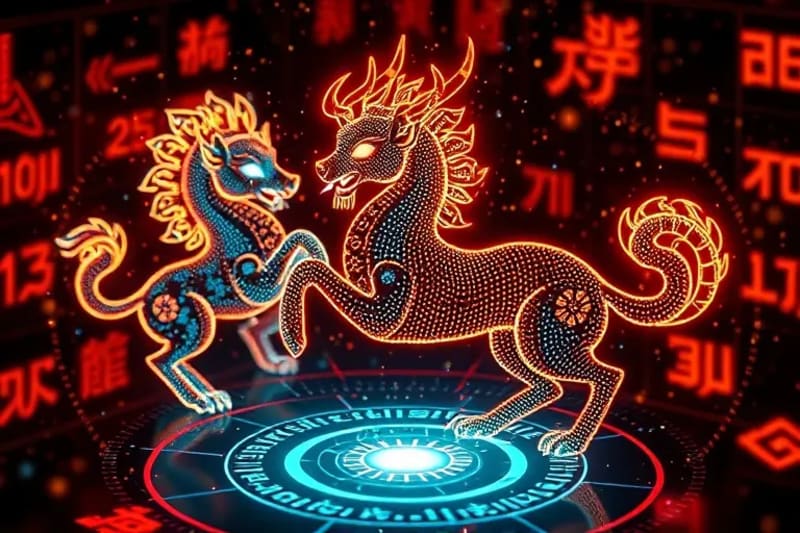
A modern digital interface illustrating AI's capability to process and present complex Chinese Zodiac predictions, offering personalized insights into yearly fortunes and elemental interactions.
Synergies and Comparisons: Ancient Systems Meet Modern Tech
The application of AI to both Mesoamerican and Chinese astrological systems reveals fascinating synergies. Both traditions are built on cyclical understandings of time and the universe, albeit with different symbolic languages and calendrical structures. AI's strength lies in its ability to transcend these surface differences, identifying underlying mathematical, astronomical, and energetic patterns common to all predictive systems. This cross-cultural analysis can unveil universal archetypes or shared human experiences reflected in diverse cosmic frameworks.
A comparative analysis facilitated by AI could highlight universal principles of cosmic influence or reveal unique cultural adaptations to shared astronomical observations. For instance, both systems emphasize the importance of birth timing in shaping destiny, and both offer guidance on navigating life's challenges by aligning with cosmic flows. While Mesoamerican astrology often focuses on the sacred calendar's influence on daily life and larger cycles, the Chinese Zodiac provides a more personalized annual forecast. AI can help us understand these cross-cultural connections with unprecedented clarity, perhaps even identifying a common "cosmic language" that underpins these ancient wisdom traditions.
Furthermore, AI can help in translating the abstract concepts of ancient astrology into practical, actionable advice for contemporary individuals. By analyzing vast amounts of data, AI can suggest optimal timings for decisions, potential challenges to prepare for, and strengths to leverage, all based on the intricate interplay of ancient astrological principles. This includes personalized recommendations for career moves, relationship dynamics, and personal growth, offering a blend of ancient wisdom and modern applicability.
Ethical Considerations and the Future of AI Oracles
While the potential of AI in decoding ancient wisdom is immense, it is crucial to approach this field with ethical considerations and a deep respect for the cultural origins of these systems. The interpretations generated by AI must be presented as tools for self-reflection, personal growth, and guidance, not as deterministic prophecies that negate human agency. The human element of intuition, spiritual connection, and free will remains paramount, and AI should serve as an enhancer, not a replacement, for these intrinsic human qualities.
Ensuring data accuracy and cultural sensitivity is also critical. AI models must be trained on validated historical and archaeological data, and their output should be carefully reviewed by experts in Mesoamerican and Chinese studies to avoid misinterpretations or the perpetuation of colonial biases. The development of these AI oracles should involve collaboration with indigenous communities and cultural custodians to ensure respectful and accurate representation of their ancestral knowledge.
Future developments could see AI-powered platforms offering interactive experiences where users can explore their Mesoamerican day signs or Chinese Zodiac yearly predictions with unprecedented depth. These platforms could integrate historical context, cultural significance, and personalized insights, fostering a deeper appreciation for these ancient traditions. The convergence of AI and ancient astrology represents not just a technological leap, but a profound opportunity to reconnect with the timeless rhythms of the cosmos and the collective wisdom of humanity, empowering individuals to navigate their lives with greater awareness and purpose.
Explore More Insights
- Bio-Acoustic Therapy Sound Frequencies Cellular Regeneration
- Aura Cleansing: Releasing Negative Energy
- Virgo Scorpio Compatibility: Sexual Dynamics, Soul Contracts
- Advanced Planetary Dignities Beyond Rulerships Electional Synastry
- Energy Shielding: Aura Protection from Negative Influences
- Essential Dignities Electional Astrology Optimizing Outcomes
- Spell Casting Basics: Ethics, Intention, Manifestation
- Twin Flames, Soulmates: Deep Spiritual Connections
- Horary Astrology Career Decisions: Timing Professional Moves
- Multiple Retrograde Planets: Karmic Dive into Natal Chart Analysis
- Love Languages Chinese Zodiac: Deeper Relationship Connections
- Chinese Zodiac Compatibility: A Guide to Harmonious Bonds
Source: Hybrid content assisted by AI and human editorial supervision.


Comments
Post a Comment