
Ancient Celestial Mechanics: Lost Cosmic Narratives
The study of celestial mechanics, the branch of astronomy that deals with the motions of celestial objects, might seem like a modern scientific endeavor. However, its roots stretch back into the mists of antiquity, forming a cornerstone of knowledge for numerous ancient civilizations. Long before telescopes and advanced mathematical models, our ancestors meticulously observed the heavens, charting the movements of stars, planets, and other cosmic phenomena with astonishing precision.
These early observations were not merely academic; they were deeply interwoven with religious beliefs, agricultural practices, navigation, and the very fabric of societal organization. From the deserts of Mesopotamia to the jungles of Mesoamerica, ancient cultures developed sophisticated systems to track celestial cycles, interpreting them as divine messages or practical guides for earthly affairs. This article delves into the fascinating world of ancient celestial mechanics, exploring the lost knowledge and cosmic narratives that shaped these remarkable civilizations.
Table of Contents
- Mesopotamia: The Cradle of Astronomical Observation
- Ancient Egypt: Celestial Rhythms and the Nile
- The Mayan Civilization: Precision in the Jungle
- Ancient Greece: Philosophical Inquiry and Geocentric Models
- Other Ancient Traditions: China and India
- Cosmic Narratives: Impact on Culture and Beliefs
- Unearthing Lost Knowledge and Modern Relevance
Mesopotamia: The Cradle of Astronomical Observation
Mesopotamia, often referred to as the "cradle of civilization," was home to some of the earliest and most influential astronomical observers. The Sumerians, Babylonians, and Assyrians, inhabiting the fertile crescent between the Tigris and Euphrates rivers, developed sophisticated systems for tracking celestial bodies. Their motivations were primarily astrological and religious, believing that the movements of the heavens directly influenced earthly events and the fates of kings and empires.
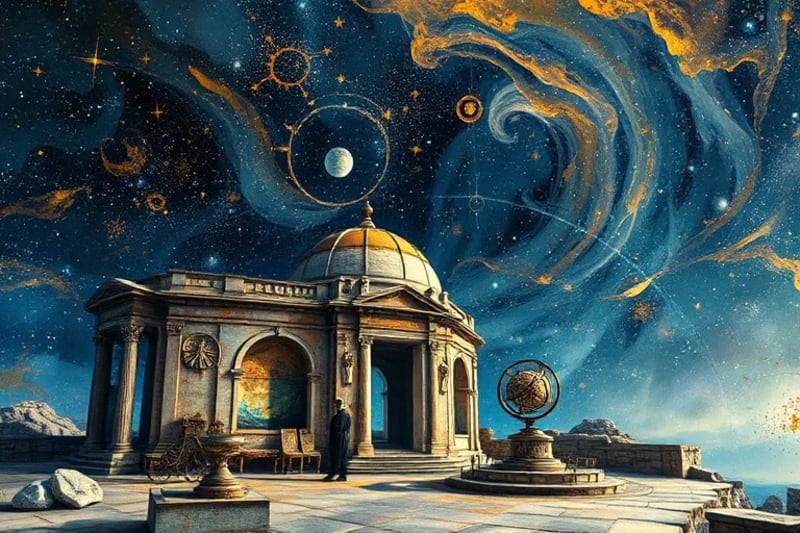 Depiction of ancient astronomers observing the night sky, symbolizing the profound connection between early civilizations and celestial mechanics.
This conceptual render, generated by AI, illustrates the dedicated pursuit of astronomical knowledge in antiquity, drawing inspiration from historical accounts of early observatories and their tools.
Babylonian astronomers were particularly renowned for their detailed records and mathematical prowess. They created extensive star catalogs and developed advanced arithmetic methods to predict lunar and solar eclipses, as well as the positions of planets. Their sexagesimal (base-60) number system, which we still use today for time and angles, was instrumental in these calculations. They meticulously documented phenomena such as the rising and setting of stars, the phases of the Moon, and the retrograde motion of planets, often inscribing their findings on clay tablets.
The ziggurats, massive stepped pyramids, often served as observatories, providing elevated platforms for clearer views of the horizon. These structures were not just temples but also centers of scientific and spiritual learning, where priests and scribes interpreted celestial omens. The Babylonians' understanding of celestial cycles, particularly the Saros cycle for eclipses, was remarkably accurate for their time, demonstrating a deep grasp of periodicity in astronomical events. Their work laid foundational concepts that would later influence Greek and Indian astronomy, highlighting the interconnectedness of ancient knowledge systems. For more on ancient cosmic symbolism, explore Astrology Art Literature: Cosmic Symbolism Ages.
Ancient Egypt: Celestial Rhythms and the Nile
In ancient Egypt, celestial mechanics was intrinsically linked to the annual flooding of the Nile River, which was vital for agriculture and the survival of their civilization. The heliacal rising of Sirius (Sopdet), the brightest star in the night sky, coincided with the onset of the Nile's inundation, signaling the beginning of the new year. This observation was so critical that it formed the basis of their civil calendar, one of the most accurate calendars of the ancient world.
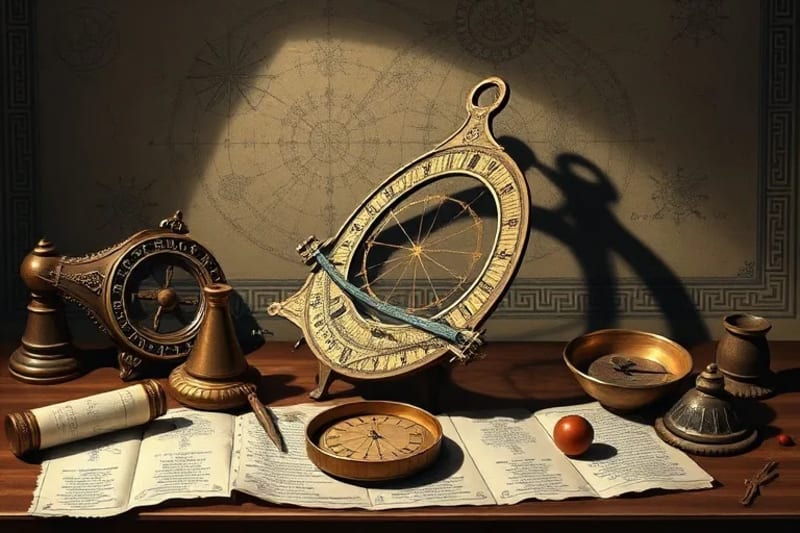 A collection of ancient astronomical tools, reflecting the ingenuity and dedication of early observers to map the heavens.
This digital painting, created by AI, imagines the instruments used by ancient astronomers to track celestial movements and predict terrestrial events, blending historical accuracy with artistic interpretation.
Egyptian temples and pyramids were often astronomically aligned, reflecting their deep reverence for the cosmos. For example, the Great Pyramid of Giza is precisely aligned with the cardinal directions, and its shafts are thought to point towards specific stars like Thuban (then the North Star) and Orion. These alignments were not accidental; they were deliberate expressions of their understanding of celestial motions and their desire to connect earthly structures with the divine order of the universe.
Their astronomical knowledge was also evident in their tomb decorations, which often depicted constellations and planetary deities. The "decans," groups of stars that rose sequentially throughout the night, were used to tell time and were associated with specific deities and astrological influences. This system of decans played a significant role in their religious practices and funerary rituals, guiding the deceased through the afterlife. The intricate relationship between celestial observations and daily life in Egypt underscores the holistic nature of ancient knowledge. You can learn more about these divisions in Decans in Astrology: Deeper Layers of Your Sun Sign.
The Mayan Civilization: Precision in the Jungle
Across the Atlantic, the Mayan civilization of Mesoamerica developed an equally, if not more, complex understanding of celestial mechanics. Without the aid of metal tools or the wheel, they constructed monumental cities with sophisticated observatories, demonstrating an unparalleled dedication to astronomical observation. Their primary motivation was to understand and predict cosmic cycles, which they believed governed human destiny and agricultural success.
The Mayans developed multiple intricate calendar systems, including the 260-day Tzolkin (sacred calendar) and the 365-day Haab' (civil calendar), which intermeshed to form a 52-year calendar round. Beyond these, their Long Count calendar tracked vast spans of time, reflecting their deep understanding of cyclical cosmic events. Their precision in calculating the length of the solar year and the synodic period of Venus was astonishing, often surpassing the accuracy of contemporary European astronomers.
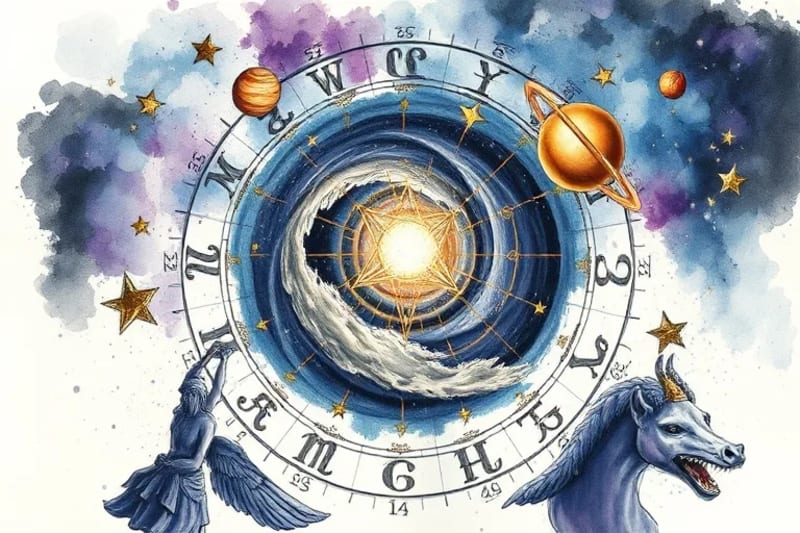 An artistic interpretation of the cosmic narratives woven into the fabric of ancient civilizations, connecting celestial bodies with mythology.
This AI-generated watercolor illustration captures the mystical and spiritual dimensions of ancient celestial observations, blending abstract forms with cultural symbols to represent cosmic understanding.
The Dresden Codex, one of the few surviving Mayan books, contains detailed astronomical tables, particularly those related to Venus. The Mayans tracked Venus's 584-day cycle with remarkable accuracy, understanding its importance as both the Morning and Evening Star. Buildings like El Caracol at Chichen Itza served as astronomical observatories, with windows and doors aligned to significant celestial events, such as solstices, equinoxes, and the extremes of Venus's appearance. Their cosmic narratives were deeply integrated into their mythology, with gods and heroes often associated with celestial bodies and their movements.
Ancient Greece: Philosophical Inquiry and Geocentric Models
Ancient Greek civilization inherited much of its astronomical knowledge from the Babylonians and Egyptians, but they transformed it through their unique philosophical and mathematical approaches. While practical prediction was still important, Greek thinkers began to seek underlying principles and geometric explanations for celestial motions. This shift marked a crucial step towards theoretical astronomy.
Early Greek philosophers like Thales of Miletus are credited with predicting eclipses, though the accuracy of these predictions is debated. Pythagoras and his followers proposed a spherical Earth and a cosmic harmony, where celestial bodies moved in perfect circles. Plato introduced the idea of uniform circular motion for celestial objects, a concept that would dominate Western astronomy for nearly two millennia.
Aristotle solidified the geocentric model, placing the Earth at the center of the universe, surrounded by concentric spheres carrying the Moon, Sun, planets, and fixed stars. This model, though ultimately incorrect, provided a coherent framework that aligned with philosophical and theological views of the time. Later, Hellenistic astronomers like Hipparchus made significant contributions, developing trigonometry and creating detailed star catalogs. He also discovered the precession of the equinoxes, a slow wobble in Earth's axis, demonstrating an advanced understanding of long-term celestial mechanics.
Ptolemy, in the 2nd century CE, synthesized and expanded upon earlier Greek knowledge in his monumental work, the Almagest. His geocentric model, incorporating epicycles and deferents to explain the retrograde motion of planets, became the authoritative astronomical text for over 1400 years. The Greek emphasis on geometric models and philosophical reasoning, even when leading to incorrect conclusions, laid the groundwork for future scientific inquiry. Their legacy profoundly influenced the development of astronomy in the Islamic world and later in Renaissance Europe.
Other Ancient Traditions: China and India
While Mesopotamia, Egypt, and Greece are often highlighted, many other ancient civilizations also made significant contributions to celestial mechanics. China, for instance, boasts one of the longest continuous traditions of astronomical observation in the world. Chinese astronomers meticulously recorded supernovae, comets, and solar eclipses for millennia, often with specific political and astrological interpretations.
They developed sophisticated armillary spheres and water-powered clocks to track celestial movements. Their calendar systems were crucial for agricultural planning and imperial legitimacy. Unlike the Greeks, Chinese astronomy focused more on empirical observation and detailed record-keeping, rather than theoretical models. They were among the first to develop a star catalog and accurately determine the length of the year.
In ancient India, astronomical knowledge was deeply intertwined with Vedic texts and the development of Jyotish, or Vedic astrology. Indian astronomers developed sophisticated mathematical techniques, including early forms of trigonometry, to calculate planetary positions and predict eclipses. Aryabhata, in the 5th century CE, proposed a heliocentric model, long before Copernicus, and accurately calculated the Earth's circumference and the length of the sidereal year. His work, along with that of Brahmagupta and Bhaskara II, demonstrates a profound understanding of celestial mechanics, influencing later Arabic and European astronomy.
Cosmic Narratives: Impact on Culture and Beliefs
The observations and calculations of celestial mechanics were not abstract scientific pursuits for ancient civilizations. They were foundational to their cosmic narratives, shaping their understanding of the universe, their place within it, and their daily lives. The heavens were seen as a living tapestry of divine will, omens, and cyclical patterns that mirrored earthly existence.
Consider the following impacts:
- Religion and Mythology: Celestial bodies were often deified or associated with powerful gods and goddesses. The Sun, Moon, and planets became central figures in creation myths, heroic sagas, and religious rituals. Eclipses, comets, and supernovae were interpreted as divine messages or portents of significant events.
- Calendar Systems: The ability to track celestial cycles allowed for the creation of accurate calendars, essential for agriculture, religious festivals, and civic administration. The timing of planting and harvesting, for example, was often dictated by the positions of specific stars or the phases of the Moon.
- Navigation: For seafaring cultures, knowledge of the stars was indispensable for navigation. Polynesian navigators, for instance, used complex star compasses and their understanding of celestial movements to traverse vast stretches of the Pacific Ocean.
- Architecture and Urban Planning: Many ancient structures, from temples to entire cities, were aligned with astronomical events. These alignments served both practical purposes (e.g., marking solstices) and symbolic ones, connecting human constructions with the cosmic order.
- Governance and Power: Rulers often derived their legitimacy from their connection to the divine cosmos. Astrologers and astronomers held positions of immense power, advising kings on auspicious times for battles, coronations, and other critical decisions.
Unearthing Lost Knowledge and Modern Relevance
Much of the knowledge of ancient celestial mechanics was lost over time, particularly during periods of societal collapse or the destruction of libraries and records. However, through archaeological discoveries, the decipherment of ancient texts, and the dedicated work of historians and astronomers, we continue to unearth these remarkable insights. The study of archaeoastronomy, for example, investigates the astronomical practices of prehistoric and ancient cultures by examining their artifacts and structures.
The precision of ancient observations, often achieved with seemingly rudimentary tools, continues to astound modern scientists. It highlights the power of sustained, meticulous observation and the human intellect's capacity to discern complex patterns in the natural world. While their cosmic models were often different from our current scientific understanding, the underlying drive to comprehend the universe remains a timeless human endeavor.
In a world increasingly reliant on technology, revisiting these ancient perspectives offers valuable lessons. It reminds us of the deep connection between humanity and the cosmos, a connection that fueled scientific inquiry, spiritual belief, and cultural development for millennia. The cosmic narratives of our ancestors, born from their diligent study of celestial mechanics, continue to resonate, offering a rich tapestry of human ingenuity and wonder. Understanding these historical perspectives can also deepen our appreciation for modern advancements in fields like Holographic Universe Manifestation Quantum Reality Principles, showing a continuous human quest for ultimate reality.
Explore More Cosmic Insights
- Composite Chart Synastry: Relationship Entity Explained
- Elemental Chinese Zodiac Baby Names: A Comprehensive Guide
- Advanced Synastry Composite Charts Davison Soul Contract
- Solar Return Chart: Annual Growth Blueprint
- Snake Tiger Compatibility: Navigating Complex Zodiac Dynamics
- Medical Astrology: Chronic Disease Predispositions, Planetary Debilities
- Spiritual Cleanse Rituals: Clearing Negative Energy
- Lunar Wisdom Chinese Zodiac Aligning Nature Rhythms
- Astro-Economics: Predicting Financial Markets Planetary Cycles
- Urban Geomancy Lunar Mansions: Celestial Well-being City Dwellings
- Inner Planet Retrogrades Natal Chart Interpretation: Deep Dive
- Lilith Houses Karmic Lessons Astrology Insights
- Legado Ábaco Griego: Antigüedad Computación Cuántica
- Tarot Arquetípico Junguiano: Integrando Sombra, Luz
- Casas Derivadas Astrología: Relaciones Complejas Eventos Futuros
- La Jerarquía Celestial Arcángeles: Funciones y Atributos
Source: Hybrid content assisted by AI and human editorial supervision.


Comments
Post a Comment