
Astro-Archeology Consciousness: Unearthing Ancient Esoteric Symbolism
Astro-Archeology of Consciousness: Unearthing Ancient Civilizations' Esoteric Symbolism
The vast tapestry of human history is woven with threads of cosmic wonder and profound spiritual insight. For millennia, ancient civilizations across the globe looked to the heavens not merely as distant lights, but as a living canvas reflecting divine order, destiny, and the very essence of consciousness. Astro-archeology of consciousness emerges as a fascinating interdisciplinary field, seeking to unearth and interpret the esoteric symbolism embedded within ancient structures, texts, and artifacts, revealing how our ancestors perceived and integrated celestial knowledge into their spiritual and societal frameworks. This exploration transcends mere astronomical observation, delving into the philosophical and mystical dimensions that shaped their worldview.
- 1. The Interdisciplinary Lens of Astro-Archeology
- 2. The Dawn of Cosmic Awareness: Ancient Cultures and the Heavens
- 3. Esoteric Symbolism: A Universal Language of the Cosmos
- 4. Case Study: Ancient Egypt and the Stellar Soul
- 5. The Mayan Cosmos: Time, Cycles, and Venus
- 6. Mesopotamian Foundations: Zodiac, Omens, and Divine Will
- 7. The Consciousness Aspect: Inner and Outer Cosmos
- 8. Modern Resonance: Bridging Ancient Wisdom with Contemporary Understanding
- 9. Conclusion: The Enduring Legacy of Cosmic Consciousness
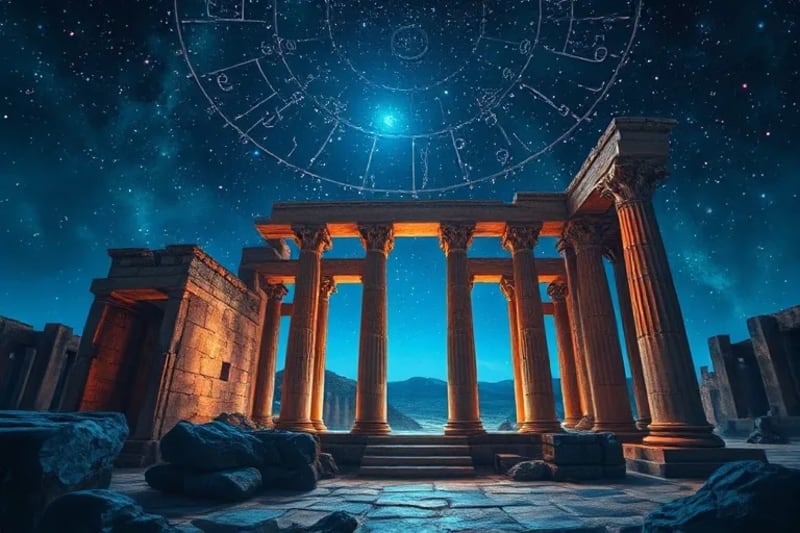
Ancient temple ruins under a cosmic sky, reflecting profound celestial wisdom.
Visual source subject to ecosystem availability: Wikimedia Commons under CC BY-SA 4.0 license or conceptual AI rendering.
1. The Interdisciplinary Lens of Astro-Archeology
Astro-archeology, often referred to as archaeoastronomy, is the study of how ancient people understood the phenomena in the sky, how they used those phenomena, and what role the sky played in their cultures. The "consciousness" aspect expands this field beyond mere alignments and calendar systems, exploring the deeper spiritual, philosophical, and psychological implications of celestial observations. It investigates how cosmic patterns influenced their myths, rituals, societal structures, and ultimately, their collective and individual awareness.
This discipline draws upon a diverse array of fields, including archaeology, anthropology, astronomy, history, religious studies, and psychology. By combining rigorous scientific analysis with a nuanced understanding of cultural contexts, researchers aim to reconstruct the comprehensive cosmic worldview of past societies. It's an attempt to not just see what they saw, but to understand what they felt and believed about the cosmos.
2. The Dawn of Cosmic Awareness: Ancient Cultures and the Heavens
From the earliest megalithic structures like Stonehenge to the intricate temples of Mesoamerica, humanity has consistently sought to align its earthly existence with celestial cycles. These alignments were not random; they were deliberate acts of connecting the terrestrial with the divine, reflecting a profound reverence for the cosmos. The sun's solstices, the moon's phases, and the movements of planets dictated agricultural cycles, religious festivals, and even the timing of significant life events.
Ancient civilizations developed sophisticated observational techniques, often without the aid of modern instruments. Their knowledge was passed down through generations, often encoded in oral traditions, sacred texts, and monumental architecture. This deep connection to the cosmos fostered a sense of interconnectedness, where human life was seen as an integral part of a larger, divine cosmic order. Understanding these celestial influences is key to navigating planetary influences daily, a practice rooted in ancient wisdom.
3. Esoteric Symbolism: A Universal Language of the Cosmos
Esoteric symbolism served as a profound language, allowing ancient cultures to encapsulate complex cosmic and spiritual truths within accessible forms. These symbols, often found in art, architecture, and religious iconography, were not merely decorative; they were mnemonic devices and portals to deeper understanding, accessible to initiates and those who understood their hidden meanings. Examples include the ankh in Egypt, representing life and the union of opposites, or the feathered serpent Quetzalcoatl in Mesoamerica, embodying the union of earth and sky.
The study of sacred geometry and celestial mechanics reveals how these cultures encoded cosmic patterns into their designs. From the golden ratio in temple construction to the specific angles of pyramid faces mirroring astronomical events, these symbols were often mathematical expressions of cosmic harmony. Decoding these symbols allows us to glimpse the sophisticated spiritual science of our ancestors.
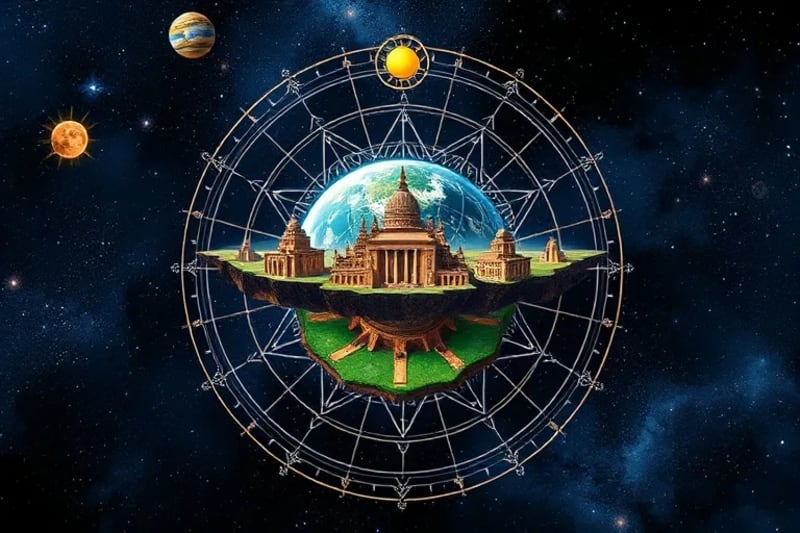
Visual representation of the deep cosmic connections observed and integrated by ancient societies.
4. Case Study: Ancient Egypt and the Stellar Soul
Ancient Egypt provides a compelling example of astro-archeology of consciousness. Their monumental architecture, particularly the pyramids of Giza, exhibits precise alignments with celestial bodies. The shafts within the Great Pyramid, for instance, are believed to align with specific stars like Sirius (Sopdet) and the constellation Orion (Sah), which held immense spiritual significance related to the pharaoh's journey to the afterlife and the rebirth of Osiris.
The Dendera Zodiac, a famous ceiling relief from the Hathor temple at Dendera, depicts the constellations and planets in a circular chart, reflecting a sophisticated understanding of astrological principles. For the Egyptians, the cosmos was not just a physical space but a living entity, and the movements of celestial bodies were direct manifestations of divine will and cosmic order. Their myths, such as the story of Isis and Osiris, were deeply intertwined with astronomical cycles, symbolizing death, resurrection, and the eternal cycle of life.
5. The Mayan Cosmos: Time, Cycles, and Venus
The Maya civilization of Mesoamerica is renowned for its incredibly precise calendars and sophisticated astronomical observatories. Their understanding of time was cyclical, governed by the intricate interplay of several calendars, including the 260-day Tzolkin and the 365-day Haab', which intermeshed to form a 52-year cycle. Beyond these, the Long Count calendar tracked vast epochs, reflecting a profound awareness of cosmic time scales.
Mayan cities like Chichen Itza and Uxmal feature structures meticulously aligned with the sun's equinoxes and solstices, as well as the extreme positions of Venus. The planet Venus held paramount importance for the Maya, associated with warfare, sacrifice, and the deity Kukulcan (Quetzalcoatl). The Dresden Codex, one of the few surviving Mayan books, contains detailed astronomical tables, particularly those tracking Venus, demonstrating their advanced predictive capabilities. This intricate cosmic understanding was integral to their spiritual practices and their perception of individual and collective destiny, much like how one might seek to unlock core identity and life purpose in astrology today.

A conceptual depiction of the scholarly dedication required to unravel the esoteric symbolism of ancient civilizations.
6. Mesopotamian Foundations: Zodiac, Omens, and Divine Will
Mesopotamia, often called the "cradle of civilization," laid many of the foundational elements of what we now recognize as astrology. The Sumerians, Babylonians, and Assyrians meticulously observed the heavens, documenting planetary movements, eclipses, and the appearance of comets. They developed the zodiac system, dividing the ecliptic into twelve segments, each associated with specific constellations and symbolic meanings.
For Mesopotamians, celestial phenomena were direct omens from the gods, influencing earthly events and the fate of kings and empires. Priests and scribes maintained extensive astronomical diaries and omen texts, interpreting the messages from the heavens to advise rulers. This early form of astrology was deeply interwoven with their religious beliefs and political decisions, reflecting a worldview where human destiny was inextricably linked to cosmic events. The detailed study of these ancient records offers insights into the origins of many astrological concepts still in use today.
7. The Consciousness Aspect: Inner and Outer Cosmos
The "consciousness" in astro-archeology of consciousness refers to the profound impact of celestial knowledge on the inner lives and spiritual development of ancient peoples. It's not just about what they observed, but how those observations shaped their understanding of self, soul, and their place in the universe. Many ancient traditions viewed the human being as a microcosm of the macrocosm, believing that the same cosmic forces that governed the stars also resonated within the individual.
This perspective often led to practices aimed at aligning personal consciousness with cosmic rhythms. Rituals, meditations, and even the construction of sacred spaces were designed to facilitate this alignment, fostering spiritual growth and a deeper connection to the divine. The esoteric symbolism served as a guide for this inner journey, mapping out pathways to expanded awareness and enlightenment. For instance, understanding the karmic cycles and ancestral trauma often discussed in practices like shadow work and lunar nodes can be seen as a modern echo of these ancient quests for self-understanding through cosmic lenses.
8. Modern Resonance: Bridging Ancient Wisdom with Contemporary Understanding
In an age increasingly disconnected from natural rhythms, the study of astro-archeology of consciousness offers valuable insights. It reminds us of a time when humanity lived in profound harmony with the cosmos, deriving meaning, guidance, and spiritual sustenance from the celestial sphere. Modern science, through fields like quantum physics and neuroscience, is beginning to explore concepts of interconnectedness and consciousness that resonate with ancient mystical traditions.
The esoteric symbolism unearthed by astro-archeologists can serve as a bridge between ancient wisdom and contemporary spiritual seeking. By deciphering these symbols, we can access alternative ways of understanding reality, fostering a more holistic and integrated view of ourselves and the universe. This interdisciplinary approach encourages us to look beyond purely materialistic interpretations of history and embrace the rich spiritual heritage of our ancestors.
Key takeaways from this field include:
- Holistic Worldview: Ancient cultures integrated astronomy, religion, and daily life seamlessly.
- Symbolic Language: Esoteric symbols were sophisticated tools for encoding and transmitting complex knowledge.
- Consciousness Expansion: Cosmic observations were linked to personal and collective spiritual development.
- Architectural Precision: Sacred structures often served as astronomical observatories and ritual spaces.
- Cyclical Time: A deep understanding of cosmic cycles influenced their perception of time and destiny.
9. Conclusion: The Enduring Legacy of Cosmic Consciousness
Astro-archeology of consciousness is more than just an academic pursuit; it is a journey into the heart of human spiritual evolution. By meticulously examining the remnants of ancient civilizations, we uncover not only their scientific prowess but also their profound spiritual connection to the cosmos. The esoteric symbolism, celestial alignments, and intricate calendars stand as testaments to a time when humanity viewed itself as an intrinsic part of a vast, intelligent universe.
This field invites us to reconsider our own relationship with the heavens, encouraging a renewed sense of wonder and a deeper appreciation for the interconnectedness of all things. As we continue to unearth these ancient cosmic blueprints, we gain invaluable insights into the enduring quest for meaning, consciousness, and our place within the grand cosmic dance.
Related Explorations in Cosmic Wisdom
Delve deeper into the intricate connections between ancient knowledge, celestial mechanics, and personal evolution with these related articles:
- Akashic Records Natal Chart: Soul's Blueprint
- Chakra Balancing: Beginner's Guide to Energy Centers
- Planetary Aspects Inner Child Healing Jungian Archetypes
- Electional Astrology Timing Life Events Success Guide
- Ayurvedic Remedies Planetary Transits Vedic Balance
- Ancient Forgotten Oracles: Celtic Geomancy Karmic Secrets
Source: Hybrid content assisted by AI and human editorial supervision.


Comments
Post a Comment