
Shadow Work Lunar Nodes Ancestral Trauma Karmic Cycles
In the intricate tapestry of human existence, certain threads seem to weave through generations, shaping our experiences and influencing our destinies. These invisible forces often stem from unresolved patterns, emotional burdens, or karmic imprints passed down through family lines, collectively known as ancestral trauma. Modern spiritual and psychological practices increasingly recognize the profound impact of these inherited legacies. Within the realm of karmic astrology, the Lunar Nodes offer a unique lens through which to understand and ultimately integrate these deep-seated patterns, paving the way for profound healing and personal evolution.

A solitary figure delves into deep meditation, connecting with the ethereal energies of ancestral lines and karmic astrological influences within an ancient temple.
This article delves into the synergistic relationship between Shadow Work and the Lunar Nodes, exploring how these powerful tools can be utilized to confront, understand, and integrate ancestral trauma. By shedding light on the hidden aspects of our psyche and the karmic lessons embedded in our birth charts, we can embark on a transformative journey to break free from inherited limitations and embrace our authentic path. Understanding these dynamics is not merely an intellectual exercise; it is a profound invitation to reclaim personal power and foster intergenerational healing.
Table of Contents
- The Essence of Shadow Work: Unveiling the Unseen
- Lunar Nodes: Navigators of Our Karmic Path
- Ancestral Trauma: Echoes in the Natal Chart
- The Synergistic Integration: Shadow Work and Lunar Nodes
- Identifying Ancestral Patterns in Your Birth Chart
- Practical Techniques for Integrating Ancestral Trauma
- Benefits and Challenges of This Profound Journey
- Conclusion: Embracing Your Liberated Legacy
The Essence of Shadow Work: Unveiling the Unseen
Shadow Work, a concept popularized by Swiss psychiatrist Carl Jung, refers to the process of exploring and integrating the unconscious aspects of our personality—the "shadow." This shadow comprises all the parts of ourselves that we have repressed, disowned, or deemed unacceptable, often due to societal conditioning, childhood experiences, or personal trauma. It can include negative traits like anger, jealousy, or insecurity, but also positive qualities such as creativity, power, or joy that we might fear to express.
Engaging in Shadow Work is not about eliminating these parts, but rather about acknowledging their existence, understanding their origins, and integrating them into our conscious awareness. When left unaddressed, the shadow can manifest in various ways, such as self-sabotage, projection onto others, recurring negative patterns, or a persistent feeling of incompleteness. By bringing these hidden aspects into the light, we can achieve greater self-awareness, emotional wholeness, and authentic self-expression.
The process often involves deep introspection, journaling, dream analysis, and confronting uncomfortable truths about oneself. It requires courage and a willingness to face what has been hidden. The ultimate goal is not to become "perfect," but to become whole, embracing all facets of our being, both light and dark. This integration is crucial for genuine personal growth and for breaking cycles that might have been perpetuated unconsciously for generations.
Lunar Nodes: Navigators of Our Karmic Path
In astrology, the Lunar Nodes, also known as the Nodes of Fate or Destiny, are not physical celestial bodies but mathematical points where the Moon's orbit intersects the Ecliptic (the Sun's apparent path around Earth). There are two main nodes: the North Node (Rahu in Vedic astrology) and the South Node (Ketu). These points are always directly opposite each other in the zodiac, meaning if your North Node is in Aries, your South Node is in Libra.
The Lunar Nodes are profoundly significant in karmic astrology, representing our soul's evolutionary journey. The South Node symbolizes our past—our comfort zone, inherited talents, past life experiences, and karmic patterns we bring into this incarnation. It represents what feels familiar, but also where we tend to get stuck or repeat old behaviors. It's the path of least resistance, but not necessarily the path of growth.
Conversely, the North Node represents our future growth, our soul's purpose, and the lessons we are meant to learn in this lifetime. It's often the path of challenge and unfamiliarity, requiring us to step outside our comfort zone. Embracing the qualities of our North Node leads to greater fulfillment, spiritual evolution, and a sense of alignment with our true destiny. The journey from South Node to North Node is the essence of our karmic evolution.
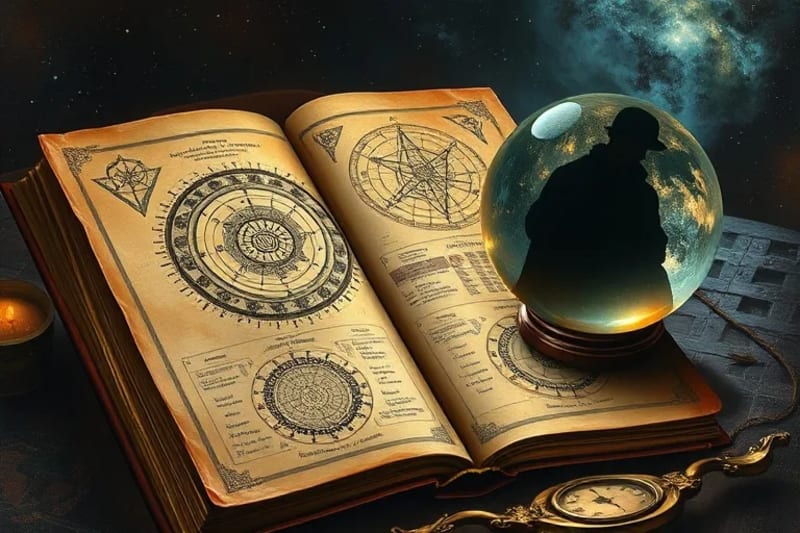
An antique journal, open to pages revealing complex astrological charts and detailed family tree diagrams, sits beside a crystal ball that subtly reflects a shadowy, indistinct human form.
Ancestral Trauma: Echoes in the Natal Chart
Ancestral trauma refers to the psychological and emotional wounds, unresolved conflicts, and behavioral patterns that are passed down through family generations. These can manifest as chronic anxiety, depression, unexplained fears, relationship difficulties, or even physical ailments, without a clear personal origin. Scientific fields like epigenetics are beginning to show how traumatic experiences can leave biological markers that affect gene expression in descendants, providing a biological basis for inherited trauma.
In karmic astrology, ancestral trauma is often deeply intertwined with the South Node. The South Node represents not only our personal past lives but also the collective karma and unresolved issues of our ancestral lineage. The zodiac sign and house placement of the South Node, along with any planets conjunct or aspecting it, can reveal the nature of these inherited patterns and the lessons our ancestors struggled with. For instance, a South Node in Cancer might indicate a family history of emotional dependency or issues related to nurturing and home, while a South Node in Capricorn could point to ancestral struggles with authority, ambition, or societal structures.
Other astrological indicators of ancestral patterns include:
- Saturn: Often associated with karma, lessons, and ancestral burdens. Its placement and aspects can highlight areas where generational patterns need to be addressed.
- Chiron: The Wounded Healer, can point to deep, often inherited, wounds that require healing.
- Fourth House: Represents roots, family, home, and ancestral lineage. Planets or aspects here can shed light on family dynamics and inherited issues.
- Planets in Retrograde: Can indicate unresolved karmic lessons or patterns from the past, potentially ancestral.
The Synergistic Integration: Shadow Work and Lunar Nodes
The true power emerges when Shadow Work is consciously applied to the insights gained from the Lunar Nodes, particularly in the context of ancestral trauma. The South Node's influence often manifests as unconscious patterns—the very "shadow" material that Jung described. These are the inherited behaviors, fears, and coping mechanisms that we adopt without question, believing them to be inherently "us," when in reality, they might be echoes of our ancestors' unresolved struggles.
By engaging in Shadow Work, we actively seek to uncover these unconscious South Node patterns. For example, if your South Node is in Libra, you might have an ancestral pattern of people-pleasing or avoiding conflict at all costs. Shadow Work would involve exploring the hidden fears behind this behavior, the anger or resentment that might be suppressed, and the potential benefits (real or perceived) of maintaining this pattern. This introspection helps to bring the unconscious South Node material into conscious awareness.
Once these shadow aspects are recognized, the integration process begins. Instead of rejecting these inherited traits, we acknowledge their presence and understand their historical context within our family lineage. This allows us to consciously choose how we want to respond, rather than being unconsciously driven by them. This conscious integration is the bridge to the North Node, enabling us to transcend the limitations of the past and step into our true evolutionary potential. It's about transforming ancestral burdens into ancestral wisdom.
A vibrant abstract digital artwork depicts luminous, intertwined threads forming a complex web around two glowing spheres, representing the intricate karmic connections and ancestral lines that shape destiny.
Identifying Ancestral Patterns in Your Birth Chart
To effectively integrate ancestral trauma, the first step is to identify where these patterns might reside within your astrological blueprint. A professional karmic astrologer can provide in-depth analysis, but you can also begin to explore these connections yourself. Here are key areas to examine:
- South Node Sign and House: This is your primary indicator. The sign describes the qualities and behaviors you're naturally inclined towards (often inherited), and the house shows the area of life where these patterns play out. For example, South Node in Gemini in the 3rd House could indicate ancestral patterns of communication issues, gossip, or superficial learning.
- Planets Conjunct the South Node: Any planet within a few degrees of your South Node amplifies its influence and highlights specific ancestral themes. A Venus conjunct South Node might suggest inherited relationship patterns or values.
- Ruler of the South Node: The planet that rules the sign of your South Node (e.g., Mars rules Aries, Venus rules Libra) provides further insight into the nature of the ancestral karma. Its sign and house placement reveal how these themes are expressed.
- Fourth House and its Ruler: As the house of roots and family, its condition, the sign on its cusp, and the aspects to its ruler can reveal much about your family lineage and inherited emotional landscape.
- Saturn's Placement and Aspects: Saturn often points to areas of restriction, fear, or karmic lessons. Its connection to the Nodes or the 4th House can indicate where ancestral burdens are most prominent.
- Chiron's Placement: The sign and house of Chiron can pinpoint deep, often transgenerational, wounds that need healing.
By mapping these points in your natal chart, you can begin to see a narrative of your ancestral journey and identify specific themes that require your conscious attention. This astrological self-discovery acts as a powerful guide for your Shadow Work practice.
Practical Techniques for Integrating Ancestral Trauma
Integrating ancestral trauma through Shadow Work and the Lunar Nodes is a multi-faceted process that combines introspection with conscious action. Here are some practical techniques:
1. Journaling and Self-Inquiry:
- Prompt-Based Reflection: Use prompts related to your South Node and 4th House themes. "What fears or insecurities do I feel that don't seem to originate from my own experiences?" "What patterns do I observe in my family that I unconsciously repeat?"
- Dream Analysis: Pay attention to recurring symbols, characters, or scenarios in your dreams. These can be messages from your unconscious, revealing shadow material or ancestral echoes.
- Active Imagination: Engage in dialogues with the parts of yourself that feel repressed or with symbolic figures that emerge from your introspection.
2. Meditative and Visualization Practices:
- Ancestral Connection Meditations: Visualize your ancestral lineage, sending love and healing to past generations. Imagine breaking energetic chains or releasing burdens that no longer serve you.
- North Node Visualization: Regularly visualize yourself embodying the qualities of your North Node, stepping into your destiny with confidence and purpose.
3. Family Systems and Genealogical Exploration:
- Genogram Creation: Map out your family tree, noting significant life events, traumas, illnesses, and relationship patterns across generations. This visual tool can highlight recurring themes.
- Family Constellations: A therapeutic approach that explores hidden family dynamics and systemic loyalties, allowing for resolution and healing of ancestral wounds. While often facilitated by a professional, understanding its principles can inform personal reflection.
4. Conscious Action and Behavioral Shifts:
- Breaking Cycles: Once a pattern is identified, consciously choose to respond differently when faced with similar situations. This might be challenging but is crucial for creating new neural pathways and karmic imprints.
- Embracing North Node Qualities: Actively seek out experiences and develop skills aligned with your North Node. This pulls you away from South Node comfort and into your growth path.
5. Seeking Professional Guidance:
- Therapy: A therapist specializing in trauma or family systems can provide a safe space and tools for processing deep emotional material.
- Karmic Astrologer: An astrologer can offer personalized insights into your chart's ancestral themes and guide you through the nodal journey.
Benefits and Challenges of This Profound Journey
Embarking on the path of integrating ancestral trauma through Shadow Work and Lunar Nodes offers transformative benefits, but it also comes with its unique set of challenges. Understanding both sides of this journey is crucial for sustainable progress.
Key Benefits:
- Emotional Freedom: Releasing inherited burdens can alleviate chronic anxiety, depression, and unexplained emotional states, leading to greater inner peace.
- Breaking Generational Cycles: You become the pattern-breaker, preventing the transmission of unresolved trauma to future generations.
- Enhanced Self-Awareness: A deeper understanding of your motivations, fears, and strengths, leading to a more authentic self.
- Fulfilling Your Destiny: By moving away from South Node comfort, you align more fully with your North Node purpose, experiencing greater fulfillment and meaning.
- Improved Relationships: Healing your own patterns can transform your interactions with others, fostering healthier and more conscious connections.
- Increased Resilience: Confronting and integrating difficult aspects builds inner strength and emotional robustness.
Potential Challenges:
- Emotional Intensity: Shadow Work can be emotionally taxing, bringing up uncomfortable feelings, memories, or insights.
- Resistance: The ego often resists change and confronting the unknown, making it difficult to persist.
- Feeling Overwhelmed: The sheer volume of ancestral patterns or karmic lessons can feel daunting.
- Lack of Support: It can be a solitary journey, and finding understanding or support from friends and family might be challenging if they are not on a similar path.
- Misinterpretation: Without proper guidance, there's a risk of misinterpreting astrological placements or shadow material, leading to self-blame or confusion.
Conclusion: Embracing Your Liberated Legacy
The journey of integrating ancestral trauma through Shadow Work and the karmic insights of the Lunar Nodes is a powerful testament to our capacity for healing and evolution. It is a deeply personal odyssey that transcends individual experience, reaching back through generations to mend what was broken and liberate what was bound. By consciously engaging with the shadow aspects revealed by our South Node and courageously stepping towards our North Node destiny, we not only heal ourselves but also contribute to the collective well-being of our lineage and future generations.
This work is not about perfection, but about wholeness—embracing every facet of our being, including the inherited wounds and the untapped potential. It empowers us to rewrite our narrative, transforming inherited burdens into sources of strength and wisdom. As we integrate these karmic cycles, we become conscious architects of our destiny, creating a liberated legacy for ourselves and for those who follow. The stars, through the Lunar Nodes, offer a map, and Shadow Work provides the compass for this profound and deeply rewarding journey of self-discovery and ancestral healing.
Fuente: Contenido híbrido asistido por IAs y supervisión editorial humana.


Comments
Post a Comment