
Astro-Botany Celestial Influences Plant Growth Garden
Astro-Botany explores the intricate connections between celestial bodies and plant life, a practice rooted in ancient traditions and gaining renewed interest among modern gardeners. This field suggests that the rhythms of the cosmos, including lunar phases, planetary positions, and zodiacal influences, can significantly impact plant growth, vitality, and even the energetic properties of herbs and crops. Far from mere superstition, Astro-Botany offers a holistic perspective on cultivation, encouraging gardeners to align their practices with natural cosmic cycles for enhanced results.

A vibrant garden thriving under the subtle glow of celestial bodies, illustrating the energetic connection between cosmos and flora.
The concept of celestial influence on earthly life is not new. Ancient civilizations, from the Egyptians and Babylonians to the Mayans and indigenous tribes, meticulously observed the sky and its correlation with agricultural success. They understood that the Sun's journey dictated seasons, the Moon's phases affected tides and plant sap flow, and even distant planets held sway over various aspects of life on Earth. Modern Astro-Botany seeks to revive and scientifically explore these age-old wisdoms, offering practical applications for contemporary gardening.
This introductory guide will delve into the core principles of Astro-Botany, examining how different celestial entities are believed to influence plant development. We will explore practical techniques for timing planting, harvesting, and other gardening tasks according to cosmic calendars, providing a foundation for gardeners looking to integrate these esoteric principles into their sustainable practices.
Table of Contents
- Historical Roots and Modern Revival
- Lunar Gardening: The Moon's Rhythmic Influence
- Planetary Energetics and Plant Associations
- Zodiacal Signs and Their Botanical Connections
- Practical Astro-Botanical Gardening Techniques
- The Scientific Perspective and Future Research
Historical Roots and Modern Revival
The practice of aligning agricultural activities with celestial movements dates back millennia. Ancient farmers observed direct correlations between lunar cycles and crop yields, or planetary alignments and the potency of medicinal herbs. These observations formed the basis of early astrological and agricultural calendars, guiding communities in their sustenance. For instance, the Babylonians meticulously charted celestial events, believing they held predictive power over harvests and natural phenomena.
In medieval Europe, almanacs often included astrological guidance for planting and harvesting, a tradition that persisted well into the modern era. Rudolf Steiner, in the early 20th century, further formalized these ideas within his biodynamic agriculture movement, emphasizing the interconnectedness of cosmic forces, soil health, and plant vitality. His work provided a philosophical and practical framework for what we now recognize as a sophisticated form of Astro-Botany.
Today, the revival of Astro-Botany is part of a broader movement towards sustainable and holistic living. Gardeners are seeking methods that go beyond conventional chemical-based agriculture, looking for ways to enhance plant resilience and nutritional value naturally. This includes exploring ancient wisdoms and integrating them with contemporary ecological understanding, recognizing the subtle energetic interplay between the Earth and the cosmos. Understanding these historical roots helps contextualize the profound depth of knowledge that informs modern Astro-Botanical practices.
Lunar Gardening: The Moon's Rhythmic Influence
The Moon is arguably the most recognized celestial body in Astro-Botany, with its phases directly influencing plant growth. Just as the Moon affects ocean tides, it is believed to influence the moisture content in soil and the sap flow within plants. Lunar gardening typically divides the month into four main phases, each associated with specific gardening tasks for optimal results.
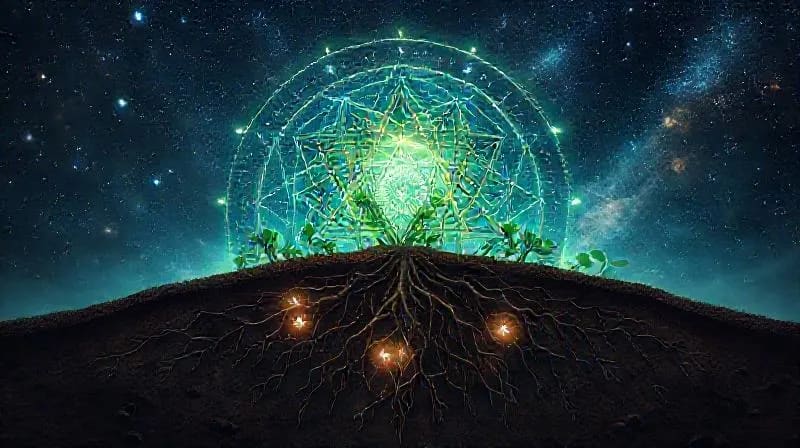
An artistic representation of subterranean plant growth influenced by subtle cosmic energies and planetary symbols.
- New Moon to First Quarter (Waxing Crescent): This period is associated with increasing light and upward energy. It is considered ideal for planting leafy greens, annual flowers, and crops that produce above-ground fruits and seeds. The rising sap flow encourages strong stem and leaf development.
- First Quarter to Full Moon (Waxing Gibbous): As the Moon approaches fullness, its gravitational pull is strongest, drawing moisture upwards. This is a prime time for planting fruit-bearing trees, shrubs, and perennial flowers. It is also excellent for grafting and transplanting, as plants are believed to be more receptive to new environments.
- Full Moon to Last Quarter (Waning Gibbous): The energy shifts downwards during this phase, promoting root growth and energy storage. This period is best for planting root crops like potatoes, carrots, and onions. It is also suitable for pruning, as sap flow is reduced, minimizing stress on the plants.
- Last Quarter to New Moon (Waning Crescent): This is a period of rest and regeneration. It is often recommended for soil cultivation, weeding, pest control, and general garden maintenance. Energy is considered to be at its lowest point, making it less ideal for planting but perfect for clearing and preparing.
Beyond these general guidelines, specific lunar nodes and eclipses are also taken into account by advanced practitioners, though these are often reserved for more specialized applications. For a deeper dive into predictive astrology, including lunar influences, consider exploring Zodiacal Releasing Profections, which can offer further insights into timing and cycles.
Planetary Energetics and Plant Associations
In Astro-Botany, each planet is associated with specific energies and qualities that influence certain types of plants. By understanding these associations, gardeners can select plants that resonate with particular planetary energies, enhancing their growth and desired properties. This system draws heavily from traditional astrological correspondences.
| Planet | Associated Energies | Example Plants |
|---|---|---|
| Sun | Vitality, growth, light, healing, leadership | Sunflower, Marigold, Rosemary, Frankincense |
| Moon | Nurturing, intuition, emotion, fertility, water | Jasmine, Willow, Cabbage, Cucumber, Water Lily |
| Mercury | Communication, intellect, versatility, quick growth | Lavender, Dill, Parsley, Fennel |
| Venus | Love, beauty, harmony, pleasure, abundance | Rose, Apple, Strawberry, Mint, Thyme |
| Mars | Action, energy, courage, passion, heat | Nettle, Garlic, Pepper, Radish, Ginger |
| Jupiter | Expansion, wisdom, prosperity, luck, generosity | Oak, Dandelion, Sage, Borage |
| Saturn | Structure, discipline, endurance, boundaries, time | Comfrey, Horsetail, Hemlock, Poppy |
By considering the planetary ruler of a plant, one can choose optimal times for planting or harvesting based on the planet's position or day of the week it rules. For example, planting Venusian herbs like mint on a Friday (Venus's day) when Venus is well-placed in the sky is believed to enhance their growth and beneficial properties. This method adds another layer of depth to the lunar calendar, allowing for more nuanced gardening decisions.
Zodiacal Signs and Their Botanical Connections
The twelve zodiacal signs also play a crucial role in Astro-Botany, each associated with specific elements (Fire, Earth, Air, Water) and influencing different parts of the plant. As the Moon transits through each zodiac sign, it is believed to activate these elemental energies, making certain gardening activities more favorable. This framework provides a detailed cosmic calendar for gardeners.
- Fire Signs (Aries, Leo, Sagittarius): Associated with warmth, light, and fruit development. Best for planting fruit-bearing crops like tomatoes, peppers, and beans.
- Earth Signs (Taurus, Virgo, Capricorn): Linked to stability, structure, and root growth. Ideal for planting root vegetables such as carrots, potatoes, and onions, and for general soil work.
- Air Signs (Gemini, Libra, Aquarius): Connected to flowering, pollination, and fragrance. Excellent for planting flowers, herbs grown for their scent, and for tasks involving pollination.
- Water Signs (Cancer, Scorpio, Pisces): Related to moisture, leaves, and overall vitality. Best for planting leafy greens like lettuce, spinach, and cabbage, and for watering and fertilizing.
Understanding these zodiacal influences allows for a highly specific timing of gardening tasks. For instance, pruning during a waning Moon in a Fire sign might be ideal for encouraging new fruit growth, while planting leafy greens during a waxing Moon in a Water sign could promote lush foliage. For those interested in the broader esoteric symbolism of these celestial archetypes, exploring Zodiac Myths: Esoteric Symbolism can provide deeper context.
Practical Astro-Botanical Gardening Techniques
Integrating Astro-Botany into your gardening routine doesn't require a complete overhaul, but rather a mindful adjustment of timing. Here are some practical techniques for the modern gardener:

A macro view of a leaf's surface, where dew drops mirror the vastness of a starry night, symbolizing cosmic connection.
- Consult an Astrological Calendar: Many biodynamic and astrological gardening calendars are available online or in print. These calendars provide daily guidance on the Moon's phase and zodiacal sign, indicating the best times for specific tasks.
- Seed Starting: Start seeds during a waxing Moon, preferably when the Moon is in a Water or Earth sign, to encourage strong germination and root development.
- Transplanting: Transplanting is most successful during a waxing Moon when the Moon is in a Water or Earth sign, as plants are believed to be more resilient and adaptable.
- Watering and Fertilizing: These tasks are most effective during a waxing Moon, especially when the Moon is in a Water sign, as plants are thought to absorb nutrients more efficiently.
- Harvesting: For leafy greens, harvest during a waxing Moon in a Water sign for maximum juiciness. For root crops, harvest during a waning Moon in an Earth sign for better storage. Medicinal herbs are often harvested during specific planetary hours or lunar phases to enhance their potency.
- Pest and Weed Control: Engage in these activities during a waning Moon, particularly when the Moon is in a Fire or Air sign, as the destructive energies are believed to be less potent.
Beyond these specific timings, the overarching principle is to cultivate a deeper connection with your garden and the natural world. Observing your plants' responses to different cosmic rhythms can be a rewarding journey, revealing subtle patterns and enhancing your intuitive gardening skills. For those interested in personal manifestation through symbolic tools, exploring Sigil Magick Personal Symbols might offer a complementary perspective on intention setting in gardening.
The Scientific Perspective and Future Research
While Astro-Botany is deeply rooted in esoteric traditions, the scientific community often approaches its claims with skepticism, demanding empirical evidence. Mainstream science acknowledges the Sun's role in photosynthesis and the Moon's gravitational pull on large bodies of water. However, direct, reproducible scientific proof linking planetary positions or zodiacal transits to specific plant growth patterns remains largely elusive.
Proponents of Astro-Botany argue that the subtle energetic influences are difficult to measure with current scientific instruments, and that the holistic nature of the practice extends beyond simple cause-and-effect relationships. They point to anecdotal evidence and the long history of successful biodynamic farming as indicators of its efficacy. Some researchers suggest that subtle electromagnetic fields, unknown biological mechanisms, or even the placebo effect (where the gardener's belief influences their care) could play a role.
Future research in areas like quantum biology, bio-electromagnetics, and even the study of plant consciousness might eventually provide a framework to understand these subtle interactions. Until then, Astro-Botany remains a fascinating blend of ancient wisdom, intuitive gardening, and a holistic approach to cultivating life. It encourages a deeper connection with nature's rhythms, whether or not the underlying scientific mechanisms are fully understood. Embracing these practices can lead to a more harmonious and productive garden, fostering not just plant growth but also a deeper appreciation for the interconnectedness of all life. For a broader understanding of how cosmic influences are interpreted in different cultural contexts, one might look into Chinese Astrology: Zodiac Animals and Their Influence.
Explore Further Insights:
- Sound Healing: Vibrations for Wellness, Inner Peace - Discover how vibrational energies can harmonize your well-being, much like cosmic energies influence plants.
- Advanced Predictive Astrology: Mastering Critical Degrees - Deepen your understanding of astrological timings and their potential impact on earthly events and personal cycles.
- Fixed Stars Mundane Astrology Global Eras Prediction - Learn about the profound influence of fixed stars on global events, extending the cosmic connection beyond our solar system.
- Animal Totems: Discovering Your Spirit Guides - Explore another facet of nature's wisdom and spiritual guidance, connecting to the energetic world around us.
- Feng Shui Chinese Zodiac Compatibility: Elemental Harmony - Understand how elemental energies and zodiacal compatibility can create harmony in your environment, similar to plant energetics.
- Neuro-rights Protecting Digital Consciousness AI Era - A fascinating look at the future of consciousness and rights, expanding the concept of interconnectedness to the digital realm.
- Ciber-Astrología Predictiva: Tránsitos Digitales, Realidad Virtual - Explore how astrological principles might apply to emerging digital realities, bridging ancient wisdom with modern technology.
- Trinidad Sagrada Geometría Divina Arquitectura Gótica Patrones - Delve into sacred geometry and divine patterns, reflecting the underlying order found in both cosmic and botanical structures.
Source: Hybrid content assisted by AI and human editorial supervision.


Comments
Post a Comment