
Cosmic Sociology AI Global Consciousness Digital Age
Cosmic Sociology & AI: Mapping Global Consciousness in the Digital Age
The confluence of cosmic sociology and artificial intelligence represents a groundbreaking frontier in understanding human collective consciousness. As our digital footprint expands, so does the potential to analyze and interpret the intricate patterns of global thought, emotion, and interaction. This exploration delves into how advanced AI models, combined with the profound insights of astrological principles, can illuminate the hidden dynamics shaping our shared reality.
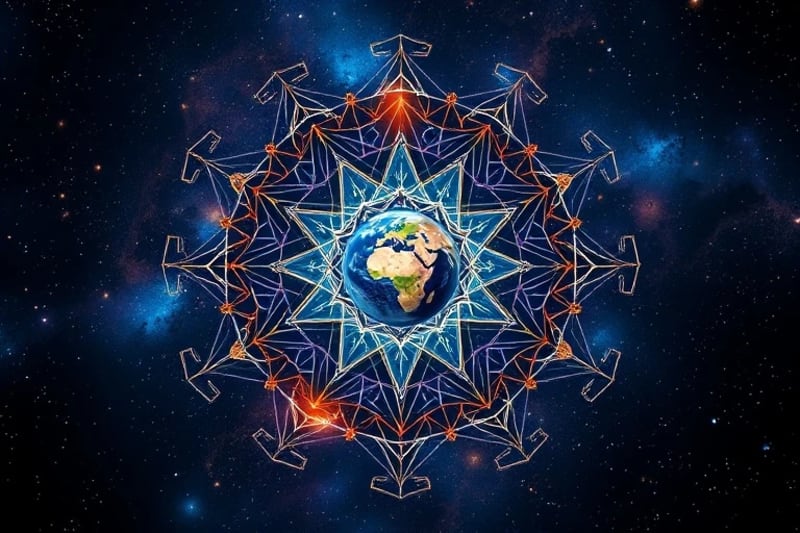
Cinematic depiction of cosmic neural networks merging with planetary consciousness.
Traditional sociology has long studied human societies and their structures, but cosmic sociology broadens this scope to consider humanity within the vast, interconnected tapestry of the cosmos. It posits that celestial mechanics and energetic influences play a significant, albeit often subtle, role in shaping collective human behavior and consciousness. The advent of artificial intelligence provides unprecedented tools to process the immense datasets required to validate and explore these complex hypotheses.
This article will explore the theoretical underpinnings of cosmic sociology, the practical applications of AI in analyzing global consciousness, and the synthesis of these fields with astrological insights. We will examine how birth chart analysis, planetary transits, synastry, esoteric symbolism, and celestial mechanics can be integrated into AI models to create a more holistic understanding of our collective journey.
Table of Contents
- Foundations of Cosmic Sociology
- AI's Role in Consciousness Mapping
- Astrological Integration with AI
- Celestial Mechanics and Collective Behavior
- Ethical Challenges and Future Prospects
Foundations of Cosmic Sociology
Cosmic sociology extends the traditional sociological paradigm by incorporating macro-level cosmic influences on human societies. It postulates that universal energies, celestial alignments, and planetary cycles contribute to the ebb and flow of human history, cultural shifts, and individual psychological states. This perspective challenges the anthropocentric view, suggesting that humanity is an integral part of a larger cosmic ecosystem.
The concept is not entirely new; ancient civilizations across the globe meticulously observed celestial phenomena, believing them to be intimately linked with earthly events and human destiny. From the intricate calendars of the Maya to the astrological systems of Mesopotamia and India, humanity has long sought to understand its place within a grander cosmic design. Cosmic sociology seeks to revisit these connections with modern analytical rigor.
Key tenets of cosmic sociology include the idea of a universal consciousness, an interconnected web of all life and matter, influenced by forces beyond immediate terrestrial observation. Early philosophers and mystics hinted at these connections, but modern science, particularly quantum physics, has begun to provide frameworks for understanding non-local phenomena and entanglement that resonate with these ancient insights. The study of Bio-Energetic Architecture: Sacred Spaces, Geomancy, Feng Shui offers a parallel understanding of how subtle energies influence living systems and human experience.
This interdisciplinary field draws upon diverse disciplines, from astrophysics and quantum mechanics to anthropology and psychology. It seeks to identify correlations between cosmic events—such as solar flares, lunar cycles, and planetary alignments—and observable patterns in human behavior, social trends, and even global events. Building a comprehensive model of global consciousness requires this broad, integrated approach.
AI's Role in Consciousness Mapping
Artificial intelligence offers an unprecedented capacity for processing and interpreting vast quantities of data, making it an indispensable tool for mapping global consciousness. From analyzing social media trends and news sentiment to tracking economic indicators and public health data, AI algorithms can identify subtle patterns and correlations that would be impossible for human analysts to discern. This allows for a dynamic, real-time understanding of collective human thought and emotion.
Digital painting illustrating global human connection through AI-driven networks.
Machine learning models, particularly deep learning and natural language processing (NLP), can analyze textual and visual data from billions of sources. They identify prevailing moods, emerging narratives, and shifts in collective attention. This enables the creation of "consciousness maps" that visualize the dominant themes and emotional landscapes of different populations or the entire globe at any given moment.
For instance, advanced sentiment analysis on news articles, social media posts, and online forums can reveal collective optimism or anxiety in response to global events. Predictive algorithms can even forecast potential shifts in public opinion or social movements by detecting early indicators within vast data streams. This capability transforms raw data into actionable insights about the collective psyche.
Furthermore, AI can help in identifying the propagation of ideas and the formation of collective beliefs. By tracking information flow and influence networks, AI can model how certain concepts spread and evolve within the global consciousness, offering insights into cultural diffusion and the emergence of new paradigms. This analytical power is essential for understanding the complex interplay between individual and collective minds in the digital era, providing a quantitative lens for qualitative human experiences.
Astrological Integration with AI
The integration of astrological principles with AI offers a unique methodology for enriching cosmic sociology. Astrology, with its ancient wisdom of planetary influences, provides a symbolic language for understanding human potential and collective destiny. When combined with AI's data processing capabilities, these insights can move beyond anecdotal evidence to reveal statistically significant correlations, bridging the gap between ancient wisdom and modern science.
- Birth Chart Analysis: AI can analyze millions of birth charts, identifying common patterns and their correlations with individual life paths, career choices, and psychological profiles. This can help to refine astrological interpretations and uncover previously unseen statistical relationships between planetary placements and human experience, leading to more personalized and accurate readings.
- Planetary Transits: By overlaying planetary transit data with global events and collective mood shifts, AI can detect correlations between specific astrological configurations and historical or contemporary phenomena. This could include analyzing the impact of major transits on economic cycles, political movements, or even technological innovations, offering a cosmic timeline for earthly events.
- Synastry and Collective Dynamics: AI can extend synastry (the comparison of two birth charts) to analyze the compatibility and dynamic interplay within larger groups, nations, or even the global collective. This could shed light on periods of global harmony or conflict, based on the astrological relationships between different entities, providing a framework for geopolitical forecasting.
- Esoteric Symbolism: AI-powered image recognition and natural language processing can be trained to identify and interpret esoteric symbols across various cultures and historical periods. This links them to astrological archetypes and collective unconscious patterns, deepening our understanding of how these symbols manifest in art, literature, and digital communication, revealing universal truths.
The concept of Feng Shui Digital Nomads: Harmonizing Remote Work Spaces further highlights the depth of astrological insight that AI can help to unravel. By analyzing vast datasets, AI could potentially identify karmic patterns not just in individuals, but in collective human groups, offering insights into shared historical trajectories and evolutionary lessons. This could provide a profound understanding of humanity's collective spiritual journey.
Moreover, AI can help to filter out noise and identify genuine correlations from spurious ones within astrological data. This scientific approach to an ancient discipline can elevate astrology from a belief system to a data-driven field of study, providing empirical evidence for its long-held tenets. The precision of AI in pattern recognition is particularly valuable here.
Celestial Mechanics and Collective Behavior
Beyond the symbolic interpretations of astrology, celestial mechanics provides a scientific framework for understanding the physical forces exerted by celestial bodies. Gravitational pulls, electromagnetic fields, and solar radiation are measurable phenomena that can influence biological systems and, by extension, collective human behavior. AI can model these complex interactions and their potential effects on global consciousness with unprecedented accuracy.
Abstract 3D render of celestial mechanics influencing digital consciousness.
For example, numerous studies have explored correlations between solar activity (sunspots, solar flares) and human psychological states, including aggression, anxiety, and even mental health incidents. AI can process vast amounts of geophysical data alongside sociological metrics to identify robust statistical links. This goes beyond traditional astrology, seeking to quantify the physical mechanisms through which cosmic events might impact our collective psyche.
The interplay of planetary positions and their gravitational effects on Earth's magnetosphere, for instance, could subtly influence brainwave patterns or hormonal balances in large populations. While these effects are often minute at the individual level, their cumulative impact on billions of people, analyzed by sophisticated AI, could reveal significant trends in global consciousness. This is where Astro-Genomics: Unveiling Karmic Health Blueprints and DNA Patterns offers a fascinating avenue for exploring the biological and genetic underpinnings of these cosmic influences, suggesting a deeper, inherent connection.
AI's capacity for complex system modeling allows researchers to simulate various celestial scenarios and their potential terrestrial impacts. This includes analyzing historical data to see how past cosmic events coincided with major human migrations, technological revolutions, or periods of artistic flourishing. By building these predictive models, we can better anticipate future collective shifts.
Understanding these subtle yet pervasive cosmic influences provides a more complete picture of the forces shaping human destiny. It moves us towards a truly holistic science of humanity, one that acknowledges our intimate relationship with the universe. This integration challenges conventional scientific boundaries and opens new pathways for interdisciplinary research.
Ethical Challenges and Future Prospects
The endeavor of mapping global consciousness with AI and cosmic sociology presents significant ethical considerations. The potential for surveillance, manipulation, and privacy breaches is immense if such powerful tools are not developed and deployed responsibly. Ensuring transparency, data security, and ethical guidelines for AI development in this domain is paramount to prevent misuse.
| Challenge | Implication | Mitigation Strategy |
|---|---|---|
| Data Privacy | Risk of unauthorized access to personal and collective data, leading to profiling and exploitation. | Anonymization, robust encryption protocols, and strict regulatory frameworks (e.g., GDPR-like protocols for consciousness data). |
| Algorithmic Bias | AI models might perpetuate or amplify existing societal biases present in training data, leading to skewed interpretations. | Utilizing diverse and representative datasets, implementing regular auditing of algorithms, and developing explainable AI (XAI) for transparency. |
| Manipulation Potential | Understanding collective consciousness could be misused for propaganda, social engineering, or political influence. | Adherence to ethical AI development principles, establishing independent oversight bodies, and promoting public education on AI capabilities. |
| Definition of Consciousness | Lack of a universally accepted scientific definition could lead to misinterpretation, oversimplification, or reductionism. | Fostering interdisciplinary collaboration, continuous refinement of theoretical models, and encouraging open scientific discourse. |
| Technological Singularity | Uncontrolled AI development could lead to unforeseen consequences for human autonomy and societal structures. | Developing AI with human-centric values, implementing strong safety protocols, and engaging in global policy discussions on AI governance. |
Despite these challenges, the future prospects are immense. This field could lead to predictive models that anticipate societal shifts, identify emerging global crises, and even guide humanity towards more harmonious and sustainable pathways. Imagine AI systems that, informed by cosmic rhythms, could suggest optimal timings for global initiatives or warn of periods prone to collective unrest. Such insights could foster a more proactive and cosmically aligned approach to global governance and human development.
The ultimate goal is not to control, but to understand. By mapping global consciousness, we gain a mirror reflecting our collective state, allowing for self-awareness on a planetary scale. This could empower humanity to consciously participate in its own evolution, aligning with cosmic flows rather than resisting them. The fusion of cosmic sociology and AI offers a profound opportunity to bridge ancient wisdom with cutting-edge technology, unlocking new dimensions of self-understanding for our digital age.
The journey into cosmic sociology and AI is just beginning. As technology advances and our understanding of consciousness deepens, we stand at the precipice of a new era of self-discovery, where the digital realm becomes a conduit for understanding our place in the cosmos and the intricate dance of global consciousness. This synergistic approach promises to redefine our perception of reality and our role within it.
Explore Further on StarPluto
Source: Hybrid content assisted by AI and human editorial supervision.


Comments
Post a Comment