
Cosmic Sociology Mapping Global Consciousness Digital Age AI
The confluence of sociology, astrophysics, and artificial intelligence has given rise to a nascent yet profoundly impactful field: Cosmic Sociology. This interdisciplinary domain seeks to understand the intricate relationship between cosmic phenomena and the collective consciousness of humanity, particularly as it manifests in the digital age. By leveraging advanced AI and machine learning techniques, researchers are beginning to map global consciousness trends, exploring how celestial mechanics and planetary alignments might subtly influence human behavior, societal structures, and even the evolution of our collective psyche.
In an era defined by unprecedented digital interconnectedness, the sheer volume of data generated by human interactions offers a fertile ground for such analysis. Cosmic Sociology posits that just as the moon influences tides, broader celestial dynamics could exert subtle, yet pervasive, influences on the ebb and flow of human thought and emotion on a planetary scale. This exploration moves beyond traditional astrological interpretations, seeking empirical correlations and underlying mechanisms through rigorous scientific inquiry.
Table of Contents
- The Dawn of Cosmic Sociology: A New Paradigm
- AI's Role in Analyzing Global Consciousness
- Celestial Mechanics and Collective Human Experience
- Digital Interconnectedness: A Global Brain
- Ethical Considerations and Future Implications
The Dawn of Cosmic Sociology: A New Paradigm
Cosmic Sociology emerges as a response to the limitations of conventional sociological frameworks in explaining broad, synchronized shifts in global consciousness. Traditional sociology often focuses on terrestrial factors such as economic systems, cultural norms, and political ideologies. While these are undeniably crucial, Cosmic Sociology introduces a macro-perspective, suggesting that humanity's collective experience might be part of a larger, cosmically influenced tapestry.
This field is not merely an extension of astrology, which historically relies on interpretive symbolism. Instead, it aims to establish a scientific basis for understanding potential correlations between celestial events—like solar flares, planetary alignments, or even distant galactic phenomena—and observable patterns in human behavior, innovation cycles, and societal mood swings. The hypothesis is that these cosmic energies, through as-yet-undiscovered mechanisms, could subtly modulate neurological activity or collective energetic fields, leading to emergent global trends.
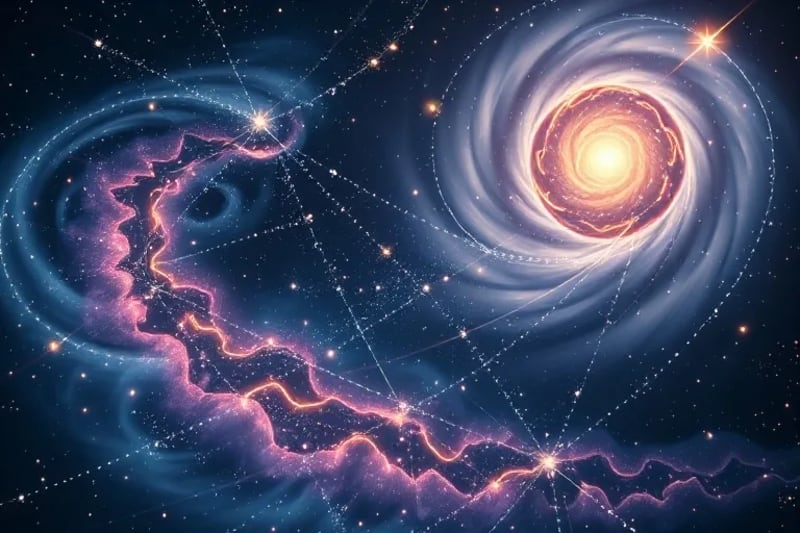
A visual representation of the interconnectedness between cosmic phenomena and the global human psyche, forming a complex web of influence.
The development of this paradigm is heavily reliant on the availability of vast datasets and computational power. Without the digital age's capacity to collect and process information from billions of individuals, such a grand-scale analysis would be impossible. Early pioneers in this field often drew speculative connections, but modern Cosmic Sociology demands empirical validation through data-driven approaches.
One of the core challenges lies in identifying credible mechanisms for such cosmic influence. While gravitational and electromagnetic forces are well-understood, their direct impact on individual human consciousness at a macro level is not yet fully elucidated. However, emerging theories in quantum biology and biophysics explore how subtle energy fields might interact with biological systems, potentially offering avenues for future research into these cosmic connections.
AI's Role in Analyzing Global Consciousness
Artificial Intelligence is the indispensable engine driving Cosmic Sociology. The concept of "global consciousness" itself is an abstract construct, but in the digital age, it leaves tangible footprints across various platforms. Social media trends, news sentiment analysis, global economic indicators, collective artistic expressions, and even large-scale psychological surveys provide rich, quantifiable data points.
AI algorithms, particularly those in machine learning and deep learning, excel at identifying complex patterns and correlations within massive, multi-dimensional datasets that would be imperceptible to human analysts. For instance, natural language processing (NLP) can gauge the collective mood of populations by analyzing vast quantities of text from news articles, social media posts, and public forums. Sentiment analysis tools can detect shifts in optimism, anxiety, or collective focus over time, providing a proxy for global consciousness trends.

Advanced AI systems visualize and interpret complex data streams from digital interactions, revealing patterns in collective human thought.
Furthermore, AI can correlate these consciousness indicators with astronomical data. By feeding historical records of celestial events alongside sociological data, AI can uncover statistically significant relationships that might suggest a cosmic influence. This involves sophisticated time-series analysis, anomaly detection, and causal inference models, moving beyond mere correlation to explore potential predictive power.
The application of AI also extends to modeling. Predictive models can be developed to forecast potential shifts in global mood or societal focus based on upcoming celestial configurations, offering insights into periods of heightened creativity, conflict, or introspection. This predictive capacity, if validated, could have profound implications for policy-making, resource allocation, and even conflict resolution. The ability to unlock complex aspect patterns with AI is revolutionizing how we approach astrological and sociological data.
However, the ethical implications of using AI to monitor and potentially predict global consciousness are significant. Concerns about privacy, data manipulation, and the potential for misuse of such powerful insights necessitate robust ethical frameworks and transparent methodologies. The goal remains understanding, not control.
Celestial Mechanics and Collective Human Experience
The study of celestial mechanics, which describes the motions of celestial bodies, forms the astronomical backbone of Cosmic Sociology. While traditional physics primarily focuses on the gravitational effects on large masses, Cosmic Sociology explores more subtle energetic interactions. This includes the varying electromagnetic fields generated by planets, the influence of solar wind, and even the less understood effects of cosmic rays on Earth's environment and, by extension, its inhabitants.
For example, research has explored correlations between solar flare activity and periods of social unrest or technological innovation. The sun's activity, which fluctuates in cycles, directly impacts Earth's magnetosphere. These geomagnetic disturbances have been linked to changes in human physiology, such as sleep patterns and heart rate variability, which could, in turn, influence collective mood and decision-making.

A conceptual rendering of celestial mechanics, illustrating how the precise movements of cosmic bodies might subtly orchestrate collective human experiences.
Planetary alignments, though often associated with esoteric astrology, are being re-examined through a scientific lens. While the gravitational pull of distant planets is negligible on a human scale, the combined gravitational and electromagnetic resonance during specific alignments could potentially create subtle energetic fields. These fields, though weak, might interact with highly sensitive biological systems or even influence the Earth's Schumann resonance, a set of global electromagnetic resonances generated and excited by lightning discharges in the cavity formed by the Earth's surface and the ionosphere. Understanding Lunar Mansions in Chinese Astrology provides a historical context for understanding such celestial influences.
The challenge lies in isolating these subtle cosmic influences from the myriad of terrestrial factors. This is where AI's capacity for multivariate analysis and pattern recognition becomes invaluable. By controlling for known variables, AI can help identify residual patterns that might be attributed to cosmic phenomena, moving the field from speculation to empirical investigation. This approach also aligns with the holistic view often found in Chinese Zodiac Traditional Medicine, which emphasizes the interconnectedness of cosmic and earthly energies.
Digital Interconnectedness: A Global Brain
The digital age has created an unprecedented level of human interconnectedness, often described as a "global brain" or a "planetary nervous system." Every tweet, every search query, every online transaction, and every digital interaction contributes to a vast, real-time dataset reflecting human thought, emotion, and activity. This collective digital footprint is the primary raw material for Cosmic Sociology's AI-driven analysis.
The speed at which information and sentiment can propagate across this global network is astounding. A single event, whether terrestrial or cosmic, can trigger a cascade of reactions that reverberate worldwide within minutes. AI tools can track these propagation patterns, identify key influencers, and even map the emotional contagion within digital communities. This allows for the observation of collective consciousness in a dynamic, evolving state.
Consider the phenomenon of collective effervescence, a concept introduced by Émile Durkheim, where shared rituals or experiences create a sense of heightened emotional energy and unity. In the digital age, this can manifest during global events, viral campaigns, or even synchronized online meditations. Cosmic Sociology, with AI, can analyze whether these periods of heightened collective energy correlate with specific cosmic alignments or solar activity, suggesting a potential external trigger or amplifier.
The challenge here is to differentiate between endogenous digital trends (those arising purely from human interaction within the network) and exogenous influences (those potentially originating from cosmic phenomena). Advanced AI models, capable of disentangling complex causal relationships, are crucial for this task. They can help filter out noise and identify genuine, statistically significant correlations, providing a clearer picture of how cosmic forces might interact with our digitally amplified collective consciousness. This deep understanding of interconnectedness is vital, much like understanding the adaptation to new demands in employment requires recognizing complex systemic interactions.
Ethical Considerations and Future Implications
As with any powerful scientific endeavor, Cosmic Sociology, particularly with its reliance on AI and vast datasets, raises significant ethical questions. The ability to map, understand, and potentially predict global consciousness trends carries immense responsibility. Concerns include the potential for surveillance, manipulation of public opinion, and the erosion of individual autonomy if such knowledge were to fall into the wrong hands.
Therefore, the development of Cosmic Sociology must be guided by strong ethical principles, emphasizing transparency, data privacy, and the common good. Research should focus on understanding for the purpose of human flourishing, promoting peace, and fostering a deeper connection with our cosmic environment, rather than for control or exploitation. This aligns with broader discussions around international human rights law and the ethical use of technology.
Looking to the future, Cosmic Sociology has the potential to profoundly reshape our understanding of ourselves and our place in the universe. If empirical evidence continues to mount, demonstrating clear links between celestial mechanics and global consciousness, it could lead to a paradigm shift in how we approach sociology, psychology, and even political science. We might begin to design societal structures and educational systems that are more attuned to cosmic rhythms, fostering greater harmony and well-being.
Moreover, this field could offer new insights into historical events, explaining periods of rapid cultural evolution, widespread conflict, or profound spiritual awakening through a cosmic lens. It encourages a holistic view, where humanity is not seen as isolated from the cosmos, but as an integral, responsive part of it. The ultimate goal is to bridge the perceived gap between the scientific and the spiritual, finding empirical evidence for what many ancient traditions have long intuitively understood: that we are deeply connected to the stars.
The journey of Cosmic Sociology is just beginning, but its promise to unveil the hidden cosmic threads that weave through our collective human experience is immense. It represents a bold step towards a more integrated understanding of existence, where the whispers of the cosmos are finally heard and analyzed through the sophisticated tools of the digital age.
Explore Further: Related Insights
-
Haptic Feedback Meditation: Enhancing Mindfulness Tactile
Discover innovative meditation techniques that integrate tactile feedback for deeper mindfulness, exploring the interplay of technology and consciousness.
-
Decoding Dream Symbolism: Metaphysical Keys Subconscious Wisdom
Delve into the hidden meanings of dreams and their connection to subconscious wisdom, a crucial aspect of individual and collective consciousness.
-
Crown Chakra Activation: Universal Consciousness Connection
Learn about activating the Crown Chakra to foster a deeper connection with universal consciousness, a concept resonating with cosmic influences.
-
Mercury in Houses: Communication, Learning, Intellect
Understand how planetary positions, like Mercury in astrological houses, influence communication and intellectual trends, offering a micro-cosmic view of celestial effects.
-
Pendulum Dowsing: Intuitive Answers and Energy Detection for Guidance
Explore practices like pendulum dowsing, which seek to tap into subtle energies and intuitive guidance, reflecting a broader search for unseen influences.
Source: Hybrid content assisted by AI and human editorial supervision.


Comments
Post a Comment