
Astro-Economy Predicting Financial Markets Planetary Cycles
Astro-Economy, often referred to as financial astrology or economic astrology, is a specialized field that explores the potential correlations between celestial movements and economic trends. This discipline posits that planetary cycles and astrological configurations can offer insights into the ebb and flow of financial markets, commodity prices, and broader economic shifts. While largely considered a fringe science by mainstream economics, its proponents point to historical patterns and anecdotal evidence to support its claims.
The core premise of Astro-Economy is that human collective consciousness, which drives economic activity, is influenced by cosmic energies. Just as astrology suggests influences on individual psychology and events, economic astrology extends this concept to the collective behavior of markets and nations. This introductory guide will delve into the foundational principles, historical context, key planetary influences, and methodologies employed in this intriguing area of study.

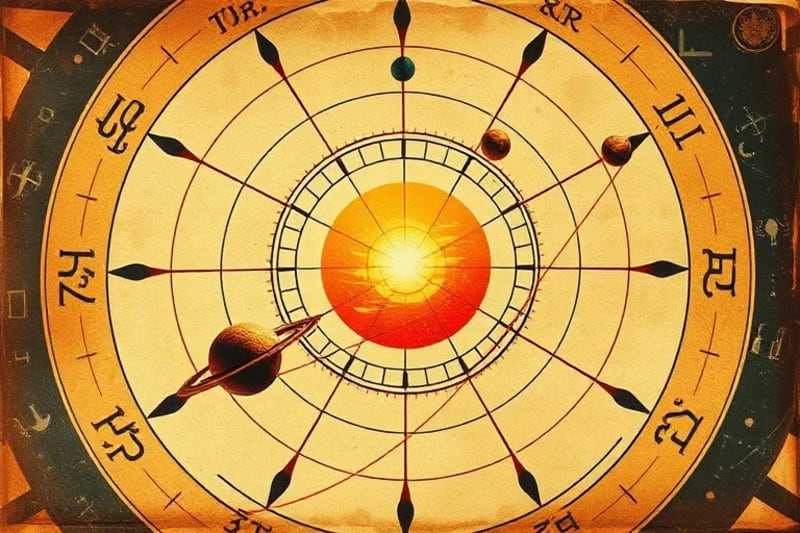
Precursors intellectuales, diagramas fundamentales y representaciones conceptuales que forjaron la visión de la Astro-Economía sobre la interconexión entre los ciclos celestes y las tendencias financieras.
Fuente visual sujeta a disponibilidad del ecosistema: Wikimedia Commons bajo licencia CC BY-SA 4.0 o renderizado conceptual IA.
Table of Contents
- What is Astro-Economy?
- Historical Roots of Economic Astrology
- Key Planetary Cycles and Economic Correlations
- Specific Planetary Influences on Markets
- Methodologies in Economic Astrology
- Scientific Skepticism and the Search for Evidence
- Practical Applications and Limitations
- The Future of Astro-Economy
What is Astro-Economy?
Astro-Economy is an interdisciplinary field that combines principles of astrology with economic analysis. It operates on the premise that celestial events, such as planetary alignments, transits, and retrogrades, can correlate with significant shifts in financial markets, including stock prices, commodity values, and currency fluctuations. Proponents believe these cosmic influences affect human behavior on a mass scale, leading to collective optimism or pessimism that drives market sentiment.
Unlike traditional economic forecasting, which relies on fundamental and technical analysis, Astro-Economy introduces a cyclical, cosmic dimension. It suggests that certain planetary configurations are consistently associated with bull markets, bear markets, or specific economic events like recessions or booms. This perspective offers a unique lens through which to view economic cycles, often identifying patterns that might be overlooked by conventional methods.
Historical Roots of Economic Astrology
The idea of celestial influence on earthly affairs is ancient, with civilizations from Mesopotamia to China observing and recording astronomical phenomena alongside societal events. Early forms of astrology often included predictions related to harvests, trade, and the prosperity of kingdoms, laying a rudimentary foundation for economic astrology. In the medieval period, astrologers advised rulers on matters of state, including economic decisions, based on planetary positions.
The modern resurgence of economic astrology can be traced to the late 19th and early 20th centuries. Pioneering figures like W.D. Gann, a legendary stock market trader, were rumored to use astrological cycles alongside other technical indicators to make his highly successful predictions. Although Gann's exact methods remain shrouded in mystery, his work inspired many to explore the potential of cosmic influences on financial markets. Other notable figures, such as Louise McWhirter and George Bayer, also contributed to the development of specific astrological techniques for market forecasting.
Key Planetary Cycles and Economic Correlations
At the heart of Astro-Economy are the cycles of the planets, particularly the outer planets due to their longer orbital periods and thus broader, more significant influences. These cycles are believed to correspond with long-term economic trends and shifts in global sentiment. Understanding these cycles is crucial for anyone interested in this field, as they form the backbone of most economic astrological analyses.
- Jupiter-Saturn Cycle (approximately 20 years): This conjunction is often associated with major economic shifts, marking the beginning or end of significant economic eras. Jupiter represents expansion and growth, while Saturn signifies contraction, structure, and discipline. Their conjunctions and oppositions are often linked to periods of boom and bust.
- Saturn-Uranus Cycle (approximately 45 years): This cycle involves the clash between tradition (Saturn) and innovation (Uranus). It is often correlated with technological revolutions, societal restructuring, and disruptive economic changes.
- Uranus-Neptune Cycle (approximately 171 years): This long cycle is associated with profound shifts in collective consciousness, ideology, and the emergence of new paradigms that can reshape global economies and financial systems.
- Neptune-Pluto Cycle (approximately 492 years): This extremely long cycle relates to fundamental transformations in humanity's spiritual and collective evolution, impacting deep-seated economic structures and resource distribution over centuries.
These larger cycles are often broken down into smaller, more frequent planetary transits that are believed to influence shorter-term market movements. For a deeper understanding of how these celestial bodies function, you can explore the general principles of Planets in Astrology: Understanding Your Natal Chart.
Representación conceptual de cómo los ciclos planetarios, con sus movimientos rítmicos, se entrelazan con las fluctuaciones de los mercados financieros.
Specific Planetary Influences on Markets
Beyond the major cycles, individual planets are thought to exert specific influences on various aspects of the economy. Each planet's astrological symbolism is translated into its potential economic impact.
- Jupiter: Associated with expansion, optimism, growth, and speculation. Positive Jupiter transits are often linked to bull markets, increased investment, and economic prosperity.
- Saturn: Represents contraction, caution, discipline, regulation, and scarcity. Saturn transits can coincide with bear markets, economic slowdowns, and periods of austerity or financial restructuring.
- Uranus: Symbolizes sudden change, disruption, innovation, and technological breakthroughs. Uranus transits are often associated with market volatility, unexpected events, and the emergence of new industries or technologies.
- Neptune: Linked to illusion, speculation, inflation, and confusion. Neptune transits can bring about periods of irrational exuberance, bubbles, or market uncertainty, as well as shifts in collective ideals.
- Pluto: Represents transformation, power, debt, and deep-seated economic forces. Pluto transits are often correlated with profound economic restructuring, debt crises, and the redistribution of wealth or power.
- Mercury: Influences communication, trade, and short-term market fluctuations. Mercury retrograde periods are sometimes associated with communication breakdowns, delays in transactions, and market indecision.
These planetary influences are not seen as deterministic but rather as indicators of prevailing energies that can shape collective sentiment and decision-making within financial systems. The interplay of these energies can create complex patterns, leading to the broader Astrology Global Events: Predicting Societal Shifts.
Methodologies in Economic Astrology
Economic astrologers employ various techniques to analyze and forecast market movements. These methodologies often blend traditional astrological tools with specific economic data points.
- National Natal Charts: A common approach involves casting a natal chart for a country, a major corporation, or even a specific market index (e.g., the NYSE or S&P 500). The "birth" of these entities (e.g., a country's independence day, a company's incorporation date) is used to create a chart, which is then analyzed for its inherent strengths, weaknesses, and potential economic cycles.
- Transits to Natal Charts: By observing current planetary transits over the natal chart of an economic entity, astrologers look for periods of stress or opportunity. For example, a challenging Saturn transit to a nation's natal chart might indicate an upcoming recession or period of economic hardship.
- Planetary Aspects and Cycles: Analyzing the aspects (angles) between planets, such as conjunctions, oppositions, squares, and trines, is fundamental. These aspects are believed to trigger specific market reactions. The recurring cycles of these aspects are often mapped against historical market data to identify predictive patterns.
- Lunations and Eclipses: The cycles of the Moon, including New Moons, Full Moons, and especially eclipses, are considered significant. Eclipses, in particular, are thought to mark turning points or periods of intensified energy that can lead to rapid market shifts. Karmic Eclipses: Deep Impact on Soul Evolution are often linked to profound shifts.
- Commodity-Specific Astrology: Some practitioners specialize in specific commodities, such as gold, silver, or oil, believing that certain planets or astrological signs have a stronger affinity with particular resources.
These methods are often used in conjunction with traditional technical analysis, providing an additional layer of insight for traders and investors seeking an edge in complex markets. The integration of such insights into a broader understanding of human potential is also explored in fields like Psycho-Astrology: Jungian Psychology Natal Chart Integration.
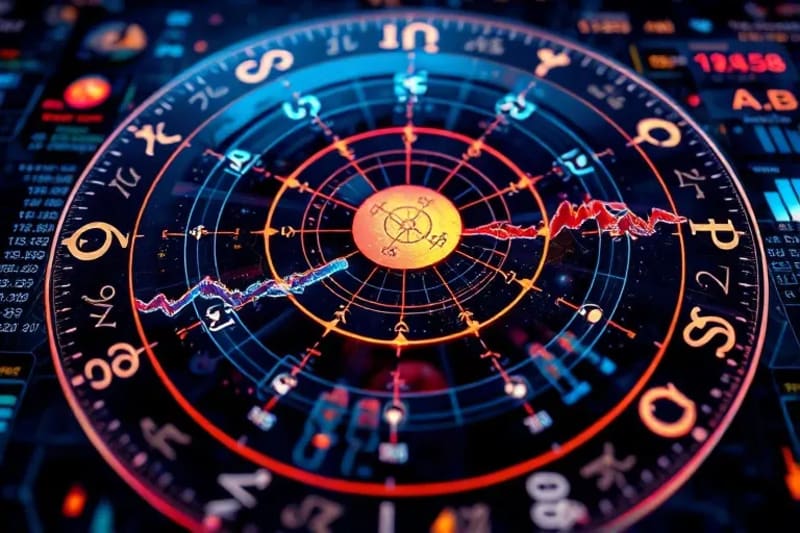
Visión futurista de un panel de control financiero que integra datos de mercado en tiempo real con proyecciones holográficas de cartas astrológicas.
Scientific Skepticism and the Search for Evidence
Mainstream science and economics largely dismiss Astro-Economy as pseudoscience, citing a lack of empirical evidence and a clear causal mechanism. Critics argue that any perceived correlations are either coincidental or the result of confirmation bias. The scientific method demands reproducible results and testable hypotheses, which economic astrology often struggles to provide in a way that satisfies conventional academic standards.
However, proponents counter that the complexity of economic systems and the sheer number of variables involved make direct, simple causation difficult to prove even in traditional economics. They often highlight historical instances where astrological predictions seemed to align with market movements, suggesting that while the mechanism may not be fully understood, the patterns are observable. Some researchers have attempted statistical analyses to find correlations, with mixed results, often limited by methodological challenges and data availability.
Practical Applications and Limitations
For those who choose to incorporate Astro-Economy into their financial strategies, it is typically used as a supplementary tool rather than a sole predictor. Traders and investors might use astrological indicators to confirm trends identified by technical analysis, to anticipate potential turning points, or to gauge overall market sentiment. It is often seen as a way to gain a deeper, more intuitive understanding of market psychology.
However, the limitations are significant. The interpretations of astrological charts can be highly subjective, and different astrologers may arrive at different conclusions for the same planetary configuration. Furthermore, real-world events, such as political instability, natural disasters, or unexpected policy changes, can override or significantly alter any astrologically predicted trends. Therefore, Astro-Economy is best approached with a critical mind and integrated cautiously into a diversified analytical framework.
The Future of Astro-Economy
Despite its controversial nature, Astro-Economy continues to fascinate a niche community of financial enthusiasts and astrologers. With advancements in data analytics and computational power, there is potential for more rigorous research into the statistical correlations between celestial events and market behavior. While it may never gain full acceptance in mainstream finance, its exploration offers an alternative perspective on the complex interplay of human psychology, cosmic rhythms, and economic cycles.
As the world becomes increasingly interconnected and complex, some believe that traditional forecasting methods may benefit from incorporating broader, cyclical perspectives. Whether as a serious predictive tool or merely a source of intriguing patterns, Astro-Economy remains a testament to humanity's enduring quest to find order and meaning in both the cosmos and the chaos of financial markets.
Explore Further
- • Astrology Global Events: Predicting Societal Shifts
- • Algorithmic Enchantment AI-Generated Sigils Sacred Art
- • Astrology NLP: Rewiring Natal Chart Potentials
- • Full Moon Rituals: Zodiac Cleansing Guide
- • Psycho-Astrology: Jungian Psychology Natal Chart Integration
- • Crystal Grids Advanced: Programming Specific Intentions
- • Tarot Esoteric Symbolism: Unlocking Universal Truths
- • Metal Goat Chinese Zodiac: Resilience, Creativity
- • 9th House Astrology: Philosophy, Travel, and Higher Learning
- • Chinese Zodiac Legend: Origins, Great Race Myth
- • Davison Relationship Chart Soul Partnership Astrology Insights
- • Planets in Astrology: Understanding Your Natal Chart
- • Esoteric Tarot Planetary Hours: Accurate Readings Guide
- • Biophilic Manifestation Nature's Blueprint Abundance Harmony
- • Dragon Phoenix Dynamics: Power Partnership Chinese Zodiac
- • Colombian Commercial Code: Maritime Insurance Art. 1703-1708
- • Thriller Motown 25: Michael Jackson's Unprecedented Success
- • Global Economic Inequality: Role of Institutions and Redistribution
- • Karmic Eclipses: Deep Impact on Soul Evolution
- • Taurus: Stability, Beauty and Challenges of the Zodiac Sign
- • Lunar Karmic Revolution: Impact on Destiny Return
- • Saint Padre Pio: Stigmata, Miracles and Prophecies
- • Marian Apparitions 20th Century: Stories of Faith and Hidden Resistance
- • Joyful Rosary: Deep Meaning and Meditation
Source: Hybrid content assisted by AI and human editorial supervision.


Comments
Post a Comment