
Astrology Health Debilities Chronic Illness Predispositions
Astrology & Health: Understanding Planetary Debilities and Chronic Illness Predispositions
Medical astrology, an ancient branch of astrological study, delves into the intricate connections between celestial bodies and human health. It posits that our birth chart, a snapshot of the heavens at the moment of our birth, can reveal predispositions to certain health conditions, both acute and chronic. This discipline offers a unique lens through which to understand our physical and mental well-being, suggesting that planetary placements, aspects, and dignities can indicate areas of strength and vulnerability within the body.

Precursors intellectuales, diagramas fundamentales y representaciones conceptuales que forjaron la visión de la astrología sobre la salud y sus influencias cósmicas.
Fuente visual sujeta a disponibilidad del ecosistema: Wikimedia Commons bajo licencia CC BY-SA 4.0 o renderizado conceptual IA.Far from being a diagnostic tool, medical astrology serves as a guide for self-awareness and preventative care, helping individuals identify potential weak points in their constitution. By understanding these astrological indicators, one can adopt lifestyle choices, dietary adjustments, or holistic therapies that support overall health and mitigate the manifestation of predispositions. This article will explore the core concepts of planetary debilities, the role of houses related to health, and how astrological insights can complement modern approaches to well-being.
Table of Contents
- The Foundations of Medical Astrology
- Planetary Debilities Explained
- Houses of Health: The 6th, 8th, and 12th
- Zodiac Signs and Associated Body Parts
- Astrological Aspects and Their Influence on Health
- Identifying Chronic Illness Predispositions
- A Holistic Approach to Health and Astrology
The Foundations of Medical Astrology
At its core, medical astrology interprets the natal chart to discern an individual's inherent physical and psychological constitution. Each planet, zodiac sign, and house corresponds to specific body parts, organs, systems, and psychological tendencies. For instance, the Sun often relates to the heart and vitality, while the Moon governs fluids and emotional well-being. Mars is associated with muscles and inflammation, and Saturn with bones and chronic conditions.
The interaction between these celestial components forms a unique health blueprint. A well-placed and strong planet might indicate a robust constitution in its associated areas, whereas a debilitated planet could point to potential vulnerabilities. This ancient system, often intertwined with esoteric symbolism, offers a framework for understanding the subtle energies that influence our physical existence. For those interested in deeper self-discovery through such symbolic systems, exploring Dream Interpretation Esoteric Symbolism Self-Discovery Guide can provide further insights into the language of the subconscious and its connection to our inner world.
Planetary Debilities Explained
Planetary debilities refer to positions where a planet is considered "weak" or "challenged" in the zodiac. These positions do not necessarily guarantee illness, but they indicate areas where a planet's energy may struggle to express itself harmoniously, potentially leading to physical or psychological imbalances. The primary debilities include:
- Detriment: A planet is in detriment when it is in the zodiac sign opposite to the sign it rules. For example, Mars rules Aries, so it is in detriment in Libra. This often signifies a struggle for the planet to function optimally, potentially leading to issues in its associated body parts or functions.
- Fall: A planet is in fall when it is in the sign opposite to its sign of exaltation. The Sun is exalted in Aries, so it is in fall in Libra. This position can indicate a lack of natural support or a tendency towards depletion in the planet's areas of influence.
- Retrograde: When a planet appears to move backward from Earth's perspective, its energy is said to be internalized, delayed, or expressed unconventionally. In medical astrology, a retrograde planet might suggest conditions that are harder to diagnose, recurrent, or require internal healing.
- Combust: A planet is combust when it is very close to the Sun (within 8.5 degrees). The Sun's powerful rays are thought to "burn up" or obscure the planet's energy, making its influence less clear or more challenging to integrate, potentially affecting the associated body part.
- Weak Aspects: Planets forming challenging aspects (squares, oppositions) with other planets, especially malefics like Mars or Saturn, can create tension and stress in the body's systems, leading to predispositions for illness. Understanding these Astro-Archeology Unearthing Ancient Celestial Narratives Civilizations is crucial for a comprehensive health reading.
Each planet's debility can manifest differently. For instance, a debilitated Mercury (ruler of the nervous system and lungs) might indicate a predisposition to respiratory issues, speech impediments, or nervous disorders. A debilitated Venus (ruler of kidneys, skin, and reproductive organs) could suggest vulnerabilities in these areas, often linked to imbalances in pleasure or relationships.

Anatomical heart interwoven with celestial symbols, representing the energetic and physical connections in medical astrology.
Houses of Health: The 6th, 8th, and 12th
In a birth chart, specific houses are traditionally associated with health matters. These are primarily the 6th, 8th, and 12th houses, often referred to as the "houses of illness" or "cadent houses" in some traditions. Their significance in medical astrology is profound:
- The 6th House: This house governs daily health, acute illnesses, work routines, and service. Planets placed here, or the sign on its cusp, can indicate the types of day-to-day health challenges one might face, as well as the body parts most susceptible to minor ailments or stress-related conditions. It also relates to how one manages their health and daily habits.
- The 8th House: Associated with chronic illness, surgery, regeneration, death, and transformation, the 8th house offers insights into deeper, more persistent health issues. Planets here or the sign on its cusp can point to inherited conditions, long-term health battles, or the body's capacity for healing and recovery from severe ailments.
- The 12th House: This house rules hidden conditions, mental health, hospitalization, isolation, and self-undoing. Health issues indicated by the 12th house may be difficult to diagnose, psychosomatic, or require periods of retreat or institutional care. It can also highlight vulnerabilities to addiction or mental health struggles that remain unseen.
The planets residing in these houses, along with the aspects they form, provide crucial information about the nature and severity of potential health challenges. For example, a malefic planet like Saturn in the 6th house might indicate chronic issues related to daily work or routine, while Mars in the 8th could suggest a predisposition to inflammatory conditions requiring surgery or intense healing processes.
Zodiac Signs and Associated Body Parts
Each zodiac sign is traditionally linked to specific body parts and physiological functions. This correspondence helps astrologers pinpoint areas of the body that may be more sensitive or prone to imbalance based on the signs prominent in a birth chart, especially those on house cusps or housing debilitated planets. Understanding these associations is fundamental to medical astrology:
| Zodiac Sign | Associated Body Parts/Functions |
|---|---|
| Aries | Head, face, brain, eyes |
| Taurus | Neck, throat, thyroid, ears, vocal cords |
| Gemini | Lungs, hands, arms, nervous system |
| Cancer | Stomach, breasts, digestive system, fluids |
| Leo | Heart, spine, upper back, circulation |
| Virgo | Intestines, digestive tract, spleen, nervous system |
| Libra | Kidneys, lower back, skin, endocrine system |
| Scorpio | Reproductive organs, bladder, bowels, excretory system |
| Sagittarius | Hips, thighs, liver, sciatic nerve |
| Capricorn | Bones, joints, teeth, skin, knees |
| Aquarius | Ankles, calves, circulatory system, nervous system |
| Pisces | Feet, lymphatic system, immune system, pineal gland |
When a planet is debilitated in a particular sign, the corresponding body part may experience increased vulnerability. For example, if the Moon (ruler of the stomach) is in Capricorn (associated with bones and structure, but also constriction), it might indicate digestive issues related to stress or a tendency towards rigidity in emotional expression affecting the gut.
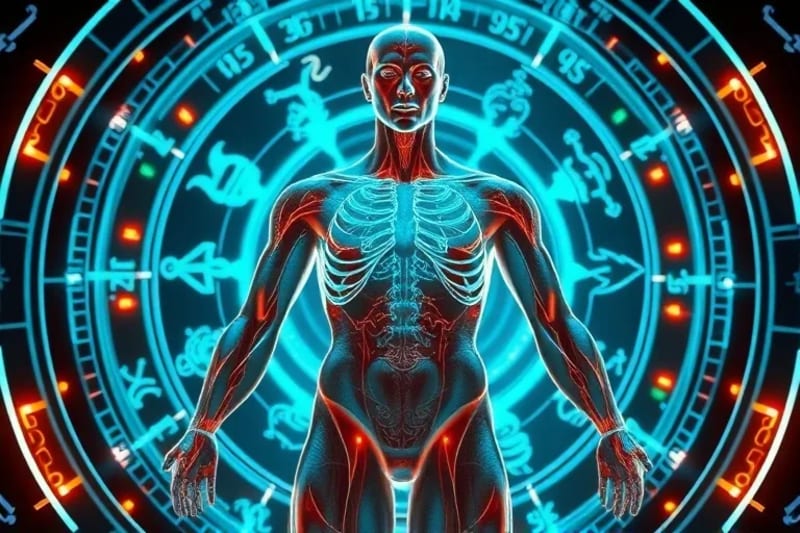
Advanced holographic display integrating anatomical data with celestial influences for a holistic health perspective.
Astrological Aspects and Their Influence on Health
Beyond planetary positions and dignities, the angular relationships between planets—known as aspects—play a critical role in medical astrology. These aspects describe how planetary energies interact, either harmoniously or tensely, and can highlight areas of the body or psychological functions that are under stress or well-supported.
- Hard Aspects (Squares, Oppositions, Conjunctions with Malefics): These aspects often indicate tension, conflict, or blockages. For health, they can point to areas of chronic stress, inflammation, or conditions that require significant effort to manage. A square between Mars (inflammation) and Saturn (restriction) might suggest conditions like arthritis or stiff joints.
- Soft Aspects (Trines, Sextiles): These aspects represent ease, flow, and support. They indicate areas of natural strength and resilience in the body. A trine between Jupiter (growth, healing) and the Sun (vitality) might suggest a strong constitution and good recuperative abilities.
The interplay of these aspects, especially involving the planets associated with health houses, can paint a detailed picture of an individual's health landscape. For example, a challenging aspect to the ruler of the 6th house could indicate ongoing struggles with daily health, while harmonious aspects could suggest natural coping mechanisms.
Identifying Chronic Illness Predispositions
Identifying predispositions to chronic illness involves a comprehensive analysis of the birth chart, focusing on several key indicators:
- Debilitated Planets in Health Houses: A planet in detriment or fall located in the 6th, 8th, or 12th house significantly increases the likelihood of chronic issues related to that planet's domain and the house's themes.
- Malefic Planets (Mars, Saturn, Uranus, Neptune, Pluto) in Health Houses: These planets, especially Mars and Saturn, can bring challenges. Mars can indicate acute inflammation or accidents, while Saturn often points to chronic, restrictive, or degenerative conditions.
- Hard Aspects to the Ascendant or its Ruler: The Ascendant represents the physical body and vitality. Challenging aspects to it or its ruling planet can indicate fundamental constitutional weaknesses.
- Planetary Transits and Progressions: While the natal chart shows predispositions, transits and progressions activate these potentials. A difficult transit from Saturn to a natal planet associated with health could trigger a chronic condition, especially if the natal planet is already debilitated. This concept aligns with the broader idea of Celestial Mechanics Conscious Evolution: Spiritual Growth Rhythms, where cosmic movements influence personal development and challenges.
- Fixed Signs and Modalities: Planets in fixed signs (Taurus, Leo, Scorpio, Aquarius) can indicate conditions that are persistent and hard to shift.
It's important to remember that a predisposition is not a diagnosis. It's an energetic tendency. Awareness of these tendencies empowers individuals to take proactive steps towards prevention and management. For instance, if a chart indicates a predisposition to kidney issues (Libra/Venus debilities), one might focus on hydration, a balanced diet, and stress reduction to support kidney health.
A Holistic Approach to Health and Astrology
Medical astrology is best utilized as a complementary tool within a holistic health framework. It does not replace conventional medical diagnosis or treatment but offers an additional layer of understanding about the individual's unique energetic constitution. By integrating astrological insights with modern medical knowledge, individuals can achieve a more comprehensive approach to their well-being.
For example, if a chart suggests a predisposition to anxiety (e.g., a challenging Mercury or Moon placement), an individual might explore mindfulness, meditation, or therapy alongside any medical recommendations. Similarly, if there's an indication of digestive sensitivity, dietary adjustments based on astrological insights could be explored in conjunction with nutritional advice. The field of Medical Astrology, Sound Healing: Vibrational Remedies further explores how these cosmic influences can be harmonized through various therapeutic modalities.
Ultimately, medical astrology encourages a proactive and personalized approach to health. It invites us to listen to our bodies, understand our energetic patterns, and align our lifestyle with our unique cosmic blueprint. This leads to greater self-awareness and empowers us to make informed choices that support our vitality and long-term health.
Explore Further: Related Astrological Insights
- Dream Interpretation: Unlocking Subconscious Messages
- Jungian Archetypes Chinese Zodiac Bridging Ancient Wisdom
- 11th House Astrology: Friendships, Hopes, and Social Causes
- Feng Shui Chinese Zodiac Business: Element Harmony Prosperity
- Part Fortune Birth Chart: Joy, Abundance, Destiny Location
- Snake 2014 Horoscope: Cycle of Change Forecast
- Decanates Zodiac Signs: Unveiling Deeper Layers
- Cosmic Sociology Global Consciousness Celestial Mechanics Trends
- Tarot Career Guidance: Professional Paths Decks Insights
- Mercury in Astrology: Communication, Intellect, and Learning Styles
- Venus Sign Decoding: Love, Values, Relationships Guide
Source: Hybrid content assisted by AI and human editorial supervision.


Comments
Post a Comment