
Cosmic Sociology Global Consciousness Celestial Mechanics Trends
In an era defined by unprecedented global interconnectedness and rapid societal transformation, the search for underlying patterns and influences has intensified. Traditional sociology often focuses on terrestrial factors, but an emerging interdisciplinary field, "cosmic sociology," proposes a broader lens. This perspective explores how celestial mechanics—the movements and interactions of astronomical bodies—might subtly yet profoundly shape global consciousness and collective human trends.
This article delves into the fascinating intersection of astrology, sociology, and the study of consciousness, examining the potential mechanisms through which planetary cycles could correlate with shifts in human behavior, cultural paradigms, and historical events. We will explore how ancient wisdom traditions, particularly astrology, offer frameworks for understanding these cosmic rhythms, and how a modern, scientific approach can begin to bridge the gap between celestial phenomena and earthly societal dynamics.
Table of Contents
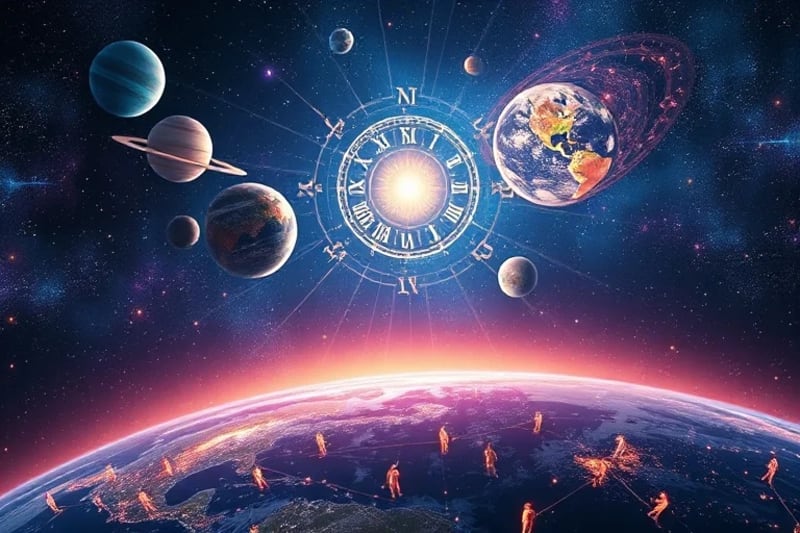
A grand cosmic tapestry illustrating the intricate connection between celestial mechanics and human global consciousness.
Visual source subject to ecosystem availability: Wikimedia Commons under CC BY-SA 4.0 license or conceptual AI rendering.
The Foundations of Cosmic Sociology
Cosmic sociology, while not a formally established academic discipline, draws inspiration from ancient philosophical and astrological traditions that recognized the profound connection between humanity and the cosmos. Civilizations from Mesopotamia to the Maya meticulously observed planetary movements, believing them to be direct indicators or even drivers of earthly events, including harvests, wars, and the rise and fall of empires.
These early systems, often intertwined with religious and political structures, laid the groundwork for a worldview where human society was seen as an integral part of a larger, celestial order. Astrology, in its classical form, was not merely about individual horoscopes but encompassed "mundane astrology," which focused on predicting and interpreting geopolitical events, natural disasters, and collective moods based on planetary alignments and ingresses into zodiacal signs.
In the modern context, cosmic sociology attempts to re-evaluate these ancient insights through a contemporary lens, seeking correlations between macro-level planetary phenomena and observable societal trends. It moves beyond deterministic predictions, instead exploring the subtle energetic or informational influences that might permeate the collective unconscious, shaping shared experiences and responses across populations.
Celestial Mechanics and Planetary Cycles
The universe operates on precise celestial mechanics, dictating the orbits, speeds, and relative positions of planets. These movements create a complex dance of planetary cycles, which astrologers have long correlated with distinct energetic qualities and developmental phases. Key aspects include conjunctions (planets aligned), oppositions (planets 180 degrees apart), and squares (planets 90 degrees apart), each believed to signify different types of collective tension or integration. These geometric relationships are not merely symbolic; they represent specific energetic dynamics that can influence the collective human experience.
Beyond daily or monthly transits, longer planetary cycles are often cited as influential in shaping generational trends and historical epochs. For instance, the approximately 29.5-year cycle of Saturn, known as the Saturn Return, is traditionally associated with periods of maturity, responsibility, and restructuring, not just for individuals but potentially for collective institutions and societal norms. These periods often manifest as societal growing pains, demanding accountability and structural reforms.
Another significant cycle is the approximately 20-year Jupiter-Saturn conjunction, which marks a new socio-economic era and often precedes major shifts in political and cultural landscapes. Historically, these conjunctions have been linked to significant global events, indicating a collective re-evaluation of values and power structures. The "Great Conjunctions," occurring every 200 years in elements (Earth, Air, Fire, Water), are believed to signify even more profound shifts in human civilization's foundational principles. Understanding these rhythms requires a deep dive into the intricate patterns of celestial mechanics, moving beyond superficial interpretations to grasp their potential influence on the collective psyche.
The individual characteristics attributed to each planet also play a crucial role in this cosmic narrative. For example:
- Mars: Associated with action, conflict, and drive, its transits can correlate with periods of heightened aggression, military conflicts, or pioneering endeavors.
- Venus: Linked to harmony, diplomacy, and values, its movements might coincide with periods of artistic flourishing, peace negotiations, or shifts in collective aesthetic preferences.
- Mercury: Governing communication, commerce, and thought, its cycles (especially retrogrades) are often seen to influence global discourse, market fluctuations, and the spread of information.
- Jupiter: Symbolizing expansion, philosophy, and justice, its transits can align with periods of economic growth, ideological movements, or legal reforms.
These planetary energies, when combined with their zodiacal placements and aspects, form a complex cosmic symphony that may subtly orchestrate the backdrop against which human history unfolds.
Planetary alignments and their subtle influence on collective human actions.
Global Consciousness: A Sociological Perspective
Global consciousness refers to the idea that humanity, as a whole, shares an interconnected awareness or collective mind, influenced by shared experiences, information, and emergent trends. This concept, explored by sociologists, psychologists, and philosophers, suggests that beyond individual thoughts and feelings, there exists a collective mental field that shapes our shared reality and societal direction.
The rise of global communication technologies, from the internet to social media, has undeniably amplified this interconnectedness, allowing ideas, emotions, and movements to spread across continents with unprecedented speed. This rapid diffusion of information and sentiment can quickly coalesce into global trends, whether in fashion, politics, environmental awareness, or spiritual movements. The question then arises: are these trends purely endogenous, or do external, cosmic factors play a subtle role?
From a sociological standpoint, understanding global consciousness involves analyzing how collective norms, values, and beliefs are formed, maintained, and transformed. While traditional sociology identifies economic, political, and cultural forces as primary drivers, cosmic sociology posits that celestial rhythms might provide an underlying energetic template or a timing mechanism for these shifts, influencing the collective unconscious and predisposing populations to certain types of experiences or responses.
Connecting Celestial Mechanics to Collective Trends
The core hypothesis of cosmic sociology is that specific planetary configurations correlate with discernible patterns in collective human behavior. For instance, periods of intense planetary tension (e.g., multiple squares or oppositions involving outer planets) are often observed to coincide with heightened social unrest, technological breakthroughs, or significant shifts in global power dynamics. Conversely, harmonious aspects might align with periods of cooperation, artistic flourishing, or economic stability.
Consider the impact of outer planets like Uranus, Neptune, and Pluto, which move slowly and spend many years in a single zodiac sign. Their transits are often associated with generational shifts and deep societal transformations. Uranus, linked to innovation and rebellion, might coincide with periods of rapid technological advancement or social revolutions. Neptune, associated with idealism and dissolution, could mark eras of spiritual awakening or widespread disillusionment. Pluto, symbolizing transformation and power, often aligns with periods of intense societal restructuring and the uncovering of hidden truths.
While direct causation is difficult to prove empirically, the consistent correlation between certain celestial events and historical trends warrants further investigation. This perspective suggests that celestial mechanics might act as a "cosmic clock," setting the stage for collective experiences, much like the changing seasons influence agricultural cycles. The study of fixed stars in electional astrology, for example, offers insights into how specific cosmic energies are harnessed for optimal timing in human endeavors, extending this concept to collective societal timing.
A deeper understanding of these correlations could provide a unique framework for predicting and navigating future collective trends, offering insights into potential periods of global challenge or opportunity. This approach doesn't diminish human agency but rather contextualizes it within a larger cosmic rhythm, much like understanding the tides helps sailors navigate the ocean.
The intricate web of global consciousness, influenced by cosmic patterns.
Astrology's Role in Understanding Societal Patterns
Astrology, often misunderstood as solely a tool for personal prediction, offers a rich symbolic language and a sophisticated system for mapping celestial influences. Mundane astrology, specifically, applies astrological principles to nations, cities, and global events, using charts cast for significant moments like a country's founding or a major political event. By analyzing these charts in conjunction with current planetary transits, astrologers attempt to forecast collective moods, economic shifts, and geopolitical developments. This ancient practice, rooted in careful observation, provides a unique framework for understanding the ebb and flow of societal energies.
For example, the placement of planets in the 10th House of Astrology, which governs career, public image, and destiny, can be examined in a nation's chart to understand its collective aspirations and challenges on the world stage. A strong Saturn in this house, for instance, might indicate a nation built on strong structures and discipline, while a prominent Uranus could suggest a revolutionary spirit or a focus on innovation. Similarly, the study of Whole Sign Houses versus other house systems provides different perspectives on how these cosmic energies are distributed and experienced by a collective, offering varied interpretations of national character and destiny.
Beyond natal charts for nations, mundane astrology pays close attention to ingresses (planets entering new signs), eclipses, and major planetary aspects. Solar and lunar eclipses, for instance, are often seen as potent harbingers of change, correlating with significant political upheavals, natural disasters, or shifts in public sentiment. The sign and house in which an eclipse occurs are believed to indicate the areas of life that will undergo transformation. Furthermore, the concept of a planetary ingress into a new zodiacal sign can mark the beginning of a new collective thematic focus, influencing global conversations and priorities for months or even years.
This approach moves beyond individual horoscopes to consider the "birth chart" of a collective entity, providing a framework for analyzing its inherent strengths, vulnerabilities, and cyclical patterns of growth and contraction. While not a definitive predictive science, it offers a symbolic narrative that can help contextualize historical events and anticipate future collective tendencies, fostering a deeper understanding of our shared human journey.
It is crucial to approach these correlations with an open mind and a critical perspective, avoiding fatalism. Astrology, in this context, serves as a tool for pattern recognition and understanding potential energetic currents, rather than a rigid blueprint for the future. It encourages a proactive approach to collective challenges, recognizing that awareness of cosmic rhythms can empower humanity to respond more consciously to unfolding events. The insights derived from mundane astrology can thus serve as a powerful complement to traditional sociological analysis, enriching our understanding of the complex forces that shape our world.
Challenges and Future Directions
The concept of cosmic sociology faces significant challenges in gaining mainstream academic acceptance. The primary hurdle lies in establishing empirical, verifiable links between celestial mechanics and complex human societal phenomena. Traditional scientific paradigms demand repeatable experiments and measurable causal pathways, which are difficult to apply to the vast, multifaceted influences proposed by cosmic sociology.
However, emerging fields like quantum physics, chaos theory, and the study of subtle energy fields are gradually expanding the boundaries of what is considered scientifically plausible. Future research could involve large-scale data analysis, correlating historical societal trends (economic indicators, social movements, technological adoption rates) with precise astrological data, using advanced statistical methods to identify significant patterns that transcend mere coincidence.
Interdisciplinary collaboration between astrophysicists, sociologists, psychologists, and historians will be crucial. This could lead to new theoretical models that integrate cosmic influences without resorting to mystical or unscientific explanations. The goal is not to prove astrology in its traditional sense, but to explore whether the rhythmic dance of the cosmos contributes to the complex symphony of human experience in ways we are only beginning to comprehend.
Ultimately, cosmic sociology invites us to reconsider our place in the universe, moving beyond an anthropocentric view to embrace a more holistic understanding of existence. It suggests that our collective destiny might be intricately woven into the fabric of the cosmos, offering a profound perspective on global consciousness and the evolving journey of humanity.
Source: Hybrid content assisted by AI and human editorial supervision.


Comments
Post a Comment