
Mesoamerican Astrology AI Oracles Bridging Ancient Wisdom
Mesoamerican Astrology: Bridging Ancient Wisdom with AI Oracles
Mesoamerican astrology represents a profound and intricate system of cosmic understanding developed by ancient civilizations such as the Maya, Aztec, and Zapotec. These cultures possessed a sophisticated grasp of celestial mechanics, time cycles, and their influence on human destiny and the natural world. Far from being simple superstitions, their astrological practices were deeply integrated into daily life, governance, agriculture, and spiritual rituals, providing a framework for understanding existence itself.
In an era increasingly shaped by technological advancements, the prospect of merging these ancient wisdom traditions with modern Artificial Intelligence (AI) presents a fascinating frontier. AI oracles, leveraging advanced algorithms and data processing capabilities, offer a unique opportunity to re-examine, interpret, and potentially revitalize the complex predictive models of Mesoamerican astrology. This convergence promises not only to unlock deeper insights into these historical systems but also to provide new perspectives on personal guidance and cosmic alignment in the 21st century.
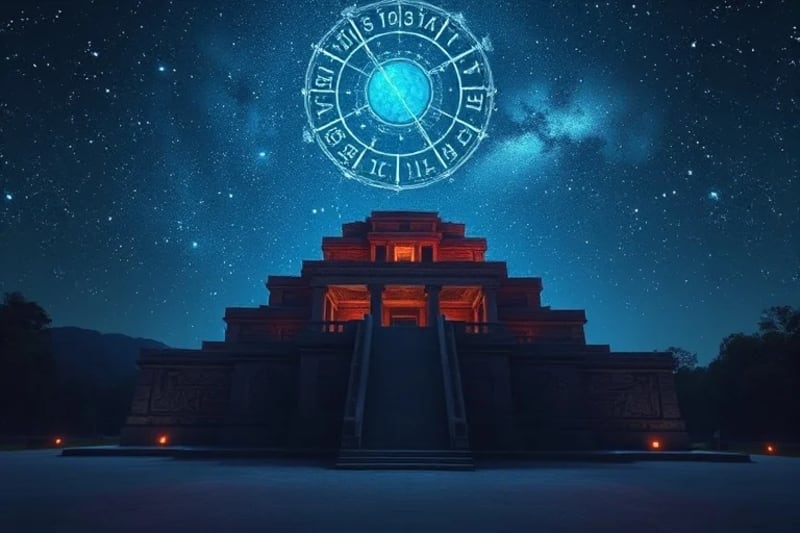 Precursors intellectuales, diagramas fundamentales y representaciones conceptuales que forjaron la visión de las civilizaciones mesoamericanas sobre la astrología y su conexión con la tecnología del futuro.
Fuente visual sujeta a disponibilidad del ecosistema: Wikimedia Commons bajo licencia CC BY-SA 4.0 o renderizado conceptual IA.
Table of Contents
- The Foundations of Mesoamerican Astrology
- Key Calendars and Their Significance
- The Role of Divination in Ancient Cultures
- Emergence of AI Oracles in Modern Astrology
- Synergy: How AI Can Interpret Ancient Data
- Ethical Considerations and Future Prospects
The Foundations of Mesoamerican Astrology
Unlike Western astrology, which primarily focuses on planetary positions within zodiac signs, Mesoamerican astrology is deeply rooted in complex calendrical systems and the cyclical nature of time. These systems were not merely tools for tracking days but served as sacred frameworks for understanding the universe, predicting events, and determining personal characteristics and destinies. The cosmos was viewed as an interconnected web, where human actions and celestial movements were intrinsically linked.
Ancient Mesoamerican societies, particularly the Maya and Aztec, developed an advanced understanding of astronomy, meticulously observing the movements of the sun, moon, Venus, and other celestial bodies. These observations were then integrated into their intricate calendars, which dictated religious ceremonies, agricultural cycles, and even political decisions. The core belief was that every day carried a unique energetic signature, influencing individuals born on that day and events occurring within its span.
The emphasis was less on individual personality traits in isolation and more on understanding one's place within the grand cosmic tapestry and the forces at play. This holistic approach contrasts with some modern astrological interpretations, aligning more closely with the ancient roots of Western Astrology: Hellenistic Roots & Traditions, which also emphasized fate and cosmic order. The wisdom derived from these systems provided guidance for navigating life's challenges and maximizing opportunities in harmony with universal rhythms.
Key Calendars and Their Significance
The Maya civilization, renowned for its intellectual achievements, developed some of the most sophisticated calendrical systems known to humanity. Central to their astrological and divinatory practices were two primary calendars that interlocked to create a larger cycle:
The Tzolkin (Sacred Round): This 260-day calendar combined 20 day-names with 13 numbers, resulting in 260 unique day combinations. Each day had a specific energy and meaning, influencing personality, destiny, and the auspiciousness of events. It was primarily used for divination, naming children, and determining the timing of rituals.
The Haab' (Civil Calendar): A 365-day solar calendar, similar to our Gregorian calendar, consisting of 18 months of 20 days each, plus a 5-day "unlucky" period called Wayeb'. The Haab' regulated agricultural cycles, seasonal changes, and public ceremonies.
These two calendars intermeshed to form a 52-year cycle, known as the Calendar Round, after which the same Tzolkin and Haab' day combination would repeat. The Aztecs utilized similar systems, with the Tonalpohualli (260-day sacred calendar) and the Xiuhpohualli (365-day solar calendar) serving comparable functions. These calendars were not just time-keeping devices; they were living prophecies, maps of cosmic energy, and guides for human existence.
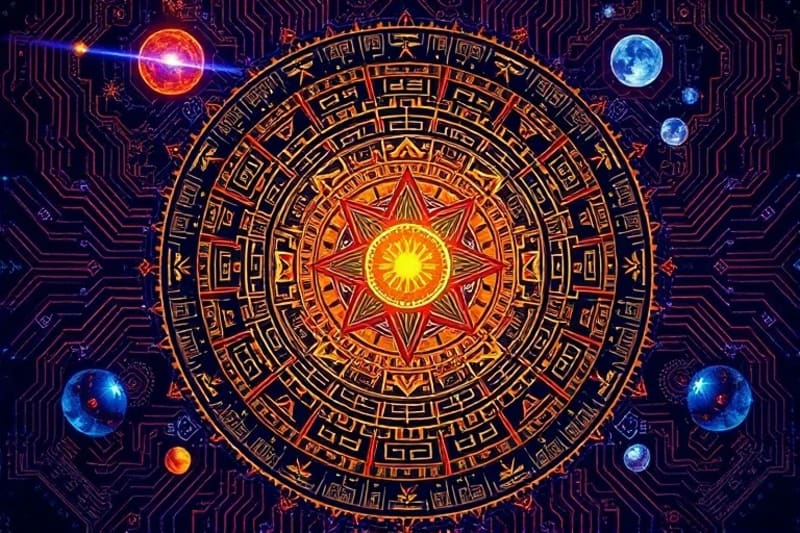 A visual representation of ancient calendrical systems evolving into modern technological interfaces, symbolizing the bridge between historical knowledge and future innovation.
The intricate nature of these calendars and their associated glyphs and deities made their interpretation a specialized skill, often reserved for priests and trained astrologers. Understanding the interplay of these cycles was crucial for personal guidance, community planning, and maintaining harmony with the divine forces. The table below outlines the primary calendars of the Maya and Aztec civilizations:
| Civilization | Sacred Calendar | Solar Calendar | Purpose |
|---|---|---|---|
| Maya | Tzolkin (260 days) | Haab' (365 days) | Divination, ritual timing, personal destiny, agricultural cycles. |
| Aztec | Tonalpohualli (260 days) | Xiuhpohualli (365 days) | Auspicious days, personal character, agricultural planning, religious festivals. |
| Zapotec | Pije (260 days) | Yza (365 days) | Similar functions to Maya and Aztec, adapted to their specific cosmology. |
The Role of Divination in Ancient Cultures
Divination was not merely a mystical practice in Mesoamerican societies; it was a practical and essential aspect of governance, social structure, and individual well-being. Priests and calendar specialists, known as day-keepers, were responsible for interpreting the complex interplay of calendrical energies. They would consult the sacred calendars to determine the most auspicious days for planting crops, going to war, conducting marriages, or performing religious ceremonies.
For individuals, a birth chart based on the Tzolkin or Tonalpohualli would reveal inherent strengths, challenges, and life paths. This information was used to guide personal decisions, understand relationships, and align one's actions with cosmic forces. The insights gained from these divinatory readings were considered invaluable, providing a sense of order and purpose in a world deeply connected to natural rhythms.
The ethical dimension of these practices was paramount. Diviners were expected to uphold strict moral codes and use their knowledge responsibly, always for the benefit of the community and individuals. This emphasis on integrity resonates with modern discussions surrounding Ethical Psychic Readings, highlighting the timeless importance of responsible interpretation and guidance.
Emergence of AI Oracles in Modern Astrology
The advent of Artificial Intelligence has opened new avenues for exploring complex systems, including ancient astrological traditions. AI oracles, in this context, refer to sophisticated computational models capable of processing vast datasets, recognizing intricate patterns, and performing complex calculations that would be impossible for human analysts alone. These systems can go beyond simple data retrieval, offering interpretive capabilities based on learned patterns and rules.
In modern astrology, AI is already being utilized to analyze birth charts, predict planetary transits, and even generate personalized astrological reports. Its ability to sift through millions of data points allows for the identification of subtle correlations and influences that might otherwise be overlooked. This technological leap provides a powerful tool for deepening our understanding of astrological principles, both ancient and contemporary.
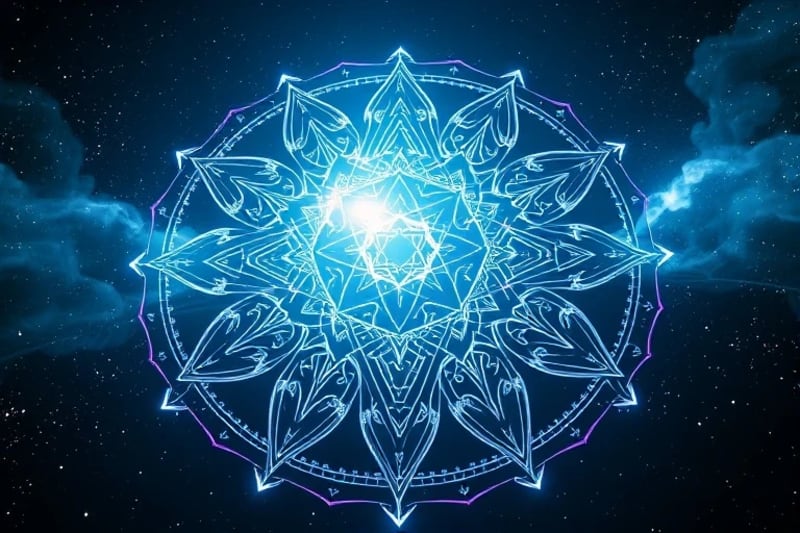 A conceptual visualization of how ancient cosmic patterns and AI algorithms can merge to create new forms of understanding and prediction.
The application of AI to Mesoamerican astrology is particularly compelling due to the highly structured and mathematical nature of its calendrical systems. The precision of these ancient calculations makes them ideal candidates for computational analysis. As discussed in Astrology and Artificial Intelligence, the potential for AI to personalize cosmic predictions is immense, offering a new dimension to how we interact with astrological insights.
Synergy: How AI Can Interpret Ancient Data
The synergy between Mesoamerican astrology and AI lies in the latter's capacity to process and interpret the vast, complex, and often fragmented data from ancient texts and artifacts. AI can be trained on existing knowledge bases, including glyph dictionaries, calendrical correlations, and historical accounts of astrological interpretations. This allows for a systematic and comprehensive analysis that transcends human limitations in processing sheer volume.
Here are some ways AI can bridge ancient wisdom with modern interpretation:
Pattern Recognition: AI algorithms excel at identifying subtle, recurring patterns within large datasets. This can be applied to calendrical sequences, astronomical observations, and historical events to uncover previously unnoticed correlations in Mesoamerican astrology.
Automated Translation and Interpretation: AI can assist in translating ancient glyphs and texts, and by cross-referencing with known interpretations, it can offer potential meanings for ambiguous or lost sections of astrological knowledge.
Predictive Modeling: By analyzing historical data of celestial events and their associated outcomes (e.g., harvests, wars, births), AI can build predictive models based on Mesoamerican astrological principles, offering insights into future trends.
Personalized Readings: Based on an individual's birth date within the Mesoamerican calendrical system, AI can generate highly detailed and personalized readings, drawing from a comprehensive database of glyph meanings, numerical influences, and cosmic energies.
Cross-Cultural Comparison: AI can facilitate comparative studies between Mesoamerican astrology and other ancient or modern astrological systems, highlighting universal themes and unique cultural perspectives.
This computational approach does not seek to replace human intuition or spiritual understanding but rather to augment it, providing a robust analytical framework that can help preserve and disseminate this invaluable cultural heritage. It allows for a systematic exploration of hypotheses and the discovery of new connections within these ancient systems.
Ethical Considerations and Future Prospects
While the potential of bridging Mesoamerican astrology with AI is vast, it also comes with significant ethical considerations. The primary concern is the respectful and accurate interpretation of cultural heritage. It is crucial to ensure that AI models are developed in collaboration with indigenous scholars and experts to avoid misrepresentation, appropriation, or the dilution of the original spiritual and cultural contexts.
Data bias is another critical factor. If the AI is trained on incomplete or biased historical records, its interpretations could perpetuate inaccuracies or harmful stereotypes. Therefore, meticulous curation of training data and continuous validation by human experts are indispensable. The goal should be to enhance understanding, not to create a purely mechanistic or culturally insensitive system.
The future prospects, however, are incredibly promising. AI oracles could make Mesoamerican astrological insights more accessible to a global audience, fostering a deeper appreciation for these ancient wisdom traditions. They could also serve as powerful research tools for archaeologists, historians, and anthropologists, helping to reconstruct lost knowledge and uncover new dimensions of these civilizations.
Moreover, the integration of AI could lead to innovative applications, such as personalized daily guidance based on Mesoamerican cycles, educational platforms, and even tools for promoting cultural preservation. By combining the analytical power of AI with the profound wisdom of ancient astrology, we can create a new paradigm for understanding ourselves and our place in the cosmos, aligning with the principles of Quantum Manifestation and Ethical AI in co-creating a more informed reality.
In conclusion, the fusion of Mesoamerican astrology with AI oracles represents an exciting frontier that honors the past while embracing the future. It offers a pathway to unlock ancient secrets, gain profound self-knowledge, and navigate the complexities of modern life with the guidance of cosmic wisdom, all while ensuring ethical and culturally sensitive development.
Related Searches
- Eclipses Astrology Portals Change Transformation Guide
- Lunar Phases Guided Meditation: Emotional Well-being
- Ceres Composite Charts: Nurturing Dynamics Advanced Astrology
- Spirit Animals Power Connections Meanings Guide
- Astrocartography: Best Places to Live with Your Birth Chart
- Monkey Ingenuity: Advanced Business Leadership Strategies Innovation
- Sagittarius Zodiac Sign: Adventure, Philosophy, Freedom
- Uranus Sign: Innovation, Rebellion, Change Explained
- Pig Zodiac: Traits, Compatibility, 2024 Forecast
- Astro-Genomics Ancestral Karmic Blueprints DNA Patterns
- Advanced Automatic Writing: Higher Selves & Spirit Guides
- Electional Astrology: Timing for Self-Improvement
Source: Hybrid content assisted by AI and human editorial supervision.


Comments
Post a Comment