
Astro-Economics: Predicting Financial Markets Planetary Cycles
Astro-economics is a fascinating, albeit controversial, interdisciplinary field that seeks to identify correlations between planetary cycles and movements, and trends within financial markets. Proponents suggest that celestial mechanics, long associated with human behavior and natural phenomena through astrology, may also exert subtle influences on collective psychology, leading to discernible patterns in economic activity and market fluctuations. This approach moves beyond conventional economic indicators, proposing a cosmic rhythm underlying global finance.
While mainstream economics relies on fundamental and technical analysis, astro-economics delves into the esoteric, exploring how planetary alignments, ingresses, and retrogrades might coincide with periods of market volatility, growth, or decline. It posits that these cosmic events could trigger shifts in investor sentiment, consumer confidence, and even geopolitical stability, which in turn impact stock prices, commodity values, and currency exchange rates. Understanding this perspective requires an open mind to the intersection of ancient wisdom and modern financial systems.
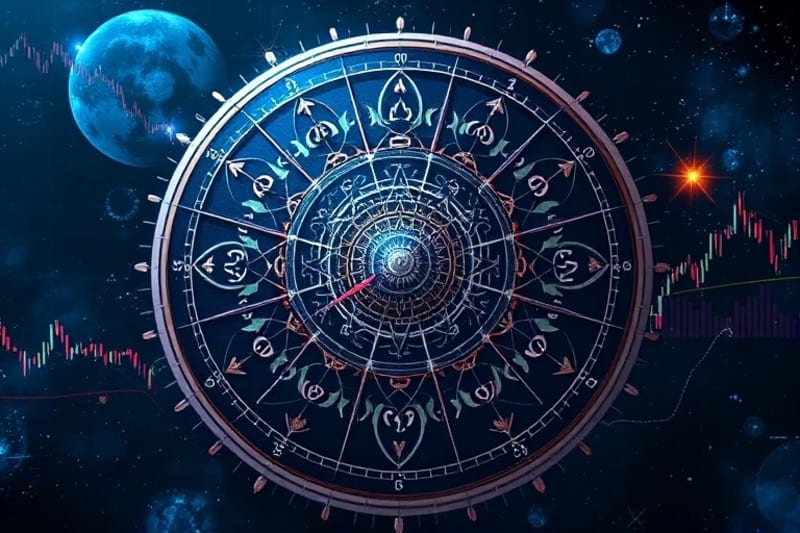 A cosmic clock face intertwining planetary symbols with abstract financial market charts, illustrating the theoretical connection between celestial movements and economic trends.
This introductory guide aims to provide an educational overview of astro-economics, exploring its foundational concepts, historical context, and the various methodologies employed by its practitioners. We will also touch upon the scientific skepticism surrounding the field and its place within the broader spectrum of financial analysis, offering a balanced perspective on its potential and limitations.
- 1. Introduction to Astro-Economics
- 2. Historical Roots and Key Proponents
- 3. Core Astrological Principles in Finance
- 4. Planetary Cycles and Market Correlations
- 5. Methodologies for Astro-Economic Analysis
- 6. Scientific Scrutiny and Skepticism
- 7. Modern Perspectives and Niche Applications
- 8. Integrating Astro-Economics with Traditional Analysis
- 9. Ethical Considerations and Responsible Practice
1. Introduction to Astro-Economics
Astro-economics is a specialized branch of financial astrology that explores the potential influence of celestial phenomena on economic trends and market behavior. Unlike traditional financial analysis, which focuses on macroeconomic data, company fundamentals, and technical chart patterns, astro-economics investigates the rhythmic patterns of planetary movements and their purported correlations with human collective psychology and, consequently, financial decisions.
The core premise is that the same astrological principles that describe individual personality traits and life events can be scaled up to understand societal moods and economic cycles. This perspective suggests that planetary alignments, such as conjunctions, oppositions, and squares, might coincide with significant shifts in market sentiment, leading to bull or bear markets, commodity booms, or economic downturns. It's a field that requires a deep understanding of both astrological calculations and financial market dynamics.
2. Historical Roots and Key Proponents
The idea of celestial influence on earthly affairs dates back millennia, with ancient civilizations observing planetary movements and associating them with harvests, wars, and the rise and fall of empires. While not directly "astro-economics" in the modern sense, these early observations laid the groundwork for the belief in a cosmic order that impacts human society. The formal application of astrological principles to financial markets began to emerge more distinctly in the 20th century.
One of the most notable pioneers in this field was W.D. Gann, a legendary trader and analyst from the early 20th century. Gann developed complex trading methods that reportedly incorporated mathematical, geometrical, and ancient astrological principles to predict market movements. Although his exact methods remained largely proprietary and continue to be debated, his work significantly influenced subsequent generations of astro-economists and financial astrologers. Other figures like Louise McWhirter and George Bayer also contributed to the early literature on financial astrology, documenting observed correlations between planetary positions and market cycles.
3. Core Astrological Principles in Finance
Astro-economics utilizes several core astrological principles to analyze financial markets. These include the symbolism of planets, zodiac signs, houses, and aspects. Each element is interpreted not just for individual psychological impact, but for its collective manifestation in economic behavior.
- Planets: Each planet is associated with specific energies and themes. For instance, Jupiter is often linked to expansion, growth, and optimism, potentially correlating with bull markets. Saturn, conversely, represents contraction, discipline, and caution, which might coincide with bear markets or economic slowdowns. Uranus signifies sudden change and innovation, potentially leading to market volatility or technological booms, while Neptune relates to illusion, speculation, and bubbles. Pluto is associated with transformation, power, and debt cycles.
- Zodiac Signs: The twelve zodiac signs are believed to influence the "flavor" of planetary energies. For example, a planet in Aries might suggest impulsive market action, while in Taurus, it could indicate stability or resistance to change.
- Houses: While individual birth charts use 12 houses to describe areas of life, in mundane or financial astrology, specific houses might be associated with national economies, specific industries, or market sectors. For a deeper dive into the significance of houses in personal astrology, consider exploring the 5th House Astrology: Creativity, Romance, Children Guide.
- Aspects: These are the angular relationships between planets. Conjunctions (0°), oppositions (180°), squares (90°), and trines (120°) are considered particularly significant. Hard aspects (squares, oppositions) are often associated with tension, crisis, or sudden shifts, while soft aspects (trines, sextiles) might indicate harmonious growth or easier transitions.
4. Planetary Cycles and Market Correlations
The core of astro-economics lies in identifying recurring planetary cycles and correlating them with historical market data. Long-term cycles, particularly those involving outer planets like Jupiter, Saturn, Uranus, Neptune, and Pluto, are often considered to influence major economic shifts.
 A digital painting illustrating the symbolic influence of Jupiter and Saturn on a swirling vortex of currency symbols, representing their purported impact on market trends.
For example, the 20-year Jupiter-Saturn conjunction cycle is frequently cited. Historically, these conjunctions have been observed to coincide with significant economic turning points, often marking the beginning or end of major economic eras. The 84-year cycle of Uranus, associated with innovation and disruption, is also studied for its potential links to technological revolutions and sudden market upheavals. For more insights into Uranus's astrological significance, you can read about Uranus Astrology: Awakening, Rebellion, Birth Chart Insights.
Shorter cycles, such as the Mars cycle (approximately 2 years) or Mercury retrogrades, are sometimes used for more immediate, tactical trading decisions, though their influence is generally considered less profound than that of the outer planets. Mercury retrograde periods, for instance, are often associated with communication breakdowns and revisions, which some believe can manifest as market indecision or corrections. Understanding these Retrograde Cycles 2024: Navigating Personal Planet Shifts can offer a broader perspective on their perceived impact.
5. Methodologies for Astro-Economic Analysis
Practitioners of astro-economics employ a variety of methods to integrate astrological data with financial analysis. These methodologies often involve meticulous charting and historical pattern recognition.
- Mundane Charts: These are astrological charts cast for specific events, such as the founding of a nation, the incorporation of a company, or the opening of a stock exchange. Analysts then track transiting planets over these mundane charts to predict periods of stress or opportunity.
- Ingress Charts: An ingress chart is cast when a planet enters a new zodiac sign or a new cardinal point (0° Aries, Cancer, Libra, Capricorn). These moments are considered significant turning points, potentially marking shifts in market sentiment or economic policy.
- Eclipses: Solar and lunar eclipses are often seen as powerful astrological events that can trigger major shifts. In astro-economics, eclipses are sometimes correlated with market reversals, significant news events, or changes in leadership that impact the economy.
- Planetary Aspects and Cycles: As mentioned, the angular relationships between planets and their recurring cycles are primary tools. Analysts might look for specific aspects (e.g., a Jupiter-Pluto conjunction) that have historically coincided with particular market behaviors.
- Financial Astrology Software: Specialized software tools have been developed to help track planetary positions, calculate aspects, and overlay this data onto financial charts, making it easier for analysts to identify potential correlations.
6. Scientific Scrutiny and Skepticism
Despite the enthusiasm of its proponents, astro-economics faces significant skepticism from mainstream academia and the scientific community. The primary criticism centers on the lack of empirical evidence and a plausible causal mechanism linking planetary positions to financial market behavior. While correlations might be observed, establishing causation is a much higher bar.
Critics argue that observed correlations are often coincidental, a result of confirmation bias, or can be explained by other, more conventional economic factors. The complexity and sheer volume of astrological data points also make it possible to find patterns retrospectively, without predictive power. Furthermore, the efficient-market hypothesis, a cornerstone of modern financial theory, suggests that all available information is already reflected in asset prices, making it impossible to consistently profit from any predictive method, including astrological ones.
 A conceptual 3D render of a holographic birth chart projected over a global map, illustrating the theoretical connection between astrological positions and worldwide financial centers.
Many scientific studies attempting to validate astrological claims, including those related to financial markets, have generally yielded negative or inconclusive results. The scientific method demands testable hypotheses and reproducible outcomes, which astro-economics has largely struggled to provide in a rigorous, peer-reviewed context. Therefore, it remains largely outside the realm of accepted scientific and economic theory.
7. Modern Perspectives and Niche Applications
Despite scientific skepticism, astro-economics continues to attract a niche following among traders, investors, and astrologers. Its appeal often stems from the desire for alternative predictive tools, especially in volatile or uncertain market conditions where conventional methods may seem insufficient. Some practitioners view it as a complementary tool, offering a different lens through which to view market cycles and potential turning points.
Modern astro-economists often combine astrological analysis with traditional technical indicators, such as moving averages, Fibonacci retracements, and Elliott Wave theory. They might use astrological insights to confirm or challenge signals generated by conventional methods, or to identify periods of heightened probability for market reversals. The growth of online communities and specialized software has also made astro-economic tools more accessible to a wider audience, fostering continued interest and experimentation.
8. Integrating Astro-Economics with Traditional Analysis
For those who explore astro-economics, it is rarely used as a standalone predictive system. Instead, it is often integrated into a broader analytical framework that includes fundamental and technical analysis. The idea is to use astrological cycles as a supplemental layer of information, providing potential insights into market psychology or long-term trends that might not be immediately apparent from conventional data.
For instance, an astro-economist might identify a significant planetary alignment that historically correlates with a market peak. They would then look for confirmation from technical indicators, such as overbought conditions, declining volume, or bearish chart patterns, before making a trading decision. This approach treats astrology as a potential "early warning system" or a tool for understanding the underlying mood of the market, rather than a definitive predictor of price movements. Similarly, understanding Astro-Psychology: Jungian Archetypes, Birth Chart Analysis can provide a deeper understanding of the collective unconscious influences that might drive market behavior.
9. Ethical Considerations and Responsible Practice
Given the speculative nature of astro-economics and the lack of scientific validation, ethical considerations are paramount for anyone exploring this field. It is crucial for practitioners and enthusiasts to approach astro-economic predictions with a high degree of caution and to avoid making investment decisions based solely on astrological indicators.
Responsible practice dictates that astro-economic insights should be treated as hypothetical correlations rather than definitive forecasts. Financial decisions should always be underpinned by thorough research, risk management strategies, and, ideally, advice from qualified financial professionals. Over-reliance on any single predictive method, especially one lacking scientific consensus, can lead to significant financial losses. The field should be explored as a fascinating area of study, not as a guaranteed path to wealth.
In conclusion, astro-economics offers a unique and intriguing lens through which to view the complexities of financial markets. While it remains outside the mainstream of economic thought, its historical roots and continued niche interest highlight humanity's enduring quest to find order and predictability in both the cosmos and our economic systems. For those interested in exploring alternative perspectives on market dynamics, astro-economics provides a rich field for study and personal experimentation, always with a healthy dose of skepticism and responsible financial planning.
Explore Further: Related Insights
-
Lunar Mansions Urban Geomancy City Dwellings Alignment
Discover how ancient lunar mansions influence urban planning and geomancy, aligning city dwellings with cosmic energies.
-
Diccionario Blockchain Criptomonedas: Guía Esencial Principiantes
An essential guide for beginners to understand the complex terminology of blockchain and cryptocurrencies.
-
Año Dragón Madera: Impacto en los 12 Signos Chinos 2024
Explore the astrological predictions and impact of the Wood Dragon year 2024 on all twelve Chinese zodiac signs.
-
Relationship Astrology: Synastry, Composite Charts, Couple Dynamics
Delve into the intricate world of relationship astrology, understanding synastry and composite charts for couple dynamics.
Source: Hybrid content assisted by AI and human editorial supervision.


Comments
Post a Comment