
Urban Geomancy Celestial Mechanics City Energy Well-being
The intricate tapestry of urban environments, far from being mere aggregations of concrete and steel, possesses a profound energetic blueprint. This blueprint is shaped not only by human design and infrastructure but also by subtle, yet powerful, cosmic and telluric forces. Urban geomancy and celestial mechanics offer advanced frameworks for understanding these influences, proposing that the well-being of a city and its inhabitants is deeply intertwined with its energetic alignment.
This exploration delves into the sophisticated interplay between the Earth's natural energy grids, the rhythmic dance of celestial bodies, and the conscious or unconscious design choices that define our urban landscapes. By integrating ancient wisdom with contemporary scientific understanding, we can uncover how cities can be optimized to foster greater harmony, vitality, and health for all who reside within them.
Understanding this energetic architecture is not merely an academic exercise; it provides actionable insights for urban planners, architects, and policymakers aiming to create environments that genuinely support human flourishing. From the layout of streets to the placement of public spaces, every element contributes to the overall energetic resonance of a city.
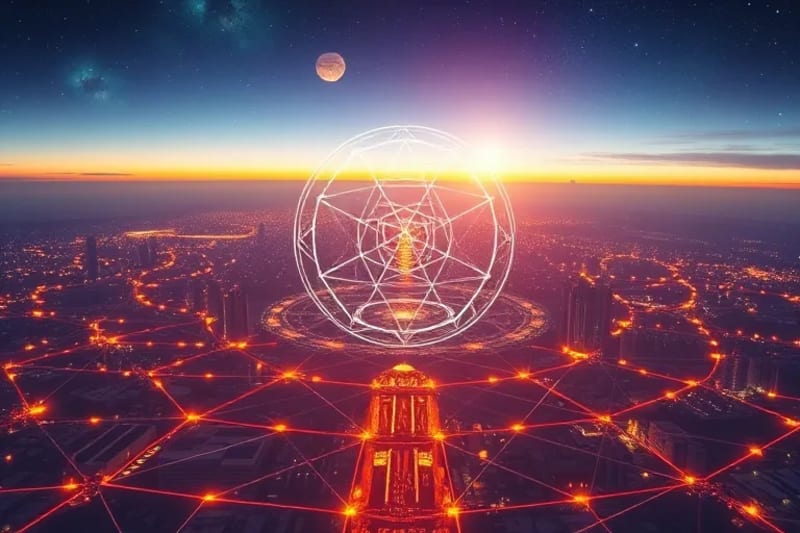 Conceptual representation of urban energetic flows, illustrating the intricate interplay between celestial mechanics and geomantic principles in city design.
Fuente visual sujeta a disponibilidad del ecosistema: Wikimedia Commons bajo licencia CC BY-SA 4.0 o renderizado conceptual IA.
Historical Roots of Urban Geomancy
Urban geomancy, the ancient art and science of understanding the Earth's energy lines and their influence on human habitats, has been a cornerstone of city planning for millennia. Civilizations across the globe, from the ancient Chinese with their sophisticated Feng Shui practices to the Egyptians and Romans, meticulously aligned their settlements with perceived telluric currents and cosmic rhythms.
These cultures recognized that specific locations possessed unique energetic qualities, which could either enhance or diminish the vitality of a community. The placement of temples, palaces, and even entire cities was often determined by these geomantic considerations, aiming to harness beneficial energies and mitigate detrimental ones. This approach was not mystical in isolation but rather a pragmatic understanding of natural forces.
In China, Feng Shui masters employed complex calculations to orient buildings and design landscapes to optimize the flow of "qi" (life force energy). This involved considering mountains, water bodies, wind patterns, and the cardinal directions. Similarly, ancient Roman cities were often laid out along a grid aligned with the sun's path, reflecting a deep awareness of celestial influences on terrestrial organization.
The concept of "ley lines," invisible energy pathways crisscrossing the Earth, has been a recurring theme in various geomantic traditions. While modern science continues to explore the mechanisms behind these phenomena, the historical evidence of their application in ancient urban planning is compelling. These lines were often associated with sacred sites, megalithic structures, and significant natural features, forming an energetic network across landscapes.
Celestial Mechanics and Urban Design
Beyond the Earth's immediate energetic field, the movements and positions of celestial bodies exert a profound influence on terrestrial phenomena, including urban environments. Celestial mechanics, the study of the motions of astronomical objects, provides a framework for understanding these cosmic rhythms and their potential impact on city planning and human well-being. Ancient civilizations were acutely aware of these connections, integrating astronomical observations into their architectural and urban design principles.
The alignment of major structures with solstices, equinoxes, and specific planetary risings was common practice, intended to imbue these spaces with particular energetic qualities or to mark significant temporal cycles. For instance, many ancient temples and monuments, such as Stonehenge or the pyramids of Giza, exhibit precise astronomical alignments, suggesting a deliberate effort to harmonize human creations with cosmic order. This deep understanding of cosmic patterns informed not only ceremonial sites but also the fundamental layout of settlements.
Astrological considerations, a branch of celestial mechanics in its broader philosophical sense, played a role in determining auspicious times for founding cities or constructing key buildings. The positions of planets and constellations were believed to confer specific qualities or destinies upon the undertakings. While often viewed as esoteric, these practices were rooted in centuries of empirical observation of correlations between celestial events and earthly occurrences.
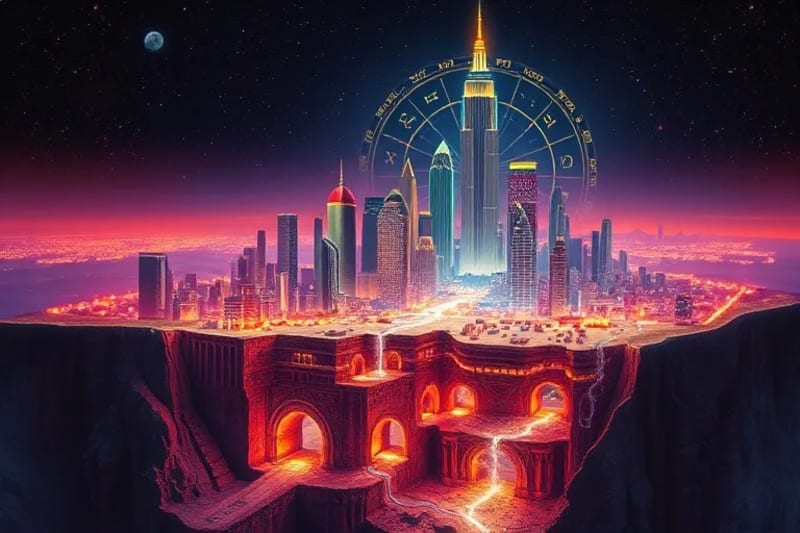 Ancient city foundations integrated with modern architectural elements, showing cosmic and telluric energy flows.
Modern research in chronobiology and geomagnetism is beginning to provide scientific validation for some of these ancient insights, demonstrating how solar and lunar cycles, as well as planetary alignments, can influence everything from human physiology to geological activity. The concept of Planetary Meditation: Connecting Celestial Archetypes highlights how individuals can consciously align with these energies, suggesting a broader potential for urban environments to do the same.
The orientation of buildings to maximize natural light or to align with prevailing winds are practical applications of understanding celestial and atmospheric mechanics. However, a deeper integration would involve considering the subtle energetic flows associated with these alignments, creating spaces that resonate with cosmic harmony. This advanced perspective moves beyond mere functionality to embrace the energetic quality of space.
The Energetic Blueprint of Modern Cities
Unlike their ancient counterparts, many modern cities have developed with less conscious consideration for geomantic principles or celestial alignments. Rapid industrialization and a focus on efficiency often led to urban sprawl and design choices that inadvertently disrupt natural energy flows. The dense concentration of electromagnetic fields from power lines, communication networks, and electronic devices creates a complex energetic environment that can impact human well-being.
Urban heat islands, caused by extensive concrete and asphalt surfaces, alter local climates and energy distribution. Pollution, both atmospheric and energetic, further contributes to a disharmonious urban blueprint. These factors, while often addressed through environmental regulations, also have subtle energetic implications that are less frequently considered in conventional urban planning.
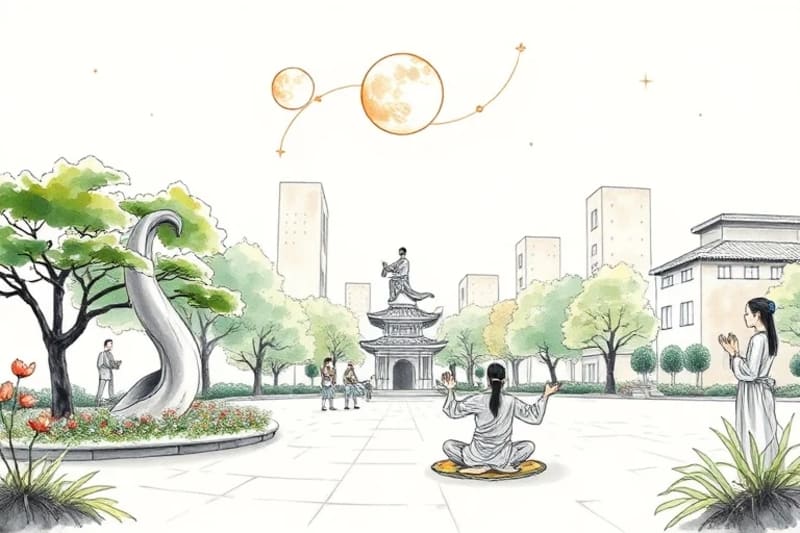 A tranquil urban park with people meditating, surrounded by eco-friendly architecture and subtle planetary influences.
The constant hum of city life, the relentless pace, and the lack of natural spaces can lead to increased stress, anxiety, and a disconnection from natural rhythms. From an energetic perspective, this signifies an imbalance in the city's overall field, which can then manifest as various forms of dis-ease within the population. Recognizing these energetic disruptions is the first step towards remediation.
However, not all modern urban development is energetically discordant. Some contemporary architects and urban designers are beginning to re-integrate principles of sacred geometry, biophilic design, and sustainable practices that inherently align with natural energy flows. These efforts represent a conscious shift towards creating urban environments that are not just functional but also energetically supportive.
Practical Applications for Urban Well-being
Integrating urban geomancy and celestial mechanics into contemporary urban planning offers a powerful pathway to enhance well-being. This involves a multi-faceted approach, combining ancient wisdom with modern technology and ecological principles. The goal is to create cities that are not only sustainable but also energetically vibrant and supportive of human life.
Key applications include:
- Strategic Green Spaces: Designing parks and green corridors to align with natural ley lines or water flows, enhancing the circulation of positive energy. These spaces can act as energetic anchors and purification zones within the urban fabric.
- Water Features: Incorporating fountains, ponds, and natural waterways not just for aesthetic appeal but for their energetic properties. Flowing water is known to activate and cleanse subtle energies, contributing to a more vibrant environment.
- Sacred Geometry in Architecture and Public Art: Utilizing geometric patterns derived from nature and ancient traditions in building designs and public installations. These patterns are believed to resonate with universal energies, creating harmonizing effects.
- Orientation and Alignment: Consciously orienting buildings and public spaces to cardinal directions, solar paths, or even specific celestial events. This can optimize natural light, airflow, and subtle energetic reception, akin to the principles used in Horary Astrology: Answering Specific Questions with a Chart, where precise timing and orientation are crucial.
- Mitigating Electromagnetic Pollution: Implementing design strategies to reduce exposure to harmful electromagnetic fields (EMFs) from modern infrastructure. This could involve shielding, strategic placement of power lines, and promoting "digital detox" zones.
- Biophilic Design: Integrating natural elements and patterns into urban design to foster a deeper connection between humans and nature. This approach inherently supports energetic balance and psychological well-being.
Case studies from cities like Freiburg, Germany, known for its sustainable urban planning, or traditional Japanese gardens, demonstrate how thoughtful design can create environments that feel inherently balanced and restorative. While not explicitly framed in geomantic terms, their success often lies in an intuitive alignment with natural principles. Furthermore, understanding the energetic balance of the human body, as explored in Chinese Zodiac Health: Wellness Tips & Elemental Balance, provides a parallel for how cities too require elemental and energetic equilibrium.
The Future of Urban Energetics
As we move towards an increasingly technologically advanced future, the integration of urban geomancy and celestial mechanics offers a unique opportunity to shape smart cities with a conscious energetic dimension. The same technologies that can create energetic discord can also be harnessed to measure, analyze, and optimize urban energy fields. Sensors could detect subtle electromagnetic anomalies, geological stresses, or even the energetic resonance of public spaces.
Imagine urban planning software that not only considers zoning, traffic flow, and environmental impact but also overlays geomantic maps and celestial alignment data. This would allow for the predictive modeling of energetic well-being, enabling designers to create cities that are inherently more harmonious and life-affirming. The concept of a "living city" that breathes and adapts to its inhabitants' energetic needs could become a reality.
Furthermore, educational initiatives could raise public awareness about the energetic dimension of urban living, empowering citizens to participate in the co-creation of their environments. From community gardens designed with permaculture and geomantic principles to public art installations that incorporate sacred geometry, the possibilities are vast. The insights from practices like Tree Life Tarot: Kabbalah's Sephiroth Self-Discovery Journey emphasize the interconnectedness of all things, a principle that can be applied to urban design.
The future of urban energetics lies in a holistic approach that acknowledges the profound connection between the Earth, the cosmos, and human experience. By consciously designing our cities to resonate with these fundamental forces, we can foster environments that support not just physical health but also mental clarity, emotional balance, and spiritual growth, leading to a truly thriving urban civilization.
Conclusion
The energetic blueprint of cities is a complex and dynamic system, influenced by both terrestrial geomancy and celestial mechanics. By re-engaging with ancient wisdom and integrating it with modern scientific understanding and technological capabilities, we have the opportunity to transform our urban environments from mere functional spaces into vibrant, life-enhancing ecosystems. The well-being of future generations hinges on our ability to design cities that are not only smart and sustainable but also deeply aligned with the energetic rhythms of the Earth and the cosmos.
Embracing this holistic perspective in urban planning and design can lead to cities that foster greater harmony, vitality, and a profound sense of connection for all who inhabit them. The journey towards creating such energetically optimized cities is a testament to humanity's evolving understanding of its place within the grand cosmic design.
Explore Further: Related Insights
- Fixed Stars Synastry: Galactic Influence Relationships
- Ethical Psychic Readings: Guide to Integrity
- Lunar Mansions: Decoding Ancient Arabic Astrology for Modern Insights and Timing
- Lilith in Houses: Embracing Your Shadow Self & Wild Feminine
- Dream Interpretation: Unlocking Subconscious Messages
- Astro-Economics: Predicting Financial Markets Planetary Cycles
- Ábaco Cuántico: Algoritmos, Historia, Futuro Computación
- Rosario Cuántico: Uniendo Fe, Mente, Conciencia IA
Source: Hybrid content assisted by AI and human editorial supervision.


Comments
Post a Comment