
I Ching Western Astrology: Synchronicities Deeper Guidance | StarPluto
In the vast tapestry of ancient wisdom traditions, two systems stand out for their enduring power to offer insight into human experience and destiny: the I Ching, an ancient Chinese oracle, and Western Astrology, a study of celestial influences. Both have been used for millennia to navigate life's complexities, understand personal patterns, and seek guidance. While originating from distinct cultural and philosophical contexts, a closer examination reveals fascinating synchronicities that can deepen our understanding and provide a more holistic approach to self-discovery.
This article delves into the core principles of both the I Ching and Western Astrology, exploring their historical development, fundamental methodologies, and the intriguing parallels that emerge when viewed through a lens of interconnectedness. By understanding how these systems can complement each other, individuals can unlock richer layers of guidance, moving beyond mere prediction to profound personal growth and awareness.
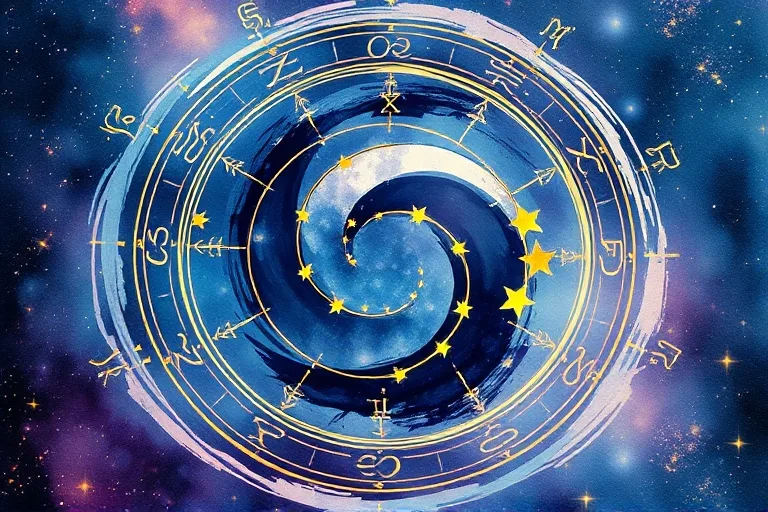
A visual representation of the interconnectedness between I Ching hexagrams and Western astrological symbols, illustrating their harmonious fusion in a cosmic design.
Table of Contents
- Introduction to I Ching and Western Astrology
- Historical Roots and Divergent Paths
- Core Principles of the I Ching
- Core Principles of Western Astrology
- Unveiling Synchronicities: Bridging the Systems
- Interpreting Guidance: A Combined Approach
- Practical Applications for Deeper Insight
- Benefits of Integrating Both Systems
- Addressing Skepticism and Embracing Nuance
- Conclusion: A Holistic Path to Wisdom
Introduction to I Ching and Western Astrology
The I Ching, often translated as the "Book of Changes," is one of the oldest and most revered texts in Chinese culture, dating back over three millennia. It is a system of divination and philosophy that utilizes 64 hexagrams, each composed of six lines (either solid for Yang or broken for Yin), to represent all possible states and transitions in the universe. Consulting the I Ching involves casting coins or yarrow stalks to generate a hexagram, which then provides an allegorical answer to a specific question, guiding the inquirer through complex situations.
Western Astrology, on the other hand, traces its origins to ancient Mesopotamia and later flourished in Hellenistic Egypt. It is a geocentric system that interprets the positions and aspects of celestial bodies—planets, Sun, Moon, and other points—at the moment of an individual's birth or a significant event. These cosmic configurations are believed to correlate with personality traits, life events, and potential challenges or opportunities. The natal chart, a snapshot of the heavens at birth, serves as a blueprint for an individual's psychological makeup and life path.
Historical Roots and Divergent Paths
While both systems offer profound insights, their historical trajectories are distinct. The I Ching evolved from ancient shamanic practices and philosophical inquiries in China, deeply influenced by Taoist and Confucian thought. Its emphasis is on understanding the dynamic interplay of opposing forces (Yin and Yang) and the constant flux of existence. It provides a framework for ethical decision-making and adapting to change, rather than predicting fixed outcomes.
Western Astrology, conversely, developed within a more deterministic worldview, initially intertwined with astronomy and mathematics. It sought to understand the "as above, so below" principle, where celestial movements mirrored earthly events. Over centuries, it integrated various philosophical and mystical traditions, including Neoplatonism and Hermeticism, evolving into the complex interpretive art practiced today. Despite their separate developments, both systems share a foundational belief in an ordered, meaningful cosmos where everything is interconnected.
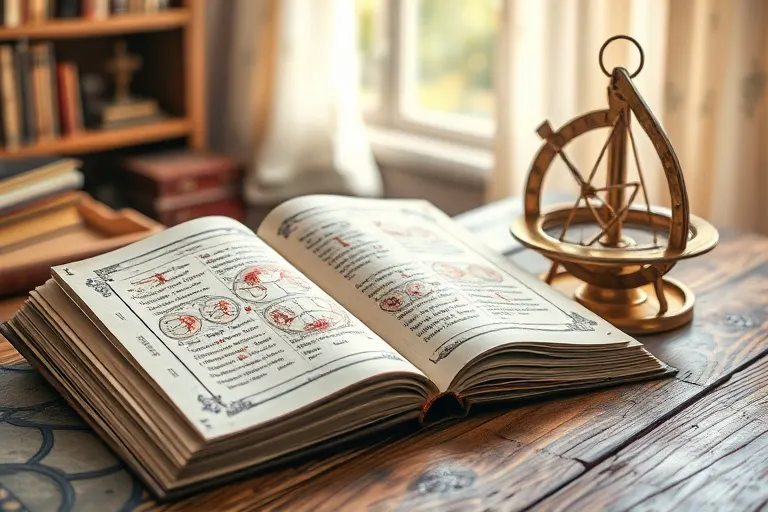
A conceptual still life featuring an open I Ching book alongside an antique astrolabe, symbolizing the tools used for ancient wisdom and celestial observation.
Core Principles of the I Ching
The I Ching operates on several fundamental principles that make it a unique tool for self-reflection and guidance:
- Yin and Yang: The universe is seen as a dynamic balance of complementary opposites. Yin represents femininity, darkness, receptivity, and stillness, while Yang represents masculinity, light, activity, and movement. Each hexagram is a unique combination of these forces.
- The 64 Hexagrams: These are the core symbols, each representing a specific situation, challenge, or opportunity. They are derived from combinations of two trigrams (three-line figures), which themselves symbolize fundamental natural phenomena like Heaven, Earth, Water, Fire, Mountain, Lake, Wind, and Thunder.
- Changing Lines: When consulting the I Ching, certain lines within a hexagram may be "changing," indicating a transition from one state to another. This leads to a "resulting hexagram," showing the direction of change and offering advice on how to adapt.
- Synchronicity: The I Ching is deeply rooted in the concept of synchronicity, as articulated by Carl Jung, who was a profound student of the text. It suggests that seemingly unrelated events are meaningfully connected, reflecting an underlying order in the universe. The hexagram generated is not random but a symbolic mirror of the inquirer's current situation and inner state.
The wisdom of the I Ching lies in its poetic and often paradoxical advice, encouraging introspection and a flexible approach to life's challenges. It teaches that change is constant and that wisdom lies in understanding the ebb and flow of circumstances, aligning oneself with the natural order.
Core Principles of Western Astrology
Western Astrology, while distinct, also rests on foundational principles that shape its interpretive framework:
- The Zodiac: A band of 12 constellations (signs) through which the Sun appears to travel over the course of a year. Each sign is associated with specific personality traits, elements (Fire, Earth, Air, Water), and modalities (Cardinal, Fixed, Mutable). For more on zodiac signs, you can explore resources on Tarot Quantum Mechanics Intersecting Divination Reality.
- Planets: Each planet (including the Sun and Moon, often referred to as luminaries) represents a specific psychological function or drive. For example, Mars signifies drive and assertion, while Venus represents love and values. Their positions in signs and houses modify their expression.
- Houses: The natal chart is divided into 12 houses, each representing a different area of life, such as self-identity, relationships, career, or home. The placement of planets and signs in these houses indicates where and how these energies are expressed in an individual's life.
- Aspects: These are the angular relationships between planets in the natal chart. Aspects like conjunctions, oppositions, squares, and trines describe the dynamic interplay and tension or harmony between planetary energies, revealing areas of strength, challenge, or potential. Learn more about Sextile Aspects Natal Chart.
Astrology provides a symbolic language to understand an individual's inherent potentials and challenges, offering a map for personal development and self-awareness. It highlights cycles and patterns, suggesting optimal timing for certain actions or periods of introspection.
Unveiling Synchronicities: Bridging the Systems
Despite their different origins and methodologies, the I Ching and Western Astrology exhibit remarkable synchronicities. Both systems are fundamentally concerned with understanding the flow of time and the patterns of energy that shape human experience. They offer frameworks for interpreting the present moment and anticipating future trends, not as fixed prophecies, but as probabilities and potentials.
- Cyclical Nature: Both systems emphasize the cyclical nature of existence. Astrology tracks planetary cycles and transits, while the I Ching describes the constant flux of situations, from rise to fall, from darkness to light. This shared understanding of cosmic rhythm fosters a perspective of adaptability and resilience.
- Symbolic Language: Each system employs a rich symbolic language to convey complex ideas. Hexagrams and their changing lines in the I Ching, and planets, signs, and houses in astrology, are all archetypal symbols that resonate with universal human experiences. This commonality allows for a deeper, intuitive understanding when integrating both.
- Holistic Perspective: Both aim to provide a holistic view of a situation or an individual. Astrology maps the entire personality and life path, while the I Ching offers a comprehensive assessment of a specific moment, including its past influences and future potentials. Together, they can offer a panoramic view that is both broad and detailed.
- Guidance for Action: Neither system is purely deterministic. Instead, they provide guidance that empowers individuals to make conscious choices. The I Ching offers advice on how to act or refrain from acting, while astrology highlights periods favorable for certain endeavors or areas requiring conscious effort.
The synchronicities suggest that these are not merely random divination tools but reflections of a deeper, underlying cosmic order. When used in conjunction, they can validate and expand upon each other's insights, creating a more robust framework for personal guidance.
Interpreting Guidance: A Combined Approach
Combining the I Ching and Western Astrology involves a nuanced approach, where insights from one system can illuminate or confirm those from the other. For instance, if an astrological transit indicates a period of significant change or challenge (e.g., a challenging Saturn transit), consulting the I Ching on how to navigate this specific period can provide practical, actionable advice.
Conversely, if an I Ching reading points to a particular theme, such as "The Wanderer" (Hexagram 56) or "Difficulty at the Beginning" (Hexagram 3), one might then look to their astrological chart for corresponding planetary placements or transits that highlight themes of travel, new beginnings, or overcoming initial obstacles. This cross-referencing helps to contextualize the guidance, making it more personal and relevant.

An abstract 3D render illustrating a glowing pathway formed by I Ching lines and planetary orbits, symbolizing a journey of profound inner discovery and guidance.
The key is not to force interpretations but to allow the wisdom of each system to naturally resonate with the other. This process often reveals deeper layers of meaning that might be missed when using only one system in isolation. It encourages a dialogue between the rational and intuitive mind, fostering a more profound connection to one's inner wisdom.
Practical Applications for Deeper Insight
Integrating the I Ching and Western Astrology offers several practical applications for navigating life with greater clarity:
- Personal Development: Use your natal chart to understand your innate strengths and challenges. When facing a specific personal growth area, consult the I Ching for advice on how to cultivate desired qualities or overcome obstacles.
- Decision Making: For significant life choices, astrology can indicate favorable periods or potential pitfalls. The I Ching can then provide specific tactical advice on the best course of action within that astrological context.
- Relationship Dynamics: Astrological synastry can reveal the energetic interplay between individuals. If a relationship faces a particular challenge, the I Ching can offer guidance on communication strategies or how to adapt to changing dynamics.
- Career and Vocation: Your Midheaven and 10th house in astrology point to career potential and public image. If you're at a crossroads in your career, the I Ching can provide insight into the current phase and suggest the most advantageous path forward.
By approaching both systems with an open mind and a willingness to engage in deep self-reflection, the combined insights can serve as a powerful compass, guiding you through life's intricate landscape.
Benefits of Integrating Both Systems
The integration of I Ching and Western Astrology offers a multitude of benefits for those seeking deeper guidance:
- Enhanced Clarity: When both systems align on a particular theme or message, it significantly amplifies the clarity and conviction of the guidance received. This dual confirmation can be incredibly reassuring.
- Holistic Perspective: Astrology provides the "what" and "when" (the inherent energies and timing), while the I Ching offers the "how" (the specific advice for action or inaction). This combination creates a truly holistic understanding.
- Personalized Insight: Each system, when applied to an individual's unique situation, yields highly personalized insights. The combination further refines this, tailoring the wisdom to the specific nuances of one's life.
- Deeper Self-Awareness: Engaging with both traditions encourages a profound journey of self-reflection. It helps individuals recognize their patterns, understand their motivations, and align their actions with their true purpose.
- Empowerment: Rather than fostering dependency, the combined use of these systems empowers individuals to take responsibility for their choices, offering a framework for navigating free will within the context of cosmic influences.
The synergy between these ancient practices transforms them from mere predictive tools into powerful instruments for personal growth and conscious living. They invite us to participate actively in our destiny, guided by the wisdom of the ages.
Addressing Skepticism and Embracing Nuance
It is natural for modern minds to approach ancient divination systems with a degree of skepticism. Both the I Ching and Western Astrology are often misunderstood as fortune-telling or superstitions. However, their enduring relevance lies not in their ability to predict fixed events, but in their capacity to provide symbolic reflections of inner states and external circumstances, fostering self-awareness and conscious decision-making.
From a scientific perspective, the mechanisms by which these systems operate are not empirically proven. Yet, their psychological and philosophical value has been acknowledged by thinkers like Carl Jung, who saw synchronicity as a meaningful acausal connecting principle. When engaging with the I Ching and astrology, it is crucial to adopt an interpretive, rather than a literal, mindset. They offer metaphors and archetypes that resonate with the human psyche, providing a language to articulate complex experiences.
The true power of these systems lies in their ability to stimulate intuition, encourage introspection, and offer alternative perspectives. They are not meant to replace critical thinking or personal responsibility but to augment them, acting as catalysts for deeper understanding and informed action. Embracing the nuance and symbolic richness of both traditions allows for a more profound and transformative experience.
Conclusion: A Holistic Path to Wisdom
The I Ching and Western Astrology, though born from different cultural cradles, converge in their profound ability to illuminate the human condition and guide individuals through life's intricate journey. Their synchronicities offer a compelling argument for a holistic approach to self-discovery, where the wisdom of the East and West can intertwine to provide a richer, more comprehensive tapestry of insight.
By understanding the cyclical nature of existence, interpreting symbolic languages, and embracing a perspective of empowerment, practitioners can leverage both systems to gain unparalleled clarity in decision-making, foster personal growth, and deepen their connection to the cosmic dance of life. The journey of integrating the I Ching and Western Astrology is one of continuous learning, introspection, and a profound appreciation for the universal patterns that shape our reality.
Fuente: Contenido híbrido asistido por IAs y supervisión editorial humana.


Comments
Post a Comment