
Vedic Western Astrology Differences Harmonizing Systems
Vedic vs. Western Astrology: Unveiling Key Differences and Harmonizing Ancient Wisdom Systems
Astrology, in its myriad forms, offers a profound lens through which humanity has sought to understand its place in the cosmos and the intricate dance between celestial movements and earthly existence. Among the most prominent and historically rich traditions are Western Astrology and Vedic Astrology, also known as Jyotish. While both systems aim to decipher the influence of planets and stars on human life, they diverge significantly in their foundational principles, calculations, and interpretive frameworks. Understanding these distinctions is crucial for anyone seeking a deeper, more nuanced astrological perspective.
This comprehensive guide delves into the core differences that set Vedic and Western astrology apart, exploring their historical origins, astronomical basis, and philosophical underpinnings. We will also examine how these seemingly disparate systems can be harmonized, offering a more holistic approach to self-discovery and destiny charting. By appreciating the unique strengths of each tradition, individuals can gain richer insights into their karma, psychological makeup, and life path.

Precursors, foundational diagrams, and conceptual representations that shaped the understanding of celestial mechanics in both Vedic and Western astrological traditions.
Fuente visual sujeta a disponibilidad del ecosistema: Wikimedia Commons bajo licencia CC BY-SA 4.0 o renderizado conceptual IA.
Table of Contents
- Understanding Western Astrology
- Understanding Vedic Astrology (Jyotish)
- Key Differences: A Comparative Overview
- Harmonizing the Systems: A Holistic Approach
- Practical Applications and Benefits
- Conclusion: Embracing Dual Perspectives
Understanding Western Astrology
Western Astrology, with its roots in ancient Mesopotamia and Hellenistic Egypt, primarily utilizes the Tropical Zodiac. This zodiac is based on the Earth's relationship to the Sun and the changing seasons. It begins with the vernal equinox (around March 20th), marking the start of Aries, and divides the ecliptic into twelve equal 30-degree segments, irrespective of the actual constellations in the sky. This system is fundamentally tied to the Earth's seasonal cycle, making it a geocentric model focused on the Sun's apparent path.
The primary focus of Western Astrology tends to be on the individual's psychological makeup, personality traits, and inherent potentials. It explores how planetary placements in signs and houses, along with the angular relationships between planets (aspects), shape one's character, motivations, and life experiences. Common house systems include Placidus, Koch, and Equal House, each offering a slightly different way to divide the astrological chart and interpret life areas. Predictive techniques often involve transits (current planetary movements over the natal chart) and progressions (symbolic advancement of the natal chart).
Western astrology is widely recognized for its emphasis on self-understanding and personal growth. It helps individuals identify their strengths, challenges, and patterns of behavior, offering guidance on how to navigate life's journey with greater awareness. The concept of decoding the wild feminine, for instance, often finds its place within Western astrological interpretations of celestial bodies like Lilith, adding layers to psychological analysis.
Understanding Vedic Astrology (Jyotish)
Vedic Astrology, or Jyotish, originates from ancient India and is deeply intertwined with Hindu philosophy, particularly the concepts of karma and dharma. Unlike its Western counterpart, Jyotish uses the Sidereal Zodiac, which is based on the actual positions of the constellations in the sky. This means it accounts for the precession of the equinoxes, a slow wobble of the Earth's axis that causes the vernal equinox point to shift backward against the backdrop of fixed stars over thousands of years. The difference between the tropical and sidereal zodiacs is known as the Ayanamsha, which currently amounts to approximately 24 degrees.
The primary focus of Vedic Astrology is on understanding one's karma, destiny, and spiritual path. It provides insights into past life influences and future potentialities, often emphasizing remedial measures (Upayas) to mitigate negative planetary effects. Key components of a Vedic chart analysis include:
- Nakshatras: 27 lunar mansions, each with unique characteristics and ruling deities, offering a more granular view of planetary energies.
- Dasha System: A complex system of planetary periods that indicates when specific planetary influences will be most prominent in a person's life, providing precise timing for events.
- Divisional Charts (Vargas): Numerous subsidiary charts derived from the main birth chart, each focusing on specific areas of life such as marriage (Navamsha), children (Saptamsha), or career (Dashamsha), offering incredible depth.
- Planetary Strengths (Shadbala): A sophisticated method for assessing the strength and influence of each planet in the chart.
Vedic astrology provides a framework for understanding the unfolding of life events and offers guidance on how to align with one's higher purpose. It often delves into aspects of karmic nodes and soul contracts, offering a spiritual dimension to astrological interpretation.
Key Differences: A Comparative Overview
The fundamental divergences between Vedic and Western astrology can be summarized across several key areas. These distinctions lead to different chart interpretations and predictive outcomes, making it essential to understand which system is being used.
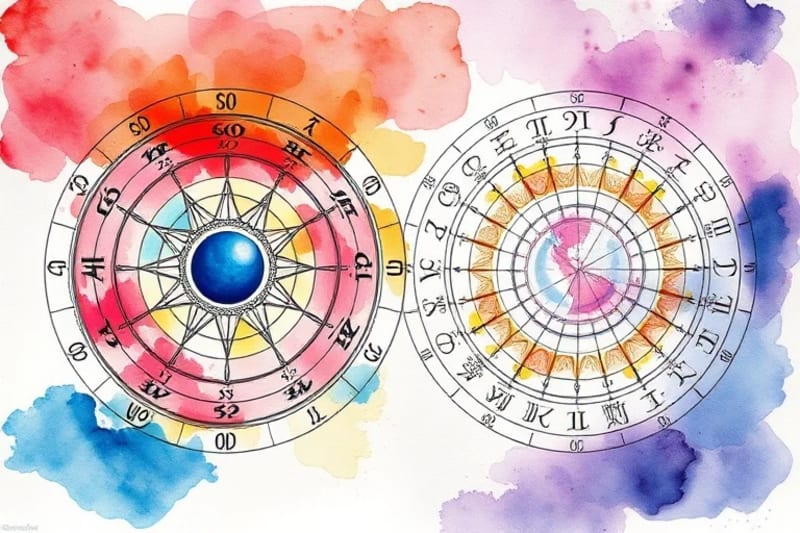
An abstract visualization blending the distinct energetic patterns of Western and Vedic astrological charts.
| Feature | Western Astrology | Vedic Astrology (Jyotish) |
|---|---|---|
| Zodiac System | Tropical Zodiac (based on seasons, Earth-Sun relationship) | Sidereal Zodiac (based on fixed stars, actual constellations) |
| Ayanamsha | Not used; zodiac is fixed to the equinox. | Crucial correction for the precession of equinoxes (approx. 24-degree difference). |
| Primary Focus | Psychological traits, personality, self-understanding, personal growth. | Karma, destiny, spiritual path, life events, material and spiritual evolution. |
| Planetary Rulerships | Traditional and modern rulers (e.g., Uranus for Aquarius, Pluto for Scorpio). | Only traditional rulers (e.g., Saturn for Aquarius, Mars for Scorpio). Outer planets (Uranus, Neptune, Pluto) are generally not used as primary rulers. |
| House Systems | Commonly Placidus, Koch, Whole Sign, Equal House. Houses often vary in size. | Predominantly Whole Sign House system, where each sign corresponds to a house. |
| Predictive Techniques | Transits, Progressions, Solar Arc Directions, Solar Return charts. | Dasha systems (Vimshottari Dasha being most common), Gochar (transits), Ashtakavarga, Muhurta (electional astrology). |
| Additional Tools | Chiron, asteroids, Arabic parts, fixed stars (less emphasis). | Nakshatras, Divisional Charts (Vargas), Yogas (planetary combinations), Gemstone/Remedial measures. |
| Cultural Context | Hellenistic, Roman, and modern psychological frameworks. | Hindu philosophy, karma, dharma, spiritual evolution. |
The 24-degree difference in zodiac alignment means that a person who is a Leo in Western astrology might be a Cancer in Vedic astrology. This shift profoundly impacts the interpretation of planetary placements, house positions, and ultimately, the overall chart reading. For example, the psychological insights offered by Western astrology often resonate deeply with an individual's conscious experience, while Vedic astrology tends to reveal deeper karmic patterns and life events that unfold over time, often through the precise timing of the Dasha system.
It is important to acknowledge that both systems, despite their differences, are complex and internally consistent. Neither is inherently "more accurate" than the other; rather, they offer different perspectives and insights into the human condition. The choice between them, or the decision to integrate them, often depends on an individual's personal goals for astrological study and self-understanding.
The philosophical underpinnings of Jyotish, for instance, are deeply rooted in ancient texts such as the Vedas, which delineate the principles of cosmic order and the interconnectedness of all phenomena. This contrasts with the more evolving, psychologically-oriented framework of Western astrology, which has incorporated modern psychological theories into its interpretive lexicon.
Harmonizing the Systems: A Holistic Approach
While a direct overlay of Vedic and Western charts can be confusing due to the Ayanamsha, it is entirely possible to derive immense benefit from studying both systems. Many modern astrologers advocate for a synthetic approach, utilizing the strengths of each tradition to create a more comprehensive picture of an individual's life. This harmonization does not mean blending the calculations but rather understanding the distinct insights each system provides.
Here's how one might approach harmonizing these two powerful traditions:
- Western for Psychology and Personality: Use the Western chart to understand your core personality, conscious motivations, relationship dynamics, and psychological patterns. It excels at describing "who you are" on a conscious and subconscious level.
- Vedic for Karma and Life Events: Turn to the Vedic chart for insights into your karmic blueprint, life purpose, specific timing of major life events, and spiritual lessons. Its predictive tools, like the Dasha system, are unparalleled for understanding "when things will happen" and the underlying karmic forces at play.
- Medical Astrology: Both systems offer perspectives on health. Western astrology might highlight predispositions, while Vedic astrology can pinpoint periods of vulnerability or strength. Combining these can offer a proactive approach to charting wellness.
- Synastry and Relationships: Western synastry is excellent for understanding interpersonal chemistry and psychological compatibility. Vedic compatibility (Kuta matching) delves deeper into karmic connections, longevity, and family harmony.
A conceptual representation of ancient astrological knowledge from scrolls merging with contemporary digital interpretations.
The key is to avoid mixing the rules of one system with the other. Instead, view them as two distinct languages, each capable of conveying profound truths about the same underlying reality. By learning to speak both languages, one gains a richer, multi-dimensional understanding. This dual perspective can be particularly insightful when exploring complex planetary influences, such as those of the outer planets. While Uranus, Neptune, and Pluto are not traditionally used as primary rulers in Vedic astrology, their transits can still be felt and interpreted through the lens of collective psychology transits, offering a bridge between the two traditions.
Practical Applications and Benefits
The practical benefits of understanding both Vedic and Western astrology are immense. For individuals, it offers a more complete toolkit for self-exploration and life management. For astrologers, it expands their interpretive capabilities and allows for a more nuanced consultation.
Consider the following applications:
- Enhanced Self-Awareness: Western astrology can illuminate your conscious personality and psychological drives, while Vedic astrology reveals deeper karmic patterns and soul lessons. Together, they paint a holistic picture of your being.
- Improved Timing and Decision-Making: Vedic Dasha systems provide precise timing for life events, helping you understand favorable and challenging periods. Western transits and progressions can offer additional layers of insight into current influences and opportunities for growth.
- Relationship Understanding: Analyze compatibility from both psychological (Western) and karmic/destiny (Vedic) perspectives for a more profound understanding of your connections.
- Career and Vocation: Both charts can indicate talents and suitable career paths. Vedic divisional charts (like Dashamsha) offer specific insights into professional life and success.
- Spiritual Growth: Vedic astrology is inherently spiritual, guiding individuals towards their dharma and spiritual evolution. Western astrology, particularly modern psychological approaches, can support personal transformation and healing.
By integrating the wisdom of both traditions, one can navigate life's complexities with greater clarity, purpose, and resilience. It's about leveraging the best of both worlds to foster a deeper connection with oneself and the cosmic rhythms that govern existence.
Conclusion: Embracing Dual Perspectives
The journey through Vedic and Western astrology reveals two distinct yet equally profound systems of celestial interpretation. While the Tropical Zodiac of Western astrology aligns with seasonal cycles and focuses on psychological development, the Sidereal Zodiac of Vedic astrology (Jyotish) aligns with fixed stars, emphasizing karmic patterns and life events through its intricate Dasha systems and divisional charts. The differences, particularly the Ayanamsha, lead to unique chart interpretations that are not interchangeable.
Rather than viewing them as competing paradigms, a holistic approach encourages the appreciation of each system's unique strengths. Western astrology offers invaluable insights into personality and conscious experience, while Vedic astrology provides a powerful framework for understanding destiny, timing, and spiritual evolution. By engaging with both, individuals can unlock a richer, multi-dimensional understanding of their cosmic blueprint, fostering enhanced self-awareness and a deeper connection to the universal energies that shape our lives. Embracing these dual perspectives allows for a more comprehensive and enriching astrological journey.
Explore More Cosmic Wisdom
- Augmented Reality Spiritual Growth
- Medical Astrology Health Proactive
- Karmic Nodes Vertex Conjunctions
- Numerology Karmic Debt Numbers
- Pendulum Dowsing Intuitive Guidance
- Lilith Astrology Decoding Wild Feminine
- Love Horoscope Decan Insights
- Urban Shamanism Connecting City Spirits
- Medical Astrology Health Patterns
- Planetary Candle Magic Rituals
- Numerology Beyond Life Path
- Lilith Karmic Astrology Shadow Selves
- Spirit Guides Celestial Support Team
- Davison Relationship Charts
- Astral Projection Out-of-Body Experiences
- Elon Musk: Visionary, Tycoon, Technology
- Dark Matter Dark Energy Cosmology
- Responsible AI Legal Challenges
- Past Lives Prophecies Birth Chart
- Chinese Horoscope 60 Years Predictions
- Collective Psychology Transits
- Forgotten Prophecies Indigenous Peoples
- Sacred Geometry Celestial Court
- Saint Faustina Kowalska Mystic
Source: Hybrid content assisted by AI and human editorial supervision.


Comments
Post a Comment