
Astro-Archeology: Ancient Celestial Narratives Significance
Astro-archeology stands as a fascinating interdisciplinary field, bridging the rigorous study of ancient cultures with the profound science of celestial mechanics. It delves into how ancient civilizations observed, interpreted, and integrated astronomical phenomena into their daily lives, spiritual beliefs, and monumental architecture. This discipline seeks to unearth the sophisticated understanding our ancestors possessed regarding the cosmos, revealing a deep connection between humanity and the stars that often transcends mere survival.
Far from being a fringe subject, astro-archeology provides critical insights into the intellectual capabilities and cultural complexities of past societies. It demonstrates that celestial observations were not just for practical purposes like timekeeping or navigation, but were fundamental to their worldview, influencing everything from religious rituals to agricultural cycles. By examining ancient structures and artifacts through an astronomical lens, we gain a richer appreciation for the ingenuity and spiritual depth of those who came before us.
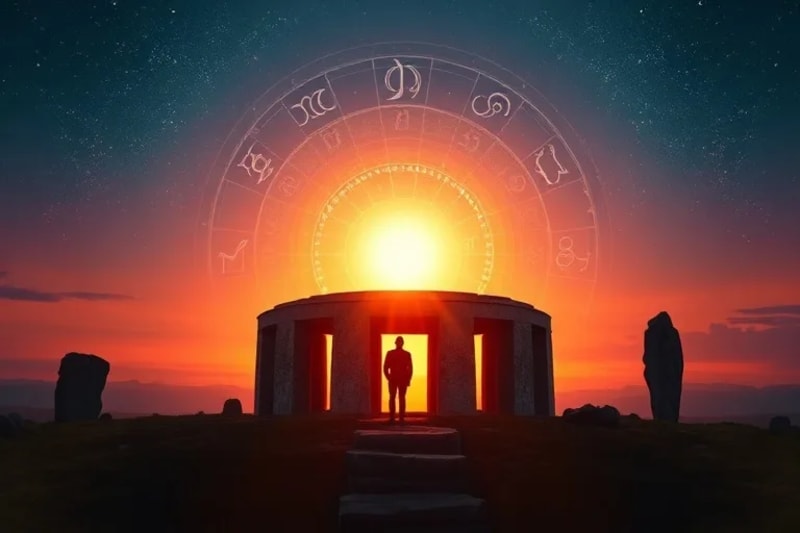 The profound connection between ancient civilizations and the cosmos, as revealed through monumental architecture and celestial alignments.
The Genesis of Celestial Observation
Humanity's relationship with the night sky is as old as civilization itself. From the earliest nomadic tribes to settled agricultural communities, observing the sun, moon, and stars was crucial for survival. These observations allowed for the development of calendars, predicting seasonal changes vital for planting and harvesting, and guiding migrations or trade routes across vast landscapes.
Early celestial narratives were often intertwined with creation myths and the origins of life. The rhythmic cycles of the cosmos provided a sense of order and predictability in an otherwise unpredictable world. This led to the deification of celestial bodies and the development of complex astrological systems that sought to understand the influence of the heavens on human affairs and destiny.
Iconic Astro-Archeological Sites and Their Secrets
Numerous sites across the globe bear testament to ancient astronomical prowess. These monumental constructions often served as observatories, calendars, and sacred spaces, all rolled into one. Their precise alignments with solstices, equinoxes, and specific stellar events reveal a sophisticated understanding of celestial mechanics that continues to awe modern researchers.
One of the most famous examples is Stonehenge in England, whose megalithic stones are meticulously aligned with the sunrise on the summer solstice and the sunset on the winter solstice. This alignment suggests its use as an ancient calendar and a site for seasonal rituals. The precision required for such an alignment, thousands of years ago, speaks volumes about the builders' astronomical knowledge.
In ancient Egypt, the Giza Pyramids are not only architectural marvels but also celestial markers. Research suggests that the three main pyramids align with the stars in Orion's Belt, a constellation deeply significant in Egyptian mythology, often associated with Osiris, the god of the afterlife. This cosmic connection underscores the spiritual dimension of their monumental construction.
 Intricate celestial maps and astrological symbols found on ancient artifacts, reflecting a meticulous study of the heavens.
The Mayan city of Chichen Itza in Mexico features the El Castillo pyramid, which exhibits a remarkable phenomenon during the spring and autumn equinoxes. The sun's angle creates a shadow that resembles a serpent descending the staircase, culminating in a stone serpent head at the base. This celestial spectacle was deeply integrated into their religious ceremonies and agricultural cycles, highlighting the importance of lunar phases astrology and solar observations for their society.
Further south, the enigmatic Nazca Lines in Peru, massive geoglyphs etched into the desert floor, are believed by some researchers to have astronomical significance. While their primary purpose remains debated, many of the animal and geometric figures align with celestial events or point to specific constellations, perhaps serving as a giant astronomical calendar or a sacred landscape for celestial worship.
Methodologies in Astro-Archeology
Astro-archeology employs a range of scientific methodologies to uncover and interpret ancient celestial knowledge. These methods combine archaeological excavation with astronomical calculations and cultural analysis.
- Archaeoastronomy: This is the core scientific approach, involving the precise measurement of alignments in ancient structures to determine their astronomical significance. Researchers use sophisticated surveying techniques and astronomical software to reconstruct the ancient sky and test hypotheses about celestial orientations.
- Ethnoastronomy: This sub-discipline studies the astronomical knowledge of contemporary indigenous cultures to gain insights into how ancient societies might have perceived and utilized the cosmos. It involves ethnographic fieldwork, collecting oral traditions, myths, and rituals related to celestial bodies.
- Iconographic Analysis: Examining ancient art, carvings, and texts for representations of celestial bodies, constellations, or astronomical events. This helps in understanding the symbolic and religious meanings attributed to the cosmos. This often involves deciphering ancient languages and astro-linguistics manifestation, revealing how celestial concepts were encoded.
- Mathematical and Computer Modeling: Using computational tools to simulate ancient skies from specific geographical locations and time periods. This allows researchers to verify potential alignments and understand the astronomical events visible to ancient observers.
These methods collectively paint a comprehensive picture of how deeply integrated celestial observations were into the fabric of ancient societies, moving beyond simple curiosity to a profound engagement with the universe.
Celestial Narratives: Shaping Culture and Belief Systems
Beyond their practical applications, celestial observations profoundly shaped the cultural and spiritual narratives of ancient peoples. The movements of planets, the changing phases of the moon, and the appearance of specific stars were often interpreted as divine messages or manifestations of powerful deities. These interpretations formed the bedrock of their mythologies, religious practices, and even social hierarchies.
Many cultures developed complex cosmologies where the heavens were seen as a direct reflection of earthly order, or even a realm where gods resided and influenced human destiny. For instance, the Andean civilizations, as explored in Cosmología Andina: Arquetipos Pachamama en tu Carta Natal, integrated celestial patterns into their worldview, connecting the movements of stars with the cycles of life and the sacredness of the earth.
 An abstract representation of the cosmic dance, intertwining celestial movements with the enduring patterns of ancient architectural wisdom.
The concept of celestial influence extended to the organization of society itself. Rulers often claimed divine lineage or a special connection to the cosmos, using astronomical events to legitimize their power. The construction of temples and pyramids aligned with celestial bodies reinforced this connection, making the sacred geography a mirror of the heavens. This deeply ingrained belief system often dictated societal structures and karmic lessons, with celestial events signaling periods of change or stability.
Understanding these narratives helps us to grasp the full scope of ancient human experience, where the boundary between the earthly and the divine was often blurred, and the cosmos was an ever-present, active participant in human destiny.
Modern Relevance and Future Directions
The study of astro-archeology is not merely an academic exercise; it offers valuable lessons for contemporary society. By understanding how ancient cultures lived in harmony with natural cycles and derived meaning from the cosmos, we can gain new perspectives on sustainability, spiritual connection, and our place in the universe. It encourages us to look beyond purely material interpretations of history and appreciate the rich tapestry of human thought and belief.
Future directions in astro-archeology involve leveraging advanced technologies such as LiDAR (Light Detection and Ranging) and satellite imagery to discover new sites and analyze existing ones with unprecedented precision. The integration of artificial intelligence and machine learning can help in identifying subtle patterns in data that might otherwise go unnoticed, potentially revealing new celestial alignments or cultural connections.
Furthermore, interdisciplinary collaboration with fields like cognitive science, anthropology, and indigenous studies will continue to deepen our understanding of the human mind's capacity to interpret and symbolize celestial phenomena. This holistic approach ensures that astro-archeology remains a vibrant and evolving field, constantly unearthing new knowledge about our shared human heritage and our enduring fascination with the stars.
Conclusion: The Enduring Legacy of Celestial Wisdom
Astro-archeology provides a compelling narrative of human ingenuity, spiritual depth, and an intrinsic connection to the cosmos. It reveals that ancient civilizations were not primitive observers but sophisticated interpreters of the heavens, embedding their celestial understanding into the very fabric of their societies, from their architecture to their mythologies.
The unearthing of these ancient celestial narratives offers more than historical data; it provides a profound reminder of humanity's continuous quest for meaning and order in the vast universe. As we continue to explore these sites and interpret their celestial messages, we gain a deeper appreciation for the enduring legacy of cosmic wisdom that continues to resonate through time, shaping our understanding of both the past and our potential future.
Explore More Celestial Insights
- Astrology for Entrepreneurs
- Lilith Chiron Lunar Nodes
- Saturn in Houses
- Astro-Linguistics Manifestation
- Chinese Zodiac Elemental Harmony
- Astro-Archeology
- Biometric Divination
- Gemini Decans Deep Dive
- Guided Meditation Lunar Phases
- Zodiac Decanates
- Guided Meditation Planetary Transits
- Vesta Astrology
- Lunar Phases Astrology
- Scrying Reflective Surfaces
- Biofield Resonance Sacred Geometry
Source: Hybrid content assisted by AI and human editorial supervision.


Comments
Post a Comment