
Celestial Mechanics: Mundane Astrology, Global Cycles
The intricate dance of celestial bodies has captivated humanity for millennia, inspiring both scientific inquiry and spiritual contemplation. Celestial mechanics, the branch of astronomy concerned with the motions of objects in outer space, provides the foundational understanding of these cosmic movements. When integrated with mundane astrology, this knowledge offers a powerful framework for predicting global cycles and understanding social trends, revealing the profound interconnectedness between the cosmos and earthly affairs.
Mundane astrology, specifically, focuses on the collective rather than the individual, examining how planetary configurations influence nations, economies, political landscapes, and societal shifts. By observing the precise mathematical relationships governing planetary orbits, astrologers can identify patterns that correlate with historical events and anticipate future developments. This discipline moves beyond personal horoscopes to analyze the grander cosmic clockwork, providing insights into the ebb and flow of collective human experience.
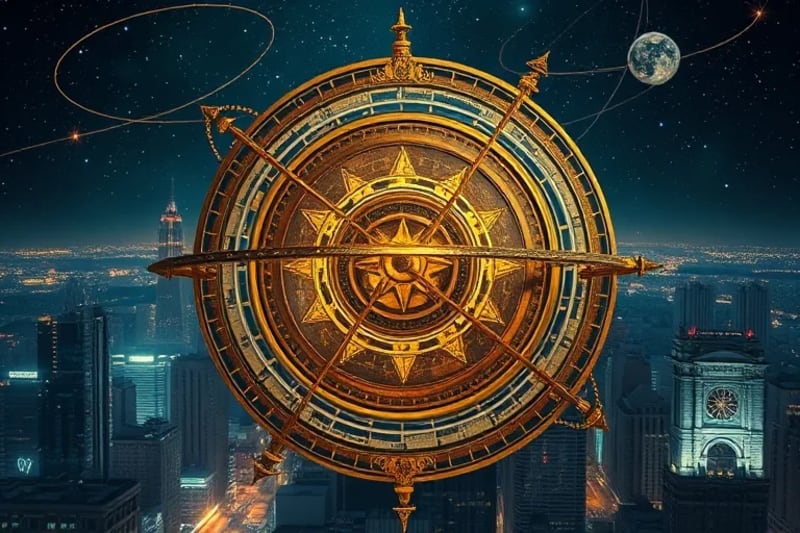 An ancient celestial sphere, illuminated by ethereal light, projects holographic planetary orbits and astrological symbols onto a modern cityscape, symbolizing the profound influence of cosmic order on global affairs.
This conceptual visualization, a unique AI render, blends historical astronomical tools with contemporary urban landscapes, reflecting the enduring quest to understand the universe's impact on human civilization.
Table of Contents
- Understanding Celestial Mechanics
- The Foundations of Mundane Astrology
- Planetary Cycles and Their Global Impact
- Astrological Houses in Mundane Analysis
- Key Astrological Techniques for Prediction
- Historical Perspectives and Modern Applications
- Challenges and Ethical Considerations
Understanding Celestial Mechanics
Celestial mechanics is the scientific study of the motion of celestial objects, such as planets, moons, asteroids, and comets. It applies the principles of physics, particularly Newton's laws of motion and universal gravitation, to predict and explain their trajectories. This field has been instrumental in our understanding of the solar system's structure and dynamics, from ancient observations to modern space exploration.
Key figures like Johannes Kepler, with his laws of planetary motion, and Isaac Newton, who formulated the law of universal gravitation, laid the groundwork for this discipline. Their work transformed astronomy from a descriptive science into a predictive one, allowing for precise calculations of planetary positions far into the future. These calculations are fundamental to astrological practice, especially mundane astrology, which relies on accurate ephemerides.
The precision offered by celestial mechanics is crucial for astrologers to cast accurate charts for specific moments in time, whether it's the ingress of a planet into a new sign or the exact moment of an eclipse. Without this scientific underpinning, the predictive power of astrology would be significantly diminished. The observable and calculable movements of planets form the raw data upon which astrological interpretations are built.
The Foundations of Mundane Astrology
Mundane astrology, derived from the Latin word "mundus" meaning world, is the branch of astrology concerned with world affairs. It analyzes the astrological charts of nations, cities, significant events, and even the birth charts of political leaders to understand collective destiny and global trends. Unlike natal astrology, which focuses on individual psychological patterns, mundane astrology seeks to interpret the broader socio-political and economic climate.
The core principle is that the same planetary energies that influence individuals also manifest on a larger scale, affecting groups, nations, and the entire planet. Astrologers examine charts for events such as the founding of a nation, the inauguration of a leader, or the precise moment a major law is enacted. These charts are then interpreted using traditional astrological principles, but with a focus on collective outcomes.
Historical records show that mundane astrology has been practiced for millennia, with ancient civilizations like the Babylonians, Egyptians, and Greeks using celestial observations to predict agricultural yields, military outcomes, and the rise and fall of empires. This ancient wisdom, combined with modern astronomical precision, continues to inform contemporary mundane astrological analysis.
Planetary Cycles and Their Global Impact
The most significant aspect of mundane astrology involves the long-term cycles of the outer planets: Jupiter, Saturn, Uranus, Neptune, and Pluto. These planets, with their slower orbits, represent generational shifts and large-scale societal transformations. Their conjunctions, oppositions, and squares are often correlated with major historical turning points and global events.
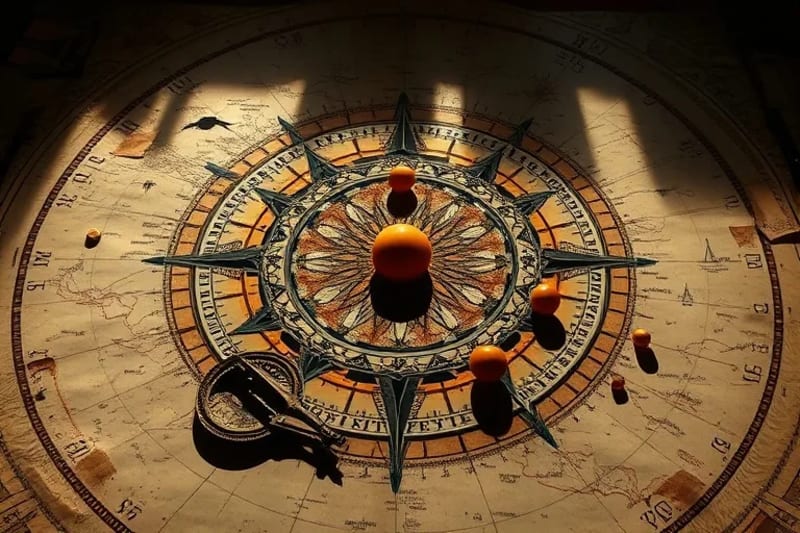 A digital painting of an open atlas, compass, and sextant, beneath a stylized planetary alignment, symbolizing the profound predictive insights derived from cosmic observations.
This artwork, generated by AI, captures the essence of exploration and the ancient practice of using celestial bodies to navigate and understand earthly patterns, echoing the principles of mundane astrology.
For instance, the Great Conjunctions of Jupiter and Saturn, occurring approximately every 20 years, have historically coincided with significant political and economic shifts. The recent conjunction in Aquarius in December 2020 marked a new 200-year cycle in air signs, suggesting a period focused on technology, innovation, and social networks, with potential for both progress and disruption in these areas. Understanding these broader cycles can provide context for current events and future trends, as discussed in Astro-Economics Planetary Cycles Financial Market Predictions.
Uranus, associated with revolution and sudden change, often correlates with technological breakthroughs, social uprisings, and paradigm shifts when it forms significant aspects. Neptune, linked to spirituality, illusion, and dissolution, can indicate periods of ideological fervor, artistic movements, or widespread confusion and deception. Pluto, the planet of transformation and power, signifies deep-seated societal restructuring, crises, and regeneration, often involving profound shifts in power dynamics.
The interaction of these slow-moving planets creates a complex tapestry of influences that unfold over decades or even centuries. Astrologers meticulously track these cycles to discern patterns that might indicate periods of war, peace, economic boom, recession, or major cultural transformations. The study of Critical Degrees Astrology: Decoding Sensitive Chart Points further refines these analyses by focusing on specific, highly charged degrees within these cycles.
Astrological Houses in Mundane Analysis
In mundane astrology, the twelve astrological houses are reinterpreted to represent different sectors of a nation or the world. Each house corresponds to specific areas of collective life, providing a structured way to analyze planetary influences on various societal aspects. This framework allows for a detailed examination of how celestial patterns manifest in different spheres of human activity.
- First House: Represents the general state of the nation, its people, reputation, and national character.
- Second House: Governs national wealth, economy, resources, and financial stability.
- Third House: Relates to communication, transportation, media, education, and neighboring countries.
- Fourth House: Signifies the land, agriculture, domestic affairs, opposition parties, and the general public.
- Fifth House: Associated with entertainment, arts, children, public pleasure, and speculative investments.
- Sixth House: Covers public health, labor, military, civil service, and daily life of the working class.
- Seventh House: Deals with foreign relations, treaties, war, alliances, and open enemies.
- Eighth House: Represents national debt, taxes, death rates, public health crises, and international finance.
- Ninth House: Governs law, religion, higher education, foreign trade, and long-distance travel.
- Tenth House: Signifies the government, national leader, ruling party, and national prestige. This is often analyzed with MC Ruler Aspects: Public Persona, Career Path Guide.
- Eleventh House: Relates to parliament, legislative bodies, national goals, and alliances.
- Twelfth House: Represents hidden enemies, hospitals, prisons, secret societies, and national suffering.
By analyzing which planets occupy or aspect these houses in a mundane chart, astrologers can gain insights into the prevailing conditions and potential developments within these sectors. For example, a challenging aspect to the Second House might indicate economic instability, while a harmonious aspect to the Tenth House could suggest a period of strong leadership and national success.
Key Astrological Techniques for Prediction
Mundane astrologers employ several specialized techniques to forecast global trends. These methods often involve tracking specific celestial events and their correlations with historical outcomes. The synthesis of these techniques provides a comprehensive picture of potential future developments.
 An abstract 3D render depicting intertwined golden and silver threads of light forming complex, dynamic patterns, symbolizing cosmic energy flows influencing large-scale events.
This AI-generated conceptual art illustrates the unseen forces and interconnectedness that mundane astrology seeks to interpret, suggesting a universal causality behind societal shifts and global trends.
- Ingress Charts: These charts are cast for the moment the Sun enters the cardinal signs (Aries, Cancer, Libra, Capricorn), marking the beginning of seasons. The Aries ingress, in particular, is considered highly significant for predicting the general tone of the year for the entire world or specific regions.
- Lunation Charts: New Moons and Full Moons, especially eclipses, are potent indicators of short-term trends and crises. Solar eclipses often signify major beginnings or endings, while lunar eclipses can bring hidden matters to light or culminations.
- Great Conjunctions: As mentioned, the conjunctions of Jupiter and Saturn, and especially the much rarer conjunctions involving Uranus, Neptune, and Pluto, are pivotal for understanding long-term societal shifts. For example, the Uranus-Pluto conjunctions have historically been associated with periods of intense social upheaval and transformation.
- Retrogrades and Stations: The retrograde periods of planets, particularly Mercury, Mars, and Venus, can indicate delays, reversals, or re-evaluations in their respective areas of influence. Planetary stations, where a planet appears to halt before changing direction, are often points of intensified energy and turning points, as explored in Planetary Stations Direct Retrograde Astrology Turning Points.
- National Charts: The birth charts of nations or significant political entities are foundational. These charts are progressed and transited to forecast periods of national prosperity, challenge, or conflict.
The combination of these techniques allows astrologers to build a multi-layered predictive model, cross-referencing different cycles and events to form a cohesive narrative of global trends. This rigorous approach helps to mitigate the inherent complexities and ambiguities of astrological interpretation.
Historical Perspectives and Modern Applications
Historically, mundane astrology was an integral part of statecraft and governance. Rulers and empires often consulted astrologers to determine auspicious times for coronations, military campaigns, or diplomatic treaties. Notable examples include the Roman Empire, where astrologers advised emperors, and medieval Europe, where court astrologers played significant roles. The Astrology History: Ancient Origins to Modern Practice details this rich heritage.
In the modern era, while mainstream science largely dismisses astrology, mundane astrology continues to be studied and practiced by a dedicated community. Contemporary mundane astrologers often analyze current events, such as elections, economic crises, and pandemics, through the lens of planetary cycles. They seek to identify underlying cosmic patterns that might explain the timing and nature of these global phenomena.
The historical correlation between significant planetary alignments and major global events is a subject of ongoing research within the astrological community. For instance, the triple conjunction of Uranus, Neptune, and Pluto in the mid-20th century coincided with the two World Wars and the rise of totalitarian regimes, demonstrating the profound impact of these rare configurations.
Similarly, the Jupiter-Saturn conjunctions have been linked to shifts in economic paradigms and political power structures across centuries. These patterns, while not universally accepted as causal, offer a compelling framework for understanding historical periodicity.
Modern applications extend to forecasting economic trends, predicting geopolitical tensions, and even understanding the broader social mood. For example, periods of strong Neptune influence might correspond to increased interest in spiritual movements or, conversely, widespread confusion and escapism. Uranus transits often herald periods of technological disruption and calls for individual freedom or collective rebellion.
Challenges and Ethical Considerations
Despite its long history and intricate methodology, mundane astrology faces significant challenges. The primary one is the lack of scientific validation in the conventional sense. While astrologers observe correlations, establishing direct causation between planetary movements and earthly events remains outside the scope of current scientific paradigms. This leads to a perception of astrology as pseudoscience by the mainstream scientific community.
Another challenge lies in the interpretation of complex planetary patterns. Astrological symbolism is rich and multi-layered, meaning that a single planetary aspect can have numerous potential manifestations. This requires deep knowledge, intuition, and careful discernment on the part of the astrologer to avoid misinterpretations or overly deterministic predictions. The ethical responsibility of astrologers is paramount, especially when dealing with sensitive global issues.
Ethical considerations in mundane astrology include avoiding fear-mongering or making definitive predictions that could cause panic. The role of the mundane astrologer is often seen as providing a framework for understanding potential trends and preparing for future challenges, rather than offering absolute prophecies. It's about empowering individuals and societies with foresight, enabling informed decision-making rather than fostering fatalism.
Furthermore, the potential for confirmation bias is ever-present. It is easy to find historical events that seem to fit an astrological pattern after the fact. Rigorous mundane astrological research attempts to mitigate this by making specific, testable predictions and systematically tracking outcomes, though this is inherently difficult with complex global phenomena. The field continues to evolve, seeking to refine its methods and provide valuable insights into the grand cosmic narrative.
Explore More Insights
- Medical Astrology: Chronic Conditions, Planetary Debilities, Rulerships
- Feng Shui Remote Work Spaces: Digital Nomad Harmony
- Psycho-Astrology Shadow Work: Integrating Archetypes Self-Mastery
- Custom Tarot Spreads: Tailoring Guidance Deep Inquiry | StarPluto
- Mesoamerican Astrology AI Oracles Bridging Ancient Wisdom
- Sun Sign Astrology: Core Identity, Traits, Understanding | StarPluto
- Psycho-Astrology Archetypal Psychology Jungian Shadow Natal Chart Wholeness
- Karmic Astrology North Node 12th House Unconscious Patterns
- Chakras Superiores: Intuición, Conexión Espiritual, Despertar | AstroFuturo
- Horóscopo Personalizado: Luna y Planetas en tu Día | AstroFuturo
- Runas Nórdicas y Magia Lunar: Rituales Abundancia Cósmica
Source: Hybrid content assisted by AI and human editorial supervision.


Comments
Post a Comment