
Cosmic Sociology: AI Ethics, Global Consciousness Shifts
Cosmic sociology emerges as a vital interdisciplinary field, seeking to understand the intricate relationship between humanity, technology, and the cosmos. In an era defined by rapid digital transformation and the pervasive influence of artificial intelligence, this discipline offers a unique lens through which to examine global consciousness shifts and collective trends. It bridges ancient esoteric wisdom with contemporary scientific and technological advancements, providing a holistic framework for navigating our complex world.
The digital age has fundamentally altered how societies interact, process information, and form collective identities. As AI systems become more sophisticated, their ethical implications and potential impact on human consciousness become paramount. Cosmic sociology probes these profound questions, exploring how celestial mechanics, esoteric symbolism, and technological evolution intertwine to shape our shared human experience.
Table of Contents
- The Foundations of Cosmic Sociology
- AI Ethics and the Digital Collective
- Global Consciousness Shifts and Astrological Influence
- Collective Trends: Decoding the Future
- Bridging Ancient Wisdom and Modern Technology
The Foundations of Cosmic Sociology
Cosmic sociology, while a relatively new term, draws deeply from historical and philosophical traditions that have long contemplated humanity's place in the universe. Ancient civilizations, from the Mesopotamians to the Mayans, meticulously observed celestial phenomena, believing that cosmic cycles directly influenced earthly events and human destiny. This perspective laid the groundwork for understanding societal patterns through an astrological or esoteric lens.
Early philosophers like Plato and Pythagoras explored the concept of universal harmony, suggesting that the cosmos operates on mathematical and musical principles that resonate within human societies. These ideas, often considered esoteric, posited a profound interconnectedness between macrocosm and microcosm. They viewed human collective behavior not merely as a product of terrestrial forces but as an echo of grander cosmic rhythms.
In modern times, thinkers like Carl Jung introduced concepts such as the collective unconscious, hinting at shared archetypal patterns that transcend individual experience. While not explicitly "cosmic," Jung's work resonates with the idea that humanity is influenced by deeper, universal structures. Cosmic sociology extends this, proposing that these structures might be intrinsically linked to astronomical configurations and their symbolic interpretations.
The field seeks to move beyond mere correlation, aiming for a more nuanced understanding of how these influences manifest. It considers how planetary alignments, lunar cycles, and even distant stellar phenomena could subtly impact human psychology, societal trends, and the very fabric of our collective consciousness. This requires a multidisciplinary approach, integrating insights from sociology, psychology, astronomy, and various esoteric traditions.

A celestial cityscape merging digital data streams and ancient astrological symbols, reflecting humanity's evolving collective consciousness.
AI Ethics and the Digital Collective
The advent of artificial intelligence presents both unprecedented opportunities and profound ethical challenges for humanity. As AI systems become increasingly integrated into our daily lives, influencing everything from healthcare to governance, the need for robust ethical frameworks is more critical than ever. Cosmic sociology examines how these technological advancements interact with, and potentially reshape, our global consciousness.
The concept of a "digital collective consciousness" refers to the emergent properties of human interaction and information exchange facilitated by digital networks. This collective mind, amplified by AI, can accelerate trends, disseminate information (and misinformation), and shape public opinion at an unprecedented scale. Understanding the ethical implications of AI within this digital collective is crucial for ensuring a benevolent future.
Ethical considerations for AI include bias in algorithms, data privacy, autonomous decision-making, and the potential for job displacement or societal control. Pioneers in cybernetics, such as Norbert Wiener, laid the groundwork for understanding the complex interplay between technology and society. His insights into feedback loops and control systems remain highly relevant in the age of advanced AI, highlighting the need for human oversight and ethical programming.
From a cosmic sociological perspective, the ethical development of AI is not just about technological governance; it's about aligning our digital creations with universal principles of harmony and evolution. It questions whether AI can be programmed to foster collective well-being, promote empathy, and contribute to a higher state of global consciousness, rather than merely optimizing for efficiency or profit.

The intricate dance between human intellect, cosmic forces, and digital networks shaping our collective awareness.
Global Consciousness Shifts and Astrological Influence
Human history is replete with periods of profound societal transformation, often accompanied by significant shifts in collective consciousness. Cosmic sociology posits that these shifts may not be random but could be subtly influenced by larger cosmic cycles and astrological configurations. While mainstream science often dismisses astrology, a cosmic sociological approach considers its symbolic language as a potential framework for understanding macro-level human behavior.
Astrological traditions have long associated planetary movements with specific archetypal energies that can manifest in collective events and psychological states. For instance, the cycles of outer planets like Uranus, Neptune, and Pluto are often linked to generational shifts, technological revolutions, spiritual awakenings, and deep societal transformations. These long-term cycles can provide a symbolic narrative for understanding the underlying currents of global change.
The concept of mundane astrology specifically focuses on global events and trends, examining the astrological charts of nations, major historical moments, and significant world events. By analyzing these cosmic blueprints, cosmic sociology seeks to identify patterns that correlate with periods of heightened collective awareness, social upheaval, or significant technological adoption. It's about recognizing potential energetic predispositions rather than deterministic predictions.
Furthermore, the idea of conscious evolution suggests that humanity's spiritual growth rhythms might be synchronized with these celestial mechanics. As we collectively face global challenges, there's an observable trend towards increased interconnectedness, empathy, and a desire for sustainable living. Cosmic sociology explores whether these emergent values are a reflection of an evolving global consciousness, perhaps subtly guided by cosmic influences.
Collective Trends: Decoding the Future
Analyzing collective trends is central to cosmic sociology, as it provides empirical data for understanding the current state and potential trajectory of global consciousness. These trends encompass a wide range of phenomena, from technological adoption rates and economic shifts to cultural movements and shifts in spiritual practices. The digital age, with its vast data streams, offers unprecedented opportunities to observe and analyze these patterns.
One prominent trend is the increasing decentralization of power and information, fueled by blockchain technology and peer-to-peer networks. This decentralization mirrors certain astrological principles of individual empowerment and the breaking down of old structures (Uranian energies). Another significant trend is the growing awareness of environmental issues and the push for global sustainability, reflecting a collective awakening to our interconnectedness with Earth.
The rise of global activism, facilitated by social media, demonstrates a powerful shift in collective agency. People are more connected and capable of mobilizing for shared causes than ever before. Cosmic sociology investigates how these rapid mobilizations and shifts in public sentiment might correlate with specific cosmic alignments, suggesting periods of heightened collective sensitivity or catalytic change.
Furthermore, the evolving relationship with spirituality and esoteric practices marks another key trend. There's a renewed interest in ancient wisdom, mindfulness, and alternative healing modalities, often integrated with modern scientific understanding. This spiritual resurgence, combined with technological advancement, points towards a synthesis that cosmic sociology aims to understand and contextualize within the broader cosmic narrative.
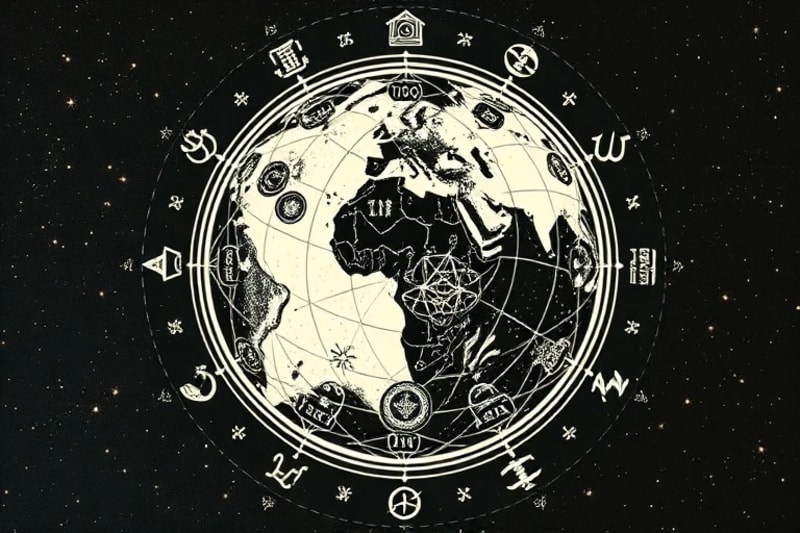
Visual representation of global trends influenced by both technological advancements and esoteric astrological patterns.
Bridging Ancient Wisdom and Modern Technology
The ultimate goal of cosmic sociology is to foster a harmonious integration of ancient wisdom with modern technological prowess. This means recognizing the value of esoteric symbolism and astrological insights not as literal predictions, but as rich metaphorical frameworks for understanding complex societal dynamics. Simultaneously, it involves leveraging cutting-edge technology, particularly AI, to analyze vast datasets of human behavior and cosmic phenomena.
For instance, AI could be used to identify subtle correlations between historical astrological patterns and major societal events, or to model the impact of collective emotional states on global trends. This scientific approach to esoteric concepts could unlock new understandings of human collective consciousness. The challenge lies in developing AI that is not only intelligent but also wise, imbued with ethical considerations that reflect universal values.
This integration also implies a shift in how we approach urban planning and environmental design. Concepts like urban geomancy, which seeks to align city dwellings with celestial well-being, can be re-evaluated through a cosmic sociological lens. By understanding the energetic flows and symbolic significance of our built environments, we can create spaces that foster collective harmony and individual flourishing.
Ultimately, cosmic sociology calls for a conscious evolution of humanity, where our technological advancements are guided by a deeper understanding of our cosmic interconnectedness. It encourages us to look beyond immediate terrestrial concerns and consider the broader universal context in which our digital age unfolds, ensuring that our progress is both intelligent and spiritually aligned.
Conclusion
Cosmic sociology offers a compelling and necessary framework for understanding the complex interplay between AI ethics, global consciousness shifts, and collective trends in the digital age. By integrating ancient esoteric wisdom with modern scientific inquiry, it provides a holistic perspective on humanity's evolving journey. This field encourages us to consider how our technological creations and societal developments are not isolated events, but rather integral parts of a larger cosmic narrative.
As we navigate the profound transformations brought about by artificial intelligence and increasing global interconnectedness, cosmic sociology reminds us of our inherent connection to the universe. It challenges us to develop ethical AI, foster a conscious collective, and build a future that harmonizes technological progress with universal principles of well-being and spiritual growth. The insights derived from this interdisciplinary approach are crucial for shaping a future where humanity thrives in alignment with its cosmic destiny.
Explore More Insights
Source: Hybrid content assisted by AI and human editorial supervision.


Comments
Post a Comment