
Astro-Botany: Celestial Plant Growth & Energetics
Astro-Botany: Celestial Influences on Plant Growth and Energetics
Astro-Botany is an intriguing field that explores the profound connections between celestial phenomena and the life cycles, growth patterns, and energetic properties of plants. While often considered a niche area bridging astrology and horticulture, its roots delve deep into ancient agricultural practices and esoteric traditions. This discipline posits that the subtle energies emanating from the Sun, Moon, planets, and even distant stars can significantly impact botanical life, influencing everything from germination rates to medicinal potency.

Precursors intellectuales, diagramas fundamentales y representaciones conceptuales que forjaron la visión de la Astro-Botany sobre la influencia cósmica en la vida vegetal.
Fuente visual sujeta a disponibilidad del ecosistema: Wikimedia Commons bajo licencia CC BY-SA 4.0 o renderizado conceptual IA.
The concept is not new; ancient civilizations meticulously observed lunar phases and planetary positions to optimize planting, harvesting, and medicinal preparations. Modern Astro-Botany seeks to systematize these observations, integrating contemporary scientific understanding with traditional wisdom to unlock new potentials in sustainable agriculture and holistic wellness. It suggests that plants, like all living organisms, are intricate receivers and transmitters of cosmic information.
This article will delve into the foundational principles of Astro-Botany, exploring the various celestial influences, their proposed mechanisms, and practical applications for gardeners, farmers, and enthusiasts alike. We will examine how different planetary energies are believed to resonate with specific plant types and growth stages, offering a comprehensive overview of this fascinating interdisciplinary field.
Table of Contents
- Foundational Principles of Astro-Botany
- The Moon's Dominant Influence: Lunar Cycles and Plant Life
- Planetary Energies and Botanical Archetypes
- Zodiacal Signs and Plant Correspondence
- Practical Applications in Astro-Horticulture
- Scientific Perspectives and Future Research
- The Holistic Connection: Plants, Cosmos, and Well-being
Foundational Principles of Astro-Botany
At its core, Astro-Botany operates on the premise of universal interconnectedness, a principle often echoed in Hermetic philosophy, such as those found in the Emerald Tablet Hermetic Principles. It suggests that the cosmos is a living, breathing entity, with every part influencing every other part. Plants, being rooted and directly exposed to atmospheric and celestial influences, are particularly sensitive to these subtle energies. This sensitivity is often attributed to their role as primary producers, mediating between earth and sky.
The primary mechanism proposed is not direct gravitational pull or light intensity alone, but rather a more subtle energetic or vibrational influence. These energies are thought to impact plant physiology, genetic expression, and even their energetic aura. Proponents argue that just as human bodies respond to circadian rhythms and seasonal changes, plants exhibit even more pronounced responses to celestial rhythms due to their less mobile nature and direct interface with their environment.
- Cosmic Rhythms: Plants are believed to entrain their biological clocks to celestial cycles, affecting germination, flowering, fruiting, and dormancy.
- Planetary Signatures: Each planet is associated with specific qualities and energies that are thought to resonate with particular plant species, influencing their growth habits, chemical composition, and medicinal properties.
- Energetic Transfer: The concept extends beyond physical growth to the energetic vitality of the plant, impacting its ability to heal, nourish, and provide spiritual benefits.
The Moon's Dominant Influence: Lunar Cycles and Plant Life
Among all celestial bodies, the Moon is perhaps the most widely acknowledged influence in Astro-Botany, particularly in biodynamic agriculture. Its gravitational pull famously affects tides, and it is believed to similarly influence the movement of water within plants and soil. The lunar cycle is divided into four main phases, each associated with different planting and cultivation activities.
| Lunar Phase | Botanical Influence | Recommended Activities |
|---|---|---|
| New Moon to First Quarter (Waxing Crescent) | Increased sap flow, upward growth, strong root development. | Planting above-ground crops with external seeds (e.g., lettuce, spinach), grafting. |
| First Quarter to Full Moon (Waxing Gibbous) | Peak growth, high vitality, increased moisture. | Planting annuals that produce fruit or seeds (e.g., tomatoes, beans), fertilizing. |
| Full Moon to Last Quarter (Waning Gibbous) | Energy directed downwards, root growth, moisture receding. | Planting root crops (e.g., potatoes, carrots), transplanting, pruning. |
| Last Quarter to New Moon (Waning Crescent) | Resting period, low vitality, ideal for soil work. | Cultivating, weeding, pest control, harvesting for storage. |
Beyond these general guidelines, specific lunar phases are also thought to influence the potency of medicinal herbs. For instance, harvesting herbs for their leaves during a waxing moon is believed to maximize their energetic content, while roots might be best harvested during a waning moon. This aligns with traditional practices of optimizing rest and cycles, extending to the plant kingdom.

The intricate dance of plant roots absorbing both terrestrial nutrients and subtle cosmic vibrations.
Planetary Energies and Botanical Archetypes
Each planet in our solar system is traditionally associated with distinct qualities and archetypes, which are believed to manifest in the plant kingdom. These planetary correspondences form a cornerstone of Astro-Botany, guiding the selection of plants for specific purposes or their cultivation under particular conditions. Understanding these associations can enhance the energetic potential of a garden or a specific herbal remedy.
- Sun: Associated with vitality, growth, strength, and life force. Plants ruled by the Sun often have large, showy flowers, grow tall, or are used for invigoration (e.g., sunflower, calendula, bay laurel).
- Moon: Linked to moisture, fertility, intuition, and nurturing. Lunar plants are typically succulent, have white flowers, or are associated with calming and soothing properties (e.g., jasmine, white rose, lettuce).
- Mercury: Governs communication, intellect, and adaptability. Mercurial plants are often fast-growing, have small leaves, or are used for mental clarity (e.g., lavender, dill, parsley).
- Venus: Represents beauty, love, harmony, and abundance. Venusian plants are often fragrant, have beautiful flowers, or are used in love spells and for attracting prosperity (e.g., rose, apple, mint).
- Mars: Associated with energy, passion, protection, and assertiveness. Martial plants are often thorny, spicy, or used for courage and defense (e.g., nettle, thistle, garlic).
- Jupiter: Symbolizes expansion, wisdom, luck, and generosity. Jovial plants are often large, stately, or used for prosperity and spiritual growth (e.g., oak, sage, dandelion).
- Saturn: Linked to discipline, structure, boundaries, and endurance. Saturnine plants are often slow-growing, have strong roots, or are used for protection and grounding (e.g., comfrey, cypress, hemlock).
These correspondences are not rigid but offer a framework for understanding the subtle energetic qualities of plants. For instance, a plant ruled by Mars might thrive when planted during a strong Mars transit, potentially enhancing its protective or stimulating properties. This intricate dance between celestial bodies and plant life highlights a deeper, more profound connection than often recognized.
Zodiacal Signs and Plant Correspondence
Beyond individual planetary influences, the twelve zodiacal signs also play a significant role in Astro-Botany. Each sign is associated with specific elements (Fire, Earth, Air, Water) and qualities (Cardinal, Fixed, Mutable), which further refine the understanding of plant energies and optimal cultivation times. Plants are believed to absorb and express the qualities of the zodiacal sign through which the Moon or other planets are transiting.
For example, planting leafy greens when the Moon is in a Water sign (Cancer, Scorpio, Pisces) is thought to encourage lush foliage due to the water element's association with growth and moisture. Conversely, root crops might benefit from planting when the Moon is in an Earth sign (Taurus, Virgo, Capricorn), which emphasizes grounding and stability. This layered approach allows for highly specific and nuanced cultivation strategies.
- Fire Signs (Aries, Leo, Sagittarius): Associated with warmth, energy, and fruit development. Good for planting fruit-bearing plants and spices.
- Earth Signs (Taurus, Virgo, Capricorn): Linked to stability, structure, and root growth. Ideal for root vegetables and hardy plants.
- Air Signs (Gemini, Libra, Aquarius): Connected to flowering, pollination, and lightness. Favorable for flowering plants and herbs grown for their blossoms.
- Water Signs (Cancer, Scorpio, Pisces): Governed by moisture, leaves, and vitality. Best for leafy greens and plants requiring abundant water.
Understanding these zodiacal influences can help gardeners plan their activities according to celestial rhythms, potentially leading to healthier plants and more bountiful harvests. This is a practice that resonates with ancient wisdom, where the microcosm of the garden mirrored the macrocosm of the heavens.
Practical Applications in Astro-Horticulture
The principles of Astro-Botany are not purely theoretical; they offer practical guidance for anyone involved in growing plants, from backyard gardeners to large-scale biodynamic farms. By aligning planting and harvesting schedules with celestial cycles, practitioners aim to enhance plant vitality, resistance to pests, and overall yield. This approach is often integrated with other holistic practices for comprehensive plant care.
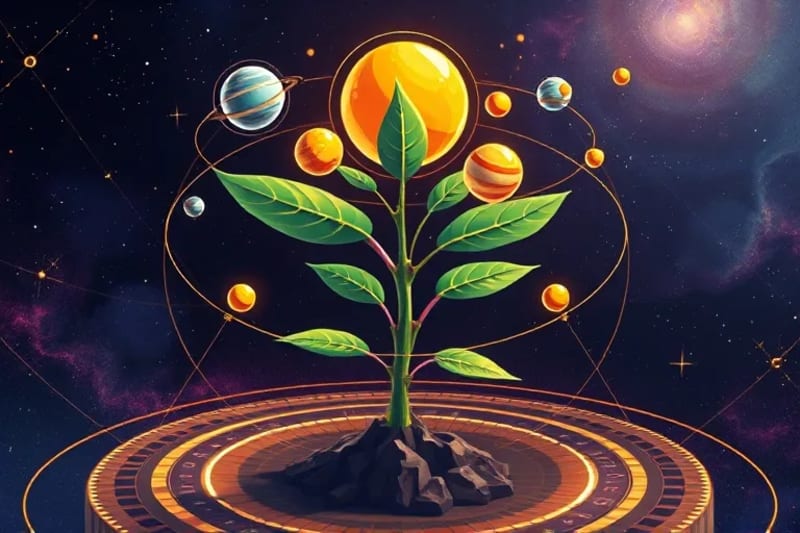
An abstract visualization of planetary energies dynamically shaping and influencing plant growth and vitality.
- Timing Planting and Sowing: Using lunar calendars to determine optimal days for sowing seeds, transplanting seedlings, and planting specific crops.
- Harvesting for Potency: Harvesting medicinal herbs or culinary plants during specific lunar or planetary alignments believed to maximize their active compounds or energetic qualities.
- Pest and Disease Management: Some Astro-Botanists suggest that certain lunar phases are more conducive to pest control or that plants are more resilient during specific celestial configurations.
- Biodynamic Preparations: Integrating cosmic rhythms into the creation and application of biodynamic preparations, which are designed to enhance soil vitality and plant health.
- Personalized Gardening: Selecting plants that resonate with one's own birth chart analysis or current planetary transits, creating a garden that supports personal well-being.
These practices require careful observation and a willingness to experiment, but many practitioners report significant improvements in the health and productivity of their gardens. The focus shifts from merely providing nutrients to creating an environment where plants can thrive in harmony with cosmic forces.
Scientific Perspectives and Future Research
From a mainstream scientific perspective, Astro-Botany often falls into the realm of pseudoscience due to the lack of widely accepted empirical evidence for direct energetic influences from celestial bodies on plant growth beyond light and gravity. However, this does not mean the field is entirely devoid of scientific inquiry or potential. Researchers continue to explore subtle environmental factors that affect plant life, some of which might inadvertently align with Astro-Botanical observations.
For instance, studies on plant photoperiodism, gravitropism, and circadian rhythms demonstrate plants' exquisite sensitivity to environmental cues. While direct planetary "energies" are not typically measured, the possibility of subtle electromagnetic or other unknown forces influencing biological systems remains a topic of fringe scientific exploration. The challenge lies in designing rigorous, repeatable experiments that can isolate and measure these proposed celestial influences.
The National Academies of Sciences, Engineering, and Medicine define scientific inquiry as a multifaceted activity that involves making observations, posing questions, examining books and other sources of information to see what is already known, planning investigations, reviewing what is already known in light of experimental evidence, using tools to gather, analyze, and interpret data, proposing answers, explanations, and predictions, and communicating the results.
While Astro-Botany's claims often extend beyond currently measurable scientific parameters, the spirit of observation and seeking patterns aligns with early scientific endeavors. Future advancements in sensing technology and biological understanding may uncover mechanisms currently unknown.
Some researchers suggest that the anecdotal successes reported by biodynamic farmers might be attributable to the holistic and meticulous care inherent in these practices, rather than solely to celestial timing. However, the consistent patterns observed across centuries and cultures warrant continued open-minded investigation. The intersection of traditional knowledge and modern science could potentially reveal new insights into plant biology and ecological systems.
The Holistic Connection: Plants, Cosmos, and Well-being
Ultimately, Astro-Botany encourages a holistic view of nature, where plants are not just inert resources but active participants in a vast cosmic dance. It fosters a deeper reverence for the natural world and an understanding of our interconnectedness with the universe. By observing and working with these subtle energies, individuals can cultivate not only healthier plants but also a greater sense of harmony and well-being within themselves.
Whether approached from a purely scientific curiosity or a spiritual perspective, the study of celestial influences on plant life offers a rich tapestry of knowledge and practice. It invites us to look beyond the obvious and consider the unseen forces that shape life on Earth, prompting a more conscious and sustainable approach to agriculture and our relationship with the botanical world. Embracing Astro-Botany can lead to a more intuitive and resonant gardening experience, connecting us to the ancient wisdom of the cosmos.
Related Articles
- Scrying: Divination Through Reflective Surfaces | StarPluto
- Astrological Ethics: Navigating Boundaries Responsibilities
- Decumbiture Astrology: Illness, Recovery, Onset Analysis
- Bio-Resonance Therapy Birth Chart Alignment Holistic Wellness
- Techno-Shamanism Digital Healing Ancient Rituals Practices
- Etnobotany Bio-innovación Plantas Medicinales Ancestrales
Source: Hybrid content assisted by AI and human editorial supervision.


Comments
Post a Comment