
Cosmic Sociology AI Global Consciousness Evolution Trends
The confluence of cosmic sociology and artificial intelligence (AI) presents a groundbreaking frontier for understanding the intricate evolution of global consciousness and the emergent digital trends shaping our collective future. This interdisciplinary field seeks to map the subtle and overt influences that govern human societies, from celestial mechanics to the vast, interconnected web of digital information. By leveraging advanced AI algorithms, researchers can now analyze patterns in human behavior, communication, and belief systems on an unprecedented scale, offering profound insights into the forces driving our shared reality.
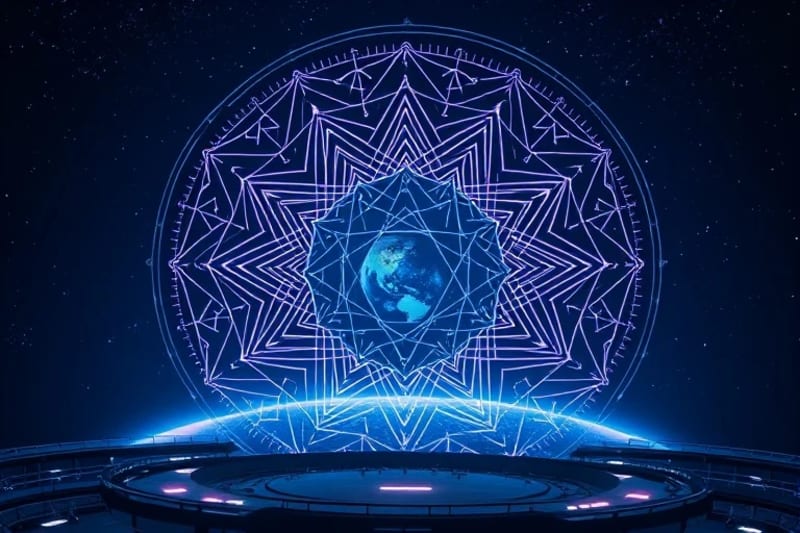
A celestial observatory with AI interfaces maps human consciousness across a holographic Earth, blending futuristic aesthetics with deep blues and purples.
Fuente visual sujeta a disponibilidad del ecosistema: Wikimedia Commons bajo licencia CC BY-SA 4.0 o renderizado conceptual IA.
This exploration delves into how AI acts as a powerful lens, not only for observing but also for interpreting the complex interplay between cosmic forces, human psychology, and technological advancements. It aims to bridge the gap between ancient esoteric wisdom and modern scientific inquiry, proposing a holistic framework for comprehending the dynamics of our evolving planetary mind. The journey into cosmic sociology, augmented by AI, promises to unveil hidden correlations and predictive models that could redefine our understanding of human destiny.
Table of Contents
- The Dawn of Cosmic Sociology
- AI as a Lens for Global Consciousness
- Celestial Mechanics and Human Experience
- Esoteric Metaphysics and Digital Realms
- Ethical Considerations and Future Outlook
- Practical Applications and Research Frontiers
The Dawn of Cosmic Sociology
Cosmic sociology emerges as a discipline dedicated to studying the relationship between cosmic phenomena and human societal structures and consciousness. It extends traditional sociology beyond terrestrial boundaries, considering the universe as an active participant in shaping collective human experience. This perspective acknowledges that humanity is not isolated but deeply embedded within a larger cosmic tapestry, where planetary alignments, solar cycles, and even galactic influences might exert subtle yet profound effects on our collective psyche.
Historically, various cultures have recognized these connections, often integrating astronomical observations into their spiritual and social frameworks. Ancient civilizations, from the Mayans to the Babylonians, developed sophisticated systems of astrology history that sought to correlate celestial events with earthly occurrences, including human behavior and societal shifts. While often dismissed by modern science, the core premise of cosmic influence on human affairs is being re-examined through new lenses, particularly with the advent of advanced computational tools.
The theoretical underpinnings of cosmic sociology draw from diverse fields such as systems theory, quantum physics, and transpersonal psychology. It posits that consciousness itself is not merely a localized brain phenomenon but an emergent property of interconnected systems, potentially influenced by universal fields of information. This holistic view challenges reductionist paradigms, suggesting a more integrated understanding of life and society within the cosmos.
AI as a Lens for Global Consciousness
Artificial intelligence, particularly in its advanced forms like machine learning and natural language processing, offers an unprecedented capability to analyze the vast and complex data generated by human interaction. This data, ranging from social media trends and news cycles to economic indicators and cultural expressions, forms a digital footprint of global consciousness. AI algorithms can identify subtle patterns, correlations, and anomalies that are imperceptible to human observers, thereby acting as a powerful lens through which to observe the evolution of our collective mind.
Interconnected human figures form a glowing neural network, blending astrological symbols and digital data streams in a vibrant, abstract composition.
By processing billions of data points, AI can track the emergence of new ideas, the spread of sentiments, and the shifts in collective values across different demographics and geographical regions. This allows researchers to quantify aspects of global consciousness that were previously only qualitative or anecdotal. For instance, AI can analyze sentiment in global news feeds to detect shifts in collective mood, or identify emerging cultural memes that reflect deeper societal anxieties or aspirations. This analytical power is crucial for understanding the rapid pace of digital trends.
Furthermore, AI can assist in predictive modeling, forecasting potential future trends in global consciousness based on historical data and current trajectories. While not deterministic, these models can provide valuable insights for policymakers, educators, and social scientists. The ability of AI to learn and adapt means that these models are constantly refining their understanding, offering an ever-evolving picture of our collective mental landscape. The field of cosmic sociology is fundamentally transformed by these capabilities.
Celestial Mechanics and Human Experience
The influence of celestial mechanics on human experience, often explored through the lens of astrology, forms a critical component of cosmic sociology. While traditional astrology focuses on individual natal charts, cosmic sociology expands this inquiry to the collective, investigating how large-scale planetary movements and cycles might correlate with global events, societal moods, and shifts in human consciousness. This is not about predicting individual fates but about identifying macro-level patterns.
For example, historical analysis, when combined with AI-driven pattern recognition, can explore correlations between significant planetary conjunctions or ingresses and periods of major social upheaval, technological innovation, or shifts in philosophical thought. The gravitational and electromagnetic fields of celestial bodies, though subtle, could potentially influence biological and neurological processes, thereby affecting collective human behavior. This hypothesis, while still largely theoretical, gains new avenues for exploration with advanced data analysis.
AI can process vast astronomical data alongside historical societal records to uncover previously unnoticed synchronistic patterns. This could include analyzing the frequency of certain types of global conflicts during specific planetary configurations, or the prevalence of particular artistic movements during periods of intense cosmic radiation. Such research moves beyond anecdotal evidence, seeking statistically significant correlations that could validate or refute ancient wisdom regarding celestial influences. Understanding planets in astrology is key here.
Esoteric Metaphysics and Digital Realms
The intersection of esoteric metaphysics and digital realms offers a fascinating perspective within cosmic sociology. Metaphysical concepts such as the collective unconscious, morphic fields, and the noosphere—a global sphere of human thought—find new resonance in the age of digital interconnectedness. The internet, with its instantaneous global communication and vast repositories of information, can be seen as a nascent manifestation of a planetary mind, a digital noosphere where collective thoughts and emotions are constantly exchanged and amplified.
A stylized 3D render depicts flowing data lines and geometric patterns converging into a central cosmic eye, symbolizing global consciousness.
AI can play a crucial role in exploring these metaphysical hypotheses. For instance, by analyzing global trends in spiritual practices, belief systems, and the adoption of manifestation techniques, AI can help identify shifts in collective spiritual consciousness. It can also monitor the propagation of ideas and archetypes across cultures, providing empirical data for theories like Jung's collective unconscious. The digital realm becomes a laboratory for observing the dynamics of collective thought forms.
This integration also opens discussions about the nature of consciousness itself in a digitally saturated world. Are we moving towards a hyper-connected, singular global consciousness, or are digital platforms merely amplifying existing divisions? Cosmic sociology, informed by AI, seeks to answer these questions by mapping the energetic and informational flows within this digital-metaphysical landscape. It considers how digital trends are not just technological phenomena but reflections of deeper collective psychological and spiritual currents.
Ethical Considerations and Future Outlook
As with any powerful technology, the application of AI in cosmic sociology raises significant ethical considerations. The ability to map and potentially influence global consciousness comes with immense responsibility. Issues of data privacy, algorithmic bias, and the potential for manipulation of collective thought patterns must be rigorously addressed. Researchers in this field must adhere to strict ethical guidelines, ensuring that AI is used for understanding and empowerment, not for control or exploitation.
The future outlook for cosmic sociology and AI is one of immense potential. It promises to deepen our understanding of humanity's place in the cosmos, revealing the intricate connections between micro and macro phenomena. This field could lead to new models of social organization, more effective approaches to global challenges, and a more profound appreciation for the interconnectedness of all life. The synthesis of scientific rigor with esoteric insights, facilitated by AI, could unlock new paradigms of knowledge.
One promising avenue is the development of AI tools that can help individuals and communities better understand their own relationship to global trends and cosmic influences. This could involve personalized insights into how collective energies might be affecting personal well-being, or tools for fostering greater empathy and collective action. The goal is to move towards a more conscious and harmonious global society, guided by data-driven wisdom and ethical principles. Techniques like biometric divination could also be integrated.
Practical Applications and Research Frontiers
The practical applications of cosmic sociology, particularly when enhanced by AI, are far-reaching. In social science, it can provide novel frameworks for analyzing historical events, predicting social movements, and understanding cultural evolution. For urban planning and policy-making, insights into collective consciousness can help design more resilient and harmonious communities. In economics, understanding shifts in global sentiment can inform market predictions and consumer behavior analysis. The interdisciplinary nature of this field allows for broad utility.
Research frontiers include developing more sophisticated AI models capable of processing multimodal data—combining textual, visual, and even biofeedback information to create a richer picture of global consciousness. Further exploration into the subtle energy fields and their interaction with human physiology and collective behavior remains a key area. The integration of quantum computing could also unlock new levels of analysis, allowing for the modeling of highly complex, non-linear systems inherent in consciousness studies.
Collaboration between astrophysicists, sociologists, computer scientists, and metaphysicians will be essential to push the boundaries of this field. Establishing open-source data repositories and standardized methodologies will facilitate rigorous scientific inquiry. Ultimately, cosmic sociology and AI offer a pathway to a more enlightened understanding of ourselves, our societies, and our place within the grand cosmic design, fostering a future where technology serves the evolution of consciousness.
The convergence of cosmic sociology and artificial intelligence is not merely an academic pursuit; it is a vital endeavor for humanity's future. By mapping the evolution of global consciousness and analyzing digital trends through a cosmic lens, we gain unparalleled insights into the forces that shape our collective destiny. This interdisciplinary approach, grounded in scientific rigor and ethical awareness, promises to unlock new understandings of our interconnectedness, paving the way for a more conscious and harmonious world. As we continue to navigate the complexities of the digital age, the wisdom gleaned from this field will be indispensable.
Decreto 2026/10: Integración de IA en Estudios Sociológicos Cósmicos.
Artículo 1. Se establece la obligatoriedad de la integración de herramientas de Inteligencia Artificial (IA) en la investigación y análisis de fenómenos sociológicos a escala cósmica, con el fin de procesar grandes volúmenes de datos y detectar patrones emergentes en la evolución de la conciencia global.
Artículo 2. Los proyectos de investigación que involucren la aplicación de IA en el estudio de tendencias digitales y su correlación con influencias celestes deberán adherirse a estrictos protocolos éticos, garantizando la privacidad de los datos y evitando cualquier forma de manipulación o sesgo algorítmico.
Artículo 3. Se promoverá la colaboración interdisciplinaria entre astrónomos, sociólogos, informáticos y expertos en metafísica para el desarrollo de nuevas metodologías y la validación de hipótesis relacionadas con la interacción entre el cosmos, la conciencia humana y el entorno digital.
Related Searches
- Advanced Automatic Writing: Higher Selves & Spirit Guides
- I Ching Oracle: Consulting the Ancient Book of Changes
- Planetary Magic: Rituals, Influences, Alignment
- Lunar Astrology Emotional Well-being Moon Phases Harmony
- Partes Arábigos: Fortuna, Espíritu, Matrimonio y Más
- Rosario Cuántico: Armonizando Fe Mente Conciencia Singularidad
Source: Hybrid content assisted by AI and human editorial supervision.


Comments
Post a Comment