
Psycho-Astrology Jungian Archetypes: Shadow, Wholeness, Self-Discovery
Psycho-astrology represents a profound intersection between the ancient wisdom of astrology and the depths of modern psychology, particularly the analytical psychology pioneered by Carl Jung. This interdisciplinary field offers a unique lens through which to explore the intricate landscape of the human psyche, utilizing the natal chart as a symbolic map of an individual's inherent psychological structure. By integrating astrological placements with Jungian concepts such as archetypes, the shadow self, and the process of individuation, psycho-astrology provides a powerful framework for self-discovery and the journey towards psychological wholeness.
The birth chart, a snapshot of the cosmos at the moment of one's birth, is not merely a predictive tool but a rich symbolic blueprint of potential. Each planet, sign, and house signifies specific psychological functions, drives, and areas of life. When viewed through a Jungian perspective, these astrological elements can be understood as expressions of universal archetypal patterns that reside in the collective unconscious, shaping our personalities, motivations, and life experiences. This article delves into how psycho-astrology illuminates these connections, guiding individuals toward a deeper understanding of their inner world and facilitating the integration of their fragmented selves.
Table of Contents
- Jungian Archetypes and Their Astrological Manifestations
- The Shadow Self: Unveiling the Unconscious in the Birth Chart
- The Path to Wholeness: Individuation Through Astrological Insight
- Practical Application: Birth Chart Analysis for Self-Discovery
- Integrating the Unconscious: Techniques and Insights
- Conclusion: The Synergy of Cosmos and Psyche

Exploring the intricate interplay between celestial patterns and the deep structures of the human psyche, psycho-astrology offers a pathway to profound self-understanding.
Jungian Archetypes and Their Astrological Manifestations
Carl Jung posited that archetypes are universal, archaic patterns and images that derive from the collective unconscious and are the psychic counterpart of instinct. They are unlearned, inherited tendencies to respond to the world in certain ways. In psycho-astrology, these archetypes find direct correlation with planetary energies, zodiac signs, and house placements, offering a symbolic language to describe fundamental human experiences and motivations.
For instance, the Sun in astrology represents the core ego, conscious identity, and life purpose, closely aligning with Jung's Hero archetype—the journey of individuation and the quest for selfhood. The Moon, governing emotions, instincts, and the subconscious, resonates with the Great Mother archetype, embodying nurturing, security, and the primal emotional landscape. Mars, the planet of action, assertion, and desire, embodies the Warrior archetype, reflecting our drive, courage, and how we fight for what we want.
Venus, representing love, beauty, and values, aligns with the Lover or Anima archetype, signifying our capacity for connection, aesthetic appreciation, and relational dynamics. Jupiter, associated with expansion, wisdom, and benevolence, mirrors the Wise Old Man or King archetype, representing our search for meaning, growth, and higher knowledge. Saturn, the planet of structure, discipline, and limitation, often embodies the Father or Senex archetype, highlighting our need for responsibility, boundaries, and maturation.
Uranus, Neptune, and Pluto, the outer planets, correspond to transpersonal archetypes that influence collective consciousness and deeper, often unconscious, transformations. Uranus relates to the Rebel or Revolutionary, embodying sudden change, innovation, and individuation from collective norms. Neptune connects with the Mystic or Visionary, representing spiritual longing, illusion, and transcendence. Pluto embodies the Destroyer/Transformer, linked to death, rebirth, power dynamics, and profound psychological regeneration. Understanding these archetypal correspondences within one's natal chart can reveal deep-seated patterns and life themes.
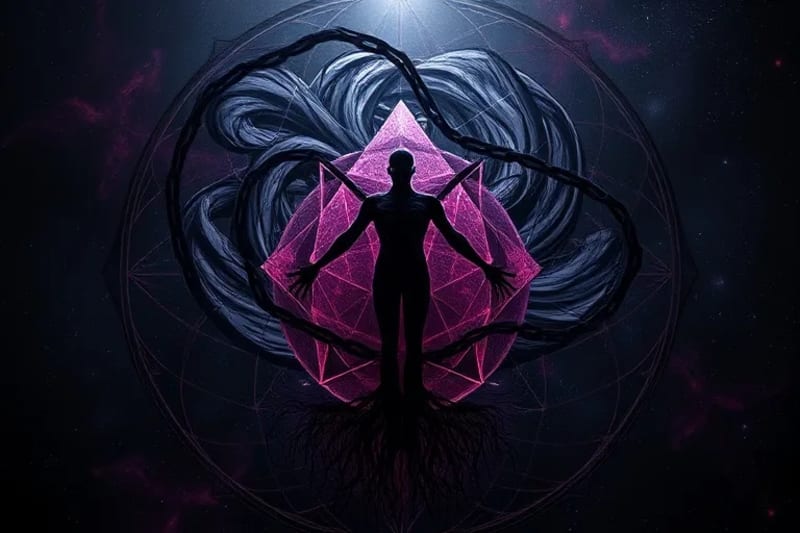
The Shadow Self, often depicted through astrological challenging aspects, represents the unacknowledged aspects of our personality.
The Shadow Self: Unveiling the Unconscious in the Birth Chart
One of Jung's most compelling concepts is the Shadow, which comprises the unconscious aspects of the personality that the conscious ego does not identify with. It includes all the things we repress, deny, or project onto others—our perceived flaws, unacceptable desires, and even undeveloped positive traits. The Shadow is not inherently evil; rather, it is unintegrated. In psycho-astrology, the Shadow Self can be identified through various astrological indicators, offering clues to its nature and how it manifests in an individual's life.
Challenging aspects (squares, oppositions, quincunxes) between planets often highlight areas where shadow material resides. For example, a square between the Sun and Pluto might indicate a struggle with power, control, or repressed aggression, suggesting a powerful, transformative Shadow. Planets in the 12th house, traditionally associated with the subconscious, hidden matters, and self-undoing, can also point to unconscious complexes and shadow projections. The sign opposite one's Sun sign can sometimes reveal qualities that are repressed and projected onto others, forming part of the personal Shadow.
Furthermore, the South Node of the Moon, representing past life patterns and ingrained habits, can also signify shadow material that needs to be brought into conscious awareness and integrated rather than continually acted out. Understanding the astrological signatures of the Shadow is the first step towards its integration. This involves acknowledging these disowned parts of ourselves, understanding their origins, and consciously working to assimilate them into our conscious personality, rather than letting them operate from the unconscious, often leading to self-sabotage or conflict.
The process of shadow integration is crucial for psychological growth. Ignoring the Shadow leads to projection, where we see our own disowned qualities in others, leading to judgment, conflict, and a distorted view of reality. By engaging with the Shadow, we reclaim our full energy and potential. This often involves confronting uncomfortable truths about ourselves, but the reward is a more authentic, integrated, and powerful self. For deeper insights into these hidden dynamics, exploring concepts like Karmic Debts and Gifts in Advanced North and South Node Astrology can provide additional context.
The Path to Wholeness: Individuation Through Astrological Insight
Jung's concept of individuation is the lifelong psychological process of differentiating the self from the collective and unconscious, integrating various aspects of the personality to become a whole, unique individual. It is the journey towards self-realization, where one becomes truly oneself. Psycho-astrology serves as an invaluable guide on this path, providing a symbolic roadmap for understanding the innate potentials and challenges inherent in one's journey.
The natal chart, with its complex interplay of energies, represents the totality of the psyche at birth—the conscious, unconscious, personal, and collective elements. The process of individuation involves consciously working with these energies rather than being unconsciously driven by them. For example, understanding one's Sun sign and its aspects reveals the core ego identity and life purpose, which is central to the individuating self. The Ascendant (Rising Sign) describes the persona, how one meets the world, and the initial steps of the journey.
The Midheaven (MC) signifies one's public role, career, and ultimate contribution, representing a conscious striving for external actualization that aligns with inner purpose. The nodal axis (North and South Nodes) specifically outlines the evolutionary path of the soul, guiding individuals away from past patterns (South Node) towards their unique destiny and growth (North Node). This astrological blueprint provides conscious direction for the individuation process, helping individuals align their outer life with their inner truth.
Wholeness, in the Jungian sense, is not about perfection but about integration—embracing all parts of oneself, including the light and the shadow. Astrology helps to identify these parts, understand their dynamics, and consciously work towards their synthesis. This journey often involves confronting difficult planetary aspects or house placements, which are not seen as curses but as opportunities for growth and integration. For instance, understanding the implications of Empty Houses in a Natal Chart can reveal areas where conscious development is particularly needed.
The journey to wholeness involves integrating all aspects of the self, represented by the balanced interplay of conscious and unconscious elements.
Practical Application: Birth Chart Analysis for Self-Discovery
Applying psycho-astrology practically involves a detailed analysis of the birth chart, interpreting its symbols through a Jungian lens. This process moves beyond simplistic interpretations, delving into the psychological underpinnings of each placement. Here’s a structured approach:
- Identify Dominant Archetypes: Look at the most prominent planets (angular, strong aspects, chart rulers), signs (stelliums, Sun/Moon/Ascendant), and house placements. These indicate the archetypal energies most active in the individual's psyche. For example, a strong Leo influence might highlight the King/Queen or Performer archetype, emphasizing creative expression and leadership.
- Map the Shadow: Examine challenging aspects, planets in the 12th house, and the South Node. What qualities are being repressed or projected? How do these manifest in life? This requires honest self-reflection and courage to face uncomfortable truths.
- Understand the Persona and Anima/Animus: The Ascendant describes the persona. For men, Venus and the Moon can indicate aspects of the Anima (inner feminine); for women, Mars and the Sun can indicate aspects of the Animus (inner masculine). Understanding these inner figures is crucial for balanced relationships and self-perception.
- Trace the Individuation Path: Analyze the North Node for the soul's evolutionary direction. How do the challenges (squares, oppositions) serve as catalysts for growth? What is the chart asking the individual to integrate or develop?
- Explore Complexes: Certain planetary configurations, especially T-squares or Grand Crosses, can point to psychological complexes—clusters of emotionally charged ideas and images that are largely unconscious and can influence behavior. Understanding these complexes through their astrological signatures can be incredibly liberating.
This analytical process is not about labeling but about understanding the dynamic interplay of forces within the psyche. It encourages self-awareness, personal responsibility, and a conscious engagement with one's inner world. For example, understanding your Leo Zodiac Sign's Traits through an archetypal lens can reveal deeper motivations for creative expression and leadership.
Integrating the Unconscious: Techniques and Insights
The journey of psycho-astrology is ultimately about integrating the unconscious into conscious awareness. This is not a passive process but an active engagement with the material revealed in the birth chart. Several techniques can facilitate this integration:
- Active Imagination: A Jungian technique where one consciously enters into a dialogue with unconscious figures, symbols, or emotions that arise from dreams or meditations. This can be particularly powerful when engaging with planetary archetypes or shadow figures identified in the chart.
- Dream Analysis: Dreams are direct messages from the unconscious. By understanding the symbols in dreams and correlating them with astrological themes, individuals can gain deeper insights into their inner dynamics and the ongoing process of individuation.
- Symbolic Engagement: Engaging with the symbols of the birth chart (e.g., meditating on a planetary glyph, drawing the chart, creating art inspired by an archetype) can help to internalize and integrate these energies on a deeper, non-rational level.
- Mindfulness and Self-Observation: Paying attention to how astrological themes manifest in daily life, emotions, and interactions can bring unconscious patterns into conscious awareness. This includes observing projections and taking responsibility for one's own shadow material.
- Therapeutic Work: Working with a qualified therapist who understands Jungian psychology and/or psycho-astrology can provide a safe and guided space for exploring complex unconscious material and facilitating integration.
The integration of the unconscious is a continuous process that leads to greater self-awareness, emotional maturity, and a more authentic way of being in the world. It allows individuals to harness their full potential, rather than being limited by unconscious complexes or shadow projections. Exploring practices like Somatic Spirituality can further aid in embodied awakening and energy healing, connecting the psychological with the physical experience.
Conclusion: The Synergy of Cosmos and Psyche
Psycho-astrology offers a rich, nuanced, and profoundly insightful approach to self-discovery and personal growth. By bridging the symbolic language of the cosmos with the intricate landscape of the psyche, it provides a powerful framework for understanding our innate archetypal patterns, confronting and integrating our shadow self, and embarking on the transformative journey towards wholeness and individuation. The birth chart, when viewed through this interdisciplinary lens, becomes more than just a map of destiny; it transforms into a dynamic guide for psychological evolution.
This synergy between astrology and Jungian psychology empowers individuals to consciously engage with their inner world, reclaim disowned parts of themselves, and live a life that is more aligned with their authentic self. It is a path that demands introspection, courage, and a willingness to explore the depths of one's being, ultimately leading to a more integrated, meaningful, and self-aware existence.
Explore More Insights
Source: Hybrid content assisted by AI and human editorial supervision.


Comments
Post a Comment