
Tarot Feng Shui Home Energy Elemental Balance
Tarot & Feng Shui: Harmonizing Home Energy with Elemental Balance
In an increasingly complex world, the quest for harmony and well-being within our personal spaces has never been more pertinent. Many traditions offer pathways to achieve this, and among the most profound are Tarot and Feng Shui. While seemingly disparate disciplines, one rooted in divination and self-reflection, the other in environmental arrangement, they share a common goal: to foster balance, enhance energy flow, and support an individual's journey towards a more fulfilling life. This article explores the fascinating synergy between these ancient practices, revealing how their combined wisdom can transform your home into a sanctuary of positive energy and insightful guidance.
Table of Contents
- Understanding Feng Shui: The Art of Elemental Balance
- Exploring Tarot: A Mirror to the Soul
- The Synergy: Connecting Tarot and Feng Shui for Home Harmony
- Practical Applications: Using Tarot for Feng Shui Decisions
- Elemental Correspondences: Tarot Suits and Feng Shui Elements
- Creating a Sacred Space: Rituals and Intentions
- Benefits of Integrating Tarot and Feng Shui
- Conclusion: A Holistic Path to a Harmonious Home
Feng Shui, an ancient Chinese art and science, focuses on arranging living spaces to optimize the flow of 'chi' (life force energy), promoting health, wealth, and happiness. It operates on the principle that our surroundings profoundly impact our inner state. Tarot, on the other hand, is a system of divination that uses a deck of 78 cards to gain insights into past, present, and future situations, offering guidance for personal growth and decision-making. By integrating these two powerful tools, we can create a dynamic approach to home harmonization that addresses both the physical environment and our inner energetic landscape.
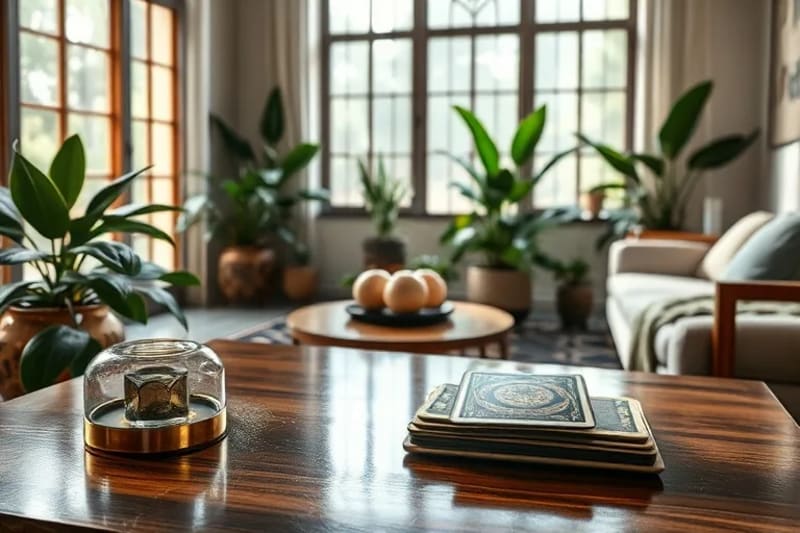
A tranquil living space where the principles of Feng Shui meet the insightful guidance of Tarot, creating a balanced and harmonious environment.
The core of both practices lies in understanding energy. Feng Shui manipulates the physical energy of a space, while Tarot helps us interpret and navigate our personal energetic currents. When combined, they offer a holistic framework for creating an environment that not only looks good but also feels right, resonating with our deepest aspirations and supporting our spiritual evolution. This synergy allows for a more intuitive and personalized application of Feng Shui principles, guided by the profound wisdom revealed through Tarot readings.
Understanding Feng Shui: The Art of Elemental Balance
Feng Shui, literally translating to "wind and water," is an ancient Chinese philosophical system of harmonizing everyone with their surrounding environment. It's not merely about interior design; it's a complex system that considers the orientation of buildings, the placement of objects, and the flow of energy to create auspicious environments. At its heart are several foundational concepts, including the Bagua map, the command position, and crucially, the five elements.
The five elements—Wood, Fire, Earth, Metal, and Water—are fundamental to Feng Shui. They represent different energies, qualities, and directions, and their balanced interaction is key to a harmonious space. Each element supports and controls others in a cyclical relationship, influencing everything from colors and materials to shapes and emotions. For instance, Wood feeds Fire, Fire creates Earth (ash), Earth bears Metal, Metal carries Water, and Water nourishes Wood. Conversely, Wood controls Earth, Earth controls Water, Water controls Fire, Fire controls Metal, and Metal controls Wood.
Understanding these elemental cycles is vital for applying Feng Shui effectively. An excess or deficiency of any element can lead to imbalance, manifesting as stagnation, conflict, or lack of prosperity in various aspects of life. For example, too much Fire energy might lead to stress and impatience, while too little Water could result in a lack of flow and emotional expression. The goal is to achieve a dynamic equilibrium where all elements are present and interacting harmoniously, supporting the occupants' well-being. This complex interplay is also reflected in Chinese Zodiac Elements, where individual characteristics are tied to these same elemental energies.
Exploring Tarot: A Mirror to the Soul
Tarot, with its rich tapestry of symbolism and archetypes, serves as a powerful tool for self-discovery and spiritual guidance. A standard Tarot deck consists of 78 cards, divided into the Major Arcana and the Minor Arcana. The Major Arcana cards represent significant life lessons, karmic influences, and overarching themes, while the Minor Arcana, comprising four suits (Wands, Cups, Swords, and Pentacles), delves into the day-to-day challenges and opportunities, reflecting the practical aspects of our existence.
Each suit of the Minor Arcana is traditionally associated with a specific element and a corresponding aspect of human experience:
- Wands: Associated with the element of Fire, representing passion, creativity, inspiration, ambition, and willpower.
- Cups: Linked to the element of Water, symbolizing emotions, intuition, relationships, love, and spiritual connection.
- Swords: Connected to the element of Air, signifying intellect, logic, communication, truth, and challenges.
- Pentacles (or Coins): Correlated with the element of Earth, representing material possessions, finances, work, stability, and physical well-being.
Through spreads and interpretations, Tarot readings can illuminate hidden truths, offer new perspectives, and help individuals make informed decisions. It acts as a mirror, reflecting our inner landscape and guiding us towards greater self-awareness. While not directly influencing physical spaces, Tarot's insights into our energetic and psychological states provide invaluable information that can inform our Feng Shui choices. This introspective approach is crucial for Mindful Manifestation, where inner alignment precedes external creation.
A visual representation of Tarot's connection to the elements, offering intuitive guidance and self-reflection.
The Synergy: Connecting Tarot and Feng Shui for Home Harmony
The true power emerges when Tarot and Feng Shui are woven together. Tarot can act as a diagnostic tool, revealing where energetic imbalances or blockages might exist within an individual's life, which can then be addressed through Feng Shui adjustments in their living space. For example, a Tarot reading might indicate a lack of passion or creativity (Wands/Fire element), suggesting that the Fire element in the home's corresponding Bagua sector needs enhancement.
Conversely, a space that feels stagnant or uninspiring might prompt a Tarot reading to uncover the underlying psychological or emotional factors contributing to that feeling. The cards can then provide specific guidance on how to shift personal energy, which can be supported by targeted Feng Shui changes. This creates a feedback loop: inner insights inform outer adjustments, and outer harmony supports inner well-being. It's a holistic approach that recognizes the interconnectedness of our internal and external worlds.
Consider using Tarot to gain clarity on specific areas of your life that you wish to improve, such as relationships, career, or health. Once you have this clarity, you can consult the Bagua map in Feng Shui to identify the corresponding areas in your home. For instance, if a Tarot reading highlights challenges in your relationships, you might focus on the "Relationship" sector of your home, using Feng Shui principles to enhance its energy. This could involve adding pairs of objects, incorporating colors associated with love and partnership, or ensuring the space is free of clutter.
Practical Applications: Using Tarot for Feng Shui Decisions
Integrating Tarot into your Feng Shui practice can make your adjustments more personal and potent. Here are several practical ways to apply this synergy:
- Diagnostic Readings: Before making any Feng Shui changes, perform a Tarot reading asking, "What is the energetic state of my home?" or "What area of my life needs the most energetic support right now?" The cards can highlight specific issues or elements that require attention.
- Elemental Guidance: Use the elemental associations of the Tarot suits to inform your Feng Shui choices. If a reading suggests a need for more passion (Fire/Wands), consider introducing red accents, candles, or triangular shapes in the relevant Bagua area. If emotional healing is indicated (Water/Cups), integrate blues, wavy patterns, or small water features.
- Object Placement: When unsure about where to place a specific item or what type of decor to choose, pull a Tarot card for guidance. For example, if you're deciding on artwork for your "Wealth" corner and pull the Ten of Pentacles, it might suggest incorporating imagery of abundance, family legacy, or earthy elements.
- Decluttering Decisions: Clutter is a major block in Feng Shui. If you struggle with letting go of items, use Tarot to understand the emotional attachment. A card like the Eight of Swords might indicate feeling trapped by possessions, encouraging you to release what no longer serves you.
- Room Purpose Clarification: For each room, pull a Tarot card to define its optimal energetic purpose. If your bedroom yields The Lovers, it reinforces its role as a space for intimacy and connection. If your office brings up The Magician, it signifies a place for creation and manifestation. This aligns with understanding the purpose of various Astrological Houses, which represent different life areas.
By approaching Feng Shui with the intuitive insights of Tarot, you move beyond mere aesthetic arrangement to create a space that genuinely supports your personal growth and energetic needs. This personalized approach ensures that your home is not just beautiful, but also a powerful ally in your life's journey.
Elemental Correspondences: Tarot Suits and Feng Shui Elements
A deeper understanding of the elemental correspondences between Tarot and Feng Shui is crucial for effective integration. While there are some variations in interpretation, the generally accepted links provide a robust framework:
| Tarot Suit | Associated Element (Tarot) | Feng Shui Element Correspondence | Qualities & Home Applications |
|---|---|---|---|
| Wands | Fire | Fire | Passion, energy, inspiration. Use reds, candles, triangular shapes in South (Fame) or Northeast (Knowledge) sectors for motivation. |
| Cups | Water | Water | Emotions, intuition, relationships. Use blues, black, wavy patterns, water features in North (Career) or Southeast (Wealth) sectors for flow and emotional depth. |
| Swords | Air | Metal (often associated with Air's clarity and sharpness) | Intellect, communication, truth. Use whites, grays, metallic objects, round shapes in West (Children/Creativity) or Northwest (Helpful People) sectors for clarity and focus. |
| Pentacles | Earth | Earth | Materiality, stability, abundance. Use browns, yellows, square shapes, ceramics, plants in Southwest (Relationships) or Center (Health) sectors for grounding and security. |
By understanding these direct links, you can translate the messages from your Tarot readings into concrete Feng Shui actions. For example, if you draw a card from the Suit of Cups that suggests a need for emotional healing, you might focus on enhancing the Water element in your home to support that process. This could involve adding a small fountain, incorporating more blue hues, or simply ensuring that your space feels calm and fluid.
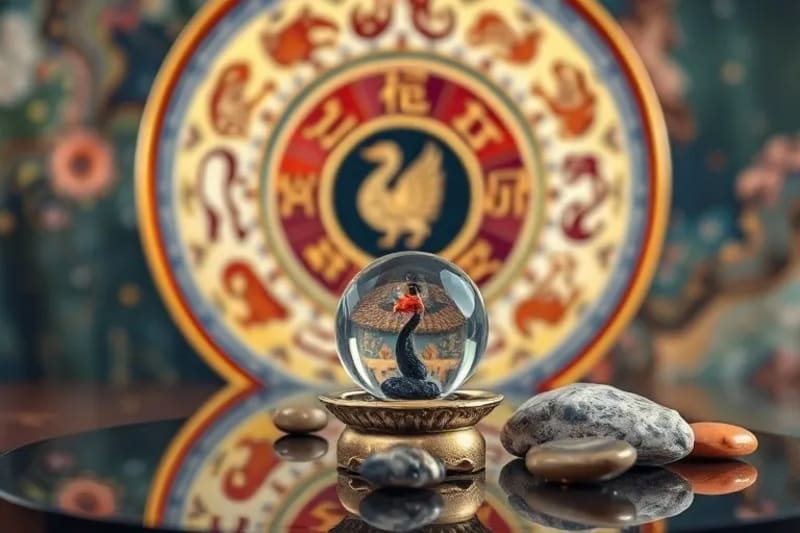
An artistic rendering of essential Feng Shui tools, symbolizing the careful arrangement of elements for optimal energy flow within a space.
Creating a Sacred Space: Rituals and Intentions
Beyond physical adjustments, the integration of Tarot and Feng Shui also involves setting intentions and performing rituals. Before beginning any Feng Shui work, you can use Tarot to clarify your intentions for the space. What kind of energy do you want to cultivate? What goals do you want your home to support? A simple three-card spread (Past, Present, Future) can offer profound insights into the current energy of your home and its potential.
Once you have clarity, you can perform a small ritual. This could involve lighting a candle, burning incense, or simply meditating in the space while holding the Tarot card that best represents your intention. As you place Feng Shui cures or arrange your furniture, visualize the desired energy flowing into your home. This conscious intention-setting elevates Feng Shui from a mere decorating exercise to a powerful act of co-creation with the universe.
Regularly checking in with your space using Tarot can also be beneficial. Just as we periodically cleanse our auras or review our goals, our homes also benefit from energetic check-ups. A monthly or quarterly Tarot reading focused on your home's energy can help you identify any new imbalances or areas that need refreshed attention. This ongoing dialogue ensures that your living environment remains a dynamic and supportive force in your life, continuously adapting to your evolving needs and aspirations.
Benefits of Integrating Tarot and Feng Shui
The combined practice of Tarot and Feng Shui offers a multitude of benefits, extending beyond mere aesthetic appeal:
- Enhanced Intuition: Regularly consulting Tarot for home decisions sharpens your intuitive faculties, allowing you to connect more deeply with your space.
- Personalized Harmony: Instead of generic Feng Shui applications, Tarot helps tailor adjustments to your unique energetic blueprint and current life circumstances.
- Deeper Understanding of Self: By observing how your inner state (revealed by Tarot) manifests in your outer environment (addressed by Feng Shui), you gain profound self-awareness.
- Proactive Problem Solving: Tarot can identify potential energetic blocks before they fully manifest in your physical space or life, allowing for proactive Feng Shui remedies.
- Sustained Positive Energy: The ongoing dialogue between inner guidance and outer arrangement ensures a continuously optimized and supportive living environment.
- Holistic Well-being: This integrated approach addresses both the spiritual and material aspects of life, fostering a sense of complete well-being and alignment.
Ultimately, harmonizing your home energy with elemental balance through Tarot and Feng Shui is an empowering journey. It transforms your living space into a conscious partner in your personal and spiritual development, a place where every object and every corner resonates with intention and supports your highest good. This deep connection to your environment can also enhance your ability to manifest desires, as discussed in various Manifestation Techniques.
Conclusion: A Holistic Path to a Harmonious Home
The integration of Tarot and Feng Shui offers a sophisticated and deeply personal approach to creating a harmonious home environment. By leveraging Tarot's intuitive insights into our inner energetic landscape and applying Feng Shui's principles to our physical surroundings, we can craft spaces that truly reflect and support our highest selves. This synergy moves beyond superficial aesthetics, delving into the energetic foundations of well-being, fostering balance, clarity, and a profound sense of peace.
As you embark on this journey, remember that both Tarot and Feng Shui are tools for empowerment. They invite you to become an active participant in shaping your reality, both within and around you. Embrace the wisdom of these ancient practices, and watch as your home transforms into a vibrant sanctuary, a true reflection of your inner harmony and elemental balance. The path to a more aligned and fulfilling life begins with conscious intention and a harmonized space.
Explore Further: Related Topics
Source: Hybrid content assisted by AI and human editorial supervision.


Comments
Post a Comment