
Astro-Archeology Celestial Narratives Lost Civilizations
Astro-archeology stands as a profound interdisciplinary field, meticulously bridging the study of ancient civilizations with the science of astronomy. It delves into the sophisticated ways our ancestors observed, understood, and integrated celestial phenomena into their cultures, architectures, and belief systems. This discipline moves beyond mere observation, seeking to unearth the intricate narratives that connected early human societies to the cosmos, revealing a shared, deep-seated human impulse to find meaning in the stars.
The core premise of astro-archeology is that ancient peoples were not only keen observers of the sky but also sophisticated interpreters, embedding their astronomical knowledge into monumental structures, sacred sites, and even their daily lives. From the precise alignments of megalithic structures to the complex calendrical systems of Mesoamerica, the celestial sphere served as a fundamental framework for timekeeping, ritual, agriculture, and cosmology. This exploration offers a unique lens through which to understand the intellectual prowess and spiritual depth of lost civilizations.
Table of Contents
- Foundations of Astro-Archeology: A Multidisciplinary Approach
- Methodologies and Tools in Celestial Archaeology
- Ancient Skywatchers: Global Perspectives on Celestial Integration
- Case Studies: Monuments and the Cosmos
- Challenges, Interpretations, and the Scientific Rigor
- Modern Advancements and the Future of Astro-Archeology
- Unveiling the Cosmic Legacy of Lost Civilizations
Foundations of Astro-Archeology: A Multidisciplinary Approach
Astro-archeology, often used interchangeably with archaeoastronomy, is inherently multidisciplinary, drawing from archaeology, astronomy, anthropology, history, and ethnography. Its primary goal is to reconstruct the astronomical practices, beliefs, and knowledge of ancient cultures by analyzing material remains. This includes the orientation of buildings, the layout of settlements, rock art, artifacts, and written records, all interpreted through the lens of celestial mechanics.
The field acknowledges that for many ancient societies, the division between science, religion, and daily life was fluid. Astronomical observations were not merely scientific pursuits but were deeply interwoven with spiritual beliefs, agricultural cycles, political power, and social organization. The rising and setting of the sun, the phases of the moon, the appearance of specific stars or constellations, and the movements of planets often dictated critical moments in the annual calendar, influencing planting, harvesting, ceremonial dates, and even the legitimacy of rulers.
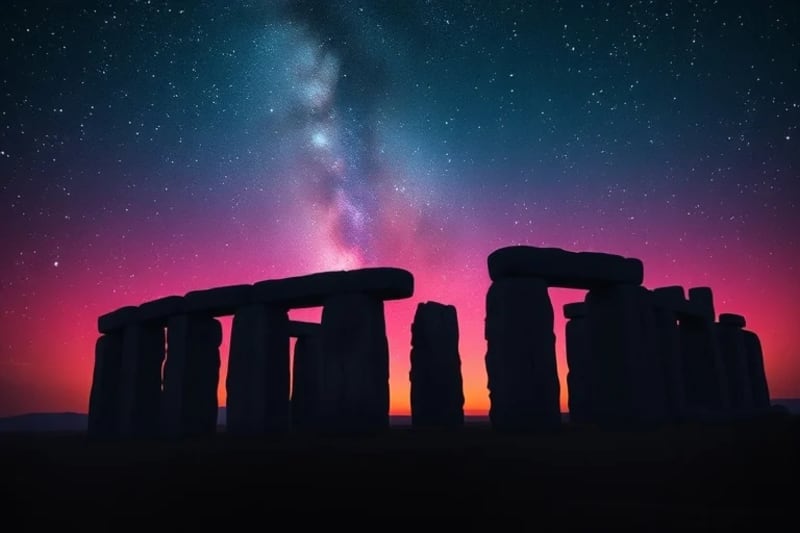
The profound connection between ancient human ingenuity and the vastness of the cosmos, as reflected in monumental architecture and celestial alignments.
Conceptual rendering generated by advanced AI, exploring the atmospheric interplay of ancient sites and stellar phenomena.Early pioneers like Alexander Thom, who meticulously surveyed megalithic sites in Britain and France, laid foundational groundwork by demonstrating precise astronomical alignments. His work on Stonehenge and other stone circles revealed sophisticated astronomical knowledge, suggesting a level of precision that challenged previous assumptions about prehistoric capabilities. This opened the door for further investigations into how celestial patterns shaped human societies across the globe.
Methodologies and Tools in Celestial Archaeology
The methodologies employed in astro-archeology are rigorous and combine field research with computational analysis. Researchers often begin with detailed surveys of archaeological sites, measuring the orientations of structures, passages, and significant features. These measurements are then compared against astronomical data, calculating the precise rising and setting points of celestial bodies (sun, moon, stars, planets) at the specific latitude and historical epoch of the site.
- Site Surveys and Measurements: Using instruments like theodolites, GPS, and laser scanners to accurately map and measure orientations.
- Astronomical Calculations: Employing specialized software to reconstruct ancient sky views, accounting for precession of the equinoxes, atmospheric refraction, and changes in the Earth's axial tilt over millennia.
- Statistical Analysis: To determine if observed alignments are statistically significant or merely coincidental, differentiating between random chance and intentional design.
- Ethnographic and Historical Data: Consulting oral traditions, myths, ancient texts, and historical records to provide cultural context and corroborate astronomical interpretations.
- Experimental Archaeology: Recreating ancient observation methods or tools to understand their practical application and limitations.
The advent of advanced technologies has revolutionized the field. LiDAR (Light Detection and Ranging) allows for the creation of highly detailed topographic maps, even under dense vegetation, revealing previously unknown structures or alignments. Satellite imagery provides broad contextual views, while computational modeling helps simulate celestial events from ancient perspectives. These tools enhance the precision and scope of astro-archeological investigations, allowing for more robust conclusions.
Ancient Skywatchers: Global Perspectives on Celestial Integration
The integration of celestial knowledge into culture is a global phenomenon, manifesting uniquely across different civilizations. From the monumental architecture of Egypt to the intricate calendars of the Maya, the cosmos provided a universal language and framework.
Intricate designs within ancient observatories, revealing how light and shadow were orchestrated to mark pivotal celestial events.
In ancient Egypt, the Nile's annual flooding was intrinsically linked to the heliacal rising of Sirius (Sopdet), a star whose appearance heralded the new year and agricultural prosperity. Temples like Karnak and Abu Simbel exhibit precise solar alignments, marking solstices and equinoxes, often illuminating cult statues or inner sanctums on specific dates. The pyramids themselves are oriented with remarkable accuracy to the cardinal directions, reflecting a sophisticated understanding of celestial north.
Mesoamerican civilizations, particularly the Maya, developed exceptionally complex calendrical systems based on intricate observations of the sun, moon, and Venus. Their cities, like Chichen Itza, Palenque, and Tikal, are replete with astronomical alignments. The famous El Castillo pyramid at Chichen Itza showcases a serpent shadow effect during the equinoxes, where the corner of the pyramid casts a shadow that appears as a descending serpent, culminating at a carved serpent head at the base. This was not merely an architectural feat but a profound ritualistic event, symbolizing cosmic order and renewal.
Across Eurasia, from the Goseck Circle in Germany (one of the oldest known solar observatories) to the intricate astronomical knowledge embedded in Chinese imperial architecture and the Vedic altars of ancient India, celestial patterns provided a blueprint for sacred space and time. These global examples underscore a universal human fascination with the sky and its perceived influence on earthly affairs.
Case Studies: Monuments and the Cosmos
Delving into specific sites provides concrete evidence of ancient astronomical prowess and its cultural significance. These examples highlight the diversity and sophistication of celestial narratives embedded in physical structures.
- Stonehenge, England: Perhaps the most iconic astro-archeological site, Stonehenge is famously aligned with the summer solstice sunrise and winter solstice sunset. The Heel Stone marks the point where the sun rises on the longest day of the year, while the main axis of the monument points towards the winter solstice sunset. This precise orientation suggests its use as a sophisticated calendar and a site for seasonal rituals.
- Nabta Playa, Egypt: Predating Stonehenge by millennia, Nabta Playa in the Egyptian Sahara features a megalithic circle and other stone structures dating back to the 5th millennium BCE. It is considered one of the world's earliest astronomical alignments, with stones marking the summer solstice sunrise and possibly other celestial events, indicating a very early understanding of celestial cycles by nomadic pastoralists.
- Chaco Canyon, New Mexico, USA: The Ancestral Puebloans of Chaco Canyon built sophisticated multi-story structures (great houses) with remarkable astronomical alignments. Fajada Butte features the "Sun Dagger," where shafts of light pierce spiral petroglyphs at solstices and equinoxes. Other structures, like Pueblo Bonito, show alignments to lunar standstills, indicating a deep understanding of complex lunar cycles.
- Gobekli Tepe, Turkey: This enigmatic Neolithic site, dating back to the 10th millennium BCE, features massive carved stone pillars arranged in circles. While its primary function is still debated, some researchers propose that certain pillars and enclosures may have been aligned with specific stars or constellations, potentially encoding ancient cosmic myths or observations of celestial events like meteor showers. This site pushes back the timeline for sophisticated astronomical awareness significantly.
These sites, among many others, serve as tangible proof that ancient societies across continents shared a profound connection with the sky, using it not only for practical purposes but also to construct their worldviews and spiritual understanding. For a broader context on how planetary cycles influence global trends, one might explore Mundane Astrology Planetary Cycles Global Trends Explained.
Challenges, Interpretations, and the Scientific Rigor
Despite its compelling findings, astro-archeology is not without its challenges and controversies. A central debate revolves around distinguishing between intentional astronomical alignments and coincidental orientations. The sheer number of possible alignments means that some will occur by chance, leading to the need for rigorous statistical analysis to validate claims.
Symbolic artifacts and tools, emerging from the earth, represent the rediscovery of ancient celestial wisdom and technological prowess.
Another challenge lies in interpretation. While an alignment can be mathematically proven, understanding its cultural significance requires careful consideration of the available archaeological, ethnographic, and historical evidence. Over-interpretation, or projecting modern astronomical knowledge onto ancient cultures without sufficient contextual evidence, is a pitfall that rigorous researchers strive to avoid. The field must walk a fine line between scientific measurement and humanistic interpretation.
The rise of pseudo-archaeology, which often makes sensational claims about ancient astronauts or lost super-technologies based on misinterpreted alignments, also poses a challenge to the credibility of legitimate astro-archeological research. This makes adherence to scientific methodology, peer review, and transparent data crucial for maintaining the field's academic integrity. Understanding the deeper meaning of celestial events can also be explored through Predictive Fixed Stars: Global Events & Personal Turning Points.
Modern Advancements and the Future of Astro-Archeology
The future of astro-archeology is bright, driven by technological advancements and an increasing recognition of its importance. The integration of GIS (Geographic Information Systems) allows researchers to map and analyze spatial relationships between sites and celestial phenomena on a grander scale. Virtual reality (VR) and augmented reality (AR) are beginning to be used to reconstruct ancient sky views and experience sites as their original builders might have, offering immersive insights into past astronomical practices.
Artificial intelligence (AI) and machine learning are also emerging as powerful tools, capable of sifting through vast datasets of archaeological features and astronomical calculations to identify patterns and potential alignments that might be missed by human observers. This can accelerate the discovery process and provide new avenues for hypothesis generation. Such advanced analytical methods parallel the predictive capabilities discussed in Astrología IA Predictiva: Algoritmos Cósmicos Futuro Personalizado, highlighting the convergence of ancient wisdom and modern technology.
Furthermore, increased collaboration between astronomers, archaeologists, anthropologists, and indigenous communities is enriching the field. Indigenous knowledge systems often preserve ancient astronomical traditions and oral histories that can provide invaluable context and interpretation for archaeological findings, offering a holistic understanding of the human-cosmos relationship.
Unveiling the Cosmic Legacy of Lost Civilizations
Astro-archeology offers a compelling narrative of human intellectual and spiritual development. It reveals that our ancestors were not primitive observers but sophisticated cosmologists who meticulously charted the heavens and integrated their understanding into the very fabric of their societies. The celestial narratives they left behind in stone, art, and myth speak to a universal human quest for order, meaning, and connection within the vastness of the universe.
By continuing to unearth and interpret these celestial legacies, we gain a deeper appreciation for the ingenuity of past civilizations and the enduring human fascination with the cosmos. It reminds us that the stars have always been, and continue to be, a source of wonder, guidance, and profound inspiration, linking us across millennia to those who gazed at the same night sky and sought to understand their place within it.
Explore More Insights
- Lunar Mansions Urban Geomancy: Aligning City Dwellings Cosmic Energies
- Astro-Linguistics Sigil Magic: Natal Chart Mantras
- Pet Astrology Compatibility Guide: Your Furry Soulmate Revealed
- Chiron Astrology Healing Wounds: Birth Chart Guide
- Biometric Divination: AI-Enhanced Intuition Self-Discovery
- Astrological Houses: Comprehensive Guide Life's Spheres
- Astrological Aspects: Conjunctions, Oppositions, Trines Explained
- Pluto in Signs: Generational Transformation and Power Dynamics
- Ecological Divination: Tarot, Runes, Oracles for Earth Healing
- Intercepted Houses Astrology: Unlocking Latent Chart Potential
- Elemental Grimoire: Advanced Western Esoteric Magic
- Past Life Regression Birth Chart: Unveiling Soul Contracts
- Rat Chinese Zodiac: Meaning, Traits, and Compatibility
- Latin American Gastronomy: Flavors, History, and Future
- Subscription Models Creator Economy Monetization Strategies Legal
- Legal Challenges Data Privacy Social Networks
- Hunter's Full Moon: Rituals of Abundance, Protection, Manifestation
- World Horoscope: Annual Predictions, Major Events
- Quantum Rosary: Neuroscience, Faith, Digital Soul Healing
- Digital Silence Mysticism: Finding God Information Overload
- Joyful Rosary: Deep Meditation and Promises
Source: Hybrid content assisted by AI and human editorial supervision.


Comments
Post a Comment