
Hellenistic Medical Astrology: Ancient Healing for Modern Ailments
Hellenistic astrology, a tradition flourishing from the 1st century BCE to the 7th century CE, laid the foundational principles for much of Western astrology, including its intricate relationship with medicine. This ancient system viewed the cosmos as a living entity, with celestial bodies exerting tangible influences on earthly phenomena, including human health. Medical astrology, a specialized branch, sought to diagnose and treat ailments by understanding these cosmic correlations, offering a holistic perspective that integrated mind, body, and spirit within a universal framework.
In an era predating modern diagnostics and pharmaceuticals, medical astrology provided a sophisticated system for practitioners to interpret an individual's constitution, predispositions to illness, and optimal timing for interventions. It wasn't merely a superstitious practice but a complex discipline rooted in observational astronomy, philosophical inquiry, and extensive clinical experience. The resurgence of interest in these ancient healing modalities reflects a growing desire for integrative approaches to health that acknowledge the multifaceted nature of human well-being.

The intricate tapestry of ancient astrological insights and contemporary medical understanding, revealing a timeless quest for well-being.
Conceptual artwork rendered by advanced AI, exploring the confluence of historical wisdom and future medical paradigms.This article delves into the core tenets of Hellenistic medical astrology, exploring its diagnostic principles, therapeutic applications, and potential relevance for contemporary health practices. We will examine how ancient astrologers used birth charts to identify constitutional strengths and weaknesses, predict periods of vulnerability, and recommend specific treatments aligned with cosmic rhythms. Understanding these historical perspectives can enrich our appreciation for the enduring human quest for healing and offer new avenues for holistic health exploration.
Table of Contents
- Foundational Principles of Hellenistic Medical Astrology
- Diagnostic Techniques and Constitutional Analysis
- Therapeutic Modalities and Astrological Timing
- Integrating Ancient Wisdom with Modern Ailments
- Challenges and Ethical Considerations
Foundational Principles of Hellenistic Medical Astrology
At the heart of Hellenistic medical astrology lies the concept of cosmic sympathy, the belief that everything in the universe is interconnected and influences one another. This philosophy extended to the human body, which was seen as a microcosm reflecting the macrocosm of the heavens. Key to this understanding was the theory of the four humors—blood, phlegm, yellow bile, and black bile—each associated with specific planets, elements, and temperaments.
Each planet and zodiac sign was believed to govern specific body parts, organs, and physiological functions. For instance, the Sun was associated with the heart and vitality, the Moon with fluids and the stomach, and Mars with muscles and inflammation. Understanding these correspondences was crucial for interpreting a birth chart and identifying potential areas of physical vulnerability. The interplay of planetary energies and their placements within the zodiacal houses provided a detailed map of an individual's health landscape.
The elemental qualities (Fire, Earth, Air, Water) also played a significant role, linking directly to the humoral theory. An excess or deficiency of a particular element, as indicated by planetary placements, could point to an imbalance in the corresponding humor, leading to specific health conditions. This intricate system allowed ancient astrologers to move beyond superficial symptoms and address the root causes of illness from a cosmic perspective.

A curated collection of botanical remedies and astrological symbols, representing the ancient pharmacopeia.
Artistic interpretation of historical healing practices, blending natural elements with celestial knowledge.Furthermore, the concept of planetary sect was vital. Planets were divided into diurnal (day) and nocturnal (night) sects, and their strength and beneficence were judged based on whether they were in their preferred sect. A planet in its sect was generally considered more helpful and less prone to causing illness, while an out-of-sect malefic could indicate significant health challenges. This added another layer of complexity to astrological health assessments.
The philosophical underpinnings of Hellenistic astrology also emphasized the interconnectedness of fate and free will. While the birth chart revealed predispositions, it was believed that individuals could mitigate negative influences through appropriate actions and treatments. This proactive approach to health empowered individuals within the cosmic framework, encouraging them to work in harmony with celestial energies rather than passively accepting their fate.
Diagnostic Techniques and Constitutional Analysis
Hellenistic medical astrologers employed several sophisticated techniques to diagnose potential health issues and understand an individual's constitutional makeup. The natal chart served as the primary diagnostic tool, offering a snapshot of the celestial influences at the moment of birth. By analyzing planetary positions, aspects, and house placements, astrologers could identify inherent strengths, weaknesses, and tendencies towards certain ailments. This comprehensive birth chart analysis was foundational.
One crucial technique was the analysis of the six places of illness (the 6th, 8th, and 12th houses and their opposite houses). The 6th house, in particular, was associated with acute illnesses, daily routines, and self-care. Planets located in these houses, especially malefics like Mars and Saturn, were considered indicators of potential health challenges. The ruler of the 6th house and its condition in the chart also provided vital clues about the nature and severity of diseases.
Decumbiture charts were another specialized diagnostic method. Cast for the moment a person fell ill or sought medical advice, these charts were used to determine the course and outcome of a disease. The Moon's position and aspects in a decumbiture chart were particularly important, as they were believed to reflect the patient's condition and the prognosis. This technique allowed astrologers to offer timely advice and predict critical turning points in an illness.
| Planet | Associated Body Parts/Functions | Humor/Temperament |
|---|---|---|
| Sun | Heart, spine, eyes, vitality | Choleric (Yellow Bile) |
| Moon | Stomach, breasts, fluids, lymphatic system | Phlegmatic (Phlegm) |
| Mercury | Nervous system, lungs, hands, communication | Melancholic/Sanguine (Varies) |
| Venus | Kidneys, throat, reproductive organs, skin | Sanguine (Blood) |
| Mars | Muscles, blood, head, inflammation, fever | Choleric (Yellow Bile) |
| Jupiter | Liver, thighs, arteries, growth | Sanguine (Blood) |
| Saturn | Bones, teeth, skin, spleen, chronic conditions | Melancholic (Black Bile) |
The concept of critical days, derived from the Moon's phases and aspects, was also integral to diagnosis and prognosis. These were specific days during an illness when a crisis or turning point was expected. Ancient physicians would closely monitor patients during these periods, adjusting treatments accordingly. This highlights the dynamic and time-sensitive nature of medical astrology, where the celestial clock guided interventions.
Understanding the constitutional type of an individual, based on their dominant planets and elements, allowed for personalized medical advice. For example, a person with a strong Mars might be prone to fevers and inflammatory conditions, while someone with a prominent Saturn might suffer from chronic ailments related to coldness and dryness. This detailed analysis provided a framework for preventive care and tailored therapeutic strategies, anticipating health issues before they fully manifested.
Therapeutic Modalities and Astrological Timing
Once a diagnosis was made, Hellenistic medical astrologers would recommend specific therapeutic modalities designed to restore humoral balance and counteract planetary malefics. These treatments often involved a combination of herbal medicine, dietary adjustments, lifestyle changes, and even spiritual practices. The selection of remedies was meticulously aligned with the astrological correspondences of the planets and signs involved in the illness.
Herbal medicine was a cornerstone of ancient healing. Plants were associated with specific planets and their qualities. For instance, herbs ruled by the Sun (like rosemary or bay laurel) might be used to strengthen the heart or boost vitality, while those ruled by the Moon (like chamomile or poppy) could address digestive issues or promote sleep. The principle was to use remedies whose planetary affiliations harmonized with the patient's needs or counteracted adverse planetary influences. This is also seen in the broader context of global predictions in mundane astrology, where celestial events impact collective health.
Dietary recommendations were also tailored to an individual's humoral constitution and current planetary transits. Foods were classified by their elemental and planetary qualities (hot, cold, wet, dry). A person suffering from an excess of hot, dry yellow bile (Mars/Sun) might be advised to consume cooling and moistening foods, while someone with cold, wet phlegm (Moon/Venus) might benefit from warming and drying foods. This personalized nutrition aimed to rebalance the internal environment.
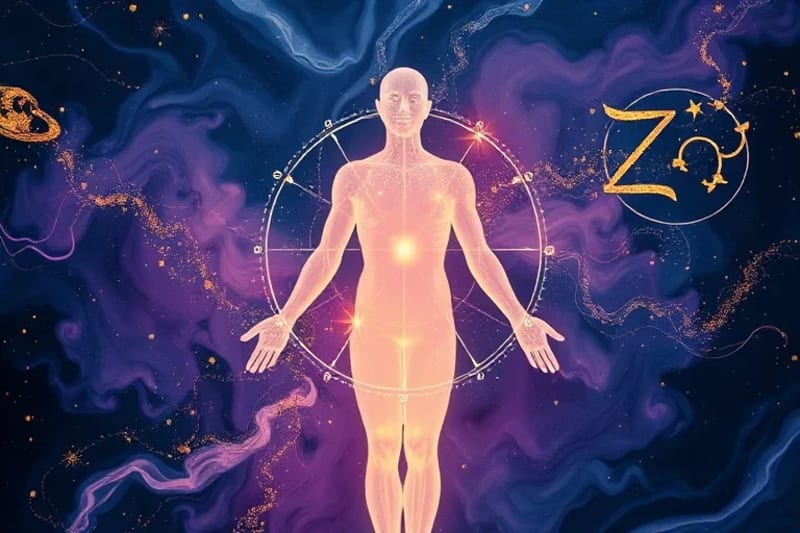
An ethereal depiction of the human form, intricately mapped with celestial energies and zodiacal influences.
Digitally generated concept art illustrating the profound connection between human physiology and astrological patterns.Crucially, the timing of treatments was paramount. This aspect falls under electional astrology, which seeks to find the most auspicious moment for any endeavor, including medical procedures, starting a new diet, or taking medication. For example, surgery on a body part ruled by a particular sign would be avoided when the Moon was in that sign or afflicted by malefics. Similarly, herbal remedies might be gathered or administered during specific planetary hours or lunar phases to maximize their potency.
Beyond physical interventions, Hellenistic medical astrology also recognized the psychological and spiritual dimensions of health. Planetary afflictions were not just seen as physical predispositions but also as indicators of mental or emotional challenges. Practices like meditation, prayer, or specific rituals might be recommended to align the individual with more benevolent cosmic energies, fostering inner harmony and resilience. This holistic view emphasized that true healing encompasses all levels of being.
Integrating Ancient Wisdom with Modern Ailments
In the 21st century, as we grapple with complex chronic diseases, mental health crises, and the limitations of purely symptomatic treatments, the holistic framework of Hellenistic medical astrology offers valuable insights. While it is not a substitute for evidence-based modern medicine, its principles can complement contemporary approaches by providing a deeper understanding of individual constitutional vulnerabilities and optimal timing for interventions. The focus on personalized health is particularly relevant today.
For instance, understanding a patient's astrological predispositions can inform preventive strategies. If a birth chart indicates a strong tendency towards digestive issues (e.g., afflicted Moon or Mercury), dietary and lifestyle adjustments can be recommended proactively. This aligns with modern preventive medicine, but with an added layer of personalized astrological insight. The intricate connection between Mercury in astrology and communication or intellect also highlights the mind-body connection.
The emphasis on timing, or electional astrology, could be applied to scheduling medical treatments, surgeries, or even the initiation of new therapeutic regimens. While not yet scientifically validated in modern terms, the concept of aligning with favorable cosmic rhythms resonates with traditional practices in many cultures that consider auspicious timing for important life events. This perspective suggests that the "when" of treatment can be as important as the "what."
Moreover, the humoral theory, though not directly accepted in modern physiology, provides a metaphorical framework for understanding constitutional types and energetic imbalances. Many alternative medicine systems, such as Traditional Chinese Medicine or Ayurveda, operate on similar principles of balancing internal energies. Medical astrology offers another lens through which to view these energetic patterns, fostering a more integrative and comprehensive approach to patient care.
The holistic perspective of Hellenistic medical astrology encourages a deeper engagement with one's own health journey, moving beyond a passive role to an active partnership with cosmic influences. It prompts individuals to consider how their lifestyle, emotional state, and even their birth moment contribute to their overall well-being. This self-awareness is a powerful tool in managing and preventing illness, fostering a more proactive and empowered approach to health.
Challenges and Ethical Considerations
While the insights from Hellenistic medical astrology are profound, integrating them into modern healthcare presents significant challenges. The primary hurdle is the lack of empirical, scientific validation for many of its claims within the current medical paradigm. Modern medicine relies on randomized controlled trials and measurable outcomes, which are difficult to apply to the highly individualized and qualitative nature of astrological interpretations.
Ethical considerations also arise, particularly regarding the potential for misinterpretation or over-reliance on astrological prognoses. Patients seeking medical advice must be guided by qualified healthcare professionals, and astrological insights should always be presented as complementary perspectives rather than definitive diagnoses or treatments. It is crucial to avoid any suggestion that astrology can replace conventional medical care for serious conditions.
Another challenge lies in the complexity of the ancient texts and the need for rigorous study and interpretation. Hellenistic astrology is a nuanced system, and superficial understanding can lead to inaccurate or misleading conclusions. Practitioners seeking to apply these modalities must undergo extensive training and possess a deep appreciation for both astrological principles and ethical practice. The distinction between Sidereal and Tropical Astrology also plays a role in interpretation.
Despite these challenges, the value of medical astrology lies in its capacity to offer a unique, holistic framework for understanding health. It encourages a personalized approach, acknowledging the individual's unique constitution and life path. By fostering greater self-awareness and encouraging alignment with natural rhythms, it can empower individuals to take a more active role in their well-being, complementing the strengths of modern medicine without supplanting them.
The exploration of ancient healing modalities, including medical astrology, is part of a broader movement towards integrative health. This movement seeks to combine the best of conventional and complementary therapies to provide comprehensive, patient-centered care. As research into mind-body connections and the subtle influences on health continues, the wisdom embedded in Hellenistic medical astrology may find new avenues for appreciation and application.
Discover More Astrological Insights
- Rabbit Chinese Zodiac: Elemental Traits Explained
- Monkey Zodiac: Mastering Problem-Solving and Adaptability
- Mindfulness Astrological Transits Navigating Challenges Presence
- Techno-Shamanism Digital Tools Ancient Rituals Modern Spirituality
- Horary Astrology: Charting Momentary Questions
- Virgo Scorpio Sexual Astrology: Deepening Intimacy Trust
- Quantum Entanglement Synastry: Non-Local Soul Connections
- Horse Personalities: Zodiac Traits in Celebrities
- Energy Protection Techniques: Shielding Aura, Negative Influences
- Affirmations Power: Manifesting Your Desires
- Virgo Scorpio Compatibility: Sexual Dynamics, Soul Contracts
Explore Our Network
- Circular Economy: Sustainable Business Model for the Future | Althox
- Neuroarchitecture and Cognitive Well-being: Spaces for Mental Health
- Blockchain and Financial Inclusion in Emerging Markets
- Astral Soulmate: Karmic and Spiritual Connections | AstroFuturo
- Viking Runes: Nordic Oracle and Spiritual Guide | AstroFuturo
- Water Pig: Personality, Love, and Detailed Destiny | AstroFuturo
- Saint Faustina Kowalska: Prophet of Divine Mercy | Profecías de la Virgen
- Artificial Intelligence, Consciousness, Soul: Prophetic Future Signal
- Cherubim in the Old Testament: Divine Guardians | Profecías de la Virgen
Source: Hybrid content assisted by AI and human editorial supervision.


Comments
Post a Comment