
Eco-Astrology Planetary Cycles Environmental Harmony
Eco-astrology emerges as a profound and timely discipline, bridging the ancient wisdom of celestial mechanics with the pressing contemporary need for environmental consciousness. This field explores the intricate relationship between planetary cycles, astrological influences, and the ecological health of our planet, offering a unique framework for understanding and promoting environmental harmony. It posits that just as celestial bodies impact human lives, they also exert influence on Earth's ecosystems, weather patterns, and even geological phenomena.
By studying these cosmic connections, eco-astrology provides insights into sustainable living, resource management, and our collective responsibility towards the Earth. It encourages individuals to view themselves not merely as inhabitants but as integral components of a vast, interconnected cosmic web. This perspective shifts our understanding of environmental issues from purely scientific or political to a more holistic and spiritually informed approach, fostering a deeper sense of stewardship.
Table of Contents
- Understanding Eco-Astrology: A Holistic Perspective
- Planetary Cycles and Earth's Rhythms
- The Birth Chart as an Ecological Blueprint
- Practical Applications for Environmental Stewardship
- Fostering Environmental Harmony and Global Consciousness
- The Future of Eco-Astrology: A Call to Action
Understanding Eco-Astrology: A Holistic Perspective
Eco-astrology is a branch of astrology that extends its traditional focus on human psychology and destiny to encompass the Earth and its intricate ecosystems. It operates on the principle of "as above, so below," suggesting that the patterns and energies observed in the cosmos are reflected in terrestrial phenomena. This field considers the Earth itself as a living entity with its own astrological chart, influenced by the same planetary movements that affect individuals.
The core tenet is that humanity's well-being is inextricably linked to the health of the planet, and that understanding cosmic rhythms can illuminate pathways to ecological balance. It integrates ecological science, spiritual philosophy, and astrological analysis to offer a comprehensive view of our place within the natural world. This holistic perspective encourages a shift from anthropocentric views to a more ecocentric understanding, recognizing the inherent value of all life forms and natural systems.
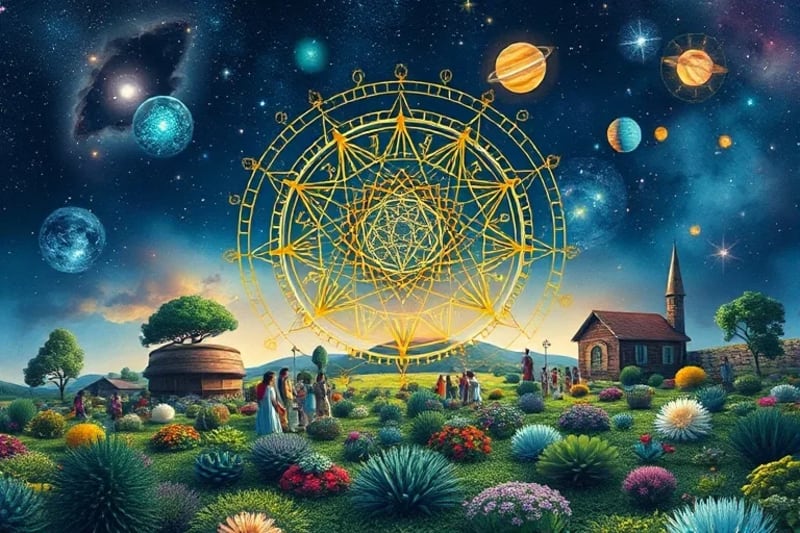
 The ancient wisdom of celestial mechanics intertwines with the Earth's ecological health, revealing profound connections between planetary cycles and environmental harmony.
This conceptual render, inspired by the intricate dance of cosmos and nature, illustrates the foundational principles of eco-astrology, drawing from themes of universal interconnectedness.
Eco-astrology also delves into the concept of planetary archetypes as they manifest in environmental challenges and solutions. For instance, the archetype of Saturn might relate to structure, limitations, and responsibility in resource management, while Uranus could signify innovation and radical shifts in environmental policy. By recognizing these archetypal energies, we can better understand the underlying dynamics of ecological crises and formulate more effective, cosmically aligned responses.
Planetary Cycles and Earth's Rhythms
The Earth is constantly bathed in the energetic influences of planetary cycles, which eco-astrology correlates with various terrestrial rhythms and events. These cycles, such as the lunar phases, solar flares, and the longer transits of outer planets, are believed to impact everything from ocean tides and plant growth to seismic activity and climate patterns. Understanding these correlations allows for a more attuned approach to agriculture, conservation, and disaster preparedness.
For example, the Moon's cycles are well-known to affect water bodies and biological rhythms, influencing planting schedules in biodynamic farming. Jupiter's expansive cycles might correlate with periods of growth and abundance, or conversely, overconsumption, while Saturn's contracting influence could signify times of scarcity, necessary restructuring, or environmental regulations. Neptune's elusive energy might relate to oceanic health, pollution, or spiritual connection to water.
Furthermore, eco-astrology examines the Lunar Nodes Aspects in relation to collective karmic patterns concerning the Earth. These nodes, representing our collective past and future evolutionary path, can highlight humanity's karmic responsibilities towards the environment. They offer insights into the soul contracts we hold with the planet and how past actions may be manifesting in current ecological challenges, guiding us towards more conscious choices for the future.
 Humanity's collective efforts in nurturing the Earth are guided by the subtle influences of planetary alignments, fostering a deeper connection to nature's rhythms.
This vibrant watercolor depicts the collaborative spirit of environmental stewardship, harmonizing human activity with celestial energies, as often explored in eco-astrological principles.
Understanding these planetary cycles also involves recognizing periods of environmental vulnerability or resilience. For instance, certain planetary alignments might coincide with increased seismic activity or extreme weather events, prompting proactive measures. Conversely, harmonious aspects could indicate opportune times for large-scale environmental restoration projects or the implementation of new sustainable technologies. This cyclical awareness fosters a more proactive and preventative approach to ecological challenges.
The Birth Chart as an Ecological Blueprint
In eco-astrology, an individual's birth chart is not only a map of their personal destiny but also an "ecological blueprint," revealing their unique connection to the Earth and their potential role in environmental stewardship. Each planet, sign, and house in the natal chart can offer clues about a person's relationship with nature, their environmental sensitivities, and their capacity to contribute to ecological harmony.
For instance, strong Earth signs (Taurus, Virgo, Capricorn) or a prominent Earth element in the chart might indicate a natural affinity for gardening, conservation, or practical environmental work. Water signs (Cancer, Scorpio, Pisces) could suggest a deep emotional connection to water bodies, marine life, or issues related to pollution. Fire signs (Aries, Leo, Sagittarius) might inspire passionate activism or leadership in environmental causes, while Air signs (Gemini, Libra, Aquarius) could excel in environmental communication, policy, or innovative solutions.
The placement of planets in specific houses can further refine these insights. A planet in the 6th house (daily routines, service) might point to an individual's daily habits and their impact on the environment, or their dedication to ecological service. Planets in the 10th house (career, public image) could indicate a calling towards environmental careers or public advocacy. By analyzing these placements, individuals can identify their unique ecological gifts and challenges, aligning their personal path with global environmental needs.
Practical Applications for Environmental Stewardship
Eco-astrology offers a range of practical applications that empower individuals and communities to engage in more effective environmental stewardship. These applications move beyond theoretical understanding, providing actionable strategies rooted in cosmic wisdom. One significant area is biodynamic agriculture, which aligns planting and harvesting with lunar and planetary cycles to enhance soil fertility and crop vitality.
Another application involves using astrological timing for environmental initiatives. Launching conservation projects, advocating for policy changes, or even organizing community clean-ups during astrologically favorable periods can enhance their effectiveness and impact. This approach suggests that aligning human efforts with cosmic flows can amplify positive outcomes, much like sailing with the wind rather than against it.
 An intricate crystal grid, resonating with planetary energies, symbolizes the energetic healing and balance that can be achieved within ecosystems through astrological principles.
This 3D digital artwork conceptually represents the application of Planetary Crystal Grids Astrological Remediation for harmonizing imbalances within natural environments.
Furthermore, eco-astrology can inform personal lifestyle choices. By understanding one's birth chart, an individual might discover a particular planetary influence that encourages mindful consumption, local sourcing, or a deeper connection to a specific element (e.g., water conservation for a strong Neptune). This personalized approach makes environmental action more intuitive and sustainable, integrating it seamlessly into daily life. It also encourages Astro-Psychology: Shadow Work to address inner blockages that prevent effective environmental action.
Fostering Environmental Harmony and Global Consciousness
Beyond individual actions, eco-astrology aims to foster a collective environmental harmony and elevate global consciousness regarding our planet's health. It suggests that major planetary alignments can influence collective shifts in awareness, prompting humanity to confront ecological crises and seek sustainable solutions. These periods can be seen as cosmic catalysts for change, urging us towards greater responsibility and interconnectedness.
The concept of "planetary citizenship" is central to this endeavor, encouraging individuals to see themselves as citizens of Earth first, transcending national or cultural boundaries in the face of shared environmental challenges. This global perspective is crucial for addressing issues like climate change, biodiversity loss, and pollution, which require coordinated international efforts. Eco-astrology provides a spiritual and philosophical foundation for such unity.
Moreover, eco-astrology contributes to the broader dialogue of Cosmic Sociology Digital Age Global Consciousness by highlighting how our collective astrological patterns reflect our relationship with the environment. By understanding these macro-level influences, we can better anticipate and respond to societal trends that impact ecological systems. This includes examining how technological advancements, economic models, and political structures are influenced by planetary energies and how they, in turn, affect the Earth.
The Future of Eco-Astrology: A Call to Action
The future of eco-astrology lies in its potential to integrate ancient wisdom with modern scientific understanding, providing a powerful framework for navigating the complexities of environmental crises. As our planet faces unprecedented ecological challenges, the insights offered by eco-astrology can inspire a deeper connection to nature and a renewed commitment to stewardship. It calls for a re-evaluation of our relationship with the Earth, moving towards one of reverence and active participation.
This evolving field encourages further research into the correlations between planetary events and terrestrial phenomena, utilizing advanced data analysis and interdisciplinary collaboration. It invites scientists, astrologers, environmentalists, and spiritual leaders to work together, pooling their knowledge to create a more sustainable and harmonious future. The goal is not to replace scientific methods but to enrich them with a cosmic perspective, fostering a more profound understanding of Earth's delicate balance.
Ultimately, eco-astrology is a call to action—a reminder that we are all interconnected with the cosmos and the Earth. By understanding our unique ecological blueprints and aligning with planetary rhythms, we can collectively contribute to healing our planet and creating a legacy of environmental harmony for generations to come. It is a path towards conscious co-creation with the natural world, guided by the wisdom of the stars.
Explore More Cosmic Insights
Source: Hybrid content assisted by AI and human editorial supervision.


Comments
Post a Comment