
Horary Astrology: Charting Momentary Questions | StarPluto
Horary astrology, a venerable branch of astrological practice, offers a unique and highly focused method for gaining insight into specific questions. Unlike natal astrology, which interprets an individual's life path based on their birth chart, horary astrology casts a chart for the precise moment a question is clearly formulated and understood by the astrologer. This "chart of the moment" then becomes a symbolic blueprint, providing direct answers and illuminating the circumstances surrounding the query.
This ancient technique, dating back to Hellenistic and Medieval periods, is renowned for its precision and ability to address practical concerns, from finding lost objects to determining the outcome of business ventures or relationships. Its methodology is rigorous, relying on a detailed set of rules and interpretations that have been refined over centuries. Understanding horary astrology requires not only a grasp of basic astrological principles but also an appreciation for its specific lexicon and judgment criteria.

An antique astrolabe and scrolls, representing the precise and venerable nature of horary astrology.
The power of horary lies in its directness. A well-formulated question, such as "Will I get the job?" or "Should I buy this house?", can be answered with remarkable clarity, often providing a simple "yes" or "no," or outlining the conditions under which a particular outcome is likely. This makes it an invaluable tool for decision-making and navigating uncertainties in life.
This article will delve into the fundamental principles of horary astrology, exploring its core components, the rules for judgment, and some advanced techniques that add layers of nuance to its interpretations. Whether you are a seasoned astrologer or a curious newcomer, this guide aims to provide a comprehensive and educational overview of this fascinating astrological discipline.
Table of Contents
- Fundamentals of Horary Astrology
- Casting the Horary Chart
- Key Components of a Horary Chart
- Rules for Judgment: Interpreting the Chart
- Advanced Horary Techniques
- Ethical Considerations in Horary Practice
- Conclusion: The Enduring Value of Horary Astrology
Fundamentals of Horary Astrology
Horary astrology operates on the principle of synchronicity, suggesting that the moment a question is asked and understood by the astrologer contains all the necessary information to answer it. This is not about predicting a fixed future but rather about revealing the current trajectory and potential outcomes based on the energies at play. The accuracy of a horary reading hinges on the clarity of the question and the astrologer's skill in interpreting the chart.
The core concept is that the universe reflects the truth of the moment. When a person (the querent) asks a question, the cosmic clock "stops" at that instant, and a unique astrological chart is cast. This chart is a snapshot of the planetary positions, houses, and aspects, all of which are then analyzed in relation to the specific question at hand. It's a highly focused and pragmatic application of astrological principles.
Casting the Horary Chart
Casting a horary chart requires the exact time and location where the astrologer *understands* the question. This is a crucial distinction. It's not when the querent thinks of the question, nor when they ask it, but when the astrologer fully comprehends the query and is ready to analyze it. This ensures the chart reflects the moment of astrological inquiry.
- Time: The precise minute the astrologer understands the question.
- Location: The geographical coordinates of the astrologer at that moment.
- House System: Traditionally, Regiomontanus or Placidus house systems are preferred for horary, as they are sensitive to geographical location and time, providing accurate house cusps.
Once the chart is cast, the astrologer examines its "radicality" – a term indicating whether the chart is fit to be read. Certain conditions, such as early or late degrees on the Ascendant, or the Moon being void of course, might suggest that the question is not yet ripe for an answer or that the querent's mind is not settled. However, experienced practitioners often find ways to interpret even these challenging charts.
Key Components of a Horary Chart
Interpreting a horary chart involves identifying key players and their relationships, much like a play with characters and their interactions. Each element holds specific significance related to the question.
- The Querent (1st House): The person asking the question is represented by the Ascendant (the cusp of the 1st house), its ruling planet, and any planets within the 1st house. The sign on the Ascendant describes the querent's attitude and immediate circumstances regarding the question.
- The Quesited (Relevant House): The subject of the question is assigned to a specific house. For example, a question about a spouse would refer to the 7th house, a lost item to the 2nd (for movable goods) or 4th (for real estate), or a career matter to the 10th house. The ruler of this house and any planets within it become the significators of the quesited.
- The Moon: The Moon is a universal significator in horary, representing the general flow of events, the querent's emotions, and often acting as a co-significator for the querent. Its next aspect is crucial for understanding the immediate future of the matter.
- Planetary Dignities and Debilities: Planets are stronger or weaker depending on the sign they are in (e.g., a planet in its domicile or exaltation is strong; in its detriment or fall, it's weak). These dignities indicate the power, influence, and motivation of the significators.
- Aspects: The angles between planets (conjunction, sextile, square, trine, opposition) show how the significators interact. Applying aspects indicate future events, while separating aspects show past events or conditions. Only Ptolemaic aspects (0, 60, 90, 120, 180 degrees) are typically used.
- Reception: This refers to how planets "feel" about each other. If the querent's significator is in a sign ruled by the quesited's significator, it shows the querent desires or is favorable towards the quesited. Mutual reception is a powerful indicator of cooperation or a strong connection.
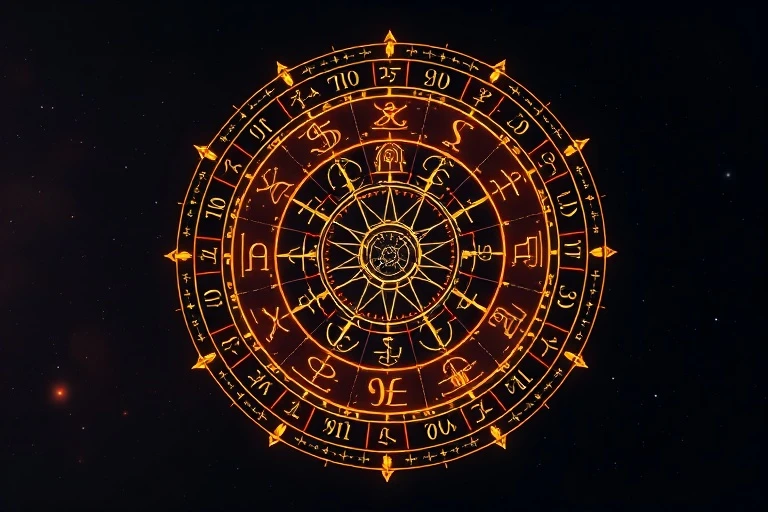
A detailed astrological chart wheel, illustrating the complex interplay of planets and houses in a horary reading.
Rules for Judgment: Interpreting the Chart
Judging a horary chart is a systematic process that follows established rules to arrive at a clear answer. These rules help determine if the question can be answered, what the outcome will be, and what obstacles or aids are present.
- Radicality: As mentioned, the chart must be "radical" or readable. This means checking for very early (0-3 degrees) or very late (27-29 degrees) Ascendants, which can suggest the question is premature or too late to be effectively answered.
- Perfection: A "perfected" outcome is indicated when the significators of the querent and quesited form an applying Ptolemaic aspect (conjunction, sextile, trine) without intervention. This signifies a successful resolution to the question.
- Prohibition: This occurs when a third planet aspects one significator before it can perfect an aspect with the other. It suggests an external force or event preventing the desired outcome.
- Frustration: Similar to prohibition, but here one significator applies to another, but before the aspect perfects, the second significator changes signs, moves into retrogradation, or is aspected by a faster planet. This often means the desired outcome is almost achieved but then slips away.
- Refranation: When two planets are applying to an aspect, but one or both turn retrograde before the aspect perfects. This indicates a change of mind or a reversal of circumstances.
- Translation of Light: A third planet collects the light of two significators that are not in aspect. This planet acts as a messenger or intermediary, bringing the querent and quesited together.
- Collection of Light: Similar to translation, but the third planet aspects both significators, bringing their energies to a common point. This also signifies an intermediary or a facilitating event.
- Void of Course Moon: When the Moon makes no major Ptolemaic aspects to any other planet before leaving its current sign. Traditionally, this is considered a strong indicator that "nothing will come of the matter" or that the situation will remain unchanged. However, modern interpretations sometimes allow for exceptions, especially if the Moon is in a favorable sign or house.
These rules, when applied systematically, allow the astrologer to construct a coherent narrative from the chart, leading to a definitive answer or a clear understanding of the situation.
Advanced Horary Techniques
Beyond the foundational rules, several advanced techniques can add depth and nuance to horary interpretations, allowing for more detailed and precise answers. These methods are often employed by experienced horary astrologers to uncover hidden layers of meaning.

A conceptual image depicting a question mark illuminated by cosmic energies, symbolizing the quest for answers in horary astrology.
- Antiscia and Contra-Antiscia: These are points in the zodiac that have the same "light" or "power" as another point, reflecting each other across the solstitial axis (0 Cancer/0 Capricorn). They can act like conjunctions, revealing hidden connections or influences between planets or house cusps that are not otherwise aspecting. Contra-antiscia are opposite these points and can indicate opposition or difficulty.
- Fixed Stars: While not always used in basic horary, prominent fixed stars conjunct significators or house cusps can add powerful, often fated, influences to the interpretation. Their nature (e.g., benefic or malefic) can color the outcome of the question significantly.
- Arabic Parts (Lots): These are calculated points in the chart derived from the positions of planets and the Ascendant. The Part of Fortune is the most common, but others like the Part of Spirit, Part of Marriage, or Part of Children can be highly relevant depending on the question. They pinpoint areas of focus or potential.
- Planetary Hours: Aligning the horary question with the planetary hour in which it is asked can further validate the chart's radicality and add another layer of interpretation. Each hour is ruled by a planet, and questions aligning with that planet's themes are considered stronger. For example, a question about love asked during Venus's hour.
- Decans and Terms: These are sub-divisions of zodiac signs, each ruled by a planet. A planet's placement within a specific decan or term can modify its strength and expression, adding subtle but important details to its dignity and influence.
- Derivation of Houses: For questions involving people or things related to the querent (e.g., "What about my brother's job?"), houses are derived from the querent's house. The 3rd house represents the querent's brother, and the 10th house from the 3rd (which is the 12th house overall) would represent the brother's job. This technique allows for complex relational questions.
Mastering these advanced techniques requires extensive study and practice, but they significantly enhance the astrologer's ability to extract detailed and nuanced answers from a horary chart. They transform a simple "yes/no" into a rich understanding of the underlying dynamics.
Ethical Considerations in Horary Practice
As with any form of divination or counseling, ethical practice is paramount in horary astrology. The astrologer holds a position of trust, and responsible conduct ensures the integrity of the practice and the well-being of the querent.
- Clarity of Question: The astrologer must ensure the querent's question is clear, specific, and genuinely important to them. Vague or frivolous questions often lead to unreadable charts or ambiguous answers.
- Respect for Free Will: Horary provides insight, not absolute destiny. The astrologer should always remind the querent that they retain their free will and the ability to act on or disregard the information provided.
- Confidentiality: All questions and readings must be kept strictly confidential.
- Avoiding Repeated Questions: It is generally considered unethical and ineffective to ask the same question multiple times, especially within a short period. The first chart cast for a genuine question holds the answer. Repeated questions often reflect anxiety rather than a new query.
- Not for Medical or Legal Advice: Horary astrology should never replace professional medical, legal, or financial advice. It can offer insights into the *outcome* of such situations but not provide the professional guidance itself.
- Objectivity: The astrologer must strive for objectivity, interpreting the chart as it is, rather than projecting their own desires or biases onto the reading.
Adhering to these ethical guidelines ensures that horary astrology remains a valuable and respected tool for guidance and self-understanding.
Conclusion: The Enduring Value of Horary Astrology
Horary astrology stands as a testament to the enduring power and practical application of astrological wisdom. By meticulously analyzing the cosmic snapshot of a specific moment, it offers direct, actionable insights into life's most pressing questions. From the simple query about a lost item to complex decisions regarding relationships or career, horary provides a unique lens through which to view potential outcomes and underlying dynamics.
Its rigorous methodology, rooted in centuries of observation and refinement, makes it a powerful tool for those seeking clarity and guidance. While requiring dedication to master, the rewards of understanding horary astrology are profound, offering a deeper connection to the synchronous nature of the universe and empowering individuals to make more informed choices. As an advanced technique within the broader field of astrology, it continues to serve as a beacon for specific inquiry, bridging ancient wisdom with contemporary needs.
Fuente: Contenido híbrido asistido por IAs y supervisión editorial humana.


Comments
Post a Comment