
Celestial Mechanics: Mundane Astrology and Global Cycles
Celestial Mechanics: Mundane Astrology and Global Cycles
Celestial mechanics, the branch of astronomy that studies the motions of celestial bodies, forms the fundamental backbone of mundane astrology. While often perceived as distinct disciplines, their intersection reveals a profound framework for understanding how planetary positions and movements correlate with global events, societal trends, and historical epochs. This intricate relationship extends beyond individual horoscopes, delving into the collective human experience and the grand cycles that shape civilizations.
Mundane astrology, specifically, focuses on the astrology of nations, cities, and the world at large, interpreting planetary influences on political developments, economic shifts, natural disasters, and cultural movements. By analyzing the precise mathematical relationships governing celestial bodies, we can gain deeper insights into the underlying cosmic rhythms that appear to synchronize with earthly phenomena. This article explores the technical foundations of celestial mechanics and its application in mundane astrology, examining how these ancient principles continue to offer a unique lens through which to view global cycles.
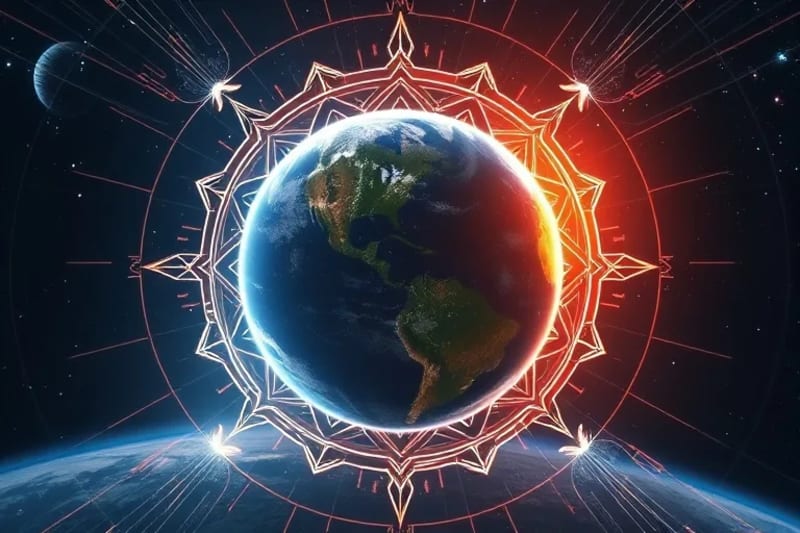
The intricate dance of celestial bodies and their gravitational influence, illustrating the foundational principles of celestial mechanics that underpin global astrological cycles.
This conceptual render, generated by AI, depicts the Earth as a focal point within a complex web of cosmic forces, reflecting the profound connection between planetary motion and terrestrial phenomena.
Table of Contents
- Historical Foundations of Celestial Mechanics in Astrology
- Key Concepts in Celestial Mechanics for Astrological Analysis
- Mundane Astrology: Global Cycles and Events
- Astrodynamics and Predictive Techniques in Mundane Astrology
- Modern Interpretations and Challenges
Historical Foundations of Celestial Mechanics in Astrology
The study of celestial mechanics has roots deeply intertwined with ancient astrological practices. Civilizations from Mesopotamia to Greece meticulously observed planetary movements, developing sophisticated mathematical models to predict their positions. Claudius Ptolemy, in his seminal work Almagest, codified much of the geocentric model, which served as the astronomical foundation for astrology for over a millennium. His subsequent work, Tetrabiblos, then applied these astronomical observations to astrological interpretations, including mundane events.
The Copernican revolution, followed by Kepler's laws of planetary motion and Newton's law of universal gravitation, fundamentally shifted our understanding of the cosmos. While these scientific advancements moved away from a geocentric view, the precise mathematical descriptions of planetary orbits became even more refined. Astrologers, over time, integrated these heliocentric calculations, focusing on the relative positions of planets from an Earth-centric perspective, which remains crucial for constructing astrological charts. The historical evolution showcases a continuous effort to accurately map celestial phenomena, irrespective of the underlying philosophical framework.
Key Concepts in Celestial Mechanics for Astrological Analysis
Understanding mundane astrology requires a grasp of several key concepts from celestial mechanics. These principles dictate the observable positions and interactions of planets, which astrologers then interpret symbolically. The precision of these calculations allows for accurate forecasting and retrospective analysis of global patterns.
- Orbital Mechanics: Planets follow elliptical paths around the Sun, characterized by their perihelion (closest point to the Sun) and aphelion (farthest point). These varying distances subtly influence the perceived speed and intensity of planetary energies from Earth's perspective.
- Precession of the Equinoxes: This slow wobble of the Earth's axis causes the vernal equinox point to shift westward along the ecliptic over approximately 25,920 years. This phenomenon is critical for understanding the difference between sidereal and tropical astrology, impacting the zodiacal placement of planets over vast historical periods.
- Nutation and Aberration: These are smaller, periodic oscillations in Earth's axial tilt and the apparent shift in a star's position due to the finite speed of light and Earth's motion. While often minute, they contribute to the extreme precision required for advanced astrological calculations.
- Retrograde Motion: From Earth's perspective, planets occasionally appear to move backward in the zodiac. Astronomically, this is an optical illusion caused by the relative speeds of Earth and another planet in their orbits. Astrologically, retrograde periods are often associated with introspection, review, and a re-evaluation of themes related to that planet's influence.
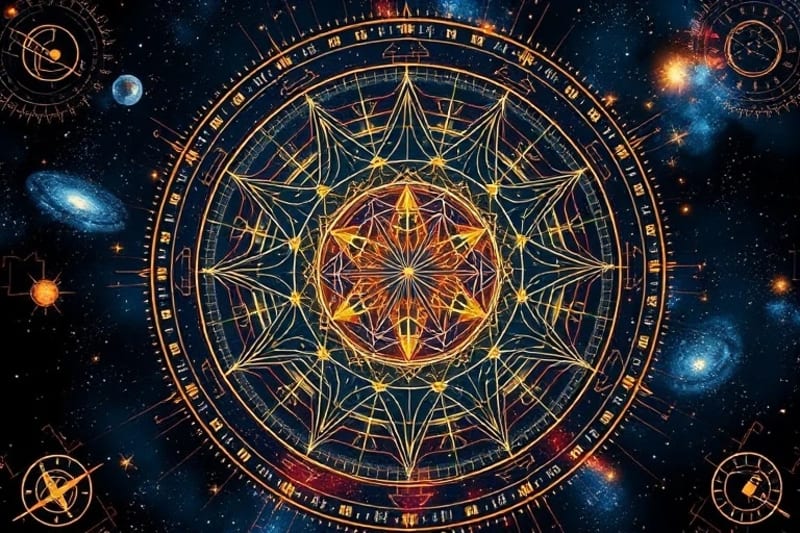
A visual representation of historical events and their potential correlation with significant planetary alignments, highlighting the cyclical nature of global influences.
This digital painting offers a symbolic interpretation of how celestial mechanics might manifest in human history, often seen through the lens of mundane astrology.
The interplay of these mechanical factors creates the dynamic celestial map that astrologers interpret. For instance, the precise timing of a planet's ingress into a new sign or house, or its exact conjunction with another planet, is entirely dependent on these calculations. Without a rigorous understanding of celestial mechanics, the foundational data for astrological analysis would be imprecise and unreliable.
Mundane Astrology: Global Cycles and Events
Mundane astrology applies astrological principles to collective entities rather than individuals. It examines the birth charts of nations, the ingress charts of planets into cardinal signs, and the grand cycles formed by outer planet conjunctions to predict and understand global trends. The core premise is that the same cosmic energies influencing individuals also affect the larger tapestry of human society.
- Ingresses: The moment a planet enters a new zodiac sign, particularly the cardinal signs (Aries, Cancer, Libra, Capricorn), is considered significant for mundane events. The Aries ingress chart, cast for the capital of a nation, is often used to forecast the year's general trends for that country.
- Great Conjunctions: Conjunctions of Jupiter and Saturn, occurring approximately every 20 years, are historically linked to major political and economic shifts. The "Great Mutation" cycles, where these conjunctions shift element (earth, air, fire, water) every 200 years, are associated with profound changes in societal paradigms and ideologies. Understanding these cycles can offer insights into global consciousness in the digital age.
- Eclipses: Solar and lunar eclipses are potent markers in mundane astrology, often correlating with significant political events, natural disasters, or the rise and fall of leaders. Their impact can be felt for several months, or even years, depending on their strength and alignment with national charts.
- Cycles of Outer Planets: The slow-moving outer planets (Uranus, Neptune, Pluto) define generational experiences and long-term societal transformations. Uranus cycles (84 years) relate to technological revolutions and social upheavals; Neptune cycles (165 years) to spiritual movements, arts, and collective illusions; and Pluto cycles (248 years) to deep power struggles, death, and rebirth of systems. These long cycles are crucial for understanding profound shifts, much like how generational roots explained by Imum Coeli offer personal insights.
The analysis of these cycles provides a framework for interpreting historical patterns and anticipating future trends. By superimposing these celestial movements onto the timeline of human events, mundane astrologers seek to identify correlations and underlying cosmic influences that transcend immediate causes.
Astrodynamics and Predictive Techniques in Mundane Astrology
Astrodynamics, often used interchangeably with celestial mechanics in this context, refers to the application of physics to the movement of celestial bodies. In mundane astrology, these precise calculations underpin various predictive techniques used to forecast global events. The accuracy of these methods relies entirely on the mathematical rigor derived from astronomical observations.
- Transits: This is the most common predictive technique, involving the current positions of planets (transiting planets) as they move through the zodiac and form aspects to the planets in a mundane chart (e.g., a nation's birth chart). Major transits, especially those involving outer planets, are often correlated with significant global events.
- Progressions: Symbolic movements of planets where each day after birth corresponds to a year of life. In mundane astrology, progressed charts for nations or major organizations can reveal their internal evolution and long-term developmental phases.
- Returns: Similar to individual solar returns, mundane astrology uses solar, lunar, and planetary returns for specific locations or national charts. A solar return chart for a nation's capital, for example, can highlight key themes and challenges for the upcoming year.
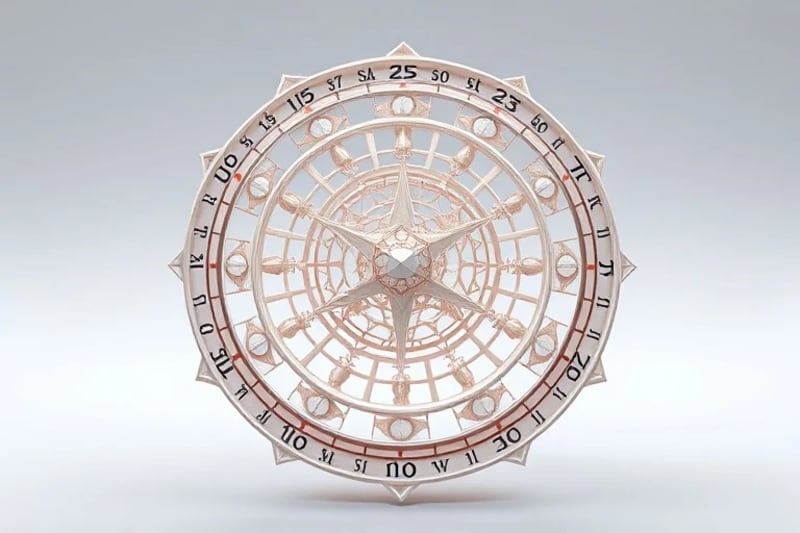
An advanced holographic chart, symbolizing the complex computational and analytical methods used in modern astrodynamics for predictive astrological analysis.
This 3D render illustrates the precision and depth involved in interpreting celestial mechanics for mundane astrological forecasts, blending ancient wisdom with contemporary tools.
The application of these techniques demands meticulous calculation and a deep understanding of both celestial mechanics and astrological symbolism. Modern software has greatly facilitated these calculations, allowing astrologers to access highly accurate ephemerides and chart calculation tools, enabling more precise predictions and analyses. This blend of ancient wisdom and modern computational power allows for new frontiers in understanding cosmic influences, much like the exploration of interplanetary travel and astrodynamics pushes the boundaries of space exploration.
Modern Interpretations and Challenges
In the modern era, the relationship between celestial mechanics and mundane astrology faces both integration and skepticism. Scientific advancements have provided an unprecedented understanding of the cosmos, allowing for incredibly precise calculations of planetary positions. This precision enhances the technical foundation of astrology, enabling more accurate chart construction and predictive modeling.
However, the challenge lies in bridging the gap between scientific observation and symbolic interpretation. While celestial mechanics describes how planets move, astrology attempts to explain what these movements might signify for human affairs. Modern astrologers often integrate computational models and statistical analysis to explore correlations, moving towards a more empirical approach. The rise of tools like AI-assisted subconscious exploration also hints at new ways to process and interpret vast datasets of astrological and mundane information.
Despite ongoing debates, the study of celestial mechanics continues to provide the bedrock for any serious astrological inquiry. The cyclical nature of planetary movements, precisely described by physics, offers a compelling framework for understanding the ebb and flow of global energies. Whether viewed as direct causation or symbolic correlation, the cosmic clock undeniably keeps time for humanity's collective journey.
Explore Our Ecosystem of Content
- Astro-Linguistics: Words, Mantras, Manifestation Power
- Biometric Divination: Biofeedback, Intuition, Self-Discovery
- Astro-Botany: Celestial Influences on Plant Growth & Energetics
- Automatic Writing for Shadow Work: Accessing Subconscious Insights
- Techno-Shamanism: Bridging Virtual Reality Rituals
- Urban Geomancy: Celestial Mechanics, City Energy, Well-being
- Hellenistic Astrology: Ancient Techniques, Philosophies Explored
- Techno-Shamanism: Digital Tools, Ancient Rituals, Healing
- Quantum Astro-Botany: Chakras, Vibrational Elixirs, Planetary Influences
- Quantum Rosary: Uniting Faith, Mind, Soul, Artificial Intelligence
Source: Hybrid content assisted by AI and human editorial supervision.


Comments
Post a Comment