
Hellenistic Astrology Ancient Techniques Philosophies Explored | StarPluto
Hellenistic astrology, a complex and profound system of celestial divination, emerged in the Hellenistic period (roughly 3rd century BCE to 7th century CE) in the eastern Mediterranean, primarily Egypt. It represents a crucial evolutionary stage in the history of astrology, bridging the gap between earlier Babylonian traditions and later medieval and modern practices. This sophisticated framework introduced many of the core concepts and techniques that form the bedrock of Western astrology today, including the twelve houses, planetary aspects, and the intricate system of "lots" or "parts."
Unlike some contemporary approaches that focus heavily on psychological interpretation, Hellenistic astrology was deeply rooted in a deterministic worldview, where the positions of celestial bodies at the moment of birth were believed to reveal the destined course of an individual's life. This ancient practice was not merely a predictive tool; it was a comprehensive philosophical system that sought to understand the intricate relationship between the cosmos and human existence. Exploring its ancient techniques and philosophies offers a unique window into the intellectual landscape of antiquity and provides profound insights for modern astrological study.
Table of Contents
- 1. The Dawn of Hellenistic Astrology
- 2. Core Principles and Philosophical Roots
- 3. Key Techniques of Hellenistic Astrology
- 4. Planetary Joys and Sect
- 5. Dodecatemoria and Lots (Parts)
- 6. Fixed Stars and Decans
- 7. The Role of Fate and Free Will
- 8. The Decline and Revival of Hellenistic Astrology
- 9. Modern Applications and Relevance

An ancient astrolabe, a cornerstone tool of Hellenistic astronomy and astrology, symbolizing the intricate celestial calculations of the era.
1. The Dawn of Hellenistic Astrology
The origins of Hellenistic astrology can be traced back to the cultural melting pot of Alexandria, Egypt, following the conquests of Alexander the Great. This period saw a fusion of Babylonian astronomical observations and omens with Egyptian decanic systems and Greek philosophical thought, particularly Stoicism and Neoplatonism. The result was a highly structured and systematic form of astrology, distinct from its predecessors.
Key figures like Vettius Valens, Dorotheus of Sidon, and Claudius Ptolemy codified many of these practices into treatises that would influence astrological thought for centuries. Their writings, often preserved through Arabic translations, form the primary source material for understanding this rich tradition. The adoption of the twelve-sign zodiac and the concept of the horoscope, a chart cast for the moment of birth, became central to this new astrological paradigm, moving beyond general omens to individual destiny.
2. Core Principles and Philosophical Roots
At its heart, Hellenistic astrology operated on the principle of cosmic sympathy, the belief that everything in the universe is interconnected and influences everything else. This philosophical underpinning, often associated with Stoicism, suggested that the celestial realm mirrors and dictates events in the terrestrial world. The cosmos was seen as a living, intelligent entity, with planets and zodiacal signs acting as divine messengers or agents of fate.
A fundamental concept was the idea of Tarot Quantum Mechanics Intersecting Divination Reality, or heimarmene, which posited that an individual's life path was largely predetermined by their birth chart. However, this determinism was often nuanced, allowing for a degree of free will within the boundaries set by fate. The astrologer's role was not to change fate, but to understand it, providing guidance on how best to navigate its currents. This perspective contrasts sharply with some modern interpretations that emphasize astrology as a tool for personal growth and self-empowerment, rather than predestination.

Bronze models of classical planets, representing the celestial bodies central to Hellenistic astrological calculations and their symbolic meanings.
3. Key Techniques of Hellenistic Astrology
Hellenistic astrology developed a rich array of techniques for interpreting the birth chart, many of which were lost or misunderstood for centuries before their modern revival. These methods provided layers of detail and specificity that allowed for highly nuanced readings of an individual's life. Understanding these techniques is crucial for anyone seeking to grasp the depth of ancient astrological practice.
The system relied heavily on concepts such as planetary conditions, aspects, and house placements, but also introduced unique methodologies that are less common in contemporary astrology. These include the intricate use of sect, planetary joys, and various "lots" or "parts" that pinpoint specific areas of life. The emphasis was on deriving concrete predictions and detailed character analyses, rather than broad psychological profiles.
4. Planetary Joys and Sect
Planetary Joys: This technique assigns specific houses to each of the seven traditional planets where they are said to "rejoice" or operate with greater ease and effectiveness. For example, Mercury rejoices in the 1st House, Venus in the 5th, and Mars in the 6th. This concept adds a layer of dignity and strength to a planet's influence, indicating areas of life where its energy is naturally well-expressed. A planet in its joy house is considered to be more fortunate and capable of manifesting its positive qualities.
Sect (Haíresis): Perhaps one of the most foundational and distinguishing features of Hellenistic astrology is the concept of sect. It divides the planets into two groups: diurnal (day) and nocturnal (night). The Sun, Jupiter, and Saturn are considered diurnal planets, while the Moon, Venus, and Mars are nocturnal. Mercury is considered neutral but takes on the sect of the luminary it rises with. A chart is said to be "in sect" if the Sun is above the horizon (day chart) and most diurnal planets are also above, or if the Moon is above the horizon (night chart) and most nocturnal planets are above. Planets operating in their preferred sect are generally considered more benevolent and powerful, while those out of sect may face greater challenges or express their energies in a more difficult manner. This principle profoundly affects the interpretation of planetary influences, turning traditionally malefic planets (Mars and Saturn) into more constructive forces when in sect, and vice-versa for benefics (Venus and Jupiter) when out of sect.
5. Dodecatemoria and Lots (Parts)
Dodecatemoria: This advanced technique subdivides each zodiac sign into twelve smaller segments, each corresponding to one of the twelve signs. For example, the first dodecatemoria of Aries is Aries, the second is Taurus, and so on. This system provides an additional layer of sub-rulership and influence, offering a micro-analysis of planetary placements within a sign. It was used to refine interpretations, particularly regarding the underlying nature or "flavor" of a planet's expression. The dodecatemoria can reveal hidden strengths or weaknesses, adding nuance to the basic sign placement.
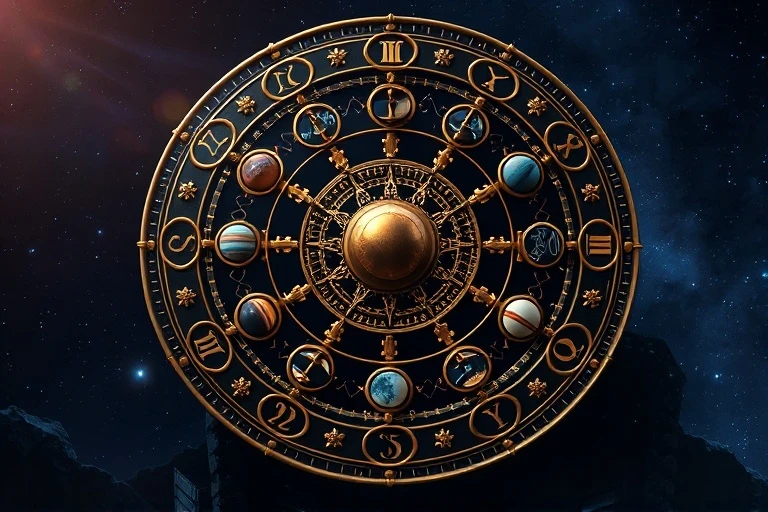
A conceptual representation of the zodiac as an intricate cosmic mechanism, highlighting the precise and interconnected nature of Hellenistic astrological calculations.
Lots (Parts): One of the most distinctive and complex features of Hellenistic astrology is the extensive use of "lots" or "parts." These are calculated points in the zodiac derived from the positions of two planets and the Ascendant, often with different formulas for day and night charts. The most famous is the Lot of Fortune (Pars Fortunae), which indicates material well-being, the body, and worldly success. Other significant lots include the Lot of Spirit (Pars Spiritus), associated with inner drive and purpose, and numerous others for children, marriage, illness, and more specific life areas. These lots act as sensitive points in the chart, revealing specific areas of destiny and fortune. Their interpretation is heavily influenced by the sign, house, and aspects they receive, providing highly detailed insights into an individual's life experiences. For example, a well-placed Lot of Fortune could indicate significant material prosperity, while a challenged one might suggest financial struggles. The calculation and interpretation of these lots require a deep understanding of the entire chart structure and planetary conditions, making them a hallmark of this ancient tradition.
6. Fixed Stars and Decans
Beyond the planets and zodiac signs, Hellenistic astrologers also incorporated the influence of and decans into their interpretations. Fixed stars, unlike the wandering planets, maintain their positions relative to the ecliptic and were believed to impart specific qualities and events, particularly when conjunct with planets or angular points in a natal chart. Bright and prominent stars were often associated with significant honors, wealth, or specific talents, while others might indicate challenges or misfortunes.
Decans, originating from Egyptian astrology, are ten-degree subdivisions of each zodiac sign, totaling thirty-six decans for the entire zodiac. Each decan was associated with a specific planetary ruler and often with a particular deity or image. These subdivisions were used to further refine the interpretation of a planet's placement within a sign, adding a layer of nuance to its expression. They could indicate specific talents, challenges, or even physical characteristics, enriching the overall astrological reading. The intricate interplay between planets, signs, houses, fixed stars, and decans created a multi-layered interpretive framework.
7. The Role of Fate and Free Will
The philosophical debate surrounding fate (heimarmene) and was central to Hellenistic thought and deeply embedded in its astrological practice. While the birth chart was seen as a blueprint of destiny, indicating predetermined events and character traits, many Hellenistic astrologers, particularly those influenced by Stoicism, believed in a form of "soft determinism." This perspective suggested that while certain events might be fated, an individual still possessed the freedom to choose their attitude and response to these circumstances.
The astrologer's role was not to predict an unchangeable future but to reveal the cosmic patterns at play, allowing the individual to align themselves with these forces. By understanding the timing and nature of fated events, one could prepare, adapt, and make choices that led to a more virtuous or harmonious life. This nuanced view allowed for both the predictive power of astrology and the moral responsibility of the individual, reconciling seemingly contradictory concepts within a coherent philosophical framework.
8. The Decline and Revival of Hellenistic Astrology
Hellenistic astrology flourished for several centuries, reaching its zenith with Ptolemy's Tetrabiblos, which became the authoritative text for Western astrology. However, with the decline of the Roman Empire and the rise of Christianity, which often viewed astrology with suspicion, its practice gradually waned in the West. Many of its intricate techniques were either simplified, misunderstood, or lost during the medieval period. While some aspects were preserved and further developed in the Islamic world, the full scope of Hellenistic practice largely disappeared from European consciousness.
The late 20th and early 21st centuries have witnessed a remarkable in traditional astrology, including the Hellenistic tradition. Scholars and practitioners, notably Robert Schmidt and Project Hindsight, have dedicated themselves to translating and interpreting ancient texts, bringing these lost techniques back into modern practice. This revival has led to a deeper appreciation for the historical depth and technical sophistication of astrology, offering new tools and perspectives for contemporary astrologers. It has also sparked a re-evaluation of fundamental astrological principles, moving beyond purely psychological interpretations to embrace the deterministic and predictive elements of the ancient art.
9. Modern Applications and Relevance
For modern astrologers, the study of Hellenistic techniques offers a profound expansion of their interpretive toolkit. Concepts like sect, planetary joys, and the extensive use of lots provide additional layers of insight into a natal chart, allowing for more precise and detailed delineations. This historical perspective enriches understanding of the evolution of astrological thought and practice, connecting contemporary methods to their ancient roots. It encourages a more holistic and less anachronistic approach to astrology, appreciating its original philosophical context.
Moreover, the Hellenistic emphasis on fate and destiny, while challenging to modern sensibilities, can offer a powerful framework for understanding life's major patterns and challenges. It encourages acceptance of certain predetermined circumstances while empowering individuals to make conscious choices within those boundaries. By integrating these ancient techniques, astrologers can provide clients with a richer, more comprehensive understanding of their life path, blending the wisdom of the past with the insights of the present. The ongoing dialogue between traditional and modern astrology continues to shape the future of this ancient discipline.
Fuente: Contenido híbrido asistido por IAs y supervisión editorial humana.


Comments
Post a Comment