
Urban Geomancy: Aligning Cities with Celestial Harmony
Urban geomancy is an ancient and profound discipline that explores the relationship between the built environment and natural energies. It delves into how the layout, design, and orientation of cities, buildings, and public spaces can either harmonize with or disrupt the subtle cosmic and telluric forces that permeate our world. This practice, often seen as a sophisticated form of environmental design, aims to create urban landscapes that foster well-being, prosperity, and spiritual connection for their inhabitants.
At its core, urban geomancy seeks to align human settlements with the natural flow of energy, known as "qi" in Eastern traditions, or "ley lines" in Western esotericism. By understanding these invisible currents, practitioners can design cities that are not only aesthetically pleasing but also energetically vibrant. This approach transcends mere aesthetics, advocating for a holistic integration of architecture, landscape, and spiritual principles to create truly sacred and thriving urban spaces.
Table of Contents
Understanding Urban Geomancy
Historical Foundations of Sacred Urban Design
Key Principles Guiding Urban Geomancy
Practical Applications: Feng Shui for Urban Harmony
Modern Urbanism and the Future of Geomancy
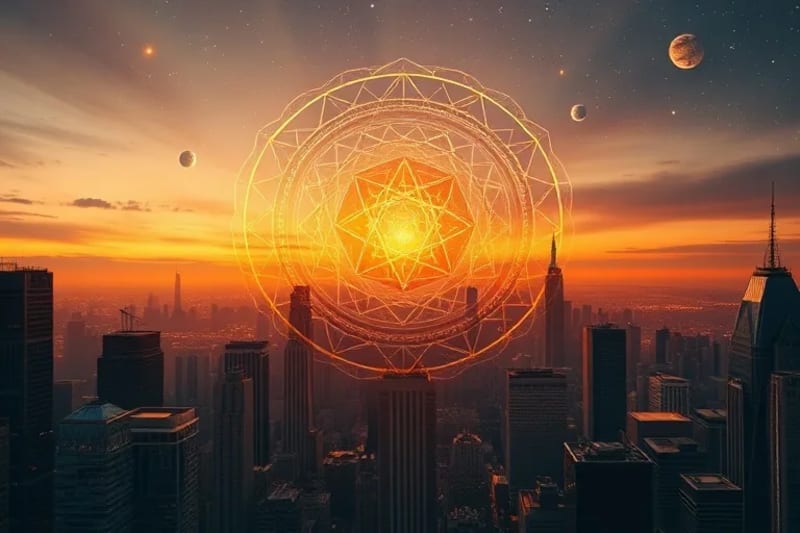 The interplay of architectural forms and cosmic energies, a foundational concept in urban geomancy, illustrating how cities can reflect and amplify celestial harmony.
This conceptual rendering, generated by AI, visualizes the subtle energetic connections between urban structures and the broader cosmos, reflecting ancient geomantic principles.
Understanding Urban Geomancy
Urban geomancy is more than just a set of design rules; it is a philosophy that views the city as a living organism, intimately connected to the Earth and the cosmos. It suggests that just as the human body has acupuncture points and energy meridians, so too does the landscape. Cities, when built with geomantic awareness, can become powerful conduits for positive energy, influencing the health, wealth, and spiritual development of their inhabitants.
This discipline draws from various ancient wisdom traditions, including Chinese Feng Shui, Indian Vastu Shastra, and indigenous land spirituality. While each tradition has its unique methodologies, they share a common goal: to create environments that are in resonance with natural laws. This often involves careful consideration of topography, water bodies, cardinal directions, and celestial alignments.
The practice of urban geomancy recognizes that human settlements are not isolated entities but integral parts of a larger energetic system. By consciously designing cities to align with these systems, we can mitigate negative influences and enhance positive ones, leading to more sustainable, harmonious, and uplifting urban experiences for everyone. It's about creating spaces that feel inherently right and supportive.
Historical Foundations of Sacred Urban Design
Throughout history, many ancient civilizations instinctively applied geomantic principles in their urban planning. From the meticulously planned cities of ancient China to the sacred geometry embedded in Egyptian temples and European cathedrals, the idea of a "sacred city" is a recurring theme across cultures. These societies understood that the physical environment profoundly impacts the human psyche and spirit.
In ancient China, the principles of Feng Shui were paramount in the siting and design of cities like Beijing. The Forbidden City, for instance, is a masterpiece of geomantic design, aligned along a north-south axis, with mountains to the north for protection and water to the south for prosperity. Every element, from the placement of gates to the flow of canals, was carefully considered to optimize the flow of qi.
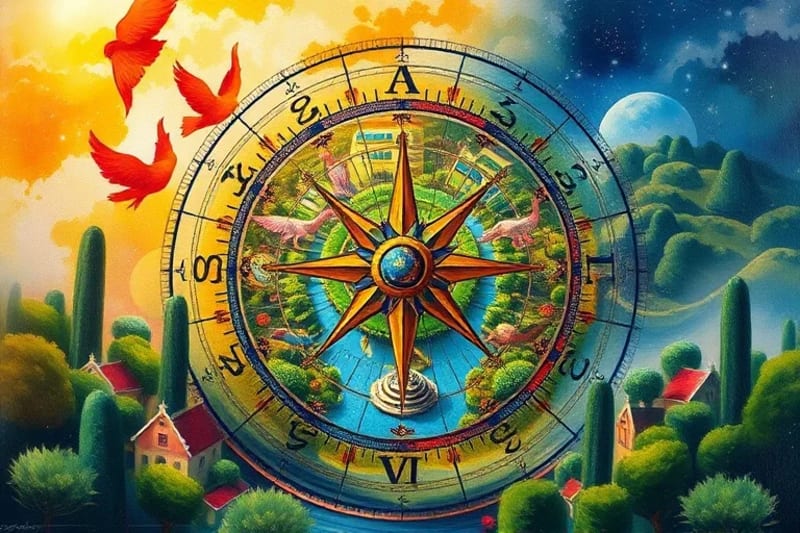 A digital illustration of a Feng Shui compass guiding the layout of a modern city park, emphasizing the integration of natural elements for optimal energy flow.
Similarly, in India, Vastu Shastra guided the construction of entire cities and individual homes, ensuring alignment with cosmic directions and elemental forces. These ancient systems were not superstitious beliefs but sophisticated frameworks for understanding and interacting with the environment, often incorporating astronomical observations and deep ecological knowledge. The goal was always to create a microcosm that mirrored the macrocosm, bringing celestial order down to Earth.
Even in Western traditions, evidence of geomantic thinking can be found. The alignment of ancient megaliths, the layout of Roman camps, and the orientation of medieval churches often reflect an awareness of energetic pathways and sacred sites. These historical examples underscore the universal human impulse to connect our built environments with something larger than ourselves, imbuing them with meaning and purpose.
Key Principles Guiding Urban Geomancy
The practice of urban geomancy is built upon several core principles that guide the assessment and design of urban spaces. Understanding these principles is crucial for anyone looking to apply geomantic wisdom to modern city planning or even personal environments. These concepts provide a framework for evaluating the energetic health of a location.
Qi Flow and Ley Lines
Central to geomancy is the concept of vital energy, or "qi" (chi). This energy flows through the landscape, much like blood flows through the body. In urban contexts, geomancers analyze how qi moves through streets, parks, and buildings. Smooth, gentle curves and open spaces facilitate beneficial qi, while sharp angles, dead ends, or cluttered areas can create stagnant or aggressive qi, leading to stress and disharmony.
Western traditions often refer to "ley lines," which are believed to be invisible lines of energy connecting ancient sites, natural landmarks, and sacred places. Urban geomancy seeks to identify and work with these lines, ensuring that new developments either align with them or avoid disrupting their flow. This respect for the underlying energetic grid of the Earth is fundamental to creating a balanced urban environment.
Five Elements in Urban Design
The Five Elements theory (Wood, Fire, Earth, Metal, Water) from Chinese philosophy is a powerful tool in urban geomancy. Each element corresponds to specific shapes, colors, materials, and directions, and their balanced interaction is essential for harmony. For example, water features (Water element) can bring fluidity and wealth, while tall buildings (Wood element) symbolize growth and aspiration.
Applying the Five Elements in urban design involves creating a dynamic equilibrium where no single element dominates or is completely absent. This holistic approach ensures that the city provides a diverse range of experiences and energies, supporting various aspects of life. For more on harmonizing elements, consider exploring Feng Shui Energy Healing: Harmonizing Home Five Elements.
Sacred Geometry and Proportions
Sacred geometry, the underlying mathematical patterns found in nature and art, also plays a significant role. Proportions like the Golden Ratio and geometric shapes such as circles, squares, and triangles are often incorporated into urban layouts and architectural designs to create aesthetic beauty and energetic resonance. These forms are believed to reflect cosmic order and bring a sense of peace and balance.
From the radial patterns of ancient cities to the precise dimensions of monumental structures, sacred geometry ensures that the built environment is not just functional but also spiritually uplifting. It's about creating spaces that feel inherently right to the human spirit, fostering a sense of connection to universal principles. This deep connection can be seen in the way certain plants thrive under specific celestial influences, as discussed in Astro-Botany: Celestial Influences on Plant Growth.
Practical Applications: Feng Shui for Urban Harmony
Applying geomantic principles, particularly those of Feng Shui, to urban planning can transform cities into more vibrant and supportive environments. These practical tips focus on optimizing energy flow and creating balance within the urban fabric.
Building Orientation and Placement
The orientation of buildings is crucial. Ideally, buildings should face a favorable direction, often determined by the surrounding landscape and the flow of qi. For instance, a building with a solid "back" (like a mountain or another large building) and an open "front" (like a plaza or water body) is considered auspicious. This configuration provides support and allows energy to gather and circulate.
Strategic placement also involves avoiding negative formations, such as buildings at the end of a long, straight road (which can create a "sha qi" or attacking energy) or those directly facing sharp corners of other structures. Thoughtful placement ensures that each building contributes positively to the overall energetic health of the city.
Water Features and Green Spaces
Water is a powerful symbol of wealth and abundance in Feng Shui. Incorporating well-designed water features like fountains, ponds, and rivers into urban landscapes can attract and circulate positive qi. The movement of water should be gentle and meandering, not turbulent or stagnant, to promote a steady flow of energy and prosperity.
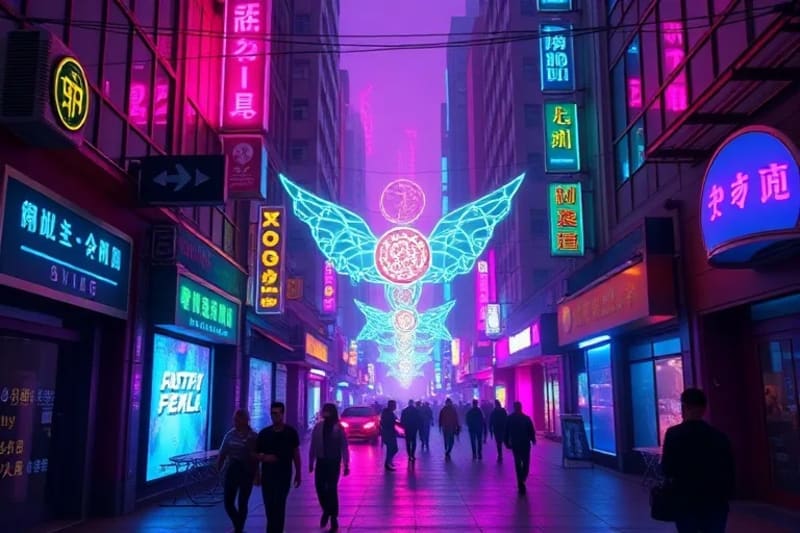 A conceptual 3D render illustrating the subtle energy pathways (qi) that permeate and influence the environment of a vibrant urban street.
Green spaces, such as parks, gardens, and tree-lined streets, are equally vital. They act as natural filters for energy, absorbing negative influences and generating fresh, vibrant qi. These areas provide places for relaxation and rejuvenation, balancing the intensity of urban life. They are the "lungs" of the city, both physically and energetically.
Street Layouts and Traffic Flow
The design of streets and roads significantly impacts qi flow. Curving streets that follow natural contours are generally preferred over straight, grid-like patterns, as they allow energy to meander gently. Excessive straightness or sharp intersections can create fast-moving, aggressive qi (sha qi), leading to accidents and stress.
Traffic flow also needs consideration. Smooth, unimpeded movement of vehicles and pedestrians contributes to positive energy. Congestion and chaotic traffic can create energetic blockages and frustration. Urban geomancy suggests designing infrastructure that supports harmonious movement, reflecting the natural flow of life.
Material Choices and Color Palettes
The materials used in construction and the color palettes applied to buildings and public spaces also have energetic implications, linked to the Five Elements. Natural materials like wood and stone connect us to the Earth, while glass and steel can represent Metal or Water, depending on their application. Colors evoke specific emotions and energies; for instance, greens and blues bring calm, while reds and oranges stimulate.
A balanced use of materials and colors can create a vibrant and supportive urban environment. For those living a more nomadic lifestyle, these principles can even extend to digital spaces, as explored in Feng Shui Digital Nomad: Harmonizing Virtual Spaces Wellbeing, demonstrating the adaptability of these ancient concepts.
Modern Urbanism and the Future of Geomancy
In an era of rapid urbanization and growing environmental concerns, the wisdom of urban geomancy offers invaluable insights. Modern city planners and architects are increasingly looking for ways to create sustainable, livable, and human-centric cities. Geomantic principles provide a framework for achieving these goals by integrating ecological awareness with energetic considerations.
The future of urban geomancy lies in its ability to bridge ancient wisdom with contemporary challenges. This involves not just preserving historical sites but also designing new developments that are energetically sound and ecologically responsible. It's about creating cities that are not just functional but also inspiring, nurturing, and deeply connected to the natural world.
By embracing urban geomancy, we can move beyond purely utilitarian urban planning to create cities that enhance human potential and foster a deeper connection to the Earth and cosmos. This holistic approach promises to build more resilient, harmonious, and truly sacred cities for generations to come, ensuring that our built environments contribute positively to our collective well-being.
Explore More Esoteric Wisdom
Dive deeper into the fascinating world of subtle energies and ancient practices that shape our existence and environment. Our curated selection of articles offers further insights into how cosmic and telluric forces influence our lives.
- Horary Astrology: Answering Specific Questions with Stars
- Yod Aspect Astrology: Finger of God Potential
- Somatic Spirituality: Embodied Awakening, Energy Healing
- Solar Return Moon: Emotional Themes, Year Ahead
- Fixed Stars Cosmic Navigators Aligning Destiny Galactic Pathways
- Eris Sedna Predictive Astrology: Collective Shifts
- AI Impact Digital Art Intellectual Property
- Eclipses Astrológicos: Significado en cada Casa
- Coronilla Divina Misericordia: Sanación Familiar y Reconciliación
Source: Hybrid content assisted by AI and human editorial supervision.


Comments
Post a Comment