
Astro-Archeology: Unearthing Celestial Narratives from Lost Civilizations
Astro-archeology stands as a captivating interdisciplinary field, bridging the study of ancient cultures with the meticulous observation of celestial phenomena. It delves into how prehistoric and historical civilizations perceived, recorded, and integrated astronomical events into their architecture, rituals, and belief systems. Far from being mere stargazers, ancient peoples often possessed sophisticated understandings of the cosmos, encoding their celestial narratives into the very fabric of their societies.
This discipline goes beyond simply identifying astronomical alignments in ancient structures; it seeks to unravel the profound esoteric symbolism and spiritual significance that these celestial observations held. For many lost civilizations, the sky was not just a backdrop but a living canvas, dictating agricultural cycles, religious ceremonies, and even societal structures. Understanding these ancient perspectives offers a unique window into their worldview, revealing a deep connection between the terrestrial and the celestial.
Table of Contents
- Introduction to Astro-Archeology
- The Dawn of Celestial Observation
- Architectural Alignments and Sacred Spaces
- Esoteric Symbolism in Ancient Cosmology
- Lost Civilizations and Their Star Maps
- Unveiling Hidden Meanings Through Astro-Archeology
- Challenging Conventional Narratives
- Modern Interpretations and the Field's Future
The term "astro-archeology" itself suggests a fusion, a recognition that the past holds secrets about our relationship with the stars. It's a field that constantly challenges modern assumptions about the capabilities and knowledge of ancient societies, often revealing an astronomical precision that astonishes contemporary researchers. This precision was not merely for practical purposes like timekeeping, but deeply intertwined with their spiritual and mythological frameworks, forming complex celestial narratives.
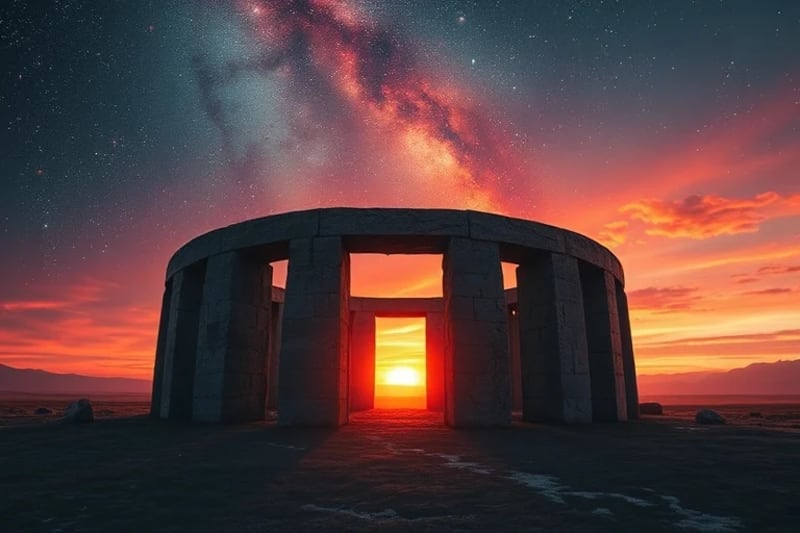 Ancient structures, often megalithic, were meticulously aligned with significant celestial events, reflecting a profound understanding and integration of cosmic rhythms into their societal and spiritual fabric.
This conceptual rendering, generated by AI, illustrates the intricate relationship between human ingenuity and the vastness of the cosmos, hinting at the sophisticated astronomical knowledge of our ancestors.
The human fascination with the night sky is as old as humanity itself. From the earliest cave paintings depicting lunar cycles to the intricate star charts of later civilizations, our ancestors sought to understand the patterns above. This initial curiosity quickly evolved into a complex system of celestial observation, driven by both practical needs, such as agriculture and navigation, and a deep spiritual quest for meaning and connection to the divine.
Early societies recognized the predictable cycles of the sun, moon, and stars, correlating them with seasonal changes, solstices, and equinoxes. These correlations were not just observational data; they became foundational elements of their cosmology, influencing their understanding of life, death, and rebirth. The rising and setting of certain stars, the phases of the moon, and the path of the sun across the sky were interpreted as messages from the gods or as indicators of cosmic order.
Perhaps the most tangible evidence of ancient celestial knowledge lies in their monumental architecture. Sites like Stonehenge in England, the Pyramids of Giza in Egypt, and Chichen Itza in Mexico are prime examples of structures meticulously aligned with astronomical events. Stonehenge, for instance, is famously aligned with the summer solstice sunrise and the winter solstice sunset, suggesting its use as an ancient observatory and ceremonial site.
The Great Pyramid of Giza exhibits remarkable alignments with the cardinal directions and certain stars, particularly those of the Orion constellation. This precision points to an advanced understanding of both astronomy and engineering. Similarly, the El Castillo pyramid at Chichen Itza, built by the Maya, showcases a stunning serpent shadow effect during the equinoxes, demonstrating their profound grasp of the sun's path and its symbolic representation.
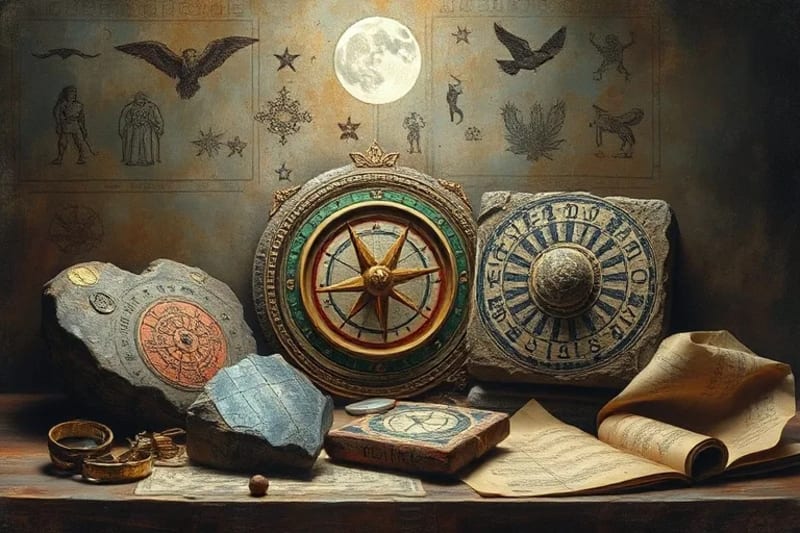 Ancient astronomical instruments and texts, adorned with esoteric symbols, were central to deciphering cosmic messages and integrating them into daily life and spiritual practices.
This oil painting captures the mystique of ancient knowledge, depicting tools and symbols that guided civilizations in their celestial explorations, licensed under Creative Commons.
Beyond the physical alignments, astro-archeology delves into the esoteric symbolism embedded within ancient cosmologies. For many cultures, stars were not just points of light; they were deities, ancestors, or cosmic guides. The constellations told stories, acted as omens, and provided a framework for understanding human destiny and spiritual evolution. This profound connection is often explored through esoteric influences and soul purpose in natal charts.
The zodiac, for instance, is a concept found in various forms across different civilizations, each attributing specific meanings and characteristics to its celestial divisions. These symbolic systems were used for divination, understanding personal traits, and predicting future events. The integration of celestial bodies into mythologies, religious texts, and ritualistic practices highlights a worldview where the cosmos was an active participant in human affairs, not a distant, indifferent observer.
The concept of "as above, so below" permeated many ancient belief systems, suggesting a direct correspondence between celestial events and earthly occurrences. This esoteric principle implied that by understanding the movements of the heavens, one could gain insight into terrestrial patterns, human behavior, and even the will of the divine. Such beliefs formed the bedrock of practices that sought to harmonize human life with cosmic rhythms, a theme also explored in karmic astrology and past life connections.
Many lost civilizations, despite their disappearance, left behind tantalizing clues of their advanced astronomical knowledge. The Maya, for example, developed an incredibly sophisticated calendar system, the Long Count, which could track time over vast periods with astonishing accuracy. Their observatories, like El Caracol at Chichen Itza, were designed to track the movements of Venus, a planet of immense mythological significance to them.
Other cultures, such as the Nazca in Peru, created vast geoglyphs, the Nazca Lines, which some theories suggest may have had astronomical significance, pointing to celestial bodies or events. While their exact purpose remains debated, the sheer scale and precision of these earthworks hint at a people deeply connected to the sky. These examples underscore the idea that these civilizations were not "primitive" but possessed complex intellectual traditions that integrated science, spirituality, and art.
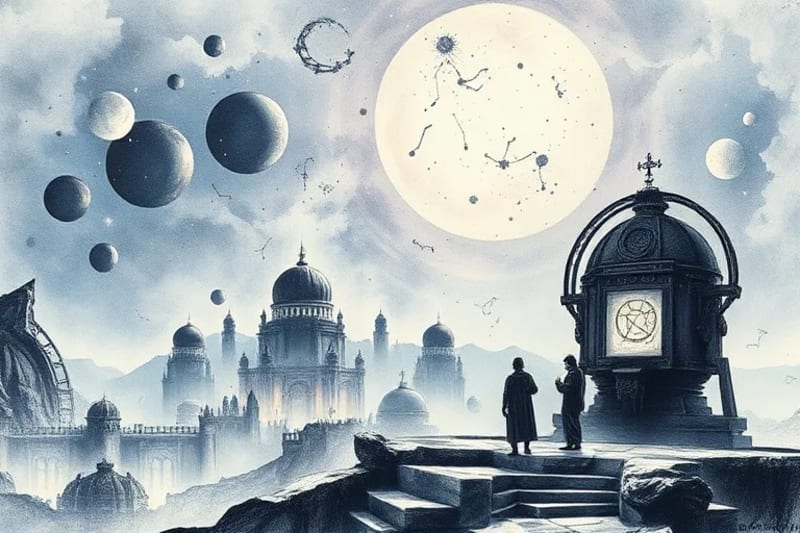 A conceptual representation of a lost civilization, where urban planning and sacred geometry subtly reflect celestial patterns, embodying an ancient, profound connection between humanity and the cosmos.
This 3D rendering envisions the architectural and spiritual harmony of forgotten cultures with the night sky, a testament to their enduring legacy, sourced from Wikimedia Commons under public domain.
The field helps to move beyond purely functional interpretations of ancient sites, revealing their deeper spiritual and cosmological dimensions. For instance, a temple might not just be a place of worship but a precisely calibrated instrument for observing the heliacal rising of a specific star, believed to herald a new season or a divine intervention. This allows for a more holistic understanding of ancient worldviews, where science and spirituality were often inseparable.
The findings of astro-archeology frequently challenge conventional historical narratives, particularly those that underestimate the intellectual capabilities of ancient peoples. The precision and complexity of astronomical alignments found in sites across the globe suggest a level of scientific observation and mathematical understanding that was once thought to be exclusive to later civilizations. This re-evaluation forces us to reconsider the timeline of human intellectual development and the transmission of knowledge across cultures.
Moreover, the field often brings to light the sophisticated ways in which ancient societies managed to preserve and transmit their celestial knowledge, sometimes through oral traditions, sometimes through symbolic art, and most enduringly, through their monumental architecture. This challenges the notion of isolated intellectual development, suggesting instead a rich tapestry of shared cosmic understanding that spanned continents and millennia. The connection between ancient rituals and modern concepts of self-discovery can be seen in fields like biometric divination and biofeedback intuition.
In the modern era, astro-archeology continues to evolve, incorporating new technologies and methodologies. Satellite imagery, LiDAR scanning, and advanced computational models allow researchers to identify and analyze ancient sites with unprecedented accuracy. This technological integration not only aids in discovery but also helps to simulate ancient sky views, allowing us to experience the cosmos as our ancestors might have.
The field is also increasingly engaging with indigenous knowledge systems and oral histories, recognizing their invaluable contribution to understanding ancient celestial narratives. By combining scientific rigor with cultural sensitivity, astro-archeologists are painting a more complete and nuanced picture of humanity's enduring relationship with the stars. This holistic approach resonates with the spirit of Techno-Shamanism, bridging ancient rituals with modern understanding.
The study of astro-archeology is not merely an academic exercise; it is a journey into the collective human psyche, revealing our innate desire to connect with something larger than ourselves. It reminds us that the sky has always been a source of wonder, inspiration, and profound meaning, shaping cultures and civilizations in ways we are only just beginning to fully comprehend.
Explore More Cosmic Connections
Astral Projection Techniques: Advanced Methods Conscious Exploration
Neuroastrology: Consciousness, Synapses, and Planetary Transits
Divine Providence: Trust in Adversity - A Complete Spiritual Guide
Source: Hybrid content assisted by AI and human editorial supervision.


Comments
Post a Comment