
Fixed Stars Mundane Astrology Global Events
In the vast tapestry of astrological study, beyond the familiar dance of planets and zodiac signs, lies a realm of profound cosmic influence: the fixed stars. These distant suns, seemingly immutable from our earthly perspective, have captivated astrologers for millennia, offering unique insights into the destiny of nations, the rise and fall of empires, and the unfolding of major global events. Unlike the wandering planets, fixed stars are believed to impart a more enduring, often fated, quality to the astrological chart, particularly within the specialized branch of mundane astrology.
Mundane astrology, derived from the Latin "mundus" meaning "world," is the study of world events, political trends, natural disasters, and societal shifts through the lens of celestial movements. While planetary cycles and ingresses are primary tools in this discipline, the integration of fixed stars adds a layer of depth and specificity that can illuminate the underlying archetypal forces at play. This article delves into the enigmatic role of fixed stars in mundane astrology, exploring their historical significance, interpretive principles, and how they contribute to predicting global phenomena.
Table of Contents
- A Historical Perspective: Ancient Wisdom and Celestial Omens
- What Exactly Are Fixed Stars?
- Mundane Astrology Fundamentals: A Brief Overview
- Interpreting Fixed Stars in Mundane Charts
- Key Fixed Stars and Their Mundane Influence
- Methodology and Challenges in Predictive Work
- Modern Applications and Ethical Considerations
A Historical Perspective: Ancient Wisdom and Celestial Omens
The practice of observing fixed stars for predictive purposes dates back to antiquity, long before the precise mathematical models of planetary movements were fully developed. Ancient Mesopotamian, Egyptian, and Greek civilizations meticulously charted the heavens, recognizing patterns and attributing specific influences to the brightest stars and constellations. These early astrologers believed that the fixed stars, being "eternal" and unchanging, held a more profound and unalterable sway over earthly affairs than the transient planets.
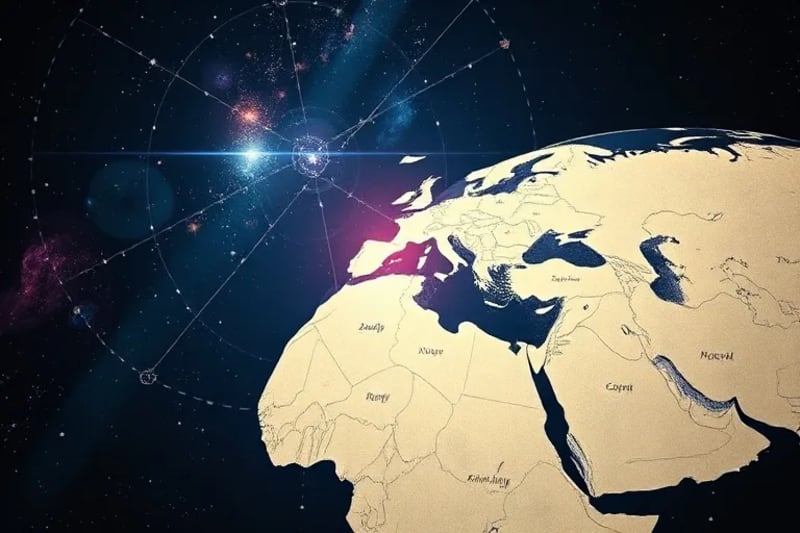
Ancient celestial wisdom, modern geopolitical landscapes, and the subtle energies of distant suns weave together, hinting at the profound connections between macrocosm and microcosm that have fascinated humanity for millennia.
This conceptual rendering, blending historical astronomical charting with contemporary mapping, is an AI-generated artistic interpretation, reflecting themes often found in ancient texts and modern astrological studies.Ptolemy, the influential Hellenistic astrologer, dedicated significant portions of his "Tetrabiblos" to the fixed stars, detailing their natures and effects. He categorized them by their resemblance to planetary influences, for example, a star might be described as "of the nature of Jupiter and Mars," indicating a blend of expansive and assertive qualities. This foundational work cemented the fixed stars' place in Western astrological tradition, influencing generations of practitioners who sought to decipher their subtle messages for both individual and collective destinies.
During the medieval period, Arabic astrologers further refined the study of fixed stars, adding their own observations and interpretations. They often linked specific stars to particular regions, cities, or even individual rulers, believing that their heliacal rising or setting (when they become visible or invisible at sunrise/sunset) could herald significant events. The understanding of these celestial bodies was not merely academic; it was deeply intertwined with political forecasting and the interpretation of omens for kings and empires.
What Exactly Are Fixed Stars?
From an astronomical perspective, fixed stars are simply other suns, vast distances away from our solar system. The term "fixed" refers to their apparent immobility relative to each other in the night sky, in contrast to the "wandering" planets. However, even fixed stars are not truly fixed; they have their own proper motion, albeit very slow from our vantage point, causing their zodiacal longitudes to change over vast periods, a phenomenon known as precession.
- Magnitude: Their brightness, as seen from Earth, is a key factor in their astrological significance. Brighter stars (lower magnitude numbers) are generally considered more potent.
- Constellation: The constellation a star belongs to often informs its archetypal meaning. For instance, stars in Orion might relate to power and ambition, while those in Virgo could signify harvest or service.
- Planetary Nature: As Ptolemy noted, fixed stars are often associated with the qualities of one or more planets, providing a shorthand for their influence (e.g., "Martian" for aggressive, "Jovian" for benevolent).
Astrologically, fixed stars are not typically considered to have their own "houses" or "rulerships" like planets. Instead, their influence is primarily felt through conjunctions (being at the same degree) with planets, angles (Ascendant, Midheaven, Descendant, Imum Coeli), or sensitive points in a mundane chart. Their impact is often described as sudden, powerful, and sometimes fated, capable of amplifying or altering the planetary energies they touch.
Mundane Astrology Fundamentals: A Brief Overview
Before diving deeper into fixed stars, it's essential to grasp the basics of mundane astrology. This branch of astrology focuses on collective phenomena rather than individual lives. It examines charts for nations, cities, political events, and even the moment a significant trend begins. Key charts include:
- Ingress Charts: Calculated for the moment the Sun enters the cardinal signs (Aries, Cancer, Libra, Capricorn), these charts are often used to predict trends for the upcoming quarter or year for a specific region.
- Eclipse Charts: Solar and lunar eclipses are considered potent indicators of major shifts and events, with their effects lasting for months or even years.
- National Charts: The chart cast for the moment a nation is founded or a constitution is signed provides insights into its character, strengths, and vulnerabilities.
- Great Conjunctions: Conjunctions of slow-moving planets like Jupiter and Saturn, or Saturn and Pluto, are seen as markers of significant historical periods and paradigm shifts.
In mundane astrology, the houses of the chart take on collective meanings. For example, the 1st house represents the general public and national identity, the 10th house signifies the government and national reputation, and the 7th house relates to foreign relations and open enemies. When fixed stars align with planets or angles in these mundane charts, their influence can manifest as significant events impacting these collective areas.
Interpreting Fixed Stars in Mundane Charts
The interpretation of fixed stars requires precision and a nuanced understanding of their specific qualities. An orb of influence for fixed stars is typically very tight, often within 0°15' to 0°30' for major conjunctions, though some astrologers use up to 1 degree for the brightest stars. The closer the conjunction, the stronger the effect. The nature of the star is paramount, as is the planet or angle it conjoins.
The tools of celestial observation, from ancient texts to modern instruments, represent humanity's enduring quest to decode the universe's profound messages and their impact on earthly existence.
This oil painting, a conceptual still-life, is an AI-generated artwork exploring themes of astrological study and cosmic discovery.When a fixed star conjoins a planet, it imbues that planet's function with its own unique characteristics. For example, if a star associated with violence conjoins Mars (the planet of war and aggression) in a mundane chart, it could signify a period of intense conflict or military action. If it conjoins Venus (diplomacy, peace), it might point to a disruption of alliances or a challenging period for international relations.
The angles of a mundane chart are particularly sensitive to fixed star conjunctions. A star on the Ascendant can describe the general mood or character of a period, while one on the Midheaven can indicate the nature of leadership, national reputation, or significant public events. The Descendant might highlight foreign affairs or conflicts, and the Imum Coeli (IC) could point to domestic issues, land, or the foundations of a society.
For a deeper understanding of how these cosmic influences shape our collective reality, consider exploring the intricate connections between astrological transits and inner harmony, as discussed in "Guided Meditation Planetary Transits Inner Harmony Cosmic Cycles" here. Such practices can help individuals align with the broader cosmic rhythms.
Key Fixed Stars and Their Mundane Influence
While there are thousands of fixed stars, a select few are considered highly significant in astrological practice due to their brightness and historical interpretations. Here are some examples and their traditional mundane associations:
| Fixed Star | Zodiacal Position (Approx.) | Planetary Nature | Mundane Associations |
|---|---|---|---|
| Regulus | Late Leo / Early Virgo | Mars-Jupiter | Royalty, leadership, power, military success, but also potential for downfall if power is misused. Associated with significant political events and changes in leadership. |
| Aldebaran | Early Gemini | Mars | Military command, honor, courage, but also danger, violence, and public disgrace. Often linked to military conflicts and national defense. |
| Antares | Early Sagittarius | Mars-Jupiter | War, destruction, stubbornness, but also courage and strategic brilliance. Can signify major conflicts, rebellions, or significant social upheaval. |
| Spica | Late Libra / Early Scorpio | Venus-Mars | Success, honor, wealth, artistic talent, and good fortune. In mundane charts, it can point to periods of prosperity, diplomatic achievements, or cultural flourishing. |
| Algol | Late Taurus / Early Gemini | Saturn-Jupiter | Considered one of the most malefic stars, associated with violence, decapitation, epidemics, and mass calamities. Its conjunctions often coincide with highly destructive or tragic events. |
| Sirius | Mid Cancer | Jupiter-Mars | Honor, wealth, fame, leadership, and protection. In mundane contexts, it can signify national prominence, significant discoveries, or periods of great public interest. |
It is crucial to remember that the influence of a fixed star is never isolated. It always interacts with the overall context of the mundane chart, including planetary aspects, dignities, and house placements. A "malefic" star might still manifest in a less destructive way if strongly aspected by benefics or placed in a house that mitigates its harsher qualities. Conversely, a "benefic" star might be weakened or its positive effects distorted if afflicted.
Methodology and Challenges in Predictive Work
Predicting global events using fixed stars involves a meticulous process of chart analysis. Astrologers typically examine mundane charts (ingresses, eclipses, national charts) and look for precise conjunctions of planets or angles with significant fixed stars. They also consider transits and progressions of planets to these fixed star positions, especially for slower-moving outer planets.
- Precision: The extremely tight orb required for fixed star conjunctions means that accurate birth data for events (e.g., nation's founding) and precise ephemeris data for fixed star positions are paramount.
- Contextualization: Interpreting a fixed star's influence requires understanding its traditional meaning, its planetary nature, the planet or angle it conjoins, and the house it falls in within the mundane chart.
- Confirmation: Astrologers often look for multiple indicators in a chart to confirm a potential prediction. A single fixed star conjunction, while potent, is usually part of a larger astrological picture.
One of the main challenges lies in the interpretative nuance. Fixed stars often represent archetypal energies that can manifest in various ways. For instance, a star associated with "violence" might manifest as a war, a natural disaster, or even a sudden societal shift in consciousness that violently disrupts old norms. The astrologer's skill lies in discerning the most probable manifestation based on the broader astrological context and current global trends. The complex interplay of these forces can be further understood by exploring concepts like "Astro Linguistics Words Mantras Manifestation Power" here, which delves into how language and cosmic energies intertwine.

An abstract visualization of cosmic threads linking distant stars to Earth, representing the subtle yet powerful energetic connections that influence global events and human destiny.
This 3D render is an AI-generated conceptual artwork, illustrating the intricate and often unseen forces at play in the astrological universe.Furthermore, the precession of the equinoxes means that the zodiacal longitudes of fixed stars slowly change over centuries. This necessitates using modern ephemerides that account for precession (often referred to as "tropical" positions for fixed stars, even though fixed stars are inherently sidereal). Astrologers must be aware of which fixed star ephemeris they are using and its specific epoch (e.g., J2000) to ensure accuracy.
Modern Applications and Ethical Considerations
In contemporary mundane astrology, fixed stars continue to be a valuable, albeit advanced, tool for understanding global dynamics. They are often consulted when analyzing major political shifts, economic crises, technological breakthroughs, or significant cultural movements. For instance, a conjunction of a slow-moving planet with a prominent fixed star might be seen as a long-term indicator for a specific type of global trend.
The rise of artificial intelligence and its potential impact on global consciousness is another area where fixed stars might offer insights. For example, a star associated with innovation or disruption, when activated in a mundane chart, could coincide with significant advancements or ethical dilemmas in fields like AI. This intersection of cosmic sociology and digital trends is explored in "Cosmic Sociology AI Global Consciousness Digital Trends" here, highlighting the evolving landscape of global influence.
Ethically, the interpretation of fixed stars in mundane astrology, particularly those with "malefic" associations, requires great responsibility. Predictions of calamities or conflicts should always be framed within a context of awareness and potential preparedness, rather than fear-mongering. The goal is to understand the cosmic currents, not to dictate an unchangeable fate. Astrologers emphasize that while fixed stars indicate powerful archetypal forces, human free will and collective action still play a crucial role in how these energies manifest.
The study of fixed stars in mundane astrology remains a specialized and intricate field, demanding dedication and a deep appreciation for the historical roots of astrology. By integrating these distant suns into the predictive framework, astrologers gain a richer, more nuanced understanding of the forces that shape our world, moving beyond the immediate planetary cycles to touch upon the more profound and enduring patterns of the cosmos.
Explore More Cosmic Insights
- Astrocartography Soulmate Connections: Ideal Relationship Lines | StarPluto
- Aromatherapy Chakra Balance: Essential Oils Guide | StarPluto
- Midheaven Aspects: Vocational Fulfillment, Destiny Unveiled | StarPluto
- Mundane Astrology Planetary Cycles Global Trends Explained | StarPluto
- Tarot Quantum Mechanics Intersecting Divination Reality
- Astrocartography Remote Work: Global Productivity Zones
- Chinese Zodiac Health Insights: Wellness Tips | StarPluto
- Esotericism AI Divination Ethical Futures Algorithmic Approaches
- Quantum Manifestation Hermetic Reality Shaping Advanced
- Dragon Five Elements: Chinese Zodiac Traits Deep Dive | StarPluto
- Neurotecnología: Interfaces Cerebro-Máquina y Futuro Humano | Althox
- Astrología Cristales Kármicos Rituales Sanar Deudas Ancestrales
Source: Hybrid content assisted by AI and human editorial supervision.


Comments
Post a Comment