
Vibrational Linguistics: Words, Power, Transformation
Vibrational linguistics explores the profound impact of words and language on our personal reality and the energetic fabric of the universe. This burgeoning field, while often associated with New Age philosophies, draws parallels with concepts in psychology and even theoretical physics, suggesting that the sounds, frequencies, and intentions embedded within our language can actively shape our experiences and transform our lives. Far beyond mere communication, words are seen as potent carriers of energy, capable of influencing our physical, mental, and spiritual well-being.
Understanding Vibrational Linguistics
Vibrational linguistics posits that every word we utter, think, or hear carries a specific energetic frequency. This frequency is not just about the sound waves produced but also encompasses the intention, emotion, and meaning attached to the word. Proponents argue that these linguistic vibrations interact with our own energetic field, influencing our thoughts, emotions, and ultimately, our physical environment. This perspective encourages a mindful approach to language, recognizing its power to create or dismantle our personal realities.

Visual representation of the subtle energetic frequencies that words and intentions are believed to carry, influencing our reality.
The concept suggests that just as a musical note resonates at a particular frequency, so too does a word. Positive words like "love," "joy," or "gratitude" are believed to carry higher, expansive vibrations, while negative words such as "fear," "anger," or "lack" are thought to possess lower, contracting frequencies. Understanding this energetic dynamic is the first step towards harnessing the transformative potential of language.
This field often overlaps with practices like positive affirmations and the law of attraction, where the consistent use of specific linguistic patterns is thought to manifest desired outcomes. It's about shifting from unconscious speech to deliberate, intentional communication that aligns with one's highest aspirations.
The Energetic Nature of Words
The idea that words are more than just symbols has roots in ancient spiritual traditions and modern philosophical thought. Many cultures have long held that language possesses a sacred or magical quality, capable of invoking spirits, healing, or cursing. In contemporary vibrational linguistics, this ancient wisdom is reinterpreted through an energetic lens.
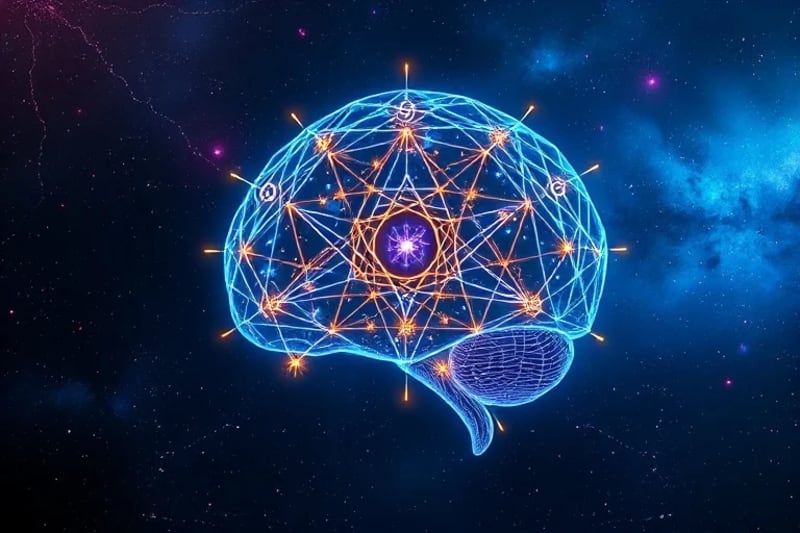
An artistic depiction of the intricate connection between the human mind, language, and the energetic patterns words create.
Words are essentially encoded information. When we speak, we are not just conveying meaning; we are also emitting sound waves that carry specific frequencies. These frequencies, according to the theory, can interact with the subtle energy fields around us and within us. Consider the impact of a harsh word versus a kind one; the immediate physiological and emotional response often reflects this energetic difference.
The study of mantra crafting provides a historical example of this principle. Mantras are sacred sounds or words repeated with specific intentions, believed to generate powerful vibrations that can induce meditative states, heal, or manifest desires. The consistent repetition of these sounds is thought to attune the individual's energy to the frequency of the mantra's meaning.
This perspective suggests that our internal dialogue, the silent words we speak to ourselves, holds immense power. These internal narratives, often unconscious, continuously broadcast frequencies that shape our self-perception, our beliefs, and ultimately, our reality. Becoming aware of and intentionally shifting this internal language is a cornerstone of vibrational linguistics.
Language and the Subconscious Mind
The subconscious mind plays a pivotal role in how vibrational linguistics operates. Our subconscious is highly receptive to language, especially repetitive patterns and emotionally charged words. It does not always distinguish between what is real and what is imagined, making it susceptible to the influence of our verbal input.
When we repeatedly use certain words or phrases, whether aloud or internally, we are essentially programming our subconscious mind. If these words are negative or limiting, they can reinforce self-sabotaging beliefs and behaviors. Conversely, positive and empowering language can reprogram the subconscious for success, health, and happiness.
The power of suggestion, a well-documented psychological phenomenon, aligns with this concept. The words used by a therapist, a coach, or even a friend can significantly impact an individual's mindset and actions. This is why practices like affirmations are so central to personal transformation, as they consciously feed the subconscious with desired outcomes.
The human brain processes linguistic information not just for semantic meaning but also for its emotional and tonal qualities.
This holistic processing influences neural pathways and can lead to measurable physiological changes, demonstrating the deep connection between language and bodily states.
Moreover, the way we frame our questions and statements can dictate the answers and experiences we attract. Asking "Why does this always happen to me?" activates a different set of neural connections and emotional responses than "How can I overcome this challenge?" The former reinforces victimhood, while the latter promotes problem-solving and resilience.
Practical Applications for Transformation
Harnessing vibrational linguistics for personal transformation involves several key practices focused on conscious language use. These techniques aim to elevate one's energetic frequency and align with desired realities.

A conceptual visualization of personal growth and transformation achieved through the conscious manipulation of linguistic and energetic patterns.
- Affirmations: Regularly repeating positive statements about oneself or desired outcomes. For example, instead of saying "I am struggling," one might affirm, "I am capable and resilient." The key is consistency and belief.
- Mindful Communication: Paying attention to the words used in daily conversations, both with others and oneself. Choosing words that empower, uplift, and foster connection rather than criticism or negativity.
- Journaling: Writing down thoughts and feelings, and then consciously reframing negative language into positive or neutral terms. This practice helps to identify ingrained linguistic patterns.
- Vocal Toning and Chanting: Engaging in practices that use sound and voice to create specific vibrations. This is often seen in meditative traditions, where vocalizations are believed to clear energetic blockages and promote healing. For more on this, explore the profound connection between sound and energy in guided meditation for planetary energetic healing.
- Environmental Language: Being aware of the language used in one's environment – media, social circles, and even the "Feng Shui" of words. Just as physical spaces can be harmonized, so too can the linguistic landscape. This concept extends to harmonizing virtual spaces for wellbeing, as discussed in Feng Shui for digital nomads.
These practices are not merely about "thinking positive" but about actively engaging with language as a tool for energetic alignment. By consistently choosing words that resonate with our desired future, we begin to shift our internal and external realities.
Scientific and Philosophical Perspectives
While vibrational linguistics is often categorized under New Age spirituality, its underlying principles touch upon various established scientific and philosophical concepts.
From a psychological standpoint, the power of language is undeniable. Cognitive linguistics explores how language structures our thoughts and perceptions. The Sapir-Whorf hypothesis, for instance, suggests that the language we speak influences how we perceive and categorize the world. This aligns with the idea that our words can shape our reality, not just describe it.
Neuroscience has also shown that words can trigger specific emotional and physiological responses. The brain's limbic system, responsible for emotions, is highly responsive to linguistic input. Studies on the placebo effect demonstrate how belief, often induced by verbal suggestion, can lead to measurable health improvements. This suggests a profound mind-body connection mediated by language.
Philosophically, the concept resonates with ideas from hermeticism and transcendentalism, which emphasize the interconnectedness of mind, language, and reality. The notion that "as above, so below" can be interpreted as the microcosm of our words influencing the macrocosm of our experiences.
However, it is crucial to approach these concepts with a balanced perspective. While the psychological impact of language is well-supported, the direct "vibrational" aspect, as described in some New Age texts, lacks empirical scientific validation in the traditional sense. Most of the evidence is anecdotal or based on interpretations of quantum mechanics that are not universally accepted within mainstream physics. Despite this, the practical benefits of conscious language use on mental well-being and personal outlook are widely recognized.
Cultivating Conscious Language for a Transformed Life
The journey into vibrational linguistics is one of self-awareness and intentionality. It requires a commitment to observing one's speech patterns, both internal and external, and making conscious choices to align them with desired outcomes. This process is not about denying challenges but about reframing them in a way that fosters growth and possibility.
By understanding that words are not inert but carry energetic weight, individuals can empower themselves to become active co-creators of their reality. This involves:
| Aspect of Language | Unconscious Practice | Conscious Practice |
|---|---|---|
| Self-Talk | "I'm not good enough," "I always fail." | "I am learning and growing," "I am capable." |
| Responding to Challenges | "This is impossible," "Why me?" | "How can I solve this?" "What can I learn?" |
| Expressing Desires | "I hope I don't fail," "I wish I had..." | "I am attracting abundance," "I am creating..." |
| Interactions with Others | Criticism, gossip, complaints. | Encouragement, active listening, positive feedback. |
The journey of cultivating conscious language is continuous, requiring patience and self-compassion. It is a powerful pathway to personal transformation, fostering a deeper connection to oneself and the world, and ultimately shaping a reality that resonates with one's highest vibrational potential.
Related Searches & Further Exploration
Source: Hybrid content assisted by AI and human editorial supervision.


Comments
Post a Comment