
Tarot Sacred Geometry Universal Truths Divination
The practice of Tarot reading has long been revered as a powerful tool for self-discovery, introspection, and foresight. Its rich tapestry of symbols, archetypes, and narratives offers profound insights into the human condition and the journey of life. Yet, beneath the surface of its vivid imagery lies a deeper, often overlooked, layer of meaning: the intrinsic connection to sacred geometry. This ancient system of universal patterns and mathematical ratios forms the very blueprint of existence, from the microscopic to the cosmic. When these two profound disciplines converge, Tarot transforms from a mere divination tool into a gateway for understanding the fundamental universal truths that govern our reality.
A mystical scene where Tarot imagery intertwines with the glowing precision of sacred geometric forms, illuminating ancient wisdom.
This exploration delves into how sacred geometry underpins the structure, symbolism, and interpretative power of Tarot. By understanding the geometric principles woven into the cards, readers can unlock a more profound and comprehensive understanding of the messages they convey. This synergy not only enriches the divination experience but also provides a unique lens through which to perceive the interconnectedness of all things, revealing the universal truths that resonate within each card and every spread.
Table of Contents
- What is Sacred Geometry? The Blueprint of Existence
- The Essence of Tarot: Archetypes and Narratives
- Intersecting Worlds: Where Tarot Meets Sacred Geometry
- Sacred Geometry in Tarot Card Design and Composition
- Numerology, Geometry, and the Tarot's Inner Structure
- Tarot Spreads as Geometric Patterns: Unveiling Hidden Connections
- Practical Application: Enhancing Readings with Geometric Insight
- Universal Truths Revealed: The Deeper Wisdom
What is Sacred Geometry? The Blueprint of Existence
Sacred geometry is the study of the fundamental patterns and mathematical relationships that are believed to underlie all of creation. It posits that certain geometric shapes and proportions are not arbitrary but are instead imbued with spiritual significance and represent the very fabric of the cosmos. From the spirals of galaxies to the branching of trees and the structure of DNA, these patterns are universally present, suggesting an intelligent design behind the universe.
Key concepts in sacred geometry include the Golden Ratio (Phi), the Fibonacci sequence, and fundamental shapes such as the circle, triangle, square, and tetrahedron. More complex forms like the Flower of Life, the Seed of Life, the Tree of Life, and Metatron's Cube are considered foundational templates for life and consciousness. These patterns are not just abstract concepts; they are seen as living symbols that carry vibrational energy and information, reflecting the divine order and harmony of the universe.
Understanding sacred geometry allows us to perceive the underlying order in what might seem chaotic. It provides a framework for understanding the interconnectedness of all things, from the smallest atom to the largest celestial body. This ancient wisdom has been incorporated into architecture, art, and spiritual practices across cultures for millennia, serving as a reminder of the inherent unity and beauty of creation.
The Essence of Tarot: Archetypes and Narratives
The Tarot is a deck of 78 cards, each rich with symbolic imagery and meaning, traditionally used for divination, meditation, and self-exploration. It is typically divided into two main sections: the Major Arcana and the Minor Arcana. The Major Arcana, consisting of 22 cards, represents significant life lessons, karmic influences, and archetypal themes that reflect the journey of the soul. These cards often depict universal human experiences, from innocence (The Fool) to enlightenment (The World).
The Minor Arcana, comprising 56 cards, is further divided into four suits: Wands, Cups, Swords, and Pentacles. Each suit corresponds to a different element (fire, water, air, earth) and represents various aspects of daily life, emotions, intellect, and material concerns. These cards delve into the more practical and immediate challenges and opportunities one encounters. Together, the Major and Minor Arcana create a comprehensive narrative of human existence, offering guidance and perspective on past, present, and future circumstances.
Tarot's power lies in its ability to tap into the collective unconscious, reflecting back to us our inner truths and potential paths. It acts as a mirror, helping individuals gain clarity, make informed decisions, and navigate their spiritual and material journeys. For those interested in deeper astrological connections, understanding concepts like Karmic Astrology Chiron Wounds Healing Natal Chart Guide can further illuminate personal challenges and growth opportunities reflected in both Tarot and natal charts.
Intersecting Worlds: Where Tarot Meets Sacred Geometry
The connection between Tarot and sacred geometry is not immediately obvious, yet it is deeply embedded in the very fabric of both systems. Both disciplines speak a universal language of symbols and patterns that transcend cultural and linguistic barriers. Sacred geometry provides the underlying structural framework, the "bones" of reality, while Tarot offers the narrative, the "flesh and blood" of human experience that plays out within that framework. The archetypes depicted in Tarot cards can be seen as manifestations of universal principles that are geometrically expressed in the cosmos.
An intricate illustration of a hand holding a Tarot card, subtly interwoven with sacred geometric symbols, representing energetic fields.
Consider the concept of balance and harmony, central to many Tarot cards like Justice or Temperance. These concepts are geometrically represented by symmetry and precise ratios. The journey of The Fool, for instance, can be seen as a spiral, a fundamental geometric form representing evolution and growth. The interconnectedness of the Major Arcana, often viewed as a cycle, mirrors the cyclical nature of geometric patterns found in nature.
By recognizing these connections, we move beyond a superficial understanding of Tarot. We begin to see the cards not just as individual symbols but as parts of a grander, geometrically ordered design. This perspective enriches the interpretative process, allowing for insights that resonate with the fundamental truths of existence. It bridges the gap between the spiritual and the mathematical, revealing a unified field of knowledge.
Sacred Geometry in Tarot Card Design and Composition
Many classic Tarot decks, particularly those with esoteric roots like the Rider-Waite-Smith or Thoth decks, subtly incorporate principles of sacred geometry in their design and composition. The way figures are positioned, the angles of objects, and the overall layout of elements within a card often adhere to geometric principles. This is not always explicit but rather an intuitive application of universal aesthetics and harmony.
For example, the Golden Ratio can be found in the proportions of figures or the division of space within a card, creating a sense of visual balance and appeal. Triangles, representing creation, manifestation, or spiritual aspiration, are frequently seen in the positioning of characters or objects. Squares and rectangles often denote stability, structure, or the material world. Circles symbolize wholeness, cycles, and divinity.
Even the overall structure of a card, with its central figure and surrounding elements, often creates a balanced composition that can be analyzed through geometric lenses. This intentional or intuitive use of geometric principles imbues the cards with a deeper, subconscious resonance, making their messages more impactful and universally understandable. It speaks to the part of our being that recognizes fundamental patterns, even if we are not consciously aware of them. This deep connection to universal patterns is also explored in practices like Automatic Writing: Advanced Spiritual Guidance Techniques, where direct access to subconscious wisdom is sought.
Numerology, Geometry, and the Tarot's Inner Structure
Numerology plays a critical role in Tarot, with each number carrying specific symbolic meanings that evolve through the Major and Minor Arcana. What is often overlooked is that numbers themselves have geometric equivalents, and these geometric forms further deepen their symbolic resonance within the Tarot. This connection reveals a profound underlying structure to the entire deck.
- Number 1 (The Magician, Aces): Represents unity, origin, potential. Geometrically, it's the point, the singularity from which all things emerge.
- Number 2 (The High Priestess, Twos): Symbolizes duality, balance, choice, partnership. Geometrically, it's the line, connecting two points, representing relationship and division.
- Number 3 (The Empress, Threes): Denotes creation, synthesis, growth, expression. Geometrically, it's the triangle, the first stable form, representing manifestation and dynamic balance.
- Number 4 (The Emperor, Fours): Represents stability, structure, foundation, order. Geometrically, it's the square or tetrahedron, symbolizing the material world, solidity, and completion.
- Number 5 (The Hierophant, Fives): Signifies change, conflict, challenge, freedom. Geometrically, it relates to the pentagram, associated with humanity, the five senses, and the spirit's journey through matter.
- Number 6 (The Lovers, Sixes): Symbolizes harmony, choice, responsibility, beauty. Geometrically, it can relate to the Star of David (two interlocking triangles) or the hexagon, representing perfect balance and union.
- Number 7 (The Chariot, Sevens): Represents victory, introspection, spiritual quest, mastery. Geometrically, it's often associated with the seven chakras or the seven classical planets, signifying spiritual journey and inner wisdom.
- Number 8 (Strength, Eights): Denotes power, infinity, balance, regeneration. Geometrically, the lemniscate (infinity symbol) is its direct representation, highlighting cycles and eternal flow.
- Number 9 (The Hermit, Nines): Symbolizes completion, wisdom, culmination, introspection. Geometrically, it represents the end of a cycle, leading to a new beginning, often seen as a spiral winding to its apex.
- Number 10 (Wheel of Fortune, Tens): Represents cycles, culmination, new beginnings, destiny. Geometrically, it brings the circle back to the point, signifying the end of one cycle and the start of another, embodying wholeness.
This geometric understanding of Tarot numerology adds depth to interpretations, allowing readers to connect the abstract numerical meanings with tangible universal forms. It highlights how the Tarot is not just a collection of symbols but a meticulously structured system reflecting cosmic order.
Tarot Spreads as Geometric Patterns: Unveiling Hidden Connections
Beyond individual card meanings, the layout of Tarot spreads themselves often forms geometric patterns, which can offer additional layers of interpretation. These patterns are not random; they are designed to create a dynamic interplay between the cards, revealing connections and influences that might not be apparent otherwise. Understanding the geometry of a spread can enhance the reader's ability to synthesize information and grasp the overarching message.
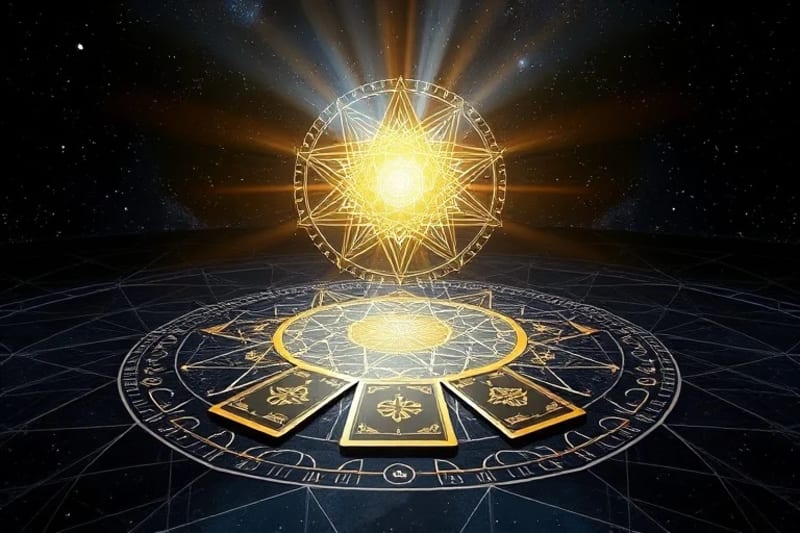
A conceptual visualization of a Tarot spread arranged on a surface of interlocking geometric shapes, revealing underlying patterns.
Common spreads like the Three-Card Spread (Past, Present, Future) form a linear or triangular pattern, emphasizing progression and cause-and-effect. The popular Celtic Cross spread, with its central cross and surrounding staff, creates a complex geometric configuration that represents the querent's situation, influences, challenges, and potential outcomes. The central cross itself forms a powerful symbol of balance and intersection.
Other spreads, such as the Tree of Life spread, directly mirror the Kabbalistic Tree of Life, a profound geometric diagram representing the path of creation and consciousness. Each position in such a spread corresponds to a sephirah or path on the Tree, adding immense depth to the reading. Even simpler spreads can be viewed through a geometric lens: a circle spread for wholeness, or a square spread for stability and material concerns. The geometric arrangement of cards creates a visual map of the energies at play, allowing for a more holistic and intuitive interpretation. This structural understanding is akin to how House Systems Astrology: Placidus Whole Koch Interpretation provides different frameworks for understanding astrological influences.
Practical Application: Enhancing Readings with Geometric Insight
Integrating sacred geometry into Tarot readings can profoundly enhance the depth and accuracy of interpretations. Here are practical ways to apply this knowledge:
- Observe Card Composition: Pay attention to the geometric shapes formed by the figures, objects, and overall layout within each card. What do these shapes convey about the card's energy (e.g., stability of a square, dynamism of a triangle, wholeness of a circle)?
- Analyze Spread Geometry: Before interpreting individual cards, observe the overall geometric pattern of the spread. Does it form a line, a triangle, a cross, or a circle? What does this overarching shape suggest about the nature of the inquiry or the energy of the situation?
- Connect Numerology to Geometry: When a number appears prominently in a reading (e.g., many Threes or Fours), consider its geometric counterpart. A prevalence of Threes might suggest creative manifestation (triangle), while Fours might point to a need for structure or stability (square).
- Meditate on Geometric Forms: Before a reading, meditate on a sacred geometric symbol like the Flower of Life or Metatron's Cube to attune your mind to universal patterns. This can open intuitive channels and help you perceive the underlying order in the cards.
- Use Geometric Overlays: Some practitioners use physical overlays of sacred geometric patterns on their Tarot spreads to visually highlight connections and energetic flows between cards.
By consciously engaging with the geometric aspects of Tarot, readers can move beyond rote memorization of meanings and tap into a more intuitive, holistic understanding of the messages being conveyed. It transforms the reading into an act of decoding the cosmic blueprint of the querent's situation.
Universal Truths Revealed: The Deeper Wisdom
The synthesis of Tarot and sacred geometry offers a powerful pathway to uncovering universal truths. It reveals that the challenges, opportunities, and archetypal journeys depicted in the Tarot are not random events but are reflections of fundamental cosmic laws and patterns. These truths include:
- Interconnectedness: Both systems emphasize that everything is connected. Sacred geometry shows the underlying unity of form, while Tarot illustrates the interconnectedness of life events and psychological states.
- Cyclical Nature of Existence: The cycles of creation, destruction, and renewal are evident in both the geometric spirals and circles, and in the journey through the Major Arcana.
- Balance and Harmony: The pursuit of balance is a core theme in sacred geometry's perfect proportions and in Tarot's quest for equilibrium and resolution.
- Order in Chaos: Even in apparent chaos, sacred geometry reveals an underlying order. Similarly, Tarot helps us find meaning and direction amidst life's complexities.
- Evolution and Growth: The spiral, a key geometric form, perfectly mirrors the evolutionary journey of the soul depicted in Tarot, constantly expanding and refining.
By approaching Tarot with an awareness of sacred geometry, we gain access to a deeper layer of wisdom, one that transcends personal narratives and connects us to the grander design of the universe. It transforms Tarot from a simple fortune-telling tool into a profound spiritual practice, a mirror reflecting the divine order within and around us, guiding us towards greater self-awareness and alignment with universal truths.
Conclusion: The Unified Language of Spirit and Form
The convergence of Tarot and sacred geometry offers a rich and expansive understanding of divination and existence itself. Far from being disparate fields, they are two facets of the same universal language, one speaking through archetypal narratives and the other through the fundamental patterns of creation. By recognizing the geometric underpinnings of Tarot, we unlock a more profound interpretative framework, allowing us to perceive the cosmic order that shapes our lives and the world around us.
This integrated approach not only enriches the practice of Tarot but also deepens our connection to the spiritual and mathematical harmony of the universe. It reminds us that the wisdom we seek is often encoded in the very structure of reality, waiting to be deciphered by those willing to look beyond the surface. Embracing this synergy transforms Tarot into a powerful tool for self-realization, guiding us toward an understanding of the universal truths that resonate within every card, every spread, and every moment of our journey.
Explore Further Insights
Source: Hybrid content assisted by AI and human editorial supervision.


Comments
Post a Comment