
House Systems Astrology: Placidus Whole Koch Interpretation | StarPluto
Astrology, at its core, is a symbolic language that translates celestial patterns into insights about human experience. Central to this practice is the birth chart, a snapshot of the heavens at the moment of an individual's birth. While zodiac signs and planetary placements often capture immediate attention, the house system employed in a chart's calculation profoundly shapes its interpretation. Understanding advanced house systems like Placidus, Whole Sign, and Koch is crucial for a nuanced and comprehensive astrological analysis, moving beyond introductory concepts to unlock deeper layers of meaning.
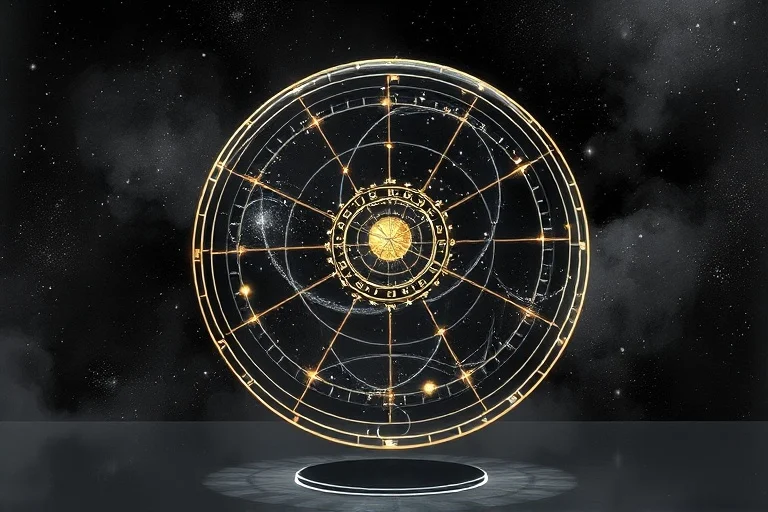
An intricate holographic projection illustrating the complex interplay of celestial mechanics and various house systems, crucial for advanced astrological interpretation.
The concept of astrological houses divides the sky into twelve segments, each representing distinct areas of life, from self and identity to relationships, career, and spirituality. However, the methods by which these houses are delineated vary significantly, leading to different interpretations of planetary placements and house cusps. This article delves into the intricacies of three prominent house systems – Placidus, Whole Sign, and Koch – exploring their historical origins, mathematical foundations, and the interpretive implications for a birth chart.
Before diving into the specifics, it's important to recognize that no single house system is universally "correct." Each offers a unique lens through which to view the birth chart, and experienced astrologers often develop a preference based on their philosophical approach and practical experience. The choice of house system can shift the emphasis of a reading, highlighting different life areas and challenges.
Table of Contents
- The Placidus House System: The Modern Standard
- Whole Sign Houses: Ancient Roots, Modern Revival
- The Koch House System: Centered on the Midheaven
- Comparative Analysis: Placidus vs. Whole Sign vs. Koch
- Impact on Astrological Interpretation
- Historical Evolution of House Systems
- Choosing Your House System: A Personal Journey
The Placidus House System: The Modern Standard
The Placidus house system is arguably the most widely used house system in Western astrology today. Its popularity stems from its intricate mathematical calculations and its ability to reflect the dynamic nature of the Earth's rotation. Developed by the Italian monk Placidus de Titis in the 17th century, though its origins can be traced back to earlier Arabic and Greek texts, this system divides the celestial sphere based on the time it takes for specific degrees of the zodiac to rise from the horizon.
The core principle of Placidus involves dividing the arc between the Ascendant and the Midheaven into three equal parts, and similarly the arc between the Midheaven and the Descendant. These divisions are then projected onto the ecliptic to determine the house cusps. This method results in houses of unequal size, with some houses being larger or smaller depending on the latitude of the birth location. At extreme northern or southern latitudes, some houses can become extremely large or even "intercepted," meaning an entire sign falls within a house without its cusp being on that sign.
- Calculation Method: Divides the semi-arc of each zodiac degree between the Ascendant and Midheaven into three equal segments of time.
- House Sizes: Unequal house sizes, varying significantly with latitude.
- Key Features: Emphasizes the temporal unfolding of life events; prone to intercepted signs and duplicated houses at higher latitudes.
- Interpretive Focus: Often associated with psychological astrology, reflecting the individual's developmental journey and the timing of experiences.
Astrologers who favor Placidus often find that the unequal house sizes provide a more nuanced understanding of how different life areas unfold. A larger house might indicate a more expansive or complex experience in that area, while a smaller house could suggest a more focused or less prominent theme. The presence of intercepted signs is also a significant interpretive factor, often suggesting repressed or unconscious energies that require conscious effort to integrate.
Whole Sign Houses: Ancient Roots, Modern Revival
Whole Sign Houses represent one of the oldest and most fundamental house systems, dating back to Hellenistic astrology. This system has experienced a significant revival in modern astrological practice, particularly among those interested in traditional and karmic astrology. Its simplicity is its strength: the sign containing the Ascendant becomes the 1st house, and each subsequent sign corresponds to the next house in order.

A cinematic still life showcasing antique astrological instruments and texts, symbolizing the historical depth of house system development.
For example, if your Ascendant is in 15 degrees of Aries, then Aries is your entire 1st house. Taurus becomes the entire 2nd house, Gemini the 3rd, and so on. This means that all planets within a given sign will fall into the same house, regardless of their precise degree. This system eliminates the concepts of intercepted signs and duplicated houses, simplifying the visual layout of the chart and providing a clear, consistent framework for interpretation.
- Calculation Method: The zodiac sign containing the Ascendant is the 1st house; each subsequent sign is the next house.
- House Sizes: All houses are equal in size (30 degrees each).
- Key Features: Simple, ancient, no intercepted signs or duplicated houses.
- Interpretive Focus: Emphasizes the inherent qualities of the zodiac signs within each house, often used for predictive techniques like profections and zodiacal releasing.
Proponents of Whole Sign Houses argue that its straightforward nature allows for a more direct and less convoluted reading of the chart. The emphasis shifts from the precise degree of a cusp to the overarching themes of the sign itself within a house. This system is particularly effective for traditional predictive techniques, where the entire sign is considered active for a given period. To learn more about the foundational elements of a birth chart, consider exploring the significance of zodiac signs in a natal chart.
The Koch House System: Centered on the Midheaven
The Koch house system, also known as the "House of the Soul" system, was developed by German astrologer Walter Koch in the mid-20th century. It is another popular quadrant house system, often favored in European astrological circles and by astrologers with a psychological or spiritual focus. Like Placidus, Koch is a time-based system, but its calculation method differs significantly, particularly in its relationship to the Midheaven (MC).
The Koch system calculates house cusps by dividing the time elapsed between the Ascendant and the Midheaven into three equal parts. However, instead of projecting these divisions onto the ecliptic directly, it uses the intermediate cusps as reference points. This method aims to create a system that is more responsive to the individual's subjective experience and psychological development. It also results in unequal house sizes, similar to Placidus, and can also produce intercepted signs and duplicated houses at higher latitudes.
- Calculation Method: Divides the time from the Ascendant to the MC into three equal parts, then projects these points onto the ecliptic using a specific formula.
- House Sizes: Unequal house sizes, varying with latitude.
- Key Features: Often used for psychological and spiritual interpretations; similar to Placidus in its potential for intercepted signs.
- Interpretive Focus: Believed to reflect inner motivations, personal growth, and the individual's journey of self-discovery.
Astrologers using the Koch system often find it resonates deeply with the individual's inner world and their personal quest for meaning. The houses are seen as arenas for psychological development, and the planets within them describe the internal dynamics at play. The Koch system is particularly valued for its insights into the motivations behind actions and the subjective experience of life events. For a deeper understanding of astrological aspects and their impact, consider exploring conjunctions, oppositions, and trines.
Comparative Analysis: Placidus vs. Whole Sign vs. Koch
To truly appreciate the nuances of each house system, a direct comparison is essential. While all aim to divide the birth chart into twelve life areas, their underlying philosophies and mathematical approaches lead to distinct outcomes. The table below highlights the key differences and similarities between Placidus, Whole Sign, and Koch.
| Feature | Placidus | Whole Sign | Koch |
|---|---|---|---|
| Origin Era | 17th Century (with earlier roots) | Hellenistic (1st Century BCE - 7th Century CE) | Mid-20th Century |
| House Size | Unequal (variable by latitude) | Equal (30 degrees each) | Unequal (variable by latitude) |
| Cusp Calculation | Time-based division of semi-arcs projected onto ecliptic. | Ascendant sign defines 1st house; subsequent signs follow. | Time-based division from Ascendant to MC, using intermediate cusps. |
| Intercepted Signs/Duplicated Houses | Yes, common at higher latitudes. | No. | Yes, common at higher latitudes. |
| Primary Focus | Psychological development, timing of events. | Sign-based qualities, traditional predictive techniques. | Inner motivations, spiritual growth, subjective experience. |
| Popularity | Most common in Western astrology. | Growing popularity, especially in traditional astrology. | Popular in European and psychological astrology. |
The choice between these systems often comes down to the astrologer's philosophical leanings and the specific questions they are trying to answer. Placidus and Koch, as quadrant systems, often provide a more dynamic and time-sensitive interpretation, focusing on the individual's journey through life. Whole Sign, with its fixed 30-degree houses, offers a more static and foundational view, emphasizing the inherent qualities of the signs and their rulers within each life area. For those interested in the broader historical context of astrological practices, exploring the ancient origins of astrology can provide valuable perspective.
Impact on Astrological Interpretation
The selection of a house system has profound implications for how a birth chart is read and understood. A planet's placement in a different house can completely alter its meaning and influence on an individual's life. Consider a planet positioned at 29 degrees of a sign. In Placidus or Koch, it might fall into one house, while in Whole Sign, it would definitively be in the next house, shifting its primary area of expression.

A conceptual art piece depicting a fragmented birth chart with glowing lines, symbolizing the intricate and multi-layered nature of astrological interpretation.
- Planetary Rulerships: The ruler of a house changes if the sign on its cusp shifts. This alters the planetary dynamics and the areas of life that are interconnected.
- Aspects to Cusps: Aspects to house cusps (especially the Ascendant and Midheaven) gain or lose significance depending on the system. Whole Sign, for example, often emphasizes sign-based aspects more than degree-based cusps.
- Intercepted Signs: In Placidus and Koch, intercepted signs introduce a layer of complexity, suggesting hidden talents or challenges that may not manifest directly until later in life or through conscious effort. Whole Sign eliminates this concept entirely.
- Predictive Techniques: Different house systems are better suited for specific predictive methods. Whole Sign is often preferred for traditional techniques like profections and zodiacal releasing, while Placidus is commonly used for transits and progressions in modern astrology.
For instance, if a planet like Jupiter, representing expansion and luck, falls into the 2nd house of finances in a Placidus chart, but into the 3rd house of communication in a Whole Sign chart, the interpretation of how one experiences abundance and growth would be significantly different. In the first case, it might suggest financial opportunities, while in the second, it could indicate abundance in learning, teaching, or local travel. Understanding these shifts is paramount for an accurate and insightful reading.
Historical Evolution of House Systems
The development of house systems is a fascinating journey through the history of astronomy and astrology. Early astrological practices, particularly in Mesopotamia, did not utilize a complex house system as we understand it today. The concept of dividing the sky into twelve distinct areas emerged more prominently with the Hellenistic tradition, where Whole Sign Houses were the prevalent method.
During the Hellenistic period (roughly 1st century BCE to 7th century CE), the Ascendant was the primary anchor, and each subsequent 30-degree zodiac sign was assigned to a house. This system was simple, elegant, and effective for the predictive techniques of the time. As astrology evolved through the Arabic and medieval periods, new mathematical approaches were introduced, leading to the development of various quadrant house systems.
- Hellenistic Period: Dominated by Whole Sign and Porphyry house systems. Emphasis on the Ascendant as the primary significator.
- Arabic & Medieval Periods: Introduction of more complex time-based divisions. Alcabitius system was popular.
- Renaissance & Modern Era: Placidus gained prominence, along with Regiomontanus. Koch emerged in the 20th century, seeking a more psychologically oriented approach.
The shift from equal house systems (like Whole Sign) to unequal house systems (like Placidus and Koch) reflects a changing understanding of celestial mechanics and the desire to create systems that more accurately reflected the Earth's rotation and the observer's specific location. This evolution also paralleled the development of more precise astronomical instruments and mathematical techniques. The ongoing debate and exploration of different house systems highlight the dynamic and evolving nature of astrological knowledge. For deeper insights into planetary influences, consider the role of Jupiter in astrology.
Choosing Your House System: A Personal Journey
For students and practitioners of astrology, the question of which house system to use is a deeply personal one. There is no definitive "best" system, as each offers valuable perspectives and resonates differently with individuals. Many astrologers begin with Placidus due to its widespread use in modern texts and software, but often explore other systems as their practice deepens.
Here are some considerations when choosing a house system:
- Personal Resonance: Which system's interpretations feel most accurate and insightful for your own chart and the charts of others you study?
- Astrological Tradition: Are you drawn to traditional Hellenistic astrology (favoring Whole Sign) or modern psychological astrology (often using Placidus or Koch)?
- Predictive Techniques: Some predictive methods work best with specific house systems. For example, profections are often more straightforward with Whole Sign.
- Latitude Considerations: If working with charts from extreme northern or southern latitudes, Whole Sign avoids the issue of intercepted houses, which can be complex to interpret in quadrant systems.
- Experimentation: The best approach is often to experiment. Calculate a few charts (including your own) using different systems and compare the interpretations. Note where planets shift houses and how that changes the narrative.
Ultimately, the house system is a tool, a framework for understanding the complex tapestry of a birth chart. A skilled astrologer can derive profound insights from any system, as long as they understand its underlying principles and limitations. The journey of mastering astrological interpretation involves not just memorizing placements but developing a deep intuitive connection to the symbolism, regardless of the specific mathematical divisions used. Further exploring concepts like planetary dignities and chart strength can also enhance your interpretive skills.
The advanced study of house systems is a testament to the depth and sophistication of astrology. By understanding the historical context, mathematical underpinnings, and interpretive nuances of Placidus, Whole Sign, and Koch, astrologers can unlock richer, more precise insights into the human condition and the cosmic blueprint of existence. Continue your exploration into the intricate world of astrology by investigating natal chart interpretation.
Fuente: Contenido híbrido asistido por IAs y supervisión editorial humana.


Comments
Post a Comment