
Archaeoastronomy: Decoding Ancient Celestial Alignments
Archaeoastronomy, a fascinating interdisciplinary field, delves into the study of how ancient cultures understood and integrated celestial phenomena into their societies. It explores the astronomical practices, beliefs, and knowledge systems of past civilizations, often revealing profound connections between their architecture, rituals, and the cosmos. This discipline transcends mere observation, seeking to decode the sophisticated ways our ancestors used the heavens as a clock, a calendar, and a source of spiritual guidance.
The alignment of sacred sites with significant celestial events is a recurring theme across diverse ancient cultures worldwide. From the megalithic structures of Europe to the elaborate temples of Mesoamerica, evidence suggests a deliberate and precise integration of astronomical knowledge into architectural design. These alignments were not accidental; they were the result of centuries of meticulous observation and a deep understanding of celestial mechanics, often serving both practical and profound spiritual purposes.
Table of Contents
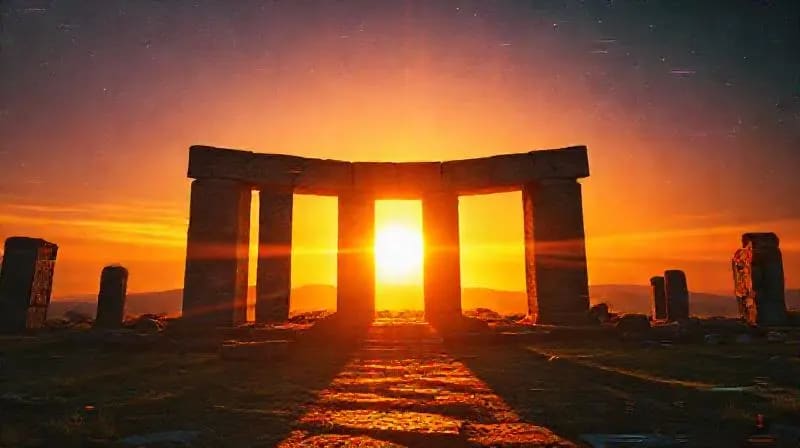
A panoramic view of an ancient megalithic structure at dawn, showcasing its precise alignment with the rising sun during a significant celestial event.
Understanding Archaeoastronomy: Bridging Skies and Stones
Archaeoastronomy combines the rigorous methods of archaeology with the precise calculations of astronomy to reconstruct the astronomical knowledge of ancient peoples. It investigates how ancient societies perceived and interacted with the cosmos, often revealing sophisticated understanding that predates modern scientific instruments. This field moves beyond simply identifying alignments; it seeks to understand the cultural context, the motivations, and the societal impact of these celestial observations.
The discipline aims to answer questions such as: What celestial phenomena were important to ancient cultures? How did they track these events? What role did astronomical knowledge play in their religious beliefs, social structures, and daily lives? By examining the orientation of buildings, the layout of cities, and the symbolism in art and mythology, archaeoastronomers piece together a compelling narrative of humanity's enduring fascination with the heavens.
Early pioneers in archaeoastronomy, like Alexander Thom and Gerald Hawkins, laid the groundwork by meticulously surveying megalithic sites and demonstrating statistical evidence for astronomical alignments. Their work, initially met with skepticism, gradually established archaeoastronomy as a legitimate and vital area of study. Today, the field continues to evolve, incorporating new technologies and interdisciplinary approaches to shed light on the cosmic wisdom of our ancestors.
Celestial Alignments: Key Concepts and Phenomena
The core of archaeoastronomy lies in identifying and interpreting specific celestial alignments within ancient structures. These alignments often correspond to predictable astronomical events that held significant meaning for the societies that observed them. Understanding these key concepts is crucial to appreciating the sophistication of ancient astronomical practices.
The most commonly observed alignments relate to the solstices and equinoxes, which mark the extreme and midpoint positions of the sun throughout the year. The summer solstice signifies the longest day, while the winter solstice marks the shortest. The spring and autumn equinoxes occur when day and night are of approximately equal length. These events were critical for agricultural cycles, seasonal rituals, and the marking of time.
Beyond the sun, ancient peoples also tracked the moon, stars, and planets. Lunar standstills, which occur approximately every 18.6 years, represent the extreme northern and southern points of the moon's rise and set. The heliacal rising of certain stars, such as Sirius, was also significant for various cultures, often signaling the start of a new year or a specific agricultural season. These complex observations demonstrate a deep, long-term commitment to celestial tracking.
The precision required to build structures that accurately align with these events is astounding, especially considering the lack of modern tools. This suggests not only advanced observational skills but also sophisticated engineering and planning capabilities. The integration of these alignments into monumental architecture speaks volumes about their perceived importance.
Iconic Sacred Sites and Their Celestial Secrets
Numerous sites around the globe bear witness to the profound connection between ancient architecture and celestial phenomena. These structures serve as enduring testaments to the astronomical prowess and spiritual beliefs of their builders. Each site tells a unique story of cosmic engagement.

An antique astrolabe and carved stone tablet, representing the sophisticated astronomical instruments and knowledge of ancient civilizations.
Stonehenge, England: Perhaps the most famous archaeoastronomical site, Stonehenge is meticulously aligned with the solstices. On the summer solstice, the sun rises directly over the Heel Stone, its rays penetrating the heart of the monument. Conversely, on the winter solstice, the sun sets in perfect alignment with the main axis of the stones. This alignment strongly suggests its use as a sophisticated calendar and a site for seasonal rituals, possibly related to fertility and rebirth.
Chichen Itza, Mexico: The El Castillo pyramid, dedicated to the feathered serpent god Kukulcán, showcases a breathtaking celestial phenomenon during the spring and autumn equinoxes. As the sun descends, the corner of the pyramid casts a shadow that, combined with the stepped terraces, creates the illusion of a serpent slithering down the northern staircase. This visual spectacle, culminating in a carved serpent's head at the base, demonstrates the Maya's advanced understanding of both astronomy and architecture.
Newgrange, Ireland: This Neolithic passage tomb, older than Stonehenge and the pyramids of Egypt, is renowned for its winter solstice illumination. For a few minutes around dawn on the shortest day of the year, a narrow beam of sunlight penetrates a small opening above the entrance (the 'roofbox') and gradually illuminates the chamber at the end of the 19-meter passage. This event, likely symbolizing rebirth and the triumph of light over darkness, highlights the spiritual significance of celestial cycles.
Abu Simbel, Egypt: The Great Temple of Ramesses II at Abu Simbel is an incredible feat of ancient engineering and astronomical precision. Twice a year, on approximately February 22nd and October 22nd, the sun's rays penetrate the temple's sanctuary, illuminating statues of Ra-Horakhty, Ramesses II, and Amun. The statue of Ptah, the god of darkness, remains in shadow. These dates are believed to correspond to Ramesses II's ascension to the throne and his birthday, underscoring the pharaoh's divine connection to the cosmos.
Goseck Circle, Germany: Considered the oldest known solar observatory in the world, dating back to around 4900 BC, the Goseck Circle consists of concentric rings of ditches and wooden palisades. Its gates are precisely aligned with the sunrise and sunset of the winter and summer solstices, making it an early example of a sophisticated calendar system used for agricultural planning and ritualistic purposes. This site offers crucial insights into early European astronomical practices.
These examples, among many others, illustrate the universal human impulse to connect with the cosmos and integrate its rhythms into terrestrial existence. The precision and scale of these ancient constructions continue to inspire awe and provide invaluable data for understanding our shared human heritage. For further exploration of ancient wisdom, consider delving into Tarot Quantum Mechanics Intersecting Divination Reality.
Methodologies of Archaeoastronomy: How We Decode the Past
The study of archaeoastronomy employs a diverse set of methodologies, drawing from both archaeological and astronomical techniques. This interdisciplinary approach is essential for accurately identifying, measuring, and interpreting celestial alignments within ancient contexts. The process often begins with meticulous fieldwork and surveys.
Researchers conduct precise surveys of ancient sites, using modern instruments like GPS and total stations to map the orientation of structures, entrances, and significant features. These measurements are then compared with astronomical calculations of past celestial events, taking into account changes in the Earth's axial tilt (precession) over millennia. This allows for accurate reconstruction of what ancient observers would have seen.
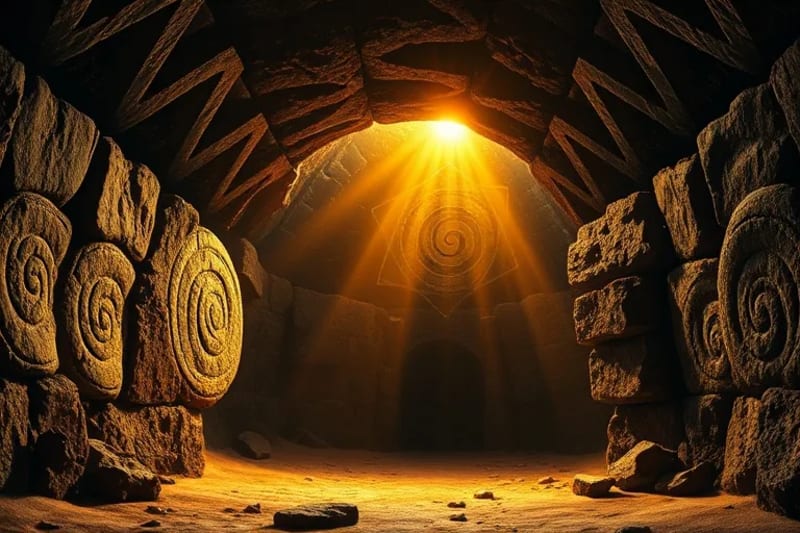
An artistic rendering of a golden light beam penetrating a dark, ancient chamber, highlighting intricate carvings during a celestial alignment.
Historical and ethnographic research also plays a crucial role. Ancient texts, oral traditions, and ethnographic accounts of contemporary indigenous cultures can provide invaluable context for understanding astronomical beliefs and practices. For instance, the study of Maya codices and oral histories has been instrumental in deciphering their complex calendar systems and astronomical observations. This contextual information helps move beyond mere statistical correlation to a deeper cultural understanding.
Furthermore, computer simulations and virtual reality are increasingly used to recreate ancient sky views and demonstrate alignments. These tools allow researchers to visualize how celestial events would have appeared from a specific site at a particular time in history, enhancing our interpretive capabilities. The combination of these methods provides a robust framework for archaeoastronomical investigations, ensuring scientific rigor in a field that often touches upon the mystical.
The Profound Significance of Celestial Architecture
The deliberate alignment of sacred sites with celestial bodies reveals much about the worldview and priorities of ancient civilizations. These architectural marvels were not just buildings; they were cosmic interfaces, designed to connect the earthly realm with the divine and to structure human life according to celestial rhythms.
One primary significance was the establishment of calendars. Accurate calendars were vital for agricultural societies, determining planting and harvesting seasons. The solstices and equinoxes provided reliable markers for these cycles, ensuring survival and prosperity. Beyond agriculture, calendars also regulated ritual cycles and social events, bringing order to communal life. This practical application underscores the fundamental importance of astronomical observation.
Spiritually, celestial alignments often imbued sacred sites with divine power. The sun, moon, and stars were frequently seen as deities or manifestations of divine forces. Aligning temples and altars with their movements was a way to honor these gods, facilitate communication with the spiritual realm, and harness cosmic energies. The dramatic visual effects created by these alignments, such as the serpent shadow at Chichen Itza or the light beam at Newgrange, likely served to reinforce religious beliefs and the authority of priestly classes.
Moreover, these alignments could symbolize rebirth, renewal, and the cyclical nature of existence. The winter solstice, for example, often represented the death and rebirth of the sun, a powerful metaphor for life's continuous cycles. Such symbolism provided comfort, meaning, and a sense of cosmic order to ancient peoples. The monumental effort involved in constructing these sites further emphasizes their profound cultural and spiritual value.
The study of these sites also highlights the universal human desire to understand our place in the universe. By observing the predictable movements of celestial bodies, ancient cultures sought to comprehend the grand design of the cosmos and their relationship to it. This quest for cosmic understanding is a thread that connects humanity across millennia, from the earliest megalith builders to modern astrophysicists. For more on how ancient wisdom influences modern thought, explore .
Challenges, Controversies, and the Future of the Field
Despite its significant contributions, archaeoastronomy faces several challenges and controversies. One major hurdle is distinguishing genuine astronomical alignments from accidental ones. Given the vast number of possible alignments, it can be tempting to find patterns where none were intended by the builders. Rigorous statistical analysis and contextual evidence are crucial to avoid confirmation bias and pseudo-scientific interpretations.
Another challenge lies in the interpretation of ancient motivations. While an alignment can be scientifically proven, understanding the exact purpose and cultural significance behind it requires careful consideration of archaeological, historical, and ethnographic data. It's essential to avoid imposing modern scientific or spiritual frameworks onto ancient belief systems. The meaning of a solstice alignment for a Neolithic community might have been vastly different from our contemporary understanding.
The preservation of archaeoastronomical sites is also a growing concern. Many ancient structures are vulnerable to natural erosion, climate change, and human activity. Protecting these invaluable cultural heritage sites ensures that future generations can continue to study and learn from the cosmic wisdom they embody. Conservation efforts often involve balancing access for tourism with the need for preservation.
The future of archaeoastronomy looks promising, with advancements in technology and increasing interdisciplinary collaboration. Remote sensing techniques, drone mapping, and advanced computational modeling are allowing researchers to discover new sites and analyze existing ones with unprecedented precision. The integration of indigenous knowledge systems and a more inclusive approach to research are also enriching the field, providing deeper cultural insights into humanity's enduring relationship with the cosmos.
Ultimately, archaeoastronomy offers a unique window into the minds of our ancestors, revealing their intellectual curiosity, spiritual depth, and remarkable engineering skills. It reminds us that the human gaze has always been directed towards the heavens, seeking answers, meaning, and connection in the vast expanse of the universe. The study of these sacred sites continues to inspire wonder and deepen our appreciation for the rich tapestry of human history and cosmic engagement.
Fuente: Contenido híbrido asistido por IAs y supervisión editorial humana.


Comments
Post a Comment