
Archetypal Shadow Work: Integrating Jungian Wholeness
In the vast landscape of self-discovery and personal growth, few concepts hold as much transformative power as shadow work. While often discussed within the context of psychological healing, its archetypal dimension offers an even deeper pathway to wholeness. This article delves into archetypal shadow work, exploring how integrating the unconscious aspects of universal Jungian archetypes can lead to profound personal evolution, extending far beyond the insights offered by a natal chart.
Archetypal shadow work invites us to confront and embrace the parts of ourselves that we have disowned, repressed, or projected onto others. By understanding these hidden facets through the lens of Carl Jung's archetypes, we gain access to a richer, more integrated sense of self. This journey is not merely about fixing flaws but about reclaiming lost power, creativity, and authenticity, ultimately fostering a more complete and harmonious existence.

A solitary figure embarks on an introspective journey, surrounded by the luminous symbols of Jungian archetypes, delving into the depths of archetypal shadow work.
Table of Contents
- Understanding the Shadow: Carl Jung's Core Concept
- The Major Jungian Archetypes and Their Shadow Aspects
- Why Shadow Work Extends Beyond the Natal Chart
- Practical Approaches to Archetypal Shadow Integration
- Benefits of Embracing Your Archetypal Shadow
- Common Misconceptions and Ethical Considerations
Understanding the Shadow: Carl Jung's Core Concept
Carl Jung, the pioneering Swiss psychiatrist, introduced the concept of the "shadow" as an unconscious aspect of the personality that the conscious ego does not identify with. It comprises all the things we deem unacceptable about ourselves—our weaknesses, fears, desires, and even positive traits that we have suppressed. The shadow is not inherently evil; rather, it is simply the unacknowledged part of our psyche.
Jung believed that everyone possesses a shadow, and its contents are often projected onto others, leading to conflict and misunderstanding in relationships. The process of shadow work involves bringing these unconscious elements into conscious awareness, not to eliminate them, but to integrate them. This integration is crucial for psychological maturity and achieving what Jung called "individuation," the process of becoming a whole, unique self.
The shadow is deeply intertwined with the collective unconscious, a concept Jung also developed, which houses universal patterns and images known as archetypes. These archetypes represent fundamental human experiences and motivations, influencing our thoughts, feelings, and behaviors. When we speak of archetypal shadow work, we are exploring the unacknowledged or repressed aspects of these universal patterns within our individual psyche.
The Major Jungian Archetypes and Their Shadow Aspects
Jung identified numerous archetypes, each with a light and shadow side. Understanding these dualities is fundamental to archetypal shadow work. Here are some prominent examples and their shadow manifestations:
- The Hero: In its light aspect, the Hero embodies courage, determination, and the will to overcome obstacles. Its shadow can manifest as arrogance, recklessness, a need for constant validation, or a refusal to acknowledge vulnerability.
- The Sage: The Sage represents wisdom, truth, and objective understanding. Its shadow can be intellectual snobbery, dogmatism, detachment from emotions, or an inability to act due to overthinking.
- The Innocent: This archetype signifies purity, optimism, and trust. The shadow Innocent might be naive to the point of self-destruction, prone to denial, or excessively dependent on others.
- The Lover: The Lover embodies passion, connection, and intimacy. Its shadow can manifest as addiction, possessiveness, obsession, or a loss of self in relationships.
- The Creator: Representing innovation, artistry, and the desire to build, the Creator's shadow can be perfectionism, creative blocks, self-doubt, or destructive tendencies.
- The Ruler: This archetype signifies leadership, responsibility, and control. Its shadow can be tyranny, manipulation, fear of losing power, or an inability to delegate.
- The Magician: The Magician embodies transformation, knowledge, and the ability to manifest. Its shadow can be manipulation, deceit, a desire for power over others, or escapism.
- The Orphan: Representing vulnerability, empathy, and a desire for belonging. The shadow Orphan can manifest as victimhood, chronic helplessness, or a deep-seated fear of abandonment.
Each of these archetypes carries universal human experiences, and their shadow aspects are not personal failings but rather expressions of repressed energy. For a deeper understanding of how unconscious desires and power dynamics play out, exploring concepts like Lilith Synastry: Decoding Power, Desires, Shadow Integration can provide valuable insights into these complex interactions.
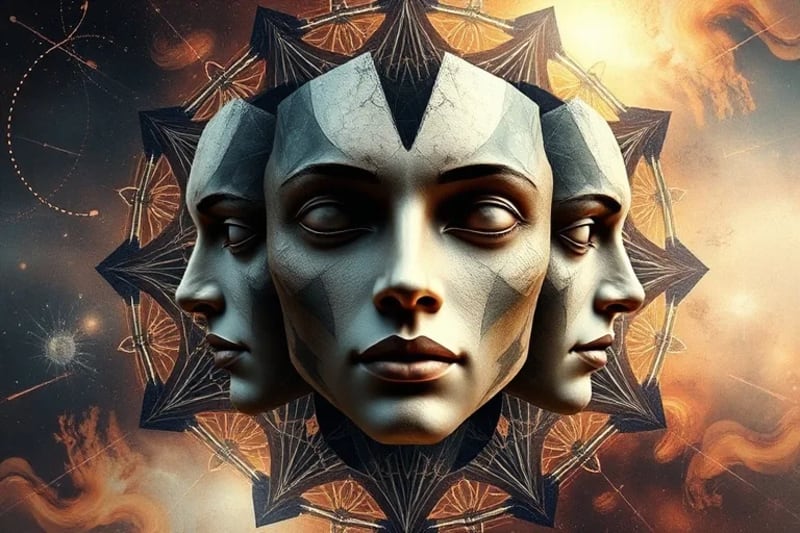
Fragmented masks converge, illustrating the profound process of integrating diverse aspects of the self into a unified, serene whole.
Why Shadow Work Extends Beyond the Natal Chart
While a natal chart provides an invaluable blueprint of an individual's psychological makeup, potentials, and challenges based on planetary positions at birth, archetypal shadow work operates on a different, yet complementary, level. Natal astrology, such as understanding your Sun Sign Astrology: Core Identity, Traits, Understanding, reveals inherent predispositions and life themes. However, it doesn't always fully address the universal, transpersonal patterns that influence human behavior and development.
Archetypal shadow work transcends the individual chart by tapping into the collective unconscious. The archetypes are universal structures of the psyche that exist independently of any individual's birth chart. While a chart might indicate a strong "Hero" archetype, shadow work explores how that Heroic energy might be repressed or distorted, leading to self-sabotage or an inability to act courageously. It delves into the *how* and *why* we embody or reject these universal patterns, regardless of specific astrological placements.
For instance, someone might have a natal chart indicating strong leadership qualities (e.g., prominent Mars or Leo placements), yet struggle with asserting themselves. Archetypal shadow work might reveal a repressed "Ruler" archetype's shadow—a fear of tyranny or a belief that power is inherently corrupt—which prevents them from stepping into their natural leadership role. This work provides a framework for understanding these deeper, often unconscious, resistances that may not be explicitly detailed in a natal chart reading alone.
Practical Approaches to Archetypal Shadow Integration
Integrating the archetypal shadow is a lifelong process that requires self-awareness, courage, and compassion. Here are several practical approaches:
- Identify Projections: Pay attention to what triggers you in others. The qualities you intensely dislike or admire in others are often reflections of your own unacknowledged shadow aspects. If you despise arrogance, you might have a repressed desire for recognition or a fear of being seen as weak.
- Dream Analysis: Dreams are a direct line to the unconscious. Keep a dream journal and look for recurring symbols, characters, or themes. These often represent archetypal energies and their shadow manifestations.
- Active Imagination: This Jungian technique involves engaging in a dialogue with figures or symbols that emerge from your unconscious. You can visualize a shadowy figure and ask it questions, allowing it to reveal its message and needs.
- Creative Expression: Art, writing, music, and dance can be powerful tools for externalizing and understanding shadow material. Engaging in practices like Automatic Writing: Advanced Spiritual Guidance Techniques can help bypass the conscious mind and access deeper insights.
- Mythology and Storytelling: Explore myths, fairy tales, and literature. Identify with characters and their struggles, noting how archetypal patterns play out. This can help you recognize similar patterns in your own life.
- Therapy and Coaching: Working with a qualified therapist or coach who understands Jungian psychology can provide a safe and guided space for exploring and integrating shadow aspects.
The goal is not to eliminate the shadow but to acknowledge its existence, understand its purpose, and integrate its energy into your conscious personality. This process enriches your life by making you more whole and authentic.

A winding path through a mystical forest leads towards an illuminating light, symbolizing the transformative journey of shadow work and self-discovery.
Benefits of Embracing Your Archetypal Shadow
Engaging in archetypal shadow work offers a multitude of profound benefits that contribute to a more fulfilling and integrated life:
- Increased Self-Awareness: You gain a deeper understanding of your motivations, fears, and desires, leading to greater clarity about who you are.
- Enhanced Authenticity: By integrating disowned parts, you become more genuine and less likely to wear masks or conform to external expectations.
- Greater Emotional Resilience: Understanding and accepting your shadow allows you to navigate difficult emotions with more grace and less reactivity.
- Improved Relationships: When you stop projecting your shadow onto others, your relationships become healthier, more honest, and less fraught with conflict.
- Unleashed Creativity and Potential: The shadow often holds repressed talents and energies. Integrating it can unlock dormant creativity and personal power.
- Reduced Self-Sabotage: By understanding the unconscious patterns that drive self-defeating behaviors, you can consciously choose different paths.
- Spiritual Growth: Shadow work is a deeply spiritual practice, leading to a sense of wholeness, interconnectedness, and a more profound connection to your inner self and the collective unconscious.
This journey is a cornerstone of psychological astrology and self-development, allowing individuals to move beyond superficial understanding into profound self-mastery. For further exploration into the depths of the psyche and its connection to universal patterns, delving into Psychological Astrology: Jung, Collective Unconscious, and Synchronicity can provide a rich theoretical framework.
Common Misconceptions and Ethical Considerations
As with any deep psychological work, there are common misconceptions and important ethical considerations to keep in mind when approaching archetypal shadow integration:
- Misconception 1: The Shadow is Purely Evil. The shadow is not inherently bad. It contains repressed aspects, both negative and positive, that simply need to be acknowledged and integrated. It's a source of raw, untamed energy that can be harnessed for good.
- Misconception 2: Shadow Work is About Eliminating Flaws. The goal is not to get rid of your shadow but to integrate it. Trying to suppress it further only makes it stronger and more likely to act out unconsciously.
- Misconception 3: It's a Quick Fix. Shadow work is a continuous, lifelong process. It requires patience, self-compassion, and a willingness to repeatedly face uncomfortable truths.
- Ethical Consideration 1: Avoid Spiritual Bypassing. Do not use spiritual concepts or practices to avoid dealing with psychological wounds. Shadow work requires genuine engagement with difficult emotions and experiences.
- Ethical Consideration 2: Seek Professional Guidance When Needed. If you encounter deeply traumatic material or feel overwhelmed, it is crucial to seek support from a qualified therapist or counselor. Self-exploration is valuable, but professional guidance can prevent re-traumatization.
- Ethical Consideration 3: Practice Self-Compassion. The journey can be challenging. Be kind to yourself, acknowledge your efforts, and understand that integration is a gradual process, not a destination to be rushed.
Archetypal shadow work is a powerful path to wholeness, offering a profound way to understand and integrate the universal patterns that shape our lives. By bravely facing the hidden aspects of our psyche, we unlock our full potential and live more authentically, beyond the confines of any single map or chart.
Source: Hybrid content assisted by AI and human editorial supervision.


Comments
Post a Comment