
Celestial Mechanics Mundane Cycles: Predicting Global Trends
Celestial mechanics, the branch of astronomy that studies the motions of celestial bodies, provides the foundational data for mundane astrology. This ancient discipline seeks to understand and predict global trends, socio-political shifts, economic cycles, and environmental changes by interpreting the positions and movements of planets, stars, and other cosmic phenomena. Far from individual horoscopes, mundane astrology focuses on collective human experience, offering a unique lens through which to view the ebb and flow of historical events and future possibilities.
The intricate dance of planets, their conjunctions, oppositions, and other significant alignments, has been observed for millennia. Ancient civilizations, from the Babylonians to the Mayans, meticulously tracked these celestial events, believing they held profound implications for kingdoms, harvests, and the fate of nations. Today, mundane astrology continues this tradition, using advanced astronomical calculations to map out potential periods of prosperity, conflict, innovation, or challenge on a global scale.

A conceptual visualization of the intricate celestial mechanics influencing earthly phenomena and global trends.
Understanding mundane astrology requires an appreciation for its core principles, which differ significantly from personal horoscope birth chart analysis. It involves examining the charts of nations, cities, and significant events (like the founding of a country or the inauguration of a leader). These charts are then analyzed in conjunction with major planetary cycles and ingresses into different zodiacal signs, which are believed to correspond to specific areas of global influence.
Table of Contents
- Historical Roots of Celestial Observation
- Key Astronomical Phenomena and Mundane Interpretations
- Major Planetary Cycles and Global Impact
- Eclipses and Lunations: Catalysts for Change
- Methodology and Challenges in Mundane Astrology
- Scientific vs. Astrological Perspectives
Historical Roots of Celestial Observation
The practice of observing celestial bodies for earthly prognostication dates back thousands of years. Ancient Mesopotamian civilizations, particularly the Babylonians, were pioneers in systematic astronomical observation. They developed sophisticated methods for tracking planetary movements, predicting eclipses, and correlating these events with political fortunes, military campaigns, and agricultural yields. Their cuneiform tablets provide some of the earliest records of mundane astrological interpretations.
Similarly, in ancient Egypt, the rising of Sirius (Sopdet) was closely tied to the annual flooding of the Nile, a vital event for their agriculture and survival. The Greeks and Romans further integrated astrology into their statecraft, consulting astrologers for guidance on wars, successions, and the founding of new cities. This historical lineage underscores the enduring human desire to find patterns and meaning in the cosmos, linking the macrocosm to the microcosm of human affairs.
Key Astronomical Phenomena and Mundane Interpretations
Mundane astrology interprets various astronomical phenomena, each carrying specific symbolic weight. These interpretations are often based on the nature of the planets involved, the zodiac signs they occupy, and the astrological houses they activate in a mundane chart. The core idea is that celestial configurations reflect prevailing energies that influence collective human consciousness and behavior.
For instance, the movement of outer planets like Uranus, Neptune, and Pluto, with their long orbital periods, is often associated with generational shifts and profound societal transformations. Inner planets like Mercury, Venus, and Mars, moving more rapidly, tend to signify shorter-term trends, daily news, and immediate events. The interplay between these different speeds creates a complex tapestry of influences.
Major Planetary Cycles and Global Impact
One of the most significant tools in mundane astrology is the analysis of major planetary cycles, particularly the conjunctions and oppositions of the slower-moving planets. These cycles can span decades or even centuries, marking distinct eras in human history. For example, the Jupiter-Saturn conjunction, occurring approximately every 20 years, has historically been linked to shifts in political power, economic paradigms, and cultural trends.
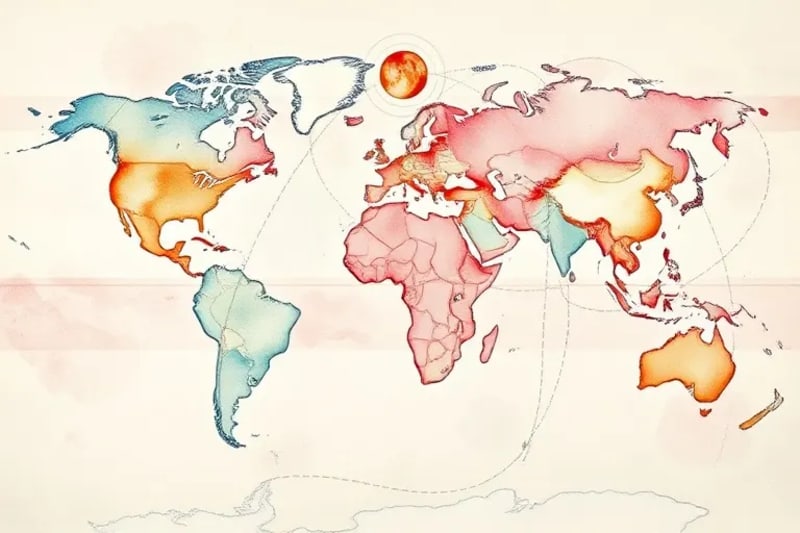
An artistic representation of how planetary alignments are interpreted to influence global socio-economic and political landscapes.
The Uranus-Pluto square or conjunction, which happens much less frequently, is often associated with periods of intense upheaval, revolution, and fundamental restructuring of society. The last major Uranus-Pluto square in the 2010s, for instance, coincided with significant social unrest, technological disruption, and shifts in global power dynamics. Astrologers also examine chart patterns astrology, such as Grand Trines or T-Squares, formed by these planetary alignments, to identify periods of ease or tension on a global scale.
Each planet's ingress into a new zodiac sign also holds significance. When a major planet like Jupiter or Saturn changes signs, it is believed to shift the collective focus and energy. For example, Saturn's transit through a particular sign might highlight themes of responsibility, restriction, or restructuring in areas governed by that sign. These long-term cycles provide a framework for understanding the overarching themes of an era.
Eclipses and Lunations: Catalysts for Change
Eclipses, both solar and lunar, are considered highly potent events in mundane astrology, often signaling periods of accelerated change, crisis, or revelation. A solar eclipse, occurring at a New Moon, is believed to initiate new beginnings, often accompanied by a sudden shift in leadership or national direction. Lunar eclipses, at a Full Moon, tend to bring matters to a head, revealing hidden truths or culminating long-standing issues.
The specific zodiac sign and house where an eclipse falls are crucial for interpretation. For instance, an eclipse in a financial house might indicate significant economic shifts, while one in a house related to foreign affairs could point to international tensions or alliances. The path of an eclipse across the globe is also considered, with areas directly touched by the eclipse path often experiencing more pronounced effects. Further insights can be gained by studying lunar phases astrology, as the New and Full Moon cycles themselves represent periods of energetic ebb and flow.
A futuristic rendering depicting a timeline influenced by celestial events, symbolizing the predictive nature of mundane astrology.
Beyond eclipses, the regular cycle of New Moons and Full Moons also provides a rhythm for mundane events. New Moons are seen as planting seeds for new initiatives, while Full Moons bring illumination and culmination. These monthly cycles offer a more granular view of ongoing trends, complementing the longer-term planetary cycles.
Methodology and Challenges in Mundane Astrology
The methodology of mundane astrology is complex, requiring precise astronomical calculations and a deep understanding of historical contexts. Astrologers analyze mundane charts using various techniques, including transits, progressions, and solar returns for nations or specific events. They also consider different zodiac systems, such as sidereal and tropical astrology, which can lead to varying interpretations of planetary positions.
A significant challenge lies in the interpretation of these celestial influences. Astrology does not claim to predict specific events with absolute certainty, but rather to identify periods of heightened potential for certain types of energies or themes. The manifestation of these energies is influenced by countless human factors, free will, and the unique circumstances of each nation or region. Therefore, mundane predictions are often framed in terms of trends, probabilities, and underlying currents rather than deterministic outcomes.
Another challenge is the accuracy of birth data for nations or significant events. While some countries have clear founding dates, others have more ambiguous origins, making chart rectification a crucial and often difficult task. Despite these complexities, mundane astrology offers a rich framework for understanding the cyclical nature of history and the interconnectedness of cosmic and earthly rhythms.
Scientific vs. Astrological Perspectives
From a scientific standpoint, celestial mechanics accurately describes the physical motions of celestial bodies based on gravitational laws. However, the scientific community generally does not recognize any causal link between these astronomical phenomena and specific earthly events or human behavior beyond gravitational effects (like tides) and solar radiation. The predictive claims of astrology, including mundane astrology, are not supported by empirical scientific evidence.
Astrology, on the other hand, operates within a symbolic and interpretive framework. It posits a correlation, rather than a direct physical causation, between celestial patterns and terrestrial events. This perspective views the cosmos as a meaningful, interconnected system where "as above, so below" is a guiding principle. Mundane astrologers interpret celestial events as symbolic indicators of collective psychological states, societal shifts, and historical turning points, much like a clock indicates time without causing it.
The value of mundane astrology, for its practitioners, lies in its ability to provide a contextual framework for understanding historical cycles and anticipating potential future challenges or opportunities. It encourages a broader perspective on human events, suggesting that they are part of larger cosmic rhythms, even if the exact mechanisms remain outside conventional scientific understanding.
In conclusion, the study of celestial mechanics provides the precise astronomical data that mundane astrologers use to interpret global trends. By examining the long-term cycles of planets, the powerful influence of eclipses, and the subtle shifts of planetary ingresses, mundane astrology attempts to map the collective destiny of humanity. While its methodologies and interpretations differ significantly from scientific approaches, it continues to offer a fascinating and historically rich perspective on the interconnectedness of the cosmos and human affairs.
Related Articles You Might Enjoy:
- Horoscope Birth Chart: Basic Definition & Components
- Chart Patterns Astrology: Grand Trines, T-Squares, Yods Explained
- Lunar Phases Astrology: New Moon, Full Moon Cycles
- Sidereal Tropical Astrology: Zodiac Meanings Explained
- Holographic Universe Manifestation Quantum Reality Principles
- Dragón de Madera: Legado Astrológico, Historia y Cultura China
Source: Hybrid content assisted by AI and human editorial supervision.


Comments
Post a Comment