
Dowsing Earth Energies: Ley Lines & Geomantic Divination
The Earth beneath our feet is often perceived as a solid, inert mass, yet ancient traditions and modern esoteric practices suggest a vibrant, energetic network flowing through its core and surface. Dowsing, ley lines, and geomantic divination are practices that seek to detect, understand, and interact with these subtle earth energies. This exploration delves into the historical context, methodologies, and contemporary relevance of these fascinating approaches to connecting with the planet's hidden currents.
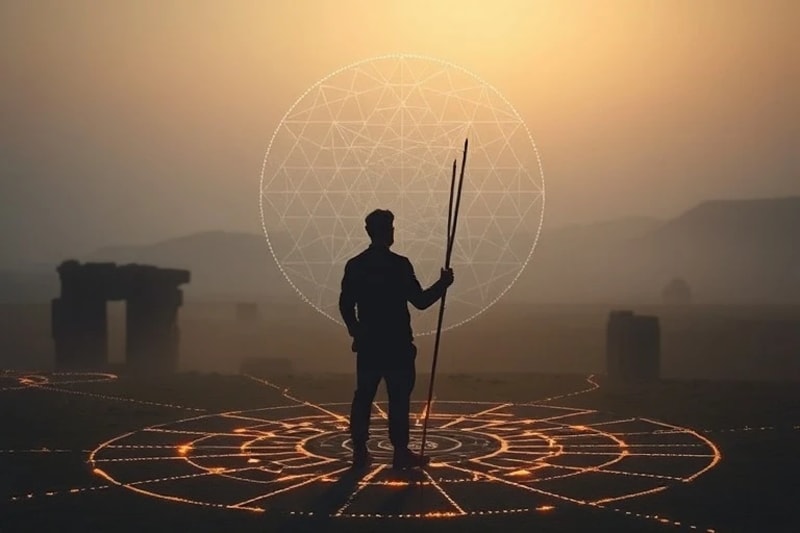
An individual engages in the ancient practice of dowsing, utilizing rods to detect unseen energetic currents within the natural landscape.
From ancient megalithic builders to contemporary wellness practitioners, humanity has long sought to harness or align with specific telluric forces. This article aims to provide an introductory yet comprehensive overview, shedding light on concepts that, while not always recognized by mainstream science, hold profound significance for many who seek a deeper connection with their environment.
Understanding these practices requires an open mind and a willingness to explore perspectives that extend beyond conventional materialistic views. We will examine the tools, techniques, and underlying philosophies that define dowsing, ley lines, and geomantic divination, offering a balanced perspective on their historical origins and modern interpretations.
Table of Contents
- Introduction to Dowsing
- Historical Roots of Earth Energy Practices
- Dowsing: Tools and Techniques
- The Concept of Ley Lines
- Geomantic Divination: Interpreting Earth's Patterns
- Scientific Skepticism and Esoteric Belief
- Practical Applications and Modern Relevance
- Ethical Considerations and Learning Paths
- Conclusion: Reconnecting with Earth's Pulse
Introduction to Dowsing
Dowsing, also known as divining or water witching, is a pseudoscientific practice aimed at finding underground water, minerals, buried metals, or even invisible "earth energies" using a divining rod, dowsing rods, or a pendulum. The practice relies on the dowser's purported ability to perceive subtle energies or vibrations that cause the tools to move involuntarily.
While often associated with finding water, the scope of dowsing has expanded significantly over centuries. Modern dowsers claim to locate everything from lost objects and archaeological sites to geopathic stress zones and beneficial energy points. The core principle remains the same: the dowser acts as a conduit, and the tool amplifies an unconscious physical reaction to the target.
The mechanisms behind dowsing are not understood by conventional science, which often attributes successful dowsing to chance, unconscious observation, or the ideomotor effect. Despite this, dowsing societies and practitioners exist worldwide, attesting to its continued appeal and perceived effectiveness in various applications.
Historical Roots of Earth Energy Practices
The practice of dowsing can be traced back thousands of years, with evidence found in ancient cave paintings in the Tassili n'Ajjer region of Algeria, depicting figures holding forked sticks. Ancient Egyptians, Romans, and Chinese cultures also had methods of divining for water and other resources, often incorporating spiritual or ritualistic elements.
In Europe, dowsing gained prominence in the Middle Ages, particularly in Germany, where it was used to locate metal ores. The term "dowsing" itself is believed to have originated in the 16th century in England. Early dowsers were often employed by miners and farmers, becoming an integral part of resource exploration.
The concept of Tarot Quantum Mechanics Intersecting Divination Reality and their alignment with sacred sites is also deeply rooted in history. Many ancient civilizations, including the builders of Stonehenge, the pyramids of Egypt, and the Mayan temples, are believed to have possessed knowledge of these energetic currents. They often constructed their significant structures on points or lines of perceived telluric power, suggesting an intentional connection to the Earth's subtle grid.
Dowsing: Tools and Techniques
Dowsing primarily involves the use of specific tools that are believed to react to the subtle energies being sought. The most common tools include:
- Y-Rod (Forked Stick): Traditionally made from a branch of a tree (often hazel, willow, or peach), this tool is held with tension, and its tip is expected to dip or rise when the dowser passes over the target.
- L-Rods: These are two L-shaped metal rods, typically copper or brass, held loosely in each hand. They are designed to cross or swing outwards when an energy line or target is encountered.
- Pendulum: A small weight suspended from a string or chain, often used for map dowsing or for more precise yes/no answers. The pendulum's swing patterns (e.g., clockwise, counter-clockwise, linear) are interpreted by the dowser.
The technique involves walking over an area with the chosen tool, maintaining a state of focused intention and receptivity. Dowsers often describe a subtle sensation or "pull" that precedes the movement of their tools. Training and practice are considered crucial for developing sensitivity and accuracy in dowsing.
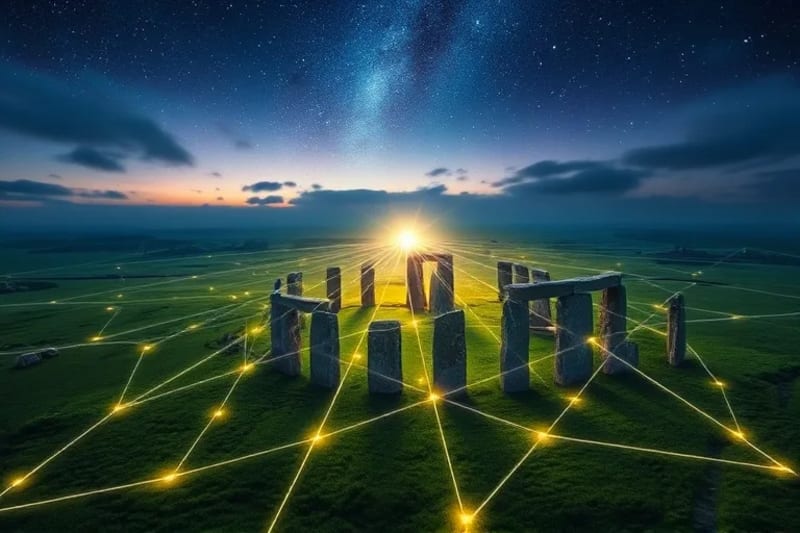
A digital painting illustrating ancient structures linked by luminous ley lines, symbolizing Earth's energetic grid.
The Concept of Ley Lines
The term "ley line" was coined in 1921 by amateur archaeologist Alfred Watkins, who observed that many ancient sites, such as standing stones, burial mounds, and churches, appeared to be aligned in straight lines across the British landscape. He hypothesized that these alignments were ancient trackways or trade routes, marked by prehistoric peoples.
Over time, the concept evolved beyond simple alignments. Modern esoteric interpretations suggest that ley lines are invisible conduits of telluric energy, akin to the Earth's "acupuncture meridians." These lines are believed to carry vital life force, and where they intersect, powerful energy vortexes or nodes are said to exist. Many dowsers claim to be able to detect and trace these ley lines.
Proponents of ley lines often point to the placement of ancient monuments, which frequently align with solstices, equinoxes, and other celestial events, as evidence of a sophisticated understanding of earth and cosmic energies by our ancestors. These alignments are not always perfectly straight, leading to variations in interpretation and debate among researchers.
Geomantic Divination: Interpreting Earth's Patterns
Geomancy, meaning "earth divination," is a method of divination that interprets markings on the ground or patterns formed by tossed handfuls of soil, rocks, or sand. Historically, it was practiced by observing patterns in the earth, much like reading tea leaves or coffee grounds. Over time, it developed into a more structured system involving sixteen figures derived from a series of random marks.
Unlike dowsing, which focuses on detection, geomancy is about interpretation and understanding the symbolic language of the Earth. Each geomantic figure has specific meanings related to astrological influences, elements, and life situations. These figures are then cast into a geomantic chart, which can be read to gain insights into questions about relationships, career, health, and spiritual paths.
Geomancy is not just about predicting the future; it's also about understanding the energetic qualities of a place. Traditional geomancers might assess the flow of Feng Shui Digital Nomads Harmonizing Virtual Well-being or the presence of geopathic stress to advise on optimal building placement or garden design. It bridges the gap between the subtle energies detected by dowsing and a systematic framework for interpretation.
A conceptual 3D render depicting an intricate, glowing geometric pattern symbolizing the interpretive nature of geomantic divination.
Scientific Skepticism and Esoteric Belief
The scientific community largely regards dowsing and ley line theories as pseudoscientific. Numerous controlled studies have been conducted on dowsing, particularly for water detection, and the vast majority have failed to demonstrate any ability beyond chance. Critics attribute apparent successes to statistical probability, confirmation bias, or the ideomotor effect, where unconscious muscle movements influence the dowsing tool.
Regarding ley lines, while the alignment of some ancient sites is undeniable, skeptics argue that with enough points on a map, it is statistically inevitable to find straight lines by chance. They also point out that the definition of a "site" can be broad, allowing for selective inclusion to fit a pattern. The concept of "earth energies" itself lacks empirical evidence and a verifiable physical mechanism.
However, proponents argue that scientific methods are not always equipped to measure subtle energies or phenomena that operate outside the known physical laws. They emphasize the subjective experience of the dowser and the anecdotal evidence of successful applications. For many, these practices are not about scientific proof but about intuition, connection to nature, and an alternative way of perceiving reality.
Practical Applications and Modern Relevance
Despite the scientific debate, dowsing and geomantic principles continue to find application in various fields:
- Well-being and Geopathic Stress: Many dowsers identify "geopathic stress zones" – areas where earth energies are believed to be detrimental to human health. They offer services to detect and neutralize these zones, often by placing specific objects or crystals.
- Site Selection and Design: Architects and landscape designers, particularly in ecological or spiritual contexts, sometimes consult dowsers or geomancers to identify optimal building sites, garden layouts, or the placement of sacred spaces.
- Agriculture: Farmers still occasionally use dowsing to locate optimal spots for wells or to understand soil energy for crop placement.
- Archaeology and Lost Objects: Some dowsers claim success in locating buried artifacts, ancient foundations, or lost items, although this remains highly controversial.
- Spiritual Connection: For many, dowsing and exploring ley lines is a spiritual practice, a way to deepen their connection to the Earth, its history, and its unseen forces. It fosters a sense of wonder and reverence for the natural world.
The modern relevance of these practices lies in their ability to offer alternative perspectives on environmental interaction and personal well-being. They encourage a holistic view, integrating the physical landscape with its energetic and spiritual dimensions.
Ethical Considerations and Learning Paths
As with any practice involving subtle energies or divination, ethical considerations are paramount. Responsible dowsers and geomancers emphasize the importance of clear intention, respect for the land and its inhabitants, and avoiding manipulation or exploitation. They often advise against using these practices for harmful purposes or making definitive claims without proper context.
For those interested in learning, various paths are available. Many dowsing societies offer workshops and training programs, providing hands-on experience with tools and techniques. Books, online courses, and mentorship from experienced practitioners can also be valuable resources. It is often recommended to start with simple exercises, such as dowsing for known water pipes, to build confidence and sensitivity.
Developing a personal connection to nature and cultivating intuition are often cited as foundational elements for effective dowsing and geomancy. Regular practice, self-reflection, and a critical yet open-minded approach are key to navigating these fascinating, ancient arts.
Conclusion: Reconnecting with Earth's Pulse
Dowsing for earth energies, understanding ley lines, and practicing geomantic divination represent a rich tapestry of human endeavor to connect with the unseen forces of our planet. While these practices may challenge conventional scientific paradigms, they offer a compelling framework for perceiving the Earth as a living, energetic entity.
Whether viewed as a form of intuitive skill, a historical curiosity, or a profound spiritual path, the exploration of these subtle energies invites us to reconsider our relationship with the environment. By engaging with these ancient traditions, we may unlock new ways of understanding our surroundings and foster a deeper, more harmonious connection with the Earth's enduring pulse.
Source: Hybrid content assisted by AIs and human editorial supervision.


Comments
Post a Comment