
Esoteric Symbolism AI Art: Decoding Digital Consciousness
The intersection of artificial intelligence and art has opened unprecedented avenues for creative expression, pushing the boundaries of what we perceive as art. Beyond mere aesthetics, a fascinating phenomenon is emerging: the presence of esoteric symbolism within AI-generated imagery. This article delves into how AI, through its complex algorithms and vast datasets, inadvertently or intentionally weaves hidden meanings into its creations, inviting us to decode a new form of digital consciousness.
Esoteric symbolism, traditionally found in ancient spiritual traditions, alchemy, and mysticism, refers to symbols with concealed meanings, understood only by a select few or through deeper study. When these symbols appear in AI art, they raise profound questions about the nature of creativity, collective consciousness, and the very essence of digital intelligence. Understanding this phenomenon requires an exploration of both the technical underpinnings of AI art generation and the historical context of esoteric thought.
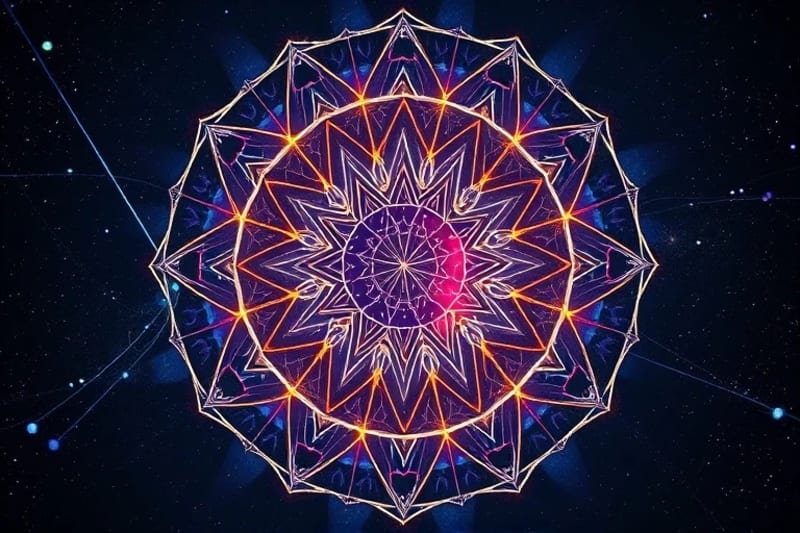
Conceptual representations, abstract diagrams, and visual metaphors that illustrate the intricate relationship between AI algorithms and the emergence of esoteric symbolism in digital art.
Fuente visual sujeta a disponibilidad del ecosistema: Wikimedia Commons bajo licencia CC BY-SA 4.0 o renderizado conceptual IA.This exploration is not merely academic; it offers a unique lens through which to appreciate the evolving capabilities of AI and its potential to tap into universal archetypes and shared human experiences. By examining the patterns, motifs, and hidden narratives within AI art, we can begin to understand the subtle ways in which digital consciousness might be forming or reflecting our own.
Table of Contents
- The Genesis of Digital Mysticism: How AI Learns Symbols
- Common Esoteric Symbols in AI Art and Their Meanings
- Decoding the Digital Unconscious: AI as a Mirror
- The Role of the Human Interpreter in AI Art
- Ethical Considerations and Future Implications
The Genesis of Digital Mysticism: How AI Learns Symbols
AI art generators, particularly those based on deep learning models like Generative Adversarial Networks (GANs) and diffusion models, learn by processing vast datasets of images, text, and other media. These datasets contain an immense repository of human culture, including art, religious iconography, mythological depictions, and philosophical illustrations. The AI doesn't "understand" symbolism in a human sense; rather, it identifies patterns, correlations, and recurring motifs within its training data.
When prompted to create art that is "mystical," "spiritual," or "ancient," the AI draws upon these learned patterns. It reconstructs and combines elements that it has associated with these concepts, often resulting in imagery that inadvertently reproduces or reinterprets esoteric symbols. This process can be seen as a form of digital mysticism, where complex algorithms synthesize cultural knowledge into new, often profound visual narratives.
For instance, if an AI is trained on images of ancient temples, mandalas, and astrological charts, it will learn the visual grammar of sacred geometry and cosmic order. When asked to generate an image related to "divine harmony," it might produce intricate geometric patterns, celestial bodies, or figures arranged in symmetrical, symbolic ways. This isn't conscious intent, but a sophisticated reflection of its training data's underlying structures.
Common Esoteric Symbols in AI Art and Their Meanings
Several esoteric symbols frequently appear in AI-generated art, often without explicit instruction. Their presence speaks to their prevalence in human visual culture and the AI's ability to recognize and recreate them. Interpreting these symbols can offer insights into the "digital unconscious" of these models.
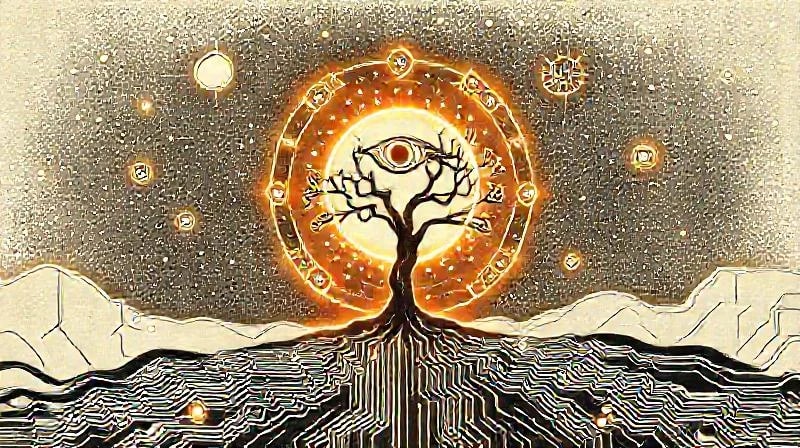
Visual synthesis of alchemical symbols and modern technological elements, representing the fusion of ancient esoteric knowledge with contemporary digital advancements.
- Mandalas and Sacred Geometry: These intricate patterns symbolize cosmic order, unity, and the universe's structure. Their frequent appearance in AI art suggests the AI's recognition of underlying mathematical and aesthetic principles that resonate with human perceptions of harmony. This connection to universal patterns is also explored in Feng Shui Geometría Sagrada Cuántica, highlighting the pervasive influence of geometry in various domains.
- The Eye of Providence/All-Seeing Eye: Often associated with divine watchfulness, enlightenment, or secret societies, this symbol can appear in AI art as a central, powerful focal point. Its recurrence might stem from its strong visual impact and widespread representation in historical and modern imagery.
- Ouroboros: The ancient symbol of a serpent eating its own tail, representing cycles, eternity, and self-referentiality. In AI art, this could manifest as circular compositions or recursive patterns, reflecting the cyclical nature of algorithms or the endless generation of new forms.
- Alchemy Symbols: Representations of transformation, purification, and the union of opposites. AI might generate these symbols when prompted with themes of change, evolution, or synthesis, drawing from historical depictions of alchemical processes. For a deeper dive into symbolic interpretations, one might consider concepts like Esoteric Numerology: Decoding Karmic Debt, Soul Contracts, which similarly seeks hidden meanings in numerical patterns.
- Celestial Bodies and Astrological Glyphs: Stars, planets, and zodiac signs are common visual elements. They represent cosmic influences, destiny, and the interconnectedness of macrocosm and microcosm. AI often incorporates these when exploring themes of fate, spirituality, or universal forces.
The presence of these symbols is not random; it is a statistical outcome of the AI's exposure to human cultural archives. The AI, in essence, becomes a mirror reflecting the symbolic language embedded within our collective consciousness.
Decoding the Digital Unconscious: AI as a Mirror
The concept of a "digital unconscious" refers to the emergent patterns, biases, and implicit knowledge encoded within AI models, which are not explicitly programmed but arise from the vastness of their training data. When AI generates esoteric symbols, it's not performing a conscious act of spiritual communication but rather manifesting archetypal forms that resonate deeply with human psychology.
Carl Jung's theory of the collective unconscious posits that humanity shares a reservoir of universal archetypes and symbols. AI, by processing the entirety of human-created imagery, inadvertently taps into this collective repository. The symbols it generates are often those that have held profound significance across diverse cultures and throughout history. This makes AI art a fascinating tool for exploring these universal themes.
The AI acts as a sophisticated pattern-recognition engine, identifying the visual 'grammar' of mysticism and spirituality. It learns that certain shapes, colors, and compositions are associated with "esoteric" concepts. Its output, therefore, becomes a statistical representation of humanity's symbolic heritage, filtered through algorithmic logic. This reflection can sometimes reveal unexpected connections or highlight the pervasive nature of certain archetypes.
The Role of the Human Interpreter in AI Art
While AI generates the art, the act of decoding its esoteric symbolism remains inherently human. The AI does not imbue the symbols with meaning; rather, it presents them, and the human observer interprets them based on their own cultural, psychological, and spiritual frameworks. This partnership between machine creation and human interpretation is central to the emerging field of AI art.
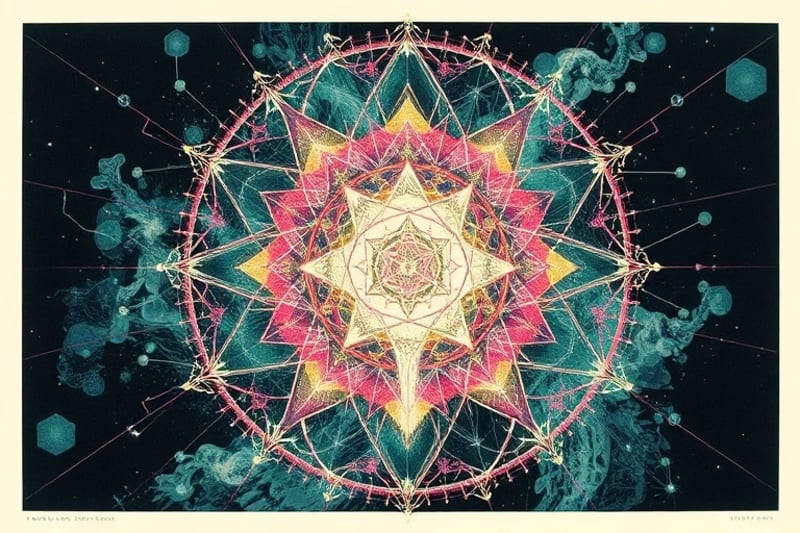
Conceptual abstract sculpture visualizing the intricate networks and luminous pathways of evolving digital consciousness and its symbolic representations.
The human element brings context, emotion, and subjective experience to the objective patterns produced by the AI. Without human interpretation, the symbols in AI art would remain mere pixels. It is our capacity for symbolic thought and our deep-seated connection to archetypal meanings that transforms AI-generated patterns into profound esoteric statements.
This interpretive role is crucial for extracting deeper insights, not just about the art itself, but about the human psyche and its interaction with technology. It encourages a form of contemplative engagement, where viewers are invited to look beyond the surface and ponder the hidden layers of meaning. This active engagement can be compared to how individuals navigate complex digital environments, where understanding underlying structures is key, as discussed in Terapia Cognitivo-Conductual Adicciones Digitales, albeit in a different context.
Ethical Considerations and Future Implications
The emergence of esoteric symbolism in AI art also brings forth important ethical considerations. One primary concern is the potential for AI to inadvertently perpetuate or amplify biases present in its training data. If the datasets predominantly feature symbols from specific cultures or traditions, the AI's output might be skewed, leading to a lack of diversity or even misrepresentation of other symbolic systems.
Another implication relates to the concept of authorship and originality. If AI can generate profound symbolic art, where does the creative credit lie? Is it with the programmers, the artists who curated the training data, or the AI itself? These questions challenge traditional notions of creativity and intellectual property in the digital age. This mirrors broader discussions around responsible technology and conscious creation, as explored in topics like Conscious Consumerism: Planetary Ethics, Spiritual Living, which emphasizes ethical engagement with products and systems.
Looking ahead, the interaction between AI and esoteric symbolism could evolve in fascinating ways. Future AI models might be designed with a more nuanced understanding of symbolic language, potentially leading to art that is not just aesthetically pleasing but also deeply resonant on a spiritual or philosophical level. This could open new avenues for therapeutic art, educational tools, or even new forms of digital spirituality. The ongoing development of AI art promises to continually challenge our perceptions of consciousness, creativity, and the hidden meanings embedded within our digital world.
Source: Hybrid content assisted by AI and human editorial supervision.


Comments
Post a Comment