
Esoteric Symbolism Modern Art Decoding Meanings Visual Media
Modern art, often perceived as a departure from traditional forms, frequently harbors a rich tapestry of esoteric symbolism, inviting viewers to delve beyond the surface and explore deeper, often mystical, meanings. This intricate language, rooted in ancient wisdom traditions, provides a profound subtext that challenges conventional interpretations and enriches the artistic experience. Understanding these hidden meanings allows for a more comprehensive appreciation of the artists' intentions and the universal truths they sought to convey.
The presence of esoteric symbolism in visual media is not merely an aesthetic choice; it represents a deliberate attempt by artists to communicate ideas that transcend the material world. These symbols act as gateways to spiritual, philosophical, and psychological dimensions, often drawing from alchemical processes, Kabbalistic diagrams, Theosophical concepts, and Hermetic principles. By embedding these elements, artists transform their works into vehicles for profound contemplation and self-discovery.
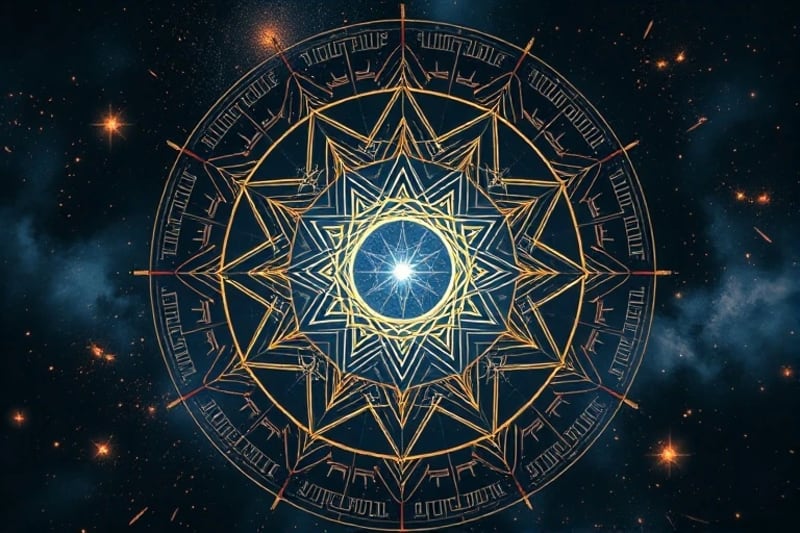
Conceptual rendering of the intricate, hidden layers of meaning embedded within modern artistic expressions, inviting a deeper, mystical interpretation.
Source visual sujeta a disponibilidad del ecosistema: Wikimedia Commons bajo licencia CC BY-SA 4.0 o renderizado conceptual IA.
This article aims to unravel the complexities of esoteric symbolism in modern art, providing an introductory guide for those seeking to understand its origins, manifestations, and enduring impact. We will explore the historical context, key traditions, influential art movements, and common symbols, ultimately empowering the viewer to engage with art on a more profound, interpretive level.
Table of Contents
- Historical Echoes: Esotericism's Enduring Artistic Legacy
- Foundational Streams: Key Esoteric Traditions in Art
- Modern Masters and Mystical Musings: Art Movements and Esotericism
- The Lexicon of the Unseen: Decoding Common Esoteric Symbols
- Pioneering Visions: Artists Who Channeled the Esoteric
- The Viewer as Interpreter: Engaging with Art's Deeper Dimensions
- Beyond the Canvas: Esoteric Symbolism in Contemporary Visual Media
Historical Echoes: Esotericism's Enduring Artistic Legacy
The intertwining of esotericism and art is not a modern phenomenon but a thread woven through the fabric of human history. From ancient Egyptian hieroglyphs to medieval alchemical manuscripts, artists have long employed symbolic language to communicate spiritual truths, cosmic orders, and hidden knowledge. These early expressions laid the groundwork for later artistic explorations, establishing a tradition where art served as a conduit for the sacred and the mysterious.
During the Renaissance, figures like Leonardo da Vinci and Albrecht Dürer integrated Neoplatonic and Hermetic ideas into their works, often subtly, reflecting the intellectual currents of their time. The Enlightenment, with its emphasis on reason, pushed esoteric thought to the fringes, yet it never truly disappeared, finding refuge in secret societies and intellectual circles. By the late 19th and early 20th centuries, a resurgence of interest in spirituality and mysticism provided fertile ground for artists to openly embrace esoteric themes, reacting against the perceived materialism of the industrial age.
Foundational Streams: Key Esoteric Traditions in Art
Several key esoteric traditions have profoundly influenced modern art, each offering a unique symbolic language and philosophical framework. Understanding these traditions is crucial for decoding numbers and desired outcomes within artistic compositions.
- Alchemy: More than just a quest for gold, alchemy was a spiritual discipline focused on transmutation and purification. Its symbols—the Ouroboros, the Philosophical Egg, the coniunctio (sacred marriage)—represent processes of transformation, integration of opposites, and the journey towards spiritual perfection.
- Kabbalah: This Jewish mystical tradition explores the nature of God and the universe through symbolic diagrams like the Tree of Life. Its intricate system of sefirot and paths, often depicted in abstract or geometric forms, signifies divine emanations and the interconnectedness of all existence.
- Theosophy: Founded by Helena Blavatsky, Theosophy synthesized Eastern and Western mystical traditions. It emphasized universal brotherhood, the study of ancient religions, and the development of latent spiritual powers. Theosophical concepts, such as cosmic evolution and the aura, heavily influenced early abstract artists.
- Hermeticism: Derived from the teachings attributed to Hermes Trismegistus, Hermeticism encompasses a wide range of philosophical and magical beliefs. Its core tenets include the principle of "as above, so below," emphasizing the correspondence between the macrocosm and microcosm, a concept frequently explored in symbolic art.
- Rosicrucianism: A mystical fraternity with roots in the early 17th century, Rosicrucianism combined elements of Hermeticism, alchemy, and Christian mysticism. Its symbolism often includes roses, crosses, and other emblems representing spiritual enlightenment and hidden wisdom.
Modern Masters and Mystical Musings: Art Movements and Esotericism
The turn of the 20th century saw a profound shift in artistic expression, with several movements directly or indirectly influenced by esoteric thought. These movements sought to break free from representational art, believing that true reality lay beyond the visible world.
- Symbolism: Emerging in the late 19th century, Symbolism rejected naturalism and realism, favoring evocative imagery, dreams, and mystical themes. Artists like Gustave Moreau and Odilon Redon used mythological and allegorical figures to explore the subconscious and the spiritual.
- Surrealism: Heavily influenced by psychoanalysis and automatic writing, Surrealism aimed to unlock the power of the unconscious mind. While not explicitly esoteric, its exploration of dreams, archetypes, and the irrational often converged with mystical concepts of hidden realities.
- Abstract Art: Perhaps the most direct manifestation of esoteric influence, early abstract artists like Wassily Kandinsky and Piet Mondrian were deeply involved in Theosophy. Kandinsky's theories on color and form were directly linked to spiritual vibrations, believing that art could express inner necessity and cosmic harmony. Mondrian's geometric abstractions sought to reveal universal laws and spiritual order, often paralleling the structural principles found in Vedic Astrology basics.
A conceptual still life symbolizing the meticulous study and illumination required to uncover profound artistic and spiritual truths.
The Lexicon of the Unseen: Decoding Common Esoteric Symbols
Esoteric symbols are not arbitrary; they are imbued with layers of meaning, often derived from cross-cultural mystical traditions. Recognizing these symbols is the first step in understanding the hidden narratives within modern art.
Here are some common symbols and their general esoteric interpretations:
| Symbol | Esoteric Meaning | Artistic Context |
|---|---|---|
| Ouroboros (snake eating its tail) | Eternity, cyclicality, self-sufficiency, renewal, the unity of all things, the infinite cycle of creation and destruction. | Found in works exploring cosmic cycles, transformation, or the interconnectedness of life and death. |
| Eye of Providence (all-seeing eye) | Divine omnipresence, spiritual insight, enlightenment, hidden wisdom, the watchful eye of a higher power. | Often used to suggest spiritual awakening, divine guidance, or the revelation of secret knowledge. |
| Mandalas / Sacred Geometry | Cosmic order, spiritual journey, wholeness, unity, the structure of the universe, meditation, and self-realization. | Prevalent in abstract art, particularly works aiming to represent spiritual harmony or universal patterns. |
| Colors (e.g., gold, purple, blue) | Gold: divine light, purity, spiritual perfection. Purple: royalty, spirituality, mysticism. Blue: truth, wisdom, intuition. | Artists use specific color palettes to evoke spiritual states, symbolic meanings, or energy frequencies. |
| The Tree of Life (Kabbalistic) | The universe's structure, divine emanations, human consciousness, the path to spiritual enlightenment, interconnectedness. | Appears in abstract or symbolic works representing cosmic order, spiritual growth, or the journey of the soul. |
Pioneering Visions: Artists Who Channeled the Esoteric
Numerous artists have consciously integrated esoteric symbolism into their practice, often driven by personal spiritual quests or a desire to express a reality beyond the visible. Their works stand as powerful testaments to the enduring influence of mystical thought.
- Hilma af Klint (1862–1944): A Swedish artist who created abstract paintings years before Kandinsky, af Klint was a profound spiritualist and Theosophist. Her monumental works, often created in series, were guided by spiritual entities and aimed to visualize the unseen dimensions of existence, cosmic laws, and spiritual evolution. Her art was a direct transcription of spiritual messages.
- Wassily Kandinsky (1866–1944): Considered one of the pioneers of abstract art, Kandinsky's theories, articulated in "Concerning the Spiritual in Art," were deeply influenced by Theosophy and an interest in synesthesia. He believed that art should express the "inner necessity" of the artist and that colors and forms possessed spiritual vibrations capable of affecting the soul.
- František Kupka (1871–1957): A Czech pioneer of abstract art, Kupka was also deeply interested in spiritualism, Theosophy, and Eastern philosophies. His early abstract works, such as "The Way of Silence" and "Cosmic Spring," reflect his attempts to visualize cosmic forces, universal harmony, and the hidden structures of reality.
- Jackson Pollock (1912–1956): While less overtly esoteric, Pollock's abstract expressionism has been interpreted through a lens of Jungian archetypes and shamanic ritual. His drip paintings, created through an almost trance-like process, can be seen as attempts to access the collective unconscious and express primal energies, akin to practices like Akashic dreamwork for past life insights.
A conceptual visualization of interconnected ideas and hidden structures, representing the complex, underlying frameworks of esoteric thought in art.
The Viewer as Interpreter: Engaging with Art's Deeper Dimensions
Engaging with esoteric art requires more than a casual glance; it demands an active, interpretive approach. The viewer becomes a participant in a dialogue with the artwork, seeking to uncover the layers of meaning embedded within its forms, colors, and symbols. This process often involves a degree of research into the artist's background, spiritual beliefs, and the esoteric traditions they drew upon.
Approaching such art with an open mind and a willingness to explore non-rational interpretations is key. It's about feeling the work, allowing its symbols to resonate, and recognizing that the meaning may not be immediately apparent but unfolds through contemplation. This engagement can lead to profound personal insights, as the viewer connects with universal archetypes and spiritual concepts that transcend individual experience.
Beyond the Canvas: Esoteric Symbolism in Contemporary Visual Media
The influence of esoteric symbolism extends far beyond traditional painting and sculpture, permeating contemporary visual media such as film, digital art, and performance. Modern artists continue to draw upon these ancient wellsprings of wisdom to create works that challenge perception, evoke spiritual experiences, and comment on the hidden forces at play in society.
From subtle allusions in cinematic narratives to explicit visual motifs in digital installations, esoteric symbols continue to serve as a powerful tool for artists seeking to communicate complex ideas about consciousness, reality, and the human condition. This ongoing engagement ensures that the hidden language of art remains vibrant and relevant, continually inviting new generations to explore its profound depths.
In conclusion, esoteric symbolism in modern art offers a compelling invitation to look deeper, think critically, and feel intuitively. It transforms art from a mere visual spectacle into a profound journey of discovery, revealing the enduring human quest for meaning, spiritual understanding, and connection to the unseen realms of existence. By learning to decode these hidden meanings, we not only enrich our appreciation of art but also gain new perspectives on the intricate tapestry of human thought and spirituality.
Explore Further: Related Insights
- Horse Goat Monkey Compatibility: Chinese Zodiac Triads - Discover how different elements intertwine, much like symbols in art.
- IoT Hogar: Seguridad, Privacidad, Confort Futuro - Explore how complex systems integrate, mirroring the layered meanings in esoteric art.
- Predicciones Anuales Retorno Saturno Lecciones Kármicas - Delve into karmic lessons and cyclical patterns, reflecting themes of transformation.
- Reliquias Pasión: Camino Místico Contemplación Sacrificio Redentor - Uncover mystical paths and contemplative journeys, akin to interpreting symbolic art.
Source: Hybrid content assisted by AI and human editorial supervision.


Comments
Post a Comment