
Tarot Esoteric Symbolism: Unveiling Hidden Meanings
Tarot cards are often seen as mere tools for divination, offering glimpses into future possibilities or insights into current situations. However, to truly grasp the depth of Tarot, one must look beyond its surface-level interpretations and delve into the rich tapestry of esoteric symbolism woven into each card. This article explores the hidden meanings, ancient traditions, and philosophical underpinnings that transform a deck of 78 cards into a profound system of self-discovery and spiritual wisdom.
The intricate imagery of an ancient Tarot deck, illuminated by mystical light, hints at the profound esoteric symbolism contained within each card.
Understanding Tarot's esoteric symbolism is not merely about memorizing card meanings; it is about connecting with universal archetypes and ancient wisdom traditions. This deeper engagement allows practitioners to utilize Tarot as a powerful tool for introspection, spiritual growth, and navigating life's complexities with greater clarity. By uncovering these hidden layers, the Tarot reveals itself as a profound guide to the human psyche and the cosmic order.
Table of Contents
- Historical Roots of Tarot Symbolism
- The Major Arcana: Archetypes of the Soul's Journey
- The Minor Arcana: Daily Life and Elemental Forces
- Numerological Significance in Tarot
- Astrological and Kabbalistic Correspondences
- The Power of Archetypes and Collective Unconscious
- Practical Application: Beyond Divination
- Conclusion
Historical Roots of Tarot Symbolism
The origins of Tarot are shrouded in mystery, with various theories tracing its lineage from ancient Egypt, Kabbalistic traditions, or medieval Europe. While its exact genesis remains debated, historical evidence suggests that by the 15th century, Tarot decks were being utilized in Italy. These early decks were not exclusively for games but also served allegorical and philosophical purposes, reflecting a deeper cultural engagement with symbolic systems.
Early decks, such as the renowned Visconti-Sforza, already featured intricate imagery that hinted at profound meanings. These designs drew heavily from classical mythology, Christian allegory, and the prevailing medieval social structures of the time. This rich blend of cultural and spiritual influences laid the groundwork for the complex esoteric system that Tarot would evolve into over centuries.
The Major Arcana: Archetypes of the Soul's Journey
The 22 cards of the Major Arcana, often referred to as "Trumps," represent significant life lessons, spiritual archetypes, and the overarching journey of the soul. Each card serves as a symbolic repository of universal human experiences, guiding the individual from the innocence of The Fool to the ultimate enlightenment of The World. Understanding their esoteric symbolism requires an appreciation for their deep connections to various mystical systems.
- The Fool (0): Represents new beginnings, innocence, spontaneity, and the leap of faith. Esoterically, it embodies unmanifested potential, the spirit embarking on its earthly journey. Its connection to the Hebrew letter Aleph signifies origin and unity.
- The Magician (I): Symbolizes willpower, manifestation, skill, and conscious creation. He stands at a table with the four elemental tools, representing mastery over the physical world. Linked to the planet Mercury and the Hebrew letter Beth, it signifies duality and the beginning of creation.
- The High Priestess (II): Embodies intuition, mystery, subconscious knowledge, and hidden wisdom. She sits between two pillars, representing duality, with a veil guarding secrets behind her. Associated with the Moon and the Hebrew letter Gimel, she represents the bridge between conscious and unconscious.
- The Empress (III): Represents fertility, abundance, creativity, nature, and nurturing. She is the archetype of the Divine Feminine, symbolizing growth and material comfort. Connected to Venus and the Hebrew letter Daleth, she signifies the door to material creation.
- The Emperor (IV): Symbolizes authority, structure, control, order, and paternal influence. He is the archetype of the Divine Masculine, representing worldly power and stability. Linked to Aries and the Hebrew letter Heh, he signifies breath and life force.
- The Hierophant (V): Represents tradition, spiritual guidance, conformity, and established beliefs. He serves as the bridge between the divine and the human, imparting sacred knowledge. Associated with Taurus and the Hebrew letter Vau, he signifies connection and binding.
- The Lovers (VI): Symbolizes choice, union, harmony, relationships, and values. It represents the decision between paths and the integration of opposites. Connected to Gemini and the Hebrew letter Zain, it signifies a weapon or choice.
- The Chariot (VII): Represents victory, control, determination, and self-mastery. The charioteer, though seemingly in control, is guided by opposing forces, symbolizing the balance of will and emotion. Linked to Cancer and the Hebrew letter Cheth, it signifies a fence or enclosure, representing protection and boundaries.
- Strength (VIII): Symbolizes courage, inner fortitude, compassion, and gentle power. A woman gently tames a lion, representing the mastery of primal instincts through love, not force. Associated with Leo and the Hebrew letter Teth, it signifies a serpent, representing wisdom and transformation.
- The Hermit (IX): Represents introspection, solitude, wisdom, guidance, and inner search. He carries a lantern, symbolizing the light of inner truth, and a staff, representing a solitary journey. Connected to Virgo and the Hebrew letter Yod, it signifies a hand, representing divine action.
- Wheel of Fortune (X): Symbolizes cycles, destiny, turning points, and inevitable change. The figures on the wheel represent the constant flux of life's fortunes. Linked to Jupiter and the Hebrew letter Kaph, it signifies the palm of the hand, representing fate and opportunity.
- Justice (XI): Represents fairness, truth, law, cause and effect, and balance. She holds scales and a sword, symbolizing objective judgment and decisive action. Associated with Libra and the Hebrew letter Lamed, it signifies an ox goad, representing learning and direction.
- The Hanged Man (XII): Symbolizes sacrifice, new perspectives, surrender, and suspension. He hangs upside down, willingly, representing a shift in viewpoint for spiritual insight. Connected to Neptune (or Water) and the Hebrew letter Mem, it signifies water, representing emotion and the unconscious.
- Death (XIII): Represents transformation, endings, beginnings, release, and profound change. It is not literal death but the death of old patterns to make way for new growth. Associated with Scorpio and the Hebrew letter Nun, it signifies a fish, representing fertility and transformation.
- Temperance (XIV): Symbolizes balance, moderation, harmony, patience, and integration. An angel pours liquid between two cups, blending opposites. Linked to Sagittarius and the Hebrew letter Samekh, it signifies a prop or support, representing balance and foundation.
- The Devil (XV): Represents bondage, addiction, materialism, the shadow self, and illusion. It highlights the chains we willingly place upon ourselves. Associated with Capricorn and the Hebrew letter Ayin, it signifies an eye, representing perception and illusion.
- The Tower (XVI): Symbolizes sudden change, upheaval, revelation, destruction of false structures, and liberation. Lightning strikes a tower, forcing a breakdown for a breakthrough. Connected to Mars and the Hebrew letter Peh, it signifies a mouth, representing speech and destruction.
- The Star (XVII): Represents hope, inspiration, healing, renewal, and serenity. A naked woman pours water, symbolizing spiritual cleansing and connection to the divine. Linked to Aquarius and the Hebrew letter Tzaddi, it signifies a fishhook, representing meditation and connection.
- The Moon (XVIII): Symbolizes intuition, dreams, illusion, subconscious fears, and hidden depths. It depicts a path between two towers, guarded by a dog and a wolf, representing the journey through the unconscious. Associated with Pisces and the Hebrew letter Qoph, it signifies the back of the head, representing the subconscious.
- The Sun (XIX): Represents joy, success, vitality, enlightenment, and optimism. A child rides a white horse under a radiant sun, symbolizing pure happiness and clarity. Linked to the Sun and the Hebrew letter Resh, it signifies a head, representing consciousness and renewal.
- Judgment (XX): Represents awakening, absolution, rebirth, inner calling, and reckoning. Figures rise from graves, responding to an angel's call, symbolizing spiritual awakening. Associated with Pluto (or Fire) and the Hebrew letter Shin, it signifies a tooth, representing judgment and transformation.
- The World (XXI): Represents completion, accomplishment, integration, wholeness, and fulfillment. A dancing figure is surrounded by a wreath, symbolizing the successful culmination of the soul's journey. Linked to Saturn and the Hebrew letter Tau, it signifies a cross, representing completion and truth.
A conceptual still life featuring a crystal ball, sage, and a symbolic tarot card, representing the tools used in esoteric practice.
The Minor Arcana: Daily Life and Elemental Forces
The 56 cards of the Minor Arcana delve into the more mundane aspects of life, representing challenges, opportunities, and experiences in specific areas. They are divided into four suits, each corresponding to an element and a distinct facet of human experience. These cards offer nuanced insights into everyday situations, providing guidance on practical matters and interpersonal dynamics.
- Wands (Fire): Represent inspiration, creativity, passion, willpower, and action. They relate to ambition, enterprise, and spiritual energy, driving forward new projects and ideas.
- Cups (Water): Represent emotions, intuition, relationships, love, and spirituality. They deal with feelings, connections, and the subconscious realm of inner experience.
- Swords (Air): Represent intellect, logic, truth, conflict, and challenges. They pertain to thoughts, communication, decisions, and mental struggles, often highlighting areas needing clarity.
- Pentacles (Earth): Represent the material world, finances, security, work, and physical well-being. They relate to resources, stability, and practical matters, grounding us in reality.
Each suit, from Ace to Ten, and the four Court Cards (Page, Knight, Queen, King), elaborates on these elemental themes. They offer a detailed narrative of how these energies play out in various stages and roles within our daily lives, providing a rich tapestry of human experience.
Numerological Significance in Tarot
Numerology plays a crucial role in Tarot symbolism, adding another layer of esoteric depth to each card's interpretation. Every number carries an inherent energetic vibration that significantly deepens the card's meaning, linking it to universal patterns and developmental stages. This numerical framework provides a systematic way to understand the progression and cycles represented by the cards.
- Aces: Symbolize new beginnings, pure potential, and the essence of the suit's elemental energy.
- Twos: Represent duality, balance, choice, and partnership, often indicating a decision point.
- Threes: Signify growth, creativity, synthesis, and expression, marking a stage of development.
- Fours: Denote stability, structure, foundation, and order, establishing a secure base.
- Fives: Indicate conflict, change, instability, and challenge, often prompting adaptation.
- Sixes: Represent harmony, balance restored, communication, and compassion, bringing resolution.
- Sevens: Point to introspection, spirituality, wisdom, and hidden motives, encouraging deeper thought.
- Eights: Symbolize movement, progress, action, and mastery, suggesting active engagement.
- Nines: Signify completion, fulfillment, culmination, and wisdom, nearing the end of a cycle.
- Tens: Represent endings, new beginnings, culmination, and finality, concluding a phase.
The Court Cards also carry numerical associations (Page=11, Knight=12, Queen=13, King=14), further integrating numerological principles into their archetypal roles. These numerical values provide additional context to their personalities and actions within a reading.
Astrological and Kabbalistic Correspondences
Beyond the immediate imagery, Tarot cards are deeply interconnected with other profound esoteric systems, most notably astrology and Kabbalah. These correspondences enrich the symbolic language of Tarot, providing a multi-dimensional framework for interpretation and understanding. By linking Tarot to these ancient traditions, its meanings become more universal and deeply resonant.
- Astrology: Each Major Arcana card is often associated with a specific planet, zodiac sign, or astrological house, which significantly enriches its meaning. For instance, The Emperor is linked to Aries, symbolizing leadership and initiative, while The High Priestess corresponds to the Moon, representing intuition and the subconscious. These connections provide a cosmic framework, allowing for a broader understanding of the archetypal energies at play within each card.
- Kabbalah: The 22 Major Arcana cards correspond directly to the 22 paths on the Tree of Life, a central diagram in Kabbalistic mysticism. Each path connects two sephiroth (emanations of God), representing a stage of spiritual evolution and the flow of divine energy. This correspondence adds a profound layer of spiritual and philosophical depth, linking Tarot to the journey of divine manifestation and human consciousness. The Hebrew letters associated with each Major Arcana card are also integral to this Kabbalistic understanding, further cementing the intricate relationship between these systems.
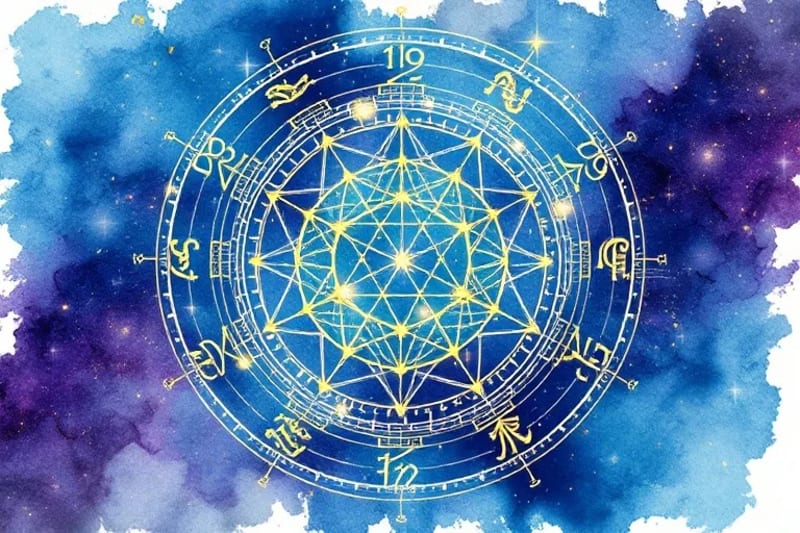
An abstract rendering of interconnected cosmic symbols and geometric patterns, illustrating the universal and hidden order within Tarot's esoteric meanings.
The Power of Archetypes and Collective Unconscious
Carl Jung, the renowned Swiss psychiatrist, extensively explored the concept of archetypes and the collective unconscious. He viewed Tarot as a symbolic representation of these universal patterns and energies that reside deep within the human psyche. These archetypes are innate, universal prototypes for ideas and may be used to interpret observations.
When we interact with Tarot, we are essentially tapping into this collective reservoir of wisdom, allowing the archetypes to speak directly to our personal experiences and guide our self-reflection. The cards act as powerful mirrors, reflecting our inner landscape and revealing unconscious motivations and patterns. This connection to the collective unconscious makes Tarot a deeply personal yet universally resonant tool for psychological insight.
Practical Application: Beyond Divination
While Tarot is widely recognized and utilized for divination, its profound esoteric symbolism offers much more than just predictions about future events. It serves as a powerful and versatile tool for personal growth and understanding, extending its utility into various aspects of self-development. By engaging with the cards on a deeper level, individuals can unlock significant insights and foster personal evolution.
- Self-Reflection: The cards provide a structured framework for examining personal challenges, identifying inherent strengths, and uncovering hidden potentials. They encourage introspection and honest self-assessment.
- Meditation: Meditating on a specific card can unlock deeper insights and connect one to its powerful archetypal energy. This practice can lead to profound moments of clarity and spiritual connection.
- Spiritual Growth: Understanding the journey depicted by the Major Arcana can illuminate one's own spiritual path and evolutionary process. It offers a roadmap for personal transformation and enlightenment.
- Problem Solving: By presenting situations from a symbolic and archetypal perspective, Tarot can help individuals reframe problems and discover innovative, often unexpected, solutions. It encourages a shift in perspective.
- Creative Inspiration: The rich imagery, narratives, and symbolic depth of the cards can spark immense creativity in various forms, including writing, art, and other expressive endeavors. They serve as a wellspring of ideas.
Conclusion
The esoteric symbolism embedded within the Tarot deck transforms it from a simple set of cards into a profound spiritual tool. By exploring its intricate connections to numerology, astrology, Kabbalah, and Jungian archetypes, we unlock layers of meaning that extend far beyond conventional interpretations. This deeper understanding not only enriches our readings but also provides a potent pathway for self-discovery, spiritual growth, and a more profound connection to the universal wisdom that underpins existence.
The Tarot, in its full esoteric glory, invites us to unveil the hidden truths within ourselves and the cosmos. It stands as a testament to humanity's enduring quest for meaning, offering a timeless language through which the mysteries of life can be explored and understood. Embracing its symbolic depth allows for a richer, more transformative engagement with this ancient and powerful system.
Fuente: Contenido híbrido asistido por IAs y supervisión editorial humana.


Comments
Post a Comment