
Astro-Quantum Physics Entanglement Synchronicity Consciousness Exploration
In the vast tapestry of existence, where the microscopic dance of particles meets the grand cosmic ballet of galaxies, a new frontier of understanding is emerging: Astro-Quantum Physics. This interdisciplinary field seeks to bridge the seemingly disparate realms of quantum mechanics, astrophysics, and consciousness studies, proposing a universe far more interconnected and intelligent than traditional science often suggests. It delves into profound concepts like quantum entanglement and synchronicity, exploring how these phenomena might be fundamental expressions of a pervasive cosmic consciousness.
Our journey into Astro-Quantum Physics invites us to reconsider the nature of reality itself. We will explore how the universe might not be a collection of isolated objects but rather a dynamic, unified field where everything is subtly or overtly linked. This perspective opens doors to understanding spiritual experiences, intuitive insights, and the profound sense of belonging many feel when contemplating the cosmos. Prepare to expand your perception of the universe and your place within it.
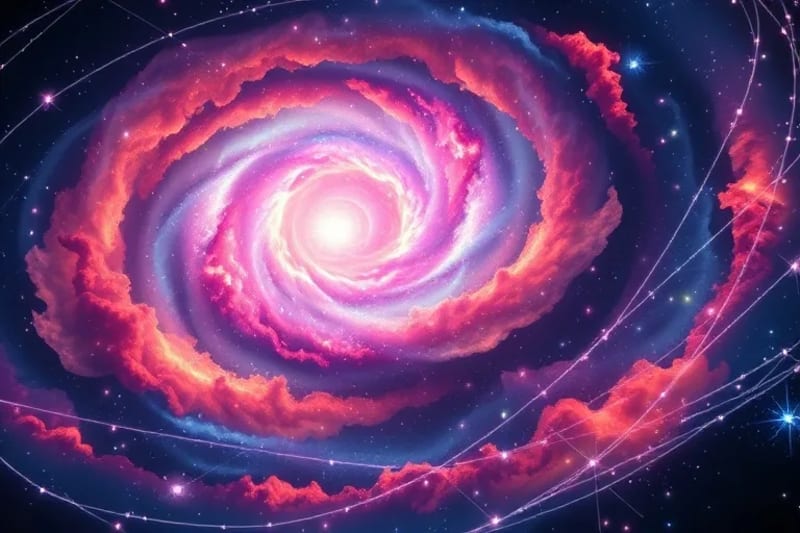
A breathtaking view of a cosmic nebula, where threads of light illustrate the profound concept of quantum entanglement, hinting at an underlying cosmic consciousness.
Table of Contents
- The Quantum Realm: A Brief Overview
- Quantum Entanglement: Spooky Action at a Distance
- Synchronicity: Meaningful Coincidences in the Universe
- Cosmic Consciousness: The Universal Mind
- Bridging the Gap: Astro-Quantum Physics Theories
- Implications for Human Understanding and Spirituality
- Challenges and Future Directions
The Quantum Realm: A Brief Overview
At the heart of Astro-Quantum Physics lies the quantum realm, a subatomic world where the rules of classical physics break down. Here, particles can exist in multiple states simultaneously (superposition), and their properties are not fixed until observed. This realm challenges our everyday intuition, suggesting that reality is far more fluid and observer-dependent than we typically perceive. Understanding these fundamental principles is crucial for grasping how the universe might operate on a deeper, interconnected level.
Key quantum phenomena include wave-particle duality, where particles exhibit characteristics of both waves and particles, and the uncertainty principle, which states that certain pairs of physical properties, like position and momentum, cannot both be known precisely at the same time. These concepts paint a picture of a universe that is inherently probabilistic and fundamentally interconnected at its most basic level. The implications of such a reality extend far beyond the laboratory, touching upon cosmology and even consciousness itself.
Quantum Entanglement: Spooky Action at a Distance
Perhaps the most mind-bending aspect of quantum mechanics is entanglement. This phenomenon occurs when two or more particles become linked in such a way that they share the same quantum state, regardless of the distance separating them. Measuring the property of one entangled particle instantaneously influences the property of the other, even if they are light-years apart. Albert Einstein famously dubbed this "spooky action at a distance," as it appears to violate the cosmic speed limit of light.
In Astro-Quantum Physics, entanglement is not just a laboratory curiosity; it's seen as a potential mechanism for cosmic communication and interconnectedness. If particles across the universe are entangled, it suggests a fundamental, non-local connection that transcends space and time. This could imply that the entire cosmos is intricately woven together through an invisible web of quantum relationships, influencing everything from the formation of stars to the subtle patterns observed in astrological eclipses and their impact on collective consciousness.
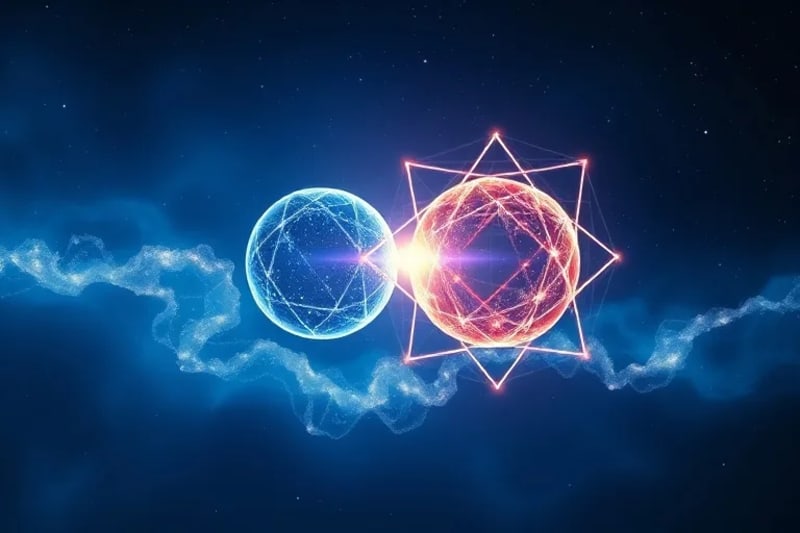
Abstract energy spheres illustrate the concept of quantum synchronicity, representing distant yet connected elements within the cosmic fabric.
Synchronicity: Meaningful Coincidences in the Universe
Beyond the quantum realm, the concept of synchronicity offers another lens through which to view cosmic interconnectedness. Coined by psychologist Carl Jung, synchronicity refers to meaningful coincidences that cannot be explained by conventional cause-and-effect. These are events that are acausal but meaningfully related, often appearing to guide or confirm a personal journey or insight. For example, thinking of an old friend just before they call, or finding a specific book with the exact answer to a question you were pondering.
From an Astro-Quantum perspective, synchronicity might be more than mere chance. It could be an observable manifestation of the underlying quantum entanglement or a reflection of a deeper, intelligent order within the universe. These "meaningful coincidences" could be signals from the cosmic consciousness, guiding individuals or revealing patterns that are otherwise hidden. They serve as reminders that our inner world and the outer world are not separate but are deeply intertwined, reflecting a unified reality. This perspective encourages a more mindful approach to life, recognizing the subtle cues the universe provides.
Cosmic Consciousness: The Universal Mind
The concept of cosmic consciousness posits that consciousness is not merely an emergent property of complex brains but a fundamental aspect of the universe itself. It suggests a universal awareness, an omnipresent intelligence that permeates all existence, from the smallest subatomic particle to the largest galaxy. This "universal mind" is seen as the source from which all individual consciousness arises and to which it ultimately returns. Various spiritual traditions and philosophical schools have long alluded to such a concept, often referring to it as the Divine Mind, Brahman, or the Akasha.
In Astro-Quantum Physics, cosmic consciousness provides a framework for understanding how entanglement and synchronicity operate. If consciousness is fundamental, then the universe itself could be a conscious entity, orchestrating the intricate dance of matter and energy. Our individual consciousness would then be like a wave in a vast cosmic ocean, connected to every other wave and to the ocean itself. This view challenges the materialist paradigm, suggesting that reality is fundamentally mental or experiential, rather than purely physical. The intricate processes of neuroeducation and how the brain learns and optimizes processes might then be seen as a localized expression of this universal learning and awareness.
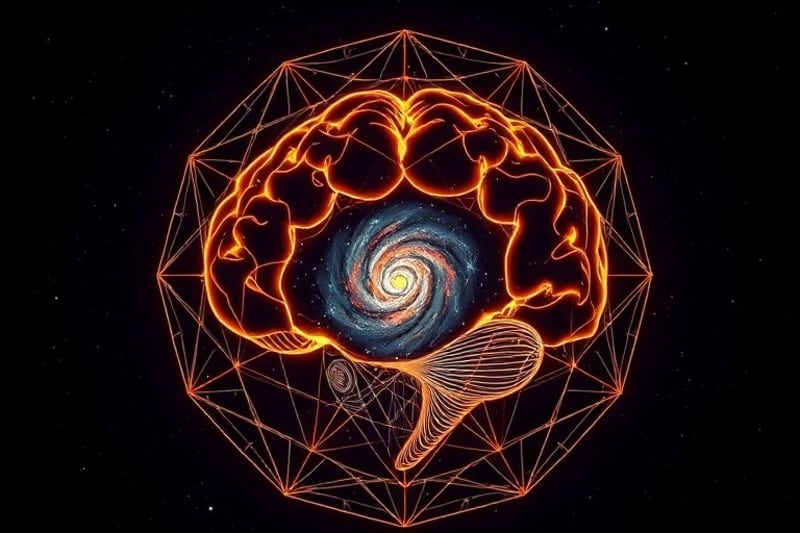
A conceptual render of a human brain merging with a galaxy, illustrating the profound connection between individual consciousness and the universal mind.
Bridging the Gap: Astro-Quantum Physics Theories
Several theoretical frameworks attempt to integrate these concepts. One prominent idea is that the universe operates as a giant quantum computer, with information being the fundamental building block of reality. In this model, entanglement facilitates the rapid processing and transfer of information across vast cosmic distances. Another theory suggests that consciousness itself collapses quantum wave functions, meaning that observation plays a crucial role in shaping reality at every level, from subatomic particles to cosmic structures.
The holographic universe theory proposes that our perceived three-dimensional reality is merely a projection from a two-dimensional information surface, much like a hologram. This could explain non-locality and the deep interconnectedness observed in quantum phenomena. Furthermore, the exploration of sacred geometry and Platonic solids often points to underlying universal patterns and structures that might be the blueprint for cosmic consciousness, bridging the gap between the physical and the metaphysical.
These theories, while still largely speculative and debated within mainstream science, offer compelling narratives that align with ancient wisdom traditions and modern mystical experiences. They push the boundaries of what is considered possible, inviting a more holistic and integrated understanding of the cosmos. The ongoing research in quantum gravity and unified field theories also seeks to find a single framework that can describe all fundamental forces and particles, potentially revealing the underlying unity of existence.
Implications for Human Understanding and Spirituality
The implications of Astro-Quantum Physics are profound, extending beyond scientific curiosity into the realms of philosophy, spirituality, and personal well-being. If we are truly part of a cosmic consciousness, it suggests that our individual lives hold immense significance within the grand scheme of the universe. It fosters a sense of unity, purpose, and interconnectedness with all life, encouraging empathy and compassion.
This perspective can also offer new ways to approach personal growth and healing. Understanding that our thoughts and intentions might subtly influence our reality, or that synchronicities are guiding us, empowers individuals to live more consciously. Practices like meditation, mindfulness, and shadow work for integrating darker aspects can become tools for aligning with this cosmic consciousness, fostering inner harmony and a deeper connection to the universal flow. It suggests that personal transformation is not just an individual journey but a contribution to the evolution of cosmic awareness.
Moreover, Astro-Quantum Physics provides a scientific language for phenomena often relegated to the mystical. It offers a framework where intuition, psychic experiences, and spiritual insights can be seen not as supernatural anomalies but as natural expressions of a deeply interconnected reality. This bridge between science and spirituality can lead to a more integrated worldview, where the pursuit of knowledge and the search for meaning converge.
Challenges and Future Directions
Despite its compelling nature, Astro-Quantum Physics faces significant challenges. Many of its propositions are highly theoretical and lack direct empirical evidence that satisfies the rigorous standards of conventional science. The difficulty in directly observing and measuring consciousness, especially at a cosmic scale, remains a major hurdle. Critics often point to the risk of pseudoscience and the misapplication of quantum concepts to phenomena they do not directly explain.
However, the field continues to evolve. Advances in quantum computing, neuroscience, and cosmology are providing new tools and insights that may one day offer testable hypotheses. Future research directions include exploring quantum effects in biological systems, investigating the role of information in the universe, and developing new mathematical models that can unify consciousness with physical laws. The interdisciplinary nature of Astro-Quantum Physics requires collaboration between physicists, biologists, philosophers, and spiritual scholars to forge a comprehensive understanding.
The journey into Astro-Quantum Physics is one of exploration and open-mindedness. It invites us to question our assumptions about reality and to embrace a more expansive view of the universe and our place within it. While definitive answers may still be distant, the questions themselves are profoundly transformative, pushing the boundaries of human knowledge and spiritual understanding.
Source: Hybrid content assisted by AI and human editorial supervision.


Comments
Post a Comment