
Celestial Mechanics: Sacred Geometry Life Synchronization
Applied Celestial Mechanics, often perceived as a branch of astrophysics, extends far beyond the mere calculation of orbital trajectories. When interwoven with the profound principles of Sacred Geometry, it offers a sophisticated framework for understanding and actively synchronizing human life with the intricate, rhythmic pulsations of the cosmos. This interdisciplinary approach bridges the gap between empirical science and ancient wisdom, revealing how the universe's inherent order can be harnessed for personal and collective well-being.
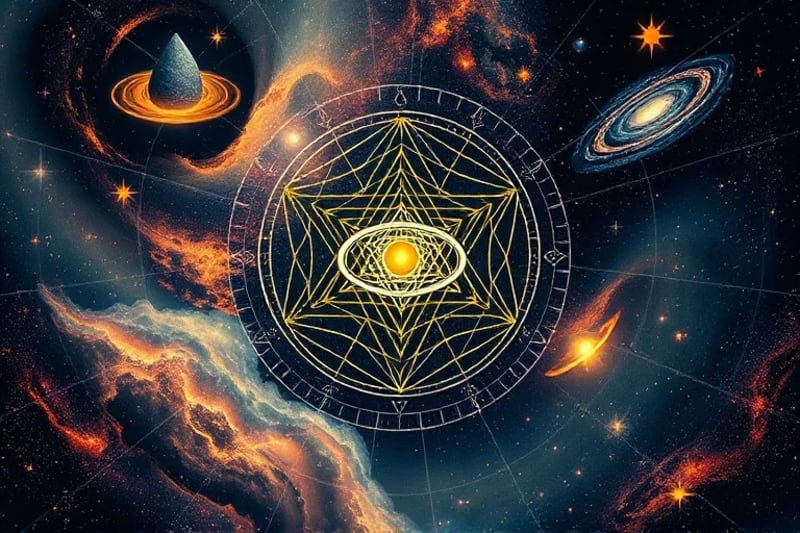 The universe's inherent order, revealed through the interplay of celestial mechanics and sacred geometry, offers a profound understanding of cosmic rhythms.
This exploration delves into the technical underpinnings of how celestial bodies move and interact, not just as physical entities, but as carriers of energetic and geometric information. By recognizing the universal patterns that govern everything from planetary orbits to the growth of a sunflower, we unlock methods to align our personal timelines, decisions, and energetic states with the grander cosmic clockwork, fostering a life of greater harmony, purpose, and flow.
Table of Contents
- Foundations of Celestial Mechanics
- Sacred Geometry: The Cosmic Blueprint
- Historical Perspectives: Ancient Wisdom and Celestial Alignment
- Synchronizing Life with Cosmic Rhythms
- Practical Applications in Modern Life
- Mathematical Elegance: Kepler, Newton, and Beyond
- Integrating Quantum and Chaos Theory
- Conclusion: Harmony in Cosmic Flow
- FAQ: Celestial Mechanics and Sacred Geometry
Foundations of Celestial Mechanics
Celestial mechanics is the scientific discipline concerned with the motion of celestial objects. It applies the principles of physics, particularly Newton's law of universal gravitation, to explain and predict the orbits of planets, moons, asteroids, comets, and artificial satellites. The core objective is to model the gravitational interactions within a system of bodies, typically focusing on two-body or restricted three-body problems for analytical solutions, and N-body simulations for more complex scenarios.
Key concepts include orbital elements (semi-major axis, eccentricity, inclination, longitude of the ascending node, argument of periapsis, and true anomaly), which precisely define an object's path in space. Perturbations, caused by the gravitational influence of other bodies, introduce complexities that lead to long-term orbital evolution, precession, and resonance phenomena. These subtle shifts are crucial for understanding the dynamic nature of our solar system and beyond.
Beyond mere prediction, celestial mechanics reveals the underlying order and predictability of cosmic cycles. The precise timing of solstices, equinoxes, eclipses, and planetary conjunctions are direct manifestations of these mechanical principles. These cycles have profound implications for life on Earth, influencing climate, biological rhythms, and even cultural practices across millennia.
Sacred Geometry: The Cosmic Blueprint
Sacred Geometry is the study of universal patterns found in nature and used in the design of sacred spaces and art. It posits that certain geometric shapes and proportions are fundamental to the creation and structure of the universe, embodying divine order and harmony. These patterns are not arbitrary; they are the visual language of creation, reflecting the mathematical precision inherent in all existence.
Fundamental elements of Sacred Geometry include:
- The Golden Ratio (Phi, φ ≈ 1.618): Found in spiral galaxies, the arrangement of leaves on a stem (phyllotaxis), the proportions of the human body, and the growth patterns of shells. It represents a harmonious expansion and balance.
- Fibonacci Sequence (0, 1, 1, 2, 3, 5, 8, 13...): Each number is the sum of the two preceding ones. This sequence generates the Golden Ratio when consecutive numbers are divided, and it appears ubiquitously in natural growth patterns.
- Platonic Solids: The five regular convex polyhedra (tetrahedron, cube, octahedron, dodecahedron, icosahedron) are associated with the classical elements (fire, earth, air, ether/universe, water, respectively) and are believed to be the fundamental building blocks of matter.
- The Flower of Life: An ancient geometric motif composed of multiple overlapping circles, forming a flower-like pattern. It is considered a blueprint of the universe, containing the basis for all geometric forms and representing the interconnectedness of all life.
 Human consciousness is intricately linked to cosmic energies, reflecting the geometric harmony of the universe.
When applied to celestial mechanics, Sacred Geometry reveals that planetary orbits are not random but often conform to these divine proportions. For instance, the ratios of orbital periods and distances between planets can approximate Golden Ratios or Fibonacci sequences, suggesting an underlying geometric orchestration of the solar system. This perspective transforms our understanding of the cosmos from a chaotic collection of bodies into a symphony of geometrically precise movements.
Historical Perspectives: Ancient Wisdom and Celestial Alignment
Throughout history, civilizations worldwide have recognized and revered the profound connection between celestial movements and earthly life. Ancient Egyptians, Mayans, Babylonians, and many indigenous cultures meticulously observed the heavens, integrating astronomical cycles into their calendars, agriculture, spiritual practices, and architectural designs.
The construction of megalithic structures like Stonehenge, the pyramids of Giza, and Mayan temples often demonstrates precise astronomical alignments. These structures were not merely monuments but sophisticated observatories and ritual sites designed to synchronize human activities with cosmic events such as solstices, equinoxes, and planetary conjunctions. This suggests a deep understanding of applied celestial mechanics, even if their descriptive language differed from modern scientific terminology.
Philosophers like Pythagoras and Plato extensively discussed the "Music of the Spheres," a concept positing that the celestial bodies, moving in perfect harmony, produce an inaudible symphony based on mathematical ratios. This ancient idea directly links celestial mechanics with sacred geometry and the notion of cosmic harmony, influencing Western thought for centuries. This historical understanding underscores the enduring human quest to find meaning and order in the celestial dance.
Synchronizing Life with Cosmic Rhythms
The core objective of applied celestial mechanics, when integrated with sacred geometry, is to achieve a state of resonance with universal rhythms. This synchronization is not passive; it involves active awareness and intentional alignment. Just as the Moon's gravitational pull influences tides, subtle cosmic energies are believed to affect human physiology, psychology, and spiritual states.
Synchronizing with cosmic rhythms involves:
- Understanding Planetary Cycles: Recognizing the energetic qualities associated with different planets and their transits. For instance, the cycles of Mercury (communication, intellect), Venus (relationships, values), or Mars (action, drive) can inform optimal timing for specific activities.
- Aligning with Lunar Phases: The Moon's phases profoundly impact Earth's biology and human emotions. Working with the new moon for setting intentions, the full moon for release and culmination, and the waxing/waning phases for growth and introspection can enhance personal effectiveness.
- Harmonizing with Solstices and Equinoxes: These cardinal points mark significant energetic shifts in the Earth's relationship with the Sun, offering powerful opportunities for ritual, reflection, and setting new directions.
- Personal Astrological Chart Integration: An individual's birth chart is a snapshot of the celestial geometry at their moment of birth. Understanding its dynamics and how current planetary transits interact with it provides a personalized roadmap for navigating life's phases. This is where exploring celestial influences like Asteroid Goddesses can provide deeper insights into personal archetypes and their cosmic connections.
The goal is to move from a state of resistance or unawareness to one of conscious co-creation, where personal will aligns with cosmic flow. This can lead to increased intuition, reduced stress, and a greater sense of purpose and belonging within the grand tapestry of existence.
Practical Applications in Modern Life
The principles of applied celestial mechanics and sacred geometry are not confined to theoretical discussions; they offer tangible benefits for modern living:
- Optimal Timing (Electional Astrology): Choosing auspicious moments for launching projects, making significant decisions, or initiating relationships based on favorable planetary alignments. This is a sophisticated application of understanding cosmic timing.
- Bio-Rhythmic Alignment: Adjusting daily routines, sleep cycles, and dietary choices to align with natural light cycles and planetary energetic influences. This can enhance vitality and well-being.
- Environmental Design: Applying sacred geometric principles and understanding of celestial orientations in architecture, urban planning, and even Feng Shui for digital spaces. This creates environments that foster harmony, balance, and positive energy flow.
- Therapeutic Practices: Integrating cosmic rhythms into healing modalities. For example, understanding planetary debilities in medical astrology can offer insights into predispositions and optimal timing for treatments, complementing conventional medicine.
- Personal Development: Using planetary transits as prompts for self-reflection, shadow work, and spiritual growth. For instance, challenging Neptune aspects might require a deeper dive into navigating dreams and illusions, fostering spiritual clarity.
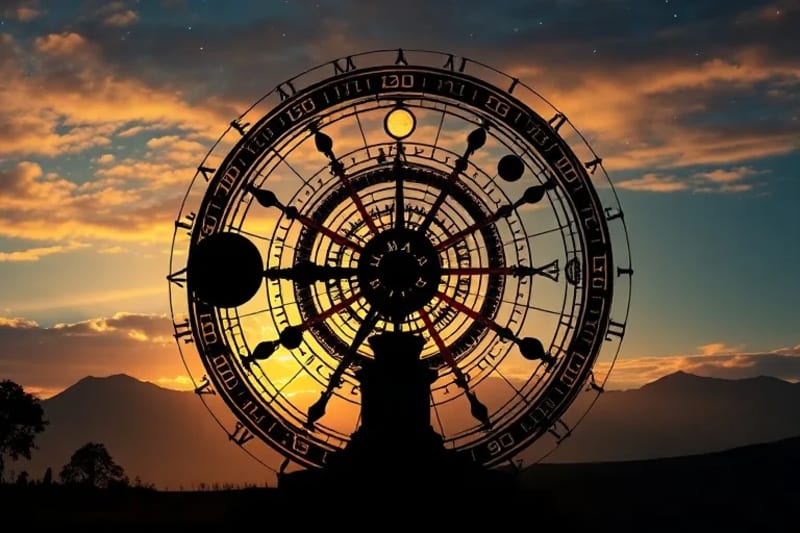 The universe operates with the precision of a celestial clockwork, guided by sacred geometric principles.
These applications move beyond mere superstition, grounding themselves in the observable patterns of the universe and their subtle yet profound effects on human experience. They offer a pathway to live more intentionally and effectively within the cosmic dance.
Mathematical Elegance: Kepler, Newton, and Beyond
The mathematical foundations of celestial mechanics are rooted in the groundbreaking work of Johannes Kepler and Isaac Newton. Kepler's three laws of planetary motion, derived from meticulous observational data, describe the elliptical paths of planets, the varying speed of their orbits, and the relationship between orbital period and distance from the Sun. These laws implicitly contain geometric elegance, particularly the concept of an ellipse with the Sun at one focus.
Newton then provided the theoretical framework with his law of universal gravitation and laws of motion. He demonstrated that Kepler's empirical laws were direct consequences of a universal force acting between any two masses. Newton's calculus provided the tools to precisely model these interactions, laying the groundwork for modern celestial mechanics. The elegance of these mathematical descriptions highlights the inherent order of the cosmos.
Further developments, such as Lagrange's and Hamilton's formulations of classical mechanics, introduced more abstract and powerful mathematical tools (e.g., Lagrangian and Hamiltonian mechanics) that simplify the analysis of complex systems and reveal conservation laws. These advanced mathematical frameworks continue to underpin our understanding of celestial dynamics, confirming the universe's profound mathematical and geometric underpinnings.
Integrating Quantum and Chaos Theory
While classical celestial mechanics provides a deterministic view of planetary motion, modern physics introduces additional layers of complexity and understanding. Quantum mechanics, operating at subatomic scales, suggests a probabilistic reality, while chaos theory reveals that even deterministic systems can exhibit unpredictable, sensitive dependence on initial conditions. How do these reconcile with the idea of cosmic order and synchronization?
Chaos theory, particularly in the context of celestial mechanics, explains phenomena like the long-term instability of certain orbits or the intricate patterns in asteroid belts. It doesn't negate order but suggests a deeper, more complex form of order that is not always linearly predictable. The "butterfly effect" implies that small variations can lead to large divergences over time, yet within these chaotic dynamics, attractors and fractal patterns often emerge, hinting at an underlying geometric structure.
From a holistic perspective, quantum and chaotic elements can be seen as providing the "texture" or "nuance" within the grand geometric framework. They introduce the element of free will and the potential for emergent properties within a system that is fundamentally ordered. This allows for both the predictability of cosmic cycles and the unique, evolving journey of individual consciousness, making the synchronization process dynamic and co-creative rather than rigidly deterministic.
Conclusion: Harmony in Cosmic Flow
Applied Celestial Mechanics, when viewed through the lens of Sacred Geometry, offers a profound paradigm for understanding our place within the universe. It moves beyond a purely mechanistic interpretation of the cosmos to reveal an intricate, living system governed by elegant mathematical and geometric principles. By consciously engaging with these principles, we can align our lives with the natural rhythms of the universe, fostering a deeper sense of harmony, purpose, and well-being.
This integration of science and spirituality provides a powerful toolkit for navigating the complexities of modern life. It encourages us to look to the stars not just for wonder, but for practical guidance, recognizing that the same universal laws that govern galaxies also resonate within our own being. Embracing this cosmic synchronization is an invitation to live a life more aligned with the universal flow, contributing to a more harmonious existence for ourselves and the world around us.
Explore Further: Related Cosmic Insights
-
Asteroid Goddesses: Pallas, Vesta, Juno in Your Birth Chart
Discover the deeper psychological and archetypal influences of these celestial bodies.
-
Neptune Aspects: Navigating Dreams, Illusion, Spirituality
Unravel the mystical connections between Neptune and your spiritual journey.
-
Advanced Medical Astrology: Chronic Conditions Planetary Debilities
Explore how celestial mechanics can inform health and well-being.
-
Feng Shui Digital Spaces: Harmonizing Virtual Environments
Apply principles of harmony and flow to your digital world.
FAQ: Celestial Mechanics and Sacred Geometry
Here are some frequently asked questions regarding the integration of celestial mechanics and sacred geometry for life synchronization:
Q: What is the primary benefit of synchronizing my life with cosmic rhythms?
A: The primary benefit is achieving greater harmony, flow, and purpose. By aligning with universal cycles, individuals often experience enhanced intuition, reduced stress, and a more profound connection to their life's path, leading to more effective decision-making and a sense of belonging.
Q: Is this approach scientific, spiritual, or both?
A: It is fundamentally both. Celestial mechanics is a rigorous scientific discipline, while sacred geometry bridges mathematics with spiritual philosophy. The applied aspect combines empirical observation with an understanding of subtle energies and consciousness, creating a holistic framework.
Q: How can I begin to apply these concepts in my daily life?
A: Start by observing lunar phases and their effects on your mood and energy. Learn about basic planetary transits (e.g., Mercury retrograde) and their general themes. Gradually delve into your personal astrological chart and explore the geometric patterns in nature around you. Meditation and mindful observation are key practices.
Source: Hybrid content assisted by AI and human editorial supervision.


Comments
Post a Comment